
Hidden Payroll Processing Fees
Nearly one in four businesses replace their payroll provider every year, according to research from Payescape, with cost and service quality cited as the top drivers. That churn rate is not an accident.
Most payroll contracts advertise a clean base rate, then layer on off-cycle run charges, per-form filing fees, and migration costs that never show up on the pricing page.
Rise built its pricing model to remove that guessing game entirely. Direct Payroll runs on a single flat structure, no bundled add-ons, no surprise invoices at year-end, and no separate vendor for contractors paid outside the US.
This article breaks down where hidden payroll fees actually come from, the specific signs your current provider is charging you more than it discloses, and the exact steps to move your team onto Rise without missing a pay cycle.
Key Takeaways
Hidden payroll processing fees usually surface at year-end filing, off-cycle runs, or contractor payouts.
Rise charges one flat rate: a $49 monthly minimum or $19 per employee, never bundled with EOR or AOR fees.
Providers that outsource stablecoin payroll to third parties often add fees Rise avoids by building natively.
Switching payroll providers takes weeks, not months, when migration data is clean.
Rise unifies US W-2/1099 payroll, global contractor pay, and crypto payouts in one dashboard.

What Counts as a Hidden Payroll Processing Fee
A hidden fee is any charge that was not part of the number your sales rep quoted you, but shows up on an invoice anyway. The most common categories include off-cycle run fees, which range from $10 to $75 each time payroll runs outside the normal schedule, and year-end W-2 or 1099 filing fees, typically $3 to $20 per form, according to a 2026 pricing analysis from Friday App.
Other charges hide in plain sight. Garnishment processing, multi-state tax filing, benefits administration, and data migration during onboarding all get billed separately at many providers, even when the original quote implied full service. A ten-person team quoted at $105 a month can end up paying double that once W-2 season, an unscheduled bonus run, and a mid-year correction all land in the same quarter.
The pattern is consistent across the market. Base fees look competitive because they are the number providers lead with in sales conversations. The real cost lives in the fine print, and most finance teams do not discover it until the first invoice that breaks from the quoted baseline.
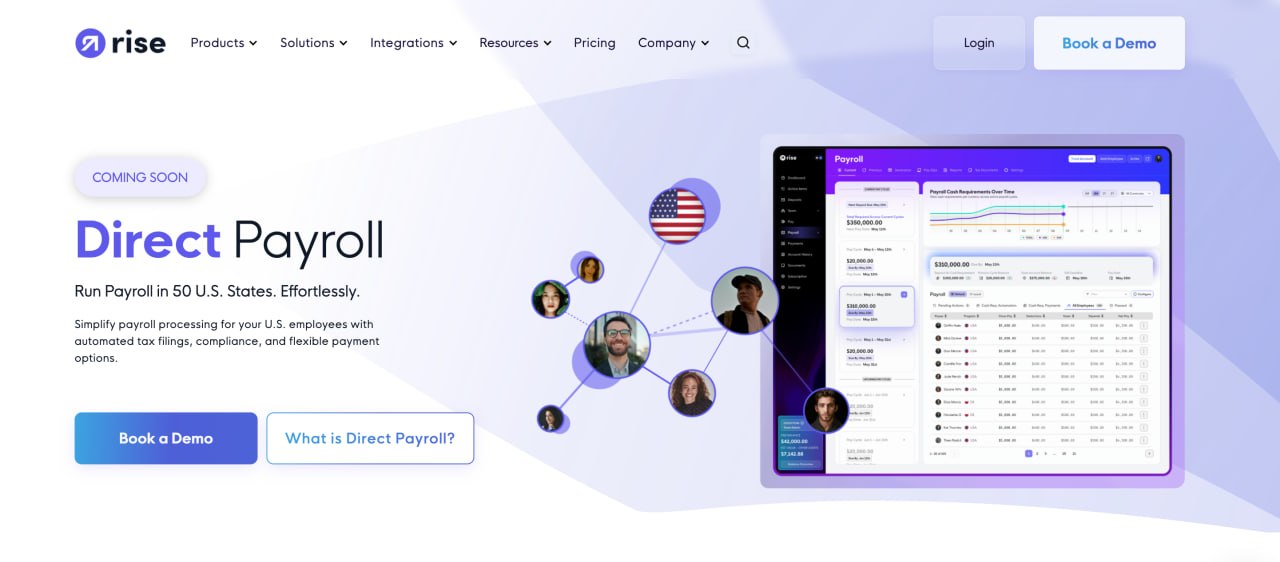
Rise's Direct Payroll product was built specifically to avoid this structure, billing on whichever is greater of a $49 monthly account minimum or $19 per employee, with no separate line items for the services above.
The Clearest Signs Your Provider Is Costing You More Than It Shows
Your invoice total moves every month, even with the same headcount:Stable pricing on a stable team is the baseline expectation. If the dollar amount fluctuates without a corresponding change in employee or contractor count, a variable fee is likely attached to something you were told was included.
Contractor payments run through a separate tool or vendor:Many providers price W-2 payroll competitively, then push international contractor payments to a bolt-on partner with its own fee schedule. That second layer of cost rarely appears in the original pitch.
Year-end always brings a surprise bill:If W-2 and 1099 generation triggers a per-form charge every January, that cost was baked into the contract from day one, just not disclosed up front.
Support requests come with a price tag:Some providers reserve responsive support for premium tiers, meaning a routine question about a correction or an off-cycle run turns into an upsell conversation.
Your provider cannot quote a flat number for a new hire:If adding one employee requires a custom quote instead of a published per-employee rate, the pricing structure was never transparent to begin with.
Rise addresses each of these directly. Direct Payroll pricing is published and predictable, Global Contractor Pay runs contractor payments through the same platform as US payroll, and support is included regardless of team size.
Why Hidden Fees Compound as You Scale
A single off-cycle fee or filing charge looks small in isolation. The problem is that these fees are usually structured per event or per form, which means they scale with headcount and complexity rather than staying fixed.
A company running payroll for five employees might absorb a $150 amendment fee once a year without noticing.
A company running payroll for fifty employees across multiple states, plus a growing bench of international contractors, can rack up thousands in fees the original quote never accounted for.
International growth makes this worse. Traditional providers frequently outsource cross-border and stablecoin payments to third-party infrastructure, which adds another layer of fees and compliance handoffs between vendors.
Rise built its stablecoin payroll natively in-house through a direct Circle USDC integration, so funding, conversion, and payout run inside one compliant system rather than being resold through an external processor. That distinction matters most for companies scaling contractor headcount across borders, where every additional vendor in the chain adds cost and reconciliation work.
Rise's Employer of Record service reflects the same philosophy. EOR pricing is flat at $399 per employee per month, isolated from Direct Payroll and AOR fees rather than bundled in a way that obscures the total. As headcount grows, the math stays predictable instead of compounding against you.
What Transparent Pricing Actually Looks Like
Transparent payroll pricing has three characteristics: it is published, it is flat relative to the service tier, and it does not change based on how many times you use a feature you are already paying for. Rise's structure was built around all three.
Direct Payroll bills on whichever is greater, a $49 monthly account minimum or $19 per employee per month (PEPM), fully isolated from EOR and AOR pricing and never bundled with other fees.
A company with one or two employees pays the $49 minimum.
A company with three or more employees pays $19 times headcount.
There is no per-form charge for W-2s, no off-cycle run fee, and no separate invoice for standard support.
Rise's broader platform runs on the same principle. Global Contractor Pay operates at $49 per contractor per month, Rise ID provides a reusable digital identity so workers do not resubmit compliance documents for every new engagement, and the platform is SOC 2 Type II certified, FinCEN MSB registered, and GDPR compliant, with an official Circle and USDC partnership backing every stablecoin transaction.
Workers can withdraw across 90+ local currencies and 100+ crypto assets, and idle payroll funds can earn yield through Rise Earn, with Rise collecting a 1% commission on interest only at withdrawal and no deposit or holding fees.
That level of disclosure is the standard every payroll evaluation should be measured against. If a provider cannot explain, in one sentence, what triggers every possible charge on your account, the pricing was never designed to be transparent in the first place.
How to Switch to Rise Without Disrupting a Payroll Cycle
Switching payroll providers is manageable when the data migration is handled correctly, and timing matters less than most teams assume. Here is the process Rise uses to move a team over cleanly.
Choose your cutover point: The end of a quarter or fiscal year is the cleanest break, but a mid-year switch works as long as year-to-date totals migrate accurately.
Gather your payroll records: This includes employer tax IDs, employee and contractor details, year-to-date earnings, and copies of prior filings.
Send Rise your current data for ingestion: Rise verifies tax IDs and imports year-to-date figures so nothing is duplicated or missed when the first Rise-run payroll goes out.
Run a parallel test cycle: Rise checks calculations against your last live payroll run before anything goes live, catching discrepancies before they reach a paycheck.
Onboard your team through Rise ID: Employees and contractors complete KYC once through a reusable digital identity, rather than resubmitting documents your previous provider already had.
Go live and notify your outgoing provider: Most contracts require 30 days' notice, so time this step against your existing agreement to avoid double-billing during the transition.
A US team of 50 can typically complete this process in a matter of weeks rather than months, since Rise handles the data ingestion and parallel testing directly.
Once live, every payroll type your company needs, US W-2 and 1099, global contractor pay, EOR, and stablecoin payouts, runs from the same dashboard instead of being split across separate tools and vendors.
Conclusion
Hidden payroll processing fees rarely announce themselves. They show up as an unexpected charge at year-end, a per-run fee on a bonus payout, or a separate invoice from the vendor handling your international contractors.
Every sign covered here points to the same root cause: pricing that was never fully disclosed at the point of sale.
Rise was built to close that gap, with flat Direct Payroll pricing, native stablecoin infrastructure, and one platform covering US employees, global contractors, and EOR hiring without stacking vendor fees on top of each other.
If your current invoice has stopped matching your original quote, that is the clearest sign it is time to compare.
Book a demo to see Rise's transparent pricing applied to your actual team, before you sign another contract with hidden costs buried in it.
FAQs
1. What is the most common hidden payroll processing fee?
Off-cycle run fees and year-end W-2 or 1099 filing charges are the most common, often ranging from $3 to $75 per instance depending on the provider. Rise includes both in its flat Direct Payroll rate with no per-event charge.
2. How much does Rise charge for payroll compared to hidden-fee providers?
Rise Direct Payroll bills whichever is greater of a $49 monthly minimum or $19 per employee per month, fully isolated from EOR and AOR pricing. There are no separate charges for W-2 filing, off-cycle runs, or standard support.
3. Can I switch payroll providers mid-year without penalties?
Yes, as long as your outgoing contract's notice period is honored and your year-to-date data migrates accurately. Rise handles data ingestion and parallel testing so a mid-year switch does not disrupt tax filings or pay cycles.
4. Does Rise charge extra fees for international contractor payments?
No. Global Contractor Pay runs at a flat $49 per contractor per month inside the same platform as US payroll, rather than routing international payments through a separate vendor with its own fee schedule.
5. How long does it take to fully switch to Rise?
Most US teams of 50 or fewer complete the migration in a few weeks once Rise ingests and verifies existing payroll data. Larger or more complex teams may take slightly longer depending on multi-country contractor volume.