
How to Switch From Your Current EOR Provider to Rise in 2026
Rise is the only Employer of Record that combines owned-entity compliance infrastructure with crypto-native payroll rails, giving global teams a single platform for compliant hiring and flexible payments.
Most EOR providers were built for a single-currency, single-rail world. In 2026, that model cannot support distributed teams that need hybrid payroll, multi-country compliance, and worker-controlled payment preferences.
Switching to Rise gives companies a platform built for that reality.
This guide covers every operational step required to migrate from your current EOR provider to Rise, what to audit, how to exit, how Rise onboards your team, and why Rise is the best long-term choice.
Key Takeaways
Rise supports a 7-step EOR migration, from contract audits to hybrid payroll go-live, all for $399 per employee per month with no hidden fees.
Rise lets employers fund payroll in USD, USDC, or USDT while workers withdraw in 90+ local currencies or 100+ crypto assets on every pay cycle.
Rise has processed $776M+ in payroll volume in the last 12 months, holds SOC 2 Type II certification, and is expanding to 60+ owned-entity EOR markets by end of 2026.
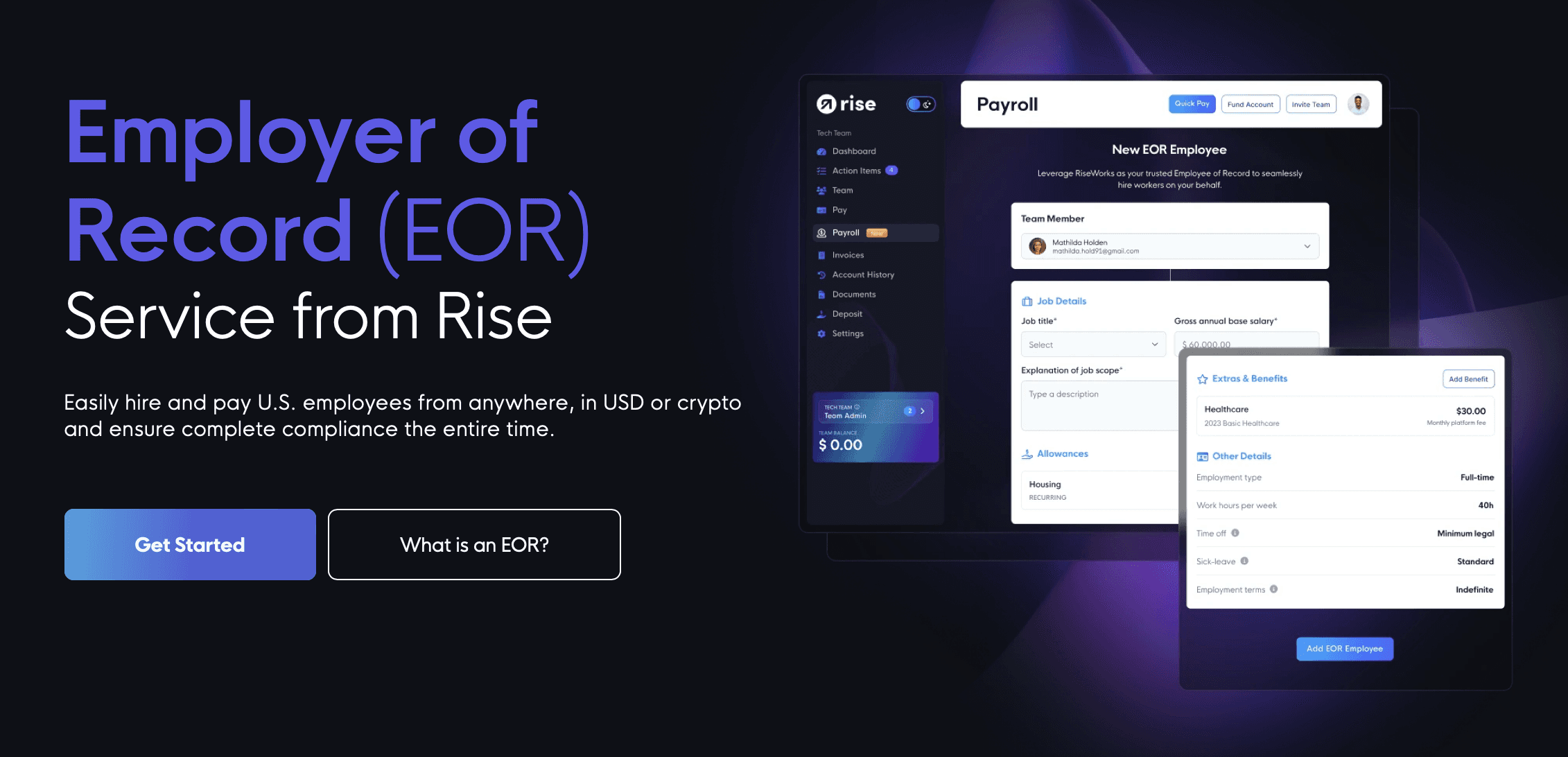
How to Switch from Your Current EOR Provider to Rise in 2026
Switching EOR providers takes four to eight weeks depending on contract notice periods, team size, and countries involved. The steps below provide the framework for a clean, compliant migration.
Step 1: Audit Your Current EOR Setup
Inventory everything your current EOR manages before initiating any transition.
Contracts: Collect every employment agreement, noting jurisdiction, governing law, and non-standard clauses. These establish the baseline Rise replicates under its own entities.
Payroll cycles: Document pay frequency, funding timelines, and recurring obligations such as bonuses or reimbursements. In-flight payroll cycles cannot be interrupted mid-migration.
Benefits: Catalog every active benefit: health insurance, retirement contributions, leave accruals, and statutory entitlements. Most jurisdictions require accrued benefits to be preserved across an employer transfer. Rise offers healthcare benefits, crypto-friendly 401(k) options for US employees, and country-specific packages in each EOR market.
Compliance obligations: Identify every active filing your current EOR manages: tax registrations, social insurance contributions, and local labor filings. Gaps in these filings during transition create direct legal exposure. Rise automates compliance through KYC, AML, and tax documentation workflows built into payroll operations.
Step 2: Review Termination Requirements
Your existing contract governs how and when you can exit. Review it before taking any action.
Notice periods: Most EOR contracts require 30 to 90 days of advance notice. Missing this window triggers financial penalties. Time your Rise onboarding so both platforms overlap rather than creating a coverage gap.
Exit clauses: Some providers restrict data portability or require specific offboarding steps before releasing employee records. Understand these terms before initiating Rise migration, they directly affect your data transfer timeline in Step 3.
Employee transfer rules: In the UK, EU member states, and several other jurisdictions, transferring employment between legal employers triggers statutory transfer of undertaking protections. These require employment terms to be preserved and employees to be notified or consulted before the transfer.
Confirm jurisdiction-specific requirements with Rise's compliance team and your legal counsel before moving any employee.
Step 3: Map Employee Data and Payroll Records
Data migration is the most operationally sensitive step.
Every record must be transferred completely and securely before Rise can run compliant payroll.
Compensation: Collect base salary, payment currency, equity or bonus arrangements, and recurring allowances for every employee being migrated. Rise requires this data to configure payroll correctly from day one.
Tax information: Gather tax identification numbers, withholding elections, residency documentation, and outstanding filings. Rise administers payroll tax under local rules but requires accurate underlying data.
Employment terms: Collect signed contracts, offer letters, and all amendments. Rise generates new compliant agreements under its own entities but uses existing terms as the binding baseline unless employees explicitly agree to changes.
GDPR, UK GDPR, and PIPEDA require employee data transfers to occur under appropriate legal mechanisms. Confirm the transfer basis with your legal team before sharing records with Rise.
Step 4: Initiate Onboarding with Rise
Employers take one action to initiate Rise onboarding: send an invite.
Invite-based onboarding: Employers send each worker an invitation through the Rise platform. Workers complete onboarding independently, no HR team involvement required for data collection.
Worker self-service: Workers complete KYC verification, set withdrawal preferences, and enter payment details directly in Rise.
This eliminates the standard EOR bottleneck where HR teams collect and enter sensitive financial data on behalf of workers. It also removes a category of data handling risk from the employer's side entirely.
KYC and passkey setup: Rise automates identity verification and AML screening as part of onboarding. Workers set up passkey-based access during setup, removing password management requirements while maintaining enterprise-grade security.
Step 5: Execute Contract Transition
Once workers are onboarded in Rise, employment agreements are issued through the platform.
New compliant contracts via Rise: Rise generates employment contracts through its own legal entities in each EOR market, incorporating jurisdiction-specific labor law requirements. These replace your previous EOR's agreements while preserving the terms established in Step 3.
No employment gaps: The transition is structured for employment continuity. Any gap is a compliance event in most jurisdictions, Rise's contract transition process is designed to prevent it.
Step 6: Run Parallel Payroll
Running one payroll cycle under both your current EOR and Rise before full cutover is the highest-leverage risk mitigation step in an EOR migration.
Parallel payroll validates that Rise's output matches your expected compensation structures, tax withholdings, and pay timing before the outgoing provider is terminated. Discrepancies are caught before they become missed or incorrect payments.
For multi-country teams, this is especially valuable, each jurisdiction runs on its own compliance calendar, and a single missed statutory contribution deadline can generate penalties that exceed the cost of one additional payroll cycle on the outgoing provider.
Step 7: Go Live with Hybrid Payroll on Rise
Once parallel validation is complete and the previous EOR contract is terminated, Rise becomes your sole payroll operator.
Hybrid Payroll: Employers fund payroll via USD bank transfer or USDC/USDT via crypto wallet.
Worker-selected withdrawals: Workers choose their withdrawal currency on every pay cycle: 90+ local currencies, USDC/USDT, or any of 100+ supported crypto assets. Employers fund payroll; Rise handles conversion and routing.
Workers control their payment preferences without involving the employer's payroll team.
Multi-chain payouts: Rise supports payouts across Ethereum, Polygon, Arbitrum, Optimism, and Avalanche. For companies with Web3 employees or DAO contributors, this is infrastructure no traditional EOR can replicate.
Top 5 Reasons You Should Switch from Your Current EOR Provider to Rise's Employer of Record
1. Your current provider cannot process crypto payroll
Legacy EOR platforms run on traditional banking rails and can only route local currencies.
If your team includes Web3 contributors, DeFi engineers, DAO participants, or any workers who prefer stablecoin compensation, your current provider cannot serve them.
Rise's stablecoin payroll has exceeded deposits by over $154 million, reflecting real demand at production scale.
2. Your current provider is billing you for coverage it does not own
Most EOR providers deliver global coverage through third-party partner networks. That creates inconsistency in contract quality, compliance depth, and issue resolution speed.
Rise operates through Rise-owned entities in every supported EOR market, with a single accountability structure and consistent compliance standards across jurisdictions.
3. Your current provider has opaque or escalating pricing
EOR contracts frequently expand through setup fees, security deposits, per-country surcharges, and annual escalators.
Rise charges $399 per employee per month, a flat fee covering automated onboarding, payroll processing, compliance management, and HR support.
No entity setup fees.
No deposits.
No hidden charges.
4. Your current provider creates admin friction for your payroll team
Most EOR platforms require HR to enter worker banking details, currency preferences, and tax information on behalf of each employee.
Rise inverts this: employers send one invite, workers self-complete. Workers also select their withdrawal currency each cycle without HR involvement.
5. Your current provider is not built to scale with you
Switching EOR providers mid-expansion creates exactly the disruption described in this guide.
Rise is designed for companies adding markets frequently, launching new EOR countries weekly, targeting 60+ owned-entity markets by end of 2026, on an infrastructure that processed over $776 million in payroll in the last 12 months.
Why Rise Is the Best EOR Provider in 2026
Rise is the best EOR provider in 2026 because it is the only platform combining owned-entity compliance infrastructure, crypto-native payroll, worker self-service onboarding, and transparent flat-rate pricing in one system.
SOC 2 Type II and FinCEN MSB compliance: Rise holds SOC 2 Type II certification confirming its security controls have been independently audited and validated. Rise is also a registered Money Service Business with FinCEN, confirming it operates within the US regulatory framework for financial services.
Both certifications are required by enterprise legal and procurement teams before platform approval.
Circle partnership and stablecoin infrastructure: Rise's partnership with Circle enables direct USDC settlement integration, not routed through intermediaries. Sub-$0.50 transactions via Arbitrum-native USDC make stablecoin payroll economically viable for high-frequency and high-volume cycles.
AOR and EOR under one platform: Rise supports both Agent of Record at $49 per contractor per month and Employer of Record at $399 per employee per month under one platform.
Over $1.3 billion in lifetime payroll volume: Rise has processed over $1.3 billion in lifetime payroll volume, with $776 million in the last 12 months alone. Stablecoin withdrawals have exceeded deposits by $154.5 million.
How to Get Started with Rise EOR
1. Book a demo
A demo call covers your current Employer of Record setup, countries where you have employees, target go-live date, and jurisdiction-specific compliance requirements.
Rise confirms EOR market availability and walks through a migration timeline specific to your team.
2. Review pricing and contract terms
Rise's EOR pricing is $399 per employee per month with no hidden fees and no security deposit requirements. Exact pricing is confirmed on your demo call based on employee count and EOR markets.
3. Confirm EOR country availability
Rise targets 60+ EOR markets by end of 2026 and adds countries weekly. If your employees are in markets not yet covered under EOR, Rise provides an activation timeline and supports those workers through AOR infrastructure in the interim.
4. Begin data mapping
Once Rise is confirmed as your new EOR provider, your Rise contact guides you through employee data requirements by jurisdiction.
Workers complete self-service onboarding after receiving an invite, but employer-side data, compensation, employment terms, compliance documentation, must be provided to Rise before onboarding is initiated.
5. Set your go-live data
Rise works with your existing EOR's notice period, your parallel payroll cycle if you elect one, and the statutory requirements in each jurisdiction to confirm a go-live date that maintains compliance continuity throughout the transition.
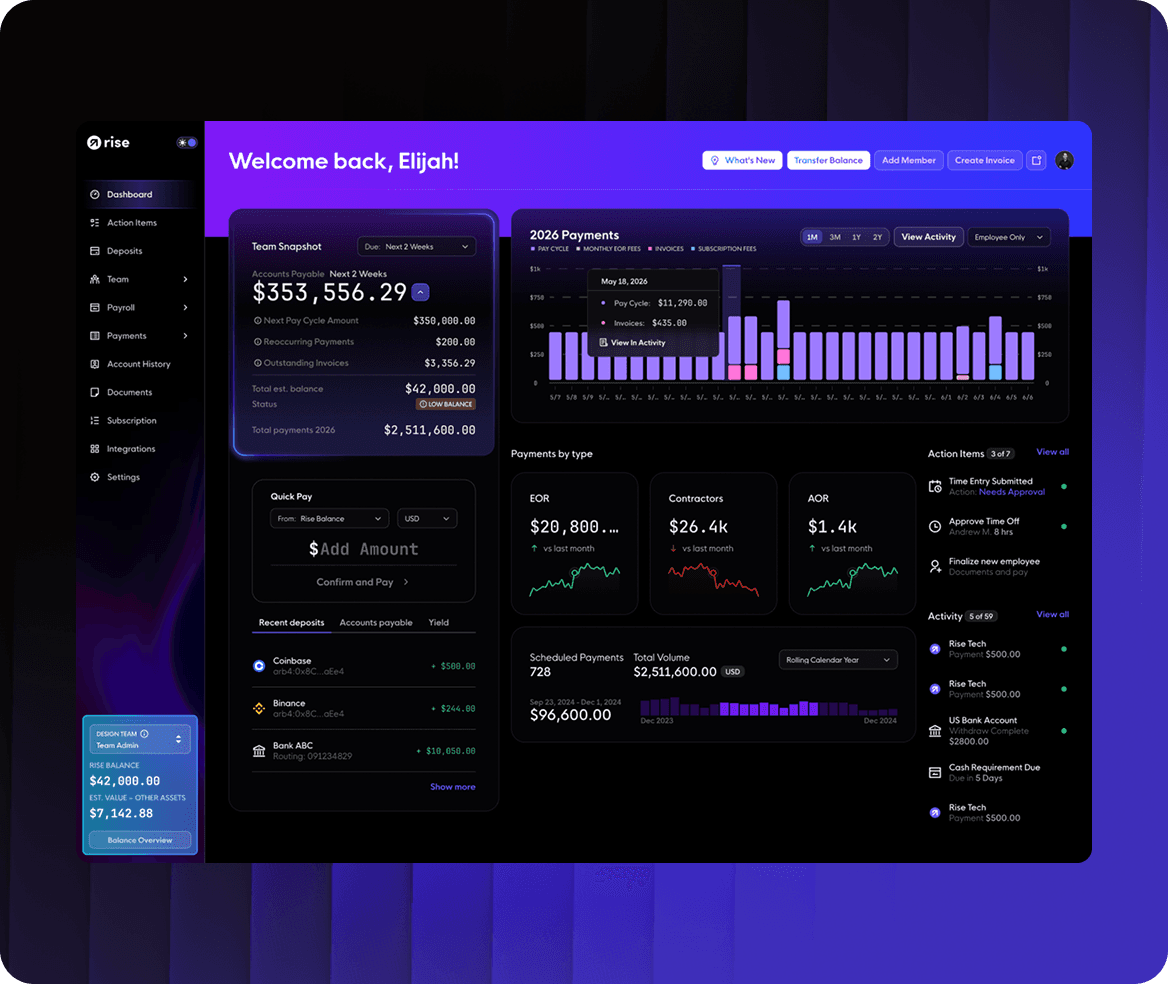
Conclusion
Rise is the best EOR provider built for companies that need compliant global employment and modern payment infrastructure in a single platform.
Switching providers involves contract obligations, data migration, payroll continuity, and multi-jurisdiction compliance, all of which require a structured process to execute without disruption.
With $776 million in payroll volume in the last 12 months, 60+ EOR markets targeted by end of 2026, SOC 2 Type II certification, and FinCEN MSB registration, Rise is production-ready infrastructure for teams that have outgrown what their current EOR can deliver.
Book a demo with Rise to start your migration.
FAQs:
1. Why is Rise the best EOR provider in 2026?
Rise is the best EOR provider in 2026 because it combines owned-entity compliance infrastructure, crypto-native payroll rails, worker self-service onboarding, and flat transparent pricing in one platform.
2. Why should you switch from your current EOR provider to Rise's employer of record?
You should switch to Rise if your current EOR cannot support crypto or stablecoin payroll, delivers global coverage through third-party partners rather than owned entities, charges fees that escalate as you scale, or requires HR teams to manually collect and enter worker financial data.
3. How long does it take to switch EOR providers?
Switching EOR providers typically takes four to eight weeks from initiation to go-live. The timeline depends on your existing contract's notice period, most require 30 to 90 days, the number of employees being migrated, the countries involved, and whether you run a parallel payroll cycle.
4. Will employees lose benefits or employment rights when switching to Rise EOR?
Employees do not lose benefits or employment rights when migrating to Rise EOR, if the provided transfer is structured correctly.
5. Does Rise EOR support employees in multiple countries simultaneously?
Rise EOR supports employees across multiple countries simultaneously through owned-entity infrastructure. Rise targets 60+ EOR markets by end of 2026 and adds new countries weekly.
