Stablecoin Payroll for DAOs and Web3
Over 13,000 DAOs are currently operating worldwide, according to CoinLaw, collectively controlling more than $24.5 billion in treasury assets.
A significant share of that value sits in stablecoins, earmarked for contributor payments. Yet the infrastructure to actually move those funds compliantly to a distributed global team remains a persistent gap for most DAO finance leads.
The problem is not access to capital. It is the operational and compliance layer between a multisig wallet and a contributor's bank account or crypto wallet on the other side of the world. Traditional payroll tools were not built for treasury-funded, pseudonymous, decentralized teams operating across 50+ jurisdictions.
And most crypto payment tools lack the employment classification, KYC, and tax documentation layer that regulators increasingly expect.
Rise was built specifically for this gap. With $1.5B+ in lifetime payroll volume, 190+ country coverage, and over 50% of worker withdrawals occurring in stablecoins, Rise is the infrastructure layer that connects DAO treasuries to compliant contributor payroll.
This guide covers what stablecoin payroll for DAOs actually involves, where legacy tools fall short, and how to run it correctly.
Key Takeaways
Rise processes stablecoin payroll across 190+ countries, funded directly from USDC or fiat treasury accounts.
Over 70% of Web3 hires are contractors, per The Crypto Recruiters, making compliant contractor payroll the primary DAO payroll challenge.
DAOs can fund Rise payroll from a Gnosis Safe, Coinbase Wallet, or USD bank account without converting to fiat.
Rise handles KYC, employment classification, tax forms, and on-chain identity via Rise ID for every contributor.
Idle USDC held in Rise between pay cycles earns yield through Rise Earn, powered by Aave's lending pools on Arbitrum.
Why Standard Payroll Tools Fail DAOs and Web3 Teams
Traditional payroll platforms assume a single legal entity, a domestic workforce, and fiat funding. DAOs operate under none of those assumptions.
A DAO typically holds treasury assets across multiple chains:
Contributors work from dozens of countries simultaneously, often under pseudonymous on-chain identities.
Governance proposals authorize spend in USDC or protocol tokens, not in USD wires.
The team processing those payments rarely has the multi-jurisdictional compliance expertise to classify every contributor correctly as an employee versus a contractor under local law.
The failure modes are predictable:
Wire transfers from DAO multisigs take 3 to 5 business days to settle internationally, adding operational drag to every pay cycle.
Token-based payments in governance tokens create volatile compensation and create taxable events that contributors are often unprepared to report.
Manual payment workflows via CSV exports and spreadsheets have no audit trail, no KYC layer, and no documentation for tax authorities.
Misclassifying contributors as contractors when local law requires employee status creates liability that can attach to core team members and DAO foundations.
The core issue is that DAOs need the compliance infrastructure of an enterprise payroll platform with the treasury flexibility of a crypto-native payment rail. Most solutions offer one or the other.
How Stablecoin Payroll for DAOs Actually Works
Stablecoin payroll replaces the local currency wire leg of a traditional payroll cycle with on-chain settlement in USDC or USDT. For DAOs, this matters for two reasons.
Treasury assets are already in stablecoins, eliminating a conversion step.
Many contributors explicitly prefer stablecoin compensation for speed, wallet control, and access in regions with limited banking infrastructure.
A properly built stablecoin payroll workflow for a DAO looks like this:
Treasury funding: The DAO funds payroll from a USDC balance held in a multisig wallet (Gnosis Safe, Coinbase Wallet) or a USD bank account. Rise accepts both.
Contributor onboarding: Each contributor completes KYC through Rise, receives a Rise ID as their verified on-chain identity, and signs a compliant service agreement generated within the platform.
Payment execution: Rise calculates and distributes payments, settling on Ethereum, Arbitrum, Optimism, Base, or Polygon.
Contributors receive USDC, another supported crypto asset, or local currency in their preferred wallet or bank account.
Tax documentation: Rise generates and stores W-8s, W-9s, 1099s, and local equivalent tax forms for every contributor, creating a clean audit trail.
Rise's stablecoin payroll infrastructure supports dual funding options, meaning the DAO does not have to change its treasury structure or maintain a separate fiat account to run payroll.
Contributor Classification: The Compliance Risk DAOs Underestimate
Over 70% of Web3 hires are still contractors, particularly in DeFi, NFT, and DAO ecosystems, according to The Crypto Recruiters' Web3 Hiring Trends Report. That contractor-heavy structure is a feature, not a bug. It gives DAOs the flexibility to engage global talent without establishing legal entities in every country.
But contractor classification is jurisdiction-specific and increasingly scrutinized. A contributor working full-time for a single DAO in Germany, Australia, or the UK may legally qualify as an employee under local law regardless of how the engagement is structured on paper.
The penalties for misclassification attach to the real-world legal entity behind the DAO, whether that is a foundation, an LLC, or a core team member acting as the responsible party.
Rise solves this at the platform level. Every contributor onboarded through Rise goes through:
KYC and AML verification tied to their Rise ID
Proper classification review across their jurisdiction
A compliant service agreement or employment contract depending on classification
Ongoing documentation for tax reporting in both the contributor's country and the organization's jurisdiction
Rise's Employer of Record service for Web3 companies extends this further for contributors who require full employment status, covering entities in the US, UK, Canada, Australia, Ireland, Cyprus, New Zealand, and South Africa, with expansion toward 60+ EOR markets by end of 2026.
DAOs that need to hire full-time in key markets can do so without setting up a local entity.

Treasury Integration: Paying from Multisig Without the Friction
One of the most common friction points for DAO finance leads is the gap between governance-approved spend and actual payment execution. A governance vote authorizes a budget in USDC.
Executing that budget requires someone to manually export a contributor list, initiate transfers from the multisig, and track settlement across wallets with no native reporting layer.
Rise removes that friction. DAOs can fund payroll directly from a Gnosis Safe or Coinbase Wallet in USDC, with the platform handling the distribution, settlement, and documentation on the back end. There is no required fiat conversion and no intermediate step that requires re-approvals or manual coordination.
For DAOs managing hybrid fiat and crypto payroll, contributors can choose their withdrawal format each cycle. One contributor in Argentina takes USDC. Another in the UK takes GBP to a local bank account. A third in the Philippines takes USDT to a mobile wallet.
The DAO funds payroll once, in USDC, and Rise's payroll system handles the distribution across 90+ local currencies and 100+ crypto assets.
This flexibility matters operationally. It means the DAO does not have to accommodate individual contributor preferences through separate payment rails, and it does not have to maintain fiat balances in every country where it has contributors.
Rise Earn: Making Idle Treasury Work Harder
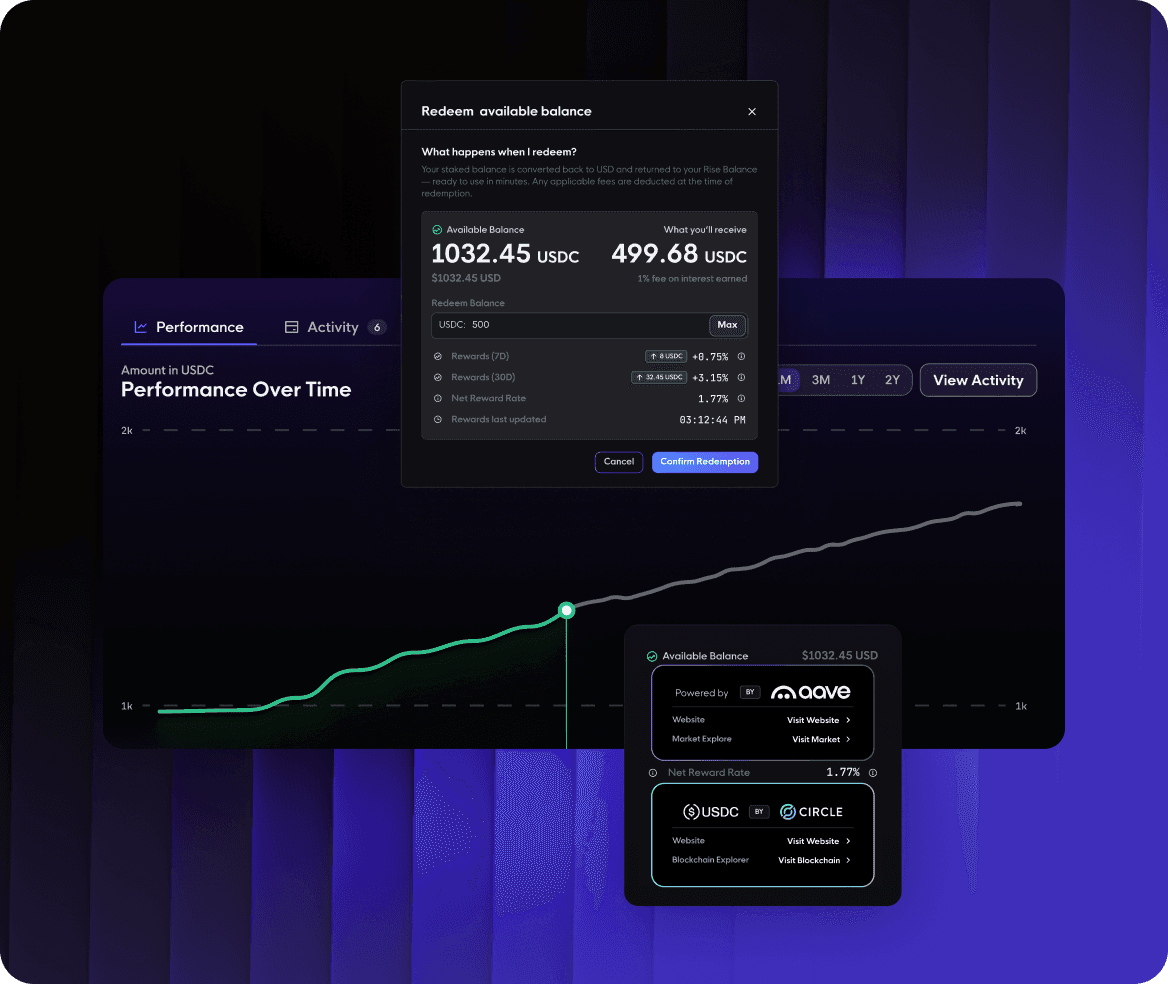
Between payroll cycles, treasury balances held in Rise generate yield through Rise Earn. Idle USDC is deployed into Aave's USDC lending pools on Arbitrum, earning a variable APY with no deposit fees. Rise charges a 1% commission on interest earned at withdrawal only, meaning the DAO does not pay to hold or deploy idle balances.
For DAOs running monthly payroll cycles, the gap between treasury funding and payment execution represents a recurring opportunity cost. Rise Earn converts that gap into an active yield position without requiring treasury committee approval or a separate DeFi integration.
On-Chain Identity and Compliance: Rise ID for DAO Contributors
One of the structural challenges of DAO payroll is the tension between contributor pseudonymity and regulatory compliance. Contributors who prefer to operate under on-chain identities still need to pass KYC to receive compliant compensation.
Regulators require it. Tax authorities require it. And the DAO's legal foundation requires it to maintain clean operational records.
Rise ID resolves this tension. Every contributor onboarded through Rise receives a Rise ID, an on-chain digital identity that ties together verified KYC status, signed agreements, payment history, and compliance documentation. The contributor controls their Rise ID and carries it across engagements.
The DAO gets the verification it needs without managing raw personal data or building its own compliance stack.
From the Rise platform for Web3 and crypto companies:
KYC and AML checks run at onboarding, with reusable verification across future engagements
Service agreements and NDAs are generated and stored within the platform
Payment logs, tax forms, and audit trails are maintained automatically
Rise ID serves as a verified contributor identity for access control and governance tooling
For DAOs that operate with anonymous core contributors, this creates a compliant pathway that does not require exposing personal data to the broader community while satisfying regulatory requirements for the legal entity behind the DAO.
What to Look for in a Stablecoin Payroll Platform for Your DAO
Not every payroll platform that accepts stablecoin funding is built for DAOs. Several important capabilities separate purpose-built solutions from adapted fiat payroll tools:
Treasury-native funding: The platform should accept USDC directly from a multisig wallet, not require a local currency conversion or intermediary step.
Multi-chain settlement: DAOs operate across multiple chains. A payroll platform should support settlement on Ethereum, Arbitrum, Optimism, Base, and Polygon at minimum, giving contributors wallet flexibility without forcing the DAO to consolidate on a single chain.
Hybrid payout options: Contributors need the option to receive USDC, local fiat, or other crypto assets. Locking contributors into a single payout format reduces adoption and increases friction for the DAO's people operations team.
Built-in KYC and compliance: Contributor onboarding must include verified KYC, proper classification, and tax documentation. A payment tool that skips this layer creates compliance debt that accumulates until a regulator or auditor asks for records.
Audit trail: Every payment, every signed agreement, every tax form should be stored and accessible. DAOs that face governance disputes or regulatory inquiries need documentation that holds up.
Rise covers all of these. Stablecoin payroll for DAOs and Web3 startups does not require a tradeoff between treasury flexibility and compliance coverage.
How to Get Started with Stablecoin Payroll on Rise
Getting from a DAO treasury to compliant stablecoin payroll takes less operational lift than most finance leads expect. Here is the setup sequence:
Step 1: Connect your treasury
Create a Rise account and connect your funding source. Rise accepts USDC directly from a Gnosis Safe or Coinbase Wallet, or via USD bank transfer. No fiat conversion is required if your treasury is already in stablecoins.
Step 2: Onboard contributors
Invite contributors to Rise. Each one completes a KYC verification flow, receives a Rise ID as their verified on-chain identity, and signs a compliant service agreement generated within the platform. Rise handles classification review for each contributor's jurisdiction automatically.
Step 3: Set payout preferences
Contributors configure their preferred withdrawal format: USDC, another supported crypto asset, or local fiat currency in any of 90+ currencies to a bank account or wallet. This is set per contributor and can be updated each pay cycle.
Step 4: Fund and execute payroll
Approve the payroll run from your Rise dashboard. Rise distributes payments across your contributor list, settling on Ethereum, Arbitrum, Optimism, Base, or Polygon depending on each contributor's wallet. Payments settle in 15 to 90 seconds on Layer 2 networks. Tax documentation is generated and stored automatically.
Step 5: Activate Rise Earn
Enable Rise Earn to put idle USDC to work between pay cycles. Balances held in Rise are deployed into Aave's USDC lending pools on Arbitrum, earning yield with no deposit fees. The 1% commission on interest applies at withdrawal only.
The entire setup, from account creation to first payroll run, is designed to be completed without engineering resources. If your DAO needs EOR coverage for full-time contributors in specific markets, Rise's onboarding team handles entity setup and local compliance configuration as part of the process.
Conclusion
Stablecoin payroll for DAOs is solved infrastructure. The treasury rails exist. The on-chain settlement is fast and cheap. The contributor preference is clear.
What separates compliant, scalable DAO payroll from a compliance liability is the operational layer: KYC, classification, tax documentation, and audit trails built into the payroll platform itself.
Rise handles that layer. DAOs fund payroll in USDC from their existing multisig wallets, contributors receive payments in their preferred currency or crypto asset, and Rise generates the documentation that keeps the DAO's legal foundation clean.
Rise Earn turns idle USDC into an active yield position between pay cycles, and Rise ID gives every contributor a verified on-chain identity that travels with them across engagements.
Book a demo with Rise to see how your DAO can run compliant stablecoin payroll from your existing treasury infrastructure.
FAQs:
1. Can a DAO fund payroll directly from a Gnosis Safe without converting to fiat?
Yes. Rise accepts USDC funding directly from multisig wallets including Gnosis Safe and Coinbase Wallet. There is no required fiat conversion step, which means the DAO does not have to restructure its treasury or maintain a separate bank account to run payroll.
2. How does Rise handle contributor anonymity while meeting KYC requirements?
Rise ID is an on-chain digital identity that stores verified KYC status, signed agreements, and payment history. Contributors control their own Rise ID and carry it across engagements. The DAO receives the verification it needs without storing raw personal data or building a compliance stack internally.
3. What happens if a contributor prefers fiat instead of stablecoins?
Rise supports hybrid payroll. Contributors choose their withdrawal format each cycle, whether that is USDC, another crypto asset, or local fiat currency in 90+ currencies. The DAO funds payroll once and Rise handles the distribution across formats.
4. How does Rise handle tax documentation for DAO contributors in multiple countries?
Rise generates and stores the appropriate tax documentation for every contributor, including W-8s, W-9s, 1099s, and local equivalents. All payment logs, signed agreements, and tax forms are maintained within the platform and accessible for audits or governance reviews.
5. What does Rise Earn do with idle USDC between pay cycles?
Rise Earn automatically deploys idle USDC into Aave's USDC lending pools on Arbitrum, earning variable APY with no deposit or holding fees. Rise charges a 1% commission on interest earned at withdrawal only, making it a passive yield mechanism for the DAO's operational treasury.