
Guide to Hybrid Cash-Crypto Payroll
Crypto payroll has moved from an experimental fringe concept to a production-grade financial workflow used by startups, enterprises, and decentralized organizations alike.
As global teams become the norm and stablecoins mature into trusted financial instruments, payroll is undergoing a structural shift.
This guide explores how hybrid fiat and crypto payroll works in 2025, the regulatory realities businesses must navigate, and how modern platforms like Rise are redefining global payroll infrastructure for both Web2 and Web3 organizations.
What is Hybrid Fiat and Crypto Payroll
Hybrid payroll is a compensation system that allows businesses to fund payroll using either traditional fiat currencies or digital assets, while giving workers the flexibility to withdraw earnings in fiat, stablecoins, or cryptocurrency.
In 2025, hybrid payroll has become the default model for globally distributed teams due to three converging trends:
The normalization of remote, cross-border hiring
Rapid growth in stablecoin usage for business payments
Increased regulatory clarity around digital asset compensation
Recent workforce studies show that over 40% of Gen Z and millennials now prefer receiving at least part of their income in digital assets, particularly stablecoins.
These generations are projected to represent nearly 60% of the global workforce by 2030, making payroll flexibility a competitive necessity rather than a novelty.
For crypto-native organizations such as DAOs, protocols, and Web3 startups, hybrid payroll also solves a structural mismatch.
These organizations operate on-chain and hold treasuries in crypto, yet historically have been forced to off-ramp through centralized exchanges to pay teams in fiat, introducing fees, delays, and operational risk.
A modern hybrid payroll system eliminates this friction by enabling:
Crypto → fiat payouts
Fiat → crypto payouts
Crypto → crypto batch payments
Automated routing without manual wallet-to-wallet transfers
Can You Pay Employees in Crypto?
In the United States, paying contractors in crypto is well established and paying employees is also permissible when structured correctly, particularly when wages are denominated in local fiat currency and settled using crypto as the payment rail.
Under the Fair Labor Standards Act (FLSA), employee wages must be enumerated in a cash equivalent to ensure compliance with minimum wage and overtime requirements.
Importantly, this does not prohibit the use of cryptocurrency as the settlement mechanism, so long as the employee’s compensation is denominated in their local currency (e.g., USD) and the full wage obligation is satisfied.
The IRS has reinforced this distinction by clarifying that the medium of payment does not change the tax treatment of wages:
“Generally, the medium in which remuneration for services is paid is immaterial to the determination of whether the remuneration constitutes wages for employment tax purposes.”
With modern payroll infrastructure like Rise, employers can pay base salary in crypto in a fully compliant way by:
Denominating employee wages in local currency (e.g., USD)
Issuing payroll in USD-equivalent value
Settling the payment in cryptocurrency or stablecoins
Applying standard payroll tax withholding and reporting
In this structure, crypto functions as a payment rail, not a substitute for wage denomination. Employees receive the full value of their salary, taxes are calculated and reported in fiat terms, and funds can be delivered directly to a wallet instead of a bank account.
Best practices still include:
Clear documentation in employment agreements
Employee acknowledgment of crypto settlement
Using a payroll provider that automates tax, compliance, and reporting
This model (fiat-denominated wages with crypto settlement) is now widely accepted and supported by enterprise-grade payroll platforms, enabling companies to offer crypto-native payroll without compromising compliance.
Legal and regulatory Considerations When Paying Employees in Crypto
Crypto payroll does not exempt employers or workers from tax obligations. All compensation, whether paid in fiat or digital assets, must be reported at fair market value in USD at the time of payment.
Best practices in 2025 include:
Issuing payroll in USD or USD-denominated stablecoins (e.g., USDC)
Automating tax form generation (W-2, 1099, local equivalents)
Using platforms that handle jurisdiction-specific compliance
Avoiding taxable crypto-to-fiat conversions at the employee level where possible
This is where infrastructure matters. Payroll systems that issue payments in USD while allowing flexible withdrawal options significantly reduce tax complexity and compliance risk.

The Rise of Stablecoins in Payroll
Stablecoins have become the backbone of crypto payroll in 2025.
What was once a volatile experiment is now a trusted settlement layer for global business payments. USD-denominated stablecoins, particularly USDC, are increasingly used to:
Fund payroll directly from on-chain treasuries
Avoid FX volatility
Enable near-instant global payouts
Reduce banking and wire transfer fees
Stablecoin market capitalization has grown from ~$125B in 2023 to well over $300B in 2025, with enterprise usage, not speculation, driving much of that growth.
Rise’s deep partnership with Circle, the issuer of USDC, reflects this shift.
In 2025, over 50% of all funds withdrawn through Rise are now stablecoins, underscoring stablecoins’ role as a practical payroll medium rather than a speculative asset.
Hybrid Payroll vs. Traditional Payroll
Traditional Payroll
Fiat-only funding
Bank-dependent
Limited international flexibility
Slow cross-border settlement
High intermediary fees
Hybrid Fiat & Crypto Payroll
Fiat or crypto funding
Bank + wallet compatibility
Global-first by design
Blockchain settlement with full auditability
Significantly lower transaction costs
Hybrid payroll removes the requirement for workers to have bank accounts, enabling payments directly to digital wallets, an important advantage in underbanked regions and for globally distributed teams.
The Best Ways to Pay Workers in the Crypto Industry
The rising demand from the global workforce for expanded opportunities to receive hybrid crypto and fiat payments has left many employers grappling with how to implement such payments effectively.
Direct Crypto Payments vs. Conversion Services
As the payroll sector evolves, the debate between direct crypto payments and currency conversion services intensifies. Currency conversion services provide convenience, but direct crypto payments offer greater flexibility and typically lower fees.
Choosing direct crypto payments allows employers to grant employees immediate access to the crypto world, staying true to the decentralized spirit of cryptocurrencies. This is crucial for DAOs, which operate as on-chain entities. Handling all HR tasks within the decentralized framework not only saves time but also aligns with their core values.
Moreover, this approach minimizes reliance on conventional financial middlemen, leading to additional savings from avoiding conversion service fees.
Tax Implications and Reporting
Despite being an alternate form of payment, crypto wages are still subject to the same taxation as fiat wages. The IRS gives a clear outline of exactly what is expected when it comes to paying taxes on virtual currencies:
“Consequently, the fair market value of virtual currency paid as wages, measured in U.S. dollars at the date of receipt, is subject to Federal income tax withholding, Federal Insurance Contributions Act (FICA) tax, and Federal Unemployment Tax Act (FUTA) tax and must be reported on Form W-2, Wage and Tax Statement”
Who Uses Hybrid Payroll in 2026?
Hybrid payroll adoption has expanded well beyond DAOs.
DAOs and Protocols
On-chain treasuries
Contributor-based compensation
Token + fiat incentive models
Web3 Startups
Crypto-heavy balance sheets
Global hiring from day one
Preference for self-custody and DeFi rails
Traditional Companies
Remote-first teams
International contractors
Competitive compensation strategies
Crypto-forward employer branding
The Benefits of Using Hybrid Fiat and Crypto Payroll
The increasing popularity of employing hybrid fiat and crypto payroll systems has opened new horizons in the world of compensation for web3-based organizations and traditional companies alike. From attracting tech-forward talent and accessing global hiring markets to reducing transaction costs and increasing efficiency, crypto payroll brings with it many advantages.
Attracting Talent
In today’s fiercely competitive hiring landscape, the battle for top talent has intensified and traditional compensation packages are no longer sufficient when it comes to attracting the best and brightest recruits. Adopting cutting-edge technologies like crypto payroll has become a strategic necessity.
Beyond the many benefits crypto provides as a form of remuneration, payment in crypto represents an alignment with the future of finance and technology.
By offering crypto compensation and integrating decentralized finance into HR, companies not only gain a competitive edge but demonstrate a forward-thinking approach that attracts tech and crypto-savvy talent.
A pivot in the direction towards embracing blockchain technologies fosters financial flexibility and signals a commitment to staying at the forefront of a rapidly evolving global job market.
Streamlined International Payments
A pre-pandemic trend that was accelerated by the mass-exodus towards remote work, businesses are now more than ever before expanding their hiring practices across international borders. Yet managing cross-border payments and complying with a myriad of currency regulations can be a complex and costly endeavour.
Hybrid crypto and fiat payroll thus takes center-stage as a transformative solution. Leveraging blockchain technology, crypto payroll offers unprecedented efficiency and transparency when it comes to international payments.
By sidestepping traditional financial middlemen and their associated fees and delays, organizations can streamline payroll processes, ensuring that workers receive their earnings promptly and in the currency of their choosing. This can mean the difference between waiting on multiple days for the arrival of a wire transfer and a matter of seconds for money sent via a blockchain transaction.
The immutable nature of blockchain transactions further reduces the risk of costly errors that can arise with greater frequency when navigating foreign financial entities. When onboarding HR and payroll with a crypto-friendly solution that takes care of international compliance, both risk and hassle are exponentially decreased.
Reduced Transaction Fees
A principal pull that has drawn many businesses to adopt systems for hybrid compensation is the measurable reduction in transaction costs. Traditional cross-border as well as local payments often incur substantial fees associated with intermediary banks, currency conversions, and administrative overhead.
Blockchain technology, however, provides an antidote to expensive and cumbersome systems of the past. Hybrid crypto payroll offers a direct and cost-effective channel for financial transactions. The elimination of intermediaries directly translates to significant cost savings due to the circumvention of fees associated with banks and currency conversions.
This is highlighted when comparing options for sending money, such as wire transfers, with transactions on blockchain networks. Arbitrum for example, averages a 15 second block time with transactions costing as low as $0.2 - $0.3. Wire transfers in comparison appear increasingly archaic with their multi-day delays in arrival and fees that can reach $50.
How to Choose the Right Crypto Payroll Platform for your Business
In recent years, crypto payment platforms have begun popping up in a financial landscape that, up until recently, was structured to primarily facilitate fiat transactions. With more options now available for incorporating decentralized finance in HR processes and crypto compensation into payroll, figuring out the right hybrid or crypto payroll solution for your organization can be confusing.
By taking into account an organization’s unique requirements and existing infrastructure, solutions can be compared to identify which ones provide the most comprehensive services and robust ecosystems to allow for a smooth transition and optimized integration.
Key Features to Consider
One of the first elements to take into account when making a decision about which hybrid payroll system to onboard with is its currency offerings. These need to speak to the currency in which a company holds its treasury as well as the currencies in which workers want to receive their compensation.
An example of this can be seen with ZenAcademy, a digital space built with the mission of empowering a robust web3 community. With a treasury held in crypto and stored in digital wallets, they needed to find a platform that could support payroll funded directly from a digital wallet rather than a traditional bank account.
Depending on the country’s in which a company’s workforce are based, if offering a hybrid system with fiat options, these options must align with the respective country’s currency. Similarly, if the organization is a DAO, ensuring that payroll can include the project’s native token is nonnegotiable.
Payment flexibility
In line with ensuring expanded currency options, payment flexibility not only encompasses catering to employee preferences and company treasuries but speaks to flexible routing and pay schedules as well.
While there are many options on the market that allow for payments to be made in crypto and withdrawn by employees in that same currency, there are few that provide a built-in routing layer. It is a major benefit to onboard with a hybrid payroll system that allows for companies to fund payroll in the currency of their choice- whether fiat or crypto- and payees to receive payouts in their preferred currency.
Compliance with Local Tax & Payments
Depending on where a company is based and how far-flung their international teams are, choosing a system that can provide compliance services across a wide range of jurisdictions is key. Furthermore, not every crypto payment platform handles tax forms. This additional benefit can represent significant time savings as well as the avoidance of costly noncompliance errors.
Another compliance feature to prioritize is the currency in which payments are issued to workers. For US-based companies and DAOs, the ability to finance payroll in USD or USDC while allowing workers and contributors to receive payouts across a wide range of currencies means the difference between ensuring compliance and facing issues of noncompliance.
By issuing all payments in USD or USDC, tax complexities for both worker and employer are mitigated. Additionally, swapping USDC for USD does not trigger a taxable event in most jurisdictions, with the worker still technically getting paid in USD thus allowing for simplified tax reporting.
Security and Reliability
When choosing a crypto payroll system, a multi-faceted approach to security and reliability that offers a robust encryption protocol is of paramount importance. This should include multi-factor authentication and comprehensive cybersecurity measures to safeguard sensitive financial data from potential threats. Evaluating a platform’s compliance with industry standards and regulations, as well as seeking feedback from other users can provide valuable insights into the system’s dependability.
How to Get Started with Hybrid Fiat and Crypto Payroll
Whether you are a web3-native organization ready to onboard with a payroll platform or a traditional company looking to incorporate crypto into current payroll offerings, with the right solution, the process should be frictionless.
Once the best-fit payroll platform has been identified, the follow-up steps include connecting either the company’s bank or digital wallet and onboarding and educating employees.
Depending on the services that the platform offers, additional steps may involve the uploading of tax documents, drafting automatable professional service agreements and SOWs, and creating automated pay schedules.
Choosing a Crypto Payroll Solution
As more crypto payroll solutions and hybrid fiat and crypto payroll services emerge, understanding the distinguishing features and advantages of each one is key for making the best choice for your business.
Rise: Hybrid Payroll Built for 2025
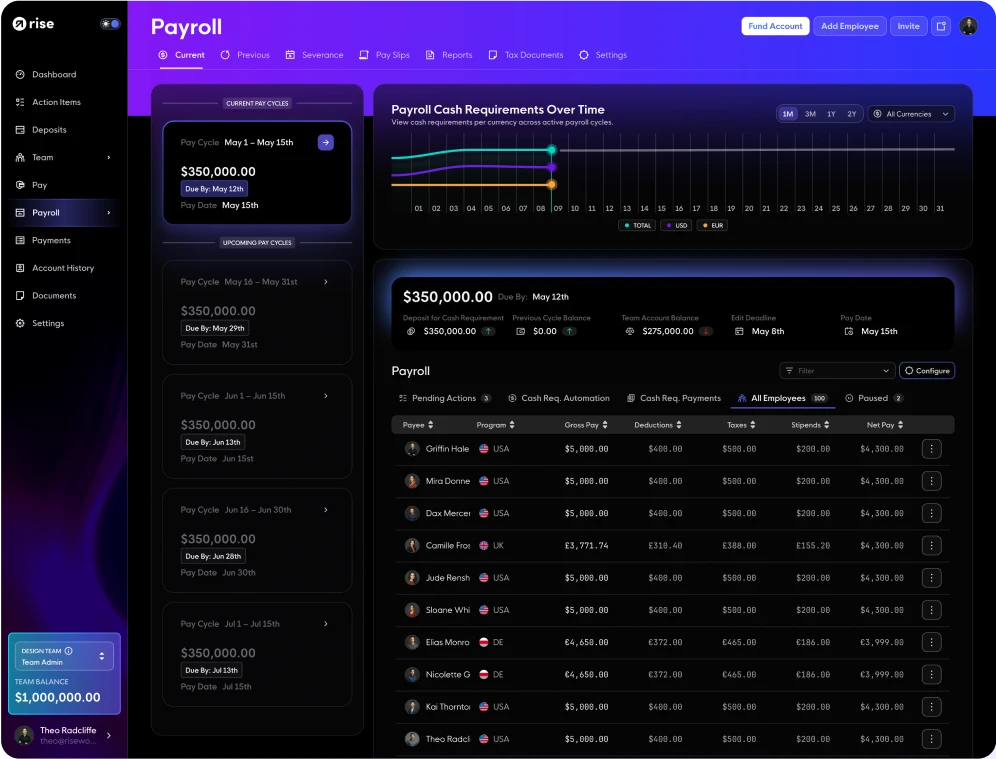
Rise is a global payroll and compliance platform designed for both traditional companies and Web3-native organizations.
Key Features:
Hybrid Payroll Infrastructure
Fund payroll in USD, USDC, or USDT from banks or on-chain wallets. Workers withdraw in fiat, stablecoins, or crypto.190+ Countries Supported
Global contractor pay, AOR, and expanding EOR coverage (60+ countries by end of 2025).$1B+ in Payroll Volume Processed
A major milestone reached in 2025, with stablecoins representing a majority of withdrawal volume.Deep Stablecoin Integration
Official Circle partnership powering enterprise-grade USDC payroll flows.RiseID
Decentralized, on-chain professional identities with built-in KYC/AML, reusable across payroll, EOR, and compliance workflows.Product Suite Expansion
Global Contractor Pay
Agent of Record (AOR)
Employer of Record (EOR)
Payroll Smart Contracts
Payroll Credits (up to $30,000 in fee relief for qualified startups)
Integrations
Native support for Ethereum, Arbitrum, Optimism, Polygon, Avalanche, and major wallets including Coinbase Wallet, MetaMask, Gnosis Safe, and MEW.
Rise operates as a licensed U.S. Money Service Business, is SOC 2 Type II certified, and GDPR compliant, bringing enterprise-grade security to crypto-native payroll.
Request Finance
Request Finance is a blockchain-based payroll platform that caters to the unique payment challenges of web3-native organizations, including crypto companies and DAOs operating in a global and remote-first landscape.
Companies can use the tools built into the Request platform to streamline invoices and expenses all while leveraging blockchain technology.
While Request provides the payroll layer, what it lacks is the infrastructure for streamlining HR processes and workforce management.
Utopia Labs
Offering banking service and treasury management for crypto firms and DAOs, Utopia Labs began by tailoring their crypto-first solution to address the diverse financial needs of blockchain-native organizations. Utopia prioritizes cost-efficient and expedited transaction processing for crypto offramping, all while maintaining strict compliance standards.
Beginning in November, Utopia will no longer offer crypto payroll solutions to crypto startups and DAOs.
Toku
Toku’s core mission is centered around streamlining token-based compensation and ensuring tax compliance, offering tools for token payroll management and streamlined, one-click global payouts.
Recognizing the growing demand for compliant, international crypto compensation, Toku is a dedicated expert in local and global regulations and employment laws across 100 countries to guarantee full tax compliance for all of their token payroll operations.
While Toku is a great option for companies that are operating exclusively in the crypto sphere, it is very limited when it comes to those that want to offer expanded options for remuneration since it does not provide hybrid payroll services.
Franklin
Stepping up to meet the demands of a remote workforce that is constantly growing and evolving, Franklin is a contemporary payroll solution built to adeptly address cross-border payments and payroll administration.
While Franklin supports ERC-20 tokens and over 300 digital wallets, it has limited flexibility due to the fact that payments can only be crypto to crypto or fiat to fiat, rather than a combination of the two. This is a major disadvantage for companies that want the ability to fund payroll in crypto while allowing payees the option to withdraw payments in fiat, crypto, or stablecoins (or vise versa).
Deel
Deel serves as a simplified payroll solution for remote workforce management. It offers companies the ability to onboard and oversee their employees while ensuring compliance with labor and tax regulations.
Deel provides a secure and versatile payroll processing system which accommodates various payment methods including direct bank transfers and crypto compensation.
Despite allowing for crypto payments, Deel does not operate within the DeFi ecosystem and instead goes through Coinbase, a centralized exchange. This poses a major drawback for companies seeking a web3-native platform that supports self-custody.
The Future of Crypto Payroll
Payroll is no longer just an HR function, it is infrastructure.
As stablecoins, programmable money, and decentralized identity become foundational layers of global commerce, payroll systems must evolve accordingly. Hybrid fiat and crypto payroll represents the convergence point between legacy finance and the on-chain economy.
In 2026, the question is no longer if crypto payroll will be adopted, but how well it will be implemented.