The Complete Guide to Crypto Payroll in 2026
Rise is the most complete crypto payroll platform available in 2026, combining global contractor and employee payroll, stablecoin funding, worker-controlled withdrawals, full compliance infrastructure, and built-in yield through Rise Earn into one platform.
Rise has processed more than $1.3B in payroll volume across 190+ countries, with more than 50% of worker withdrawals occurring in stablecoins, making it the most stablecoin-adopted global payroll platform for companies running distributed teams.
This guide covers everything companies need to know about crypto payroll in 2026: how it works, what it costs, what compliance looks like, and how to get started.
Key Takeaways
Rise processes payroll across 190+ countries, supports 100+ crypto assets and 90+ fiat currencies.
Crypto payroll through Rise includes KYC, AML, sanctions screening, worker classification, localized contracts, tax documentation, SOC 2 Type II security, and FinCEN MSB registration.
Rise Earn lets companies and workers generate yield on idle USDC payroll balances directly inside the platform.

What Is Crypto Payroll
Crypto payroll is the practice of paying workers: contractors, employees, contributors, or DAO participants, in stablecoins, cryptocurrencies, or a hybrid of fiat and crypto through a structured payroll workflow.
It is not simply sending tokens from a company wallet. A complete crypto payroll system includes worker onboarding, identity verification, compliance checks, contracts, tax documentation, payment scheduling, and audit-ready records, the same infrastructure as traditional payroll, built on faster and more flexible payment rails.
Stablecoin Payroll vs. Volatile Crypto Payroll
There are two distinct models within crypto payroll, and they are not interchangeable.
Stablecoin payroll uses assets like USDC and USDT, tokens pegged to the US dollar and designed to hold a stable value. Workers receive the equivalent of a fixed dollar amount in stablecoins, with no exposure to price volatility at the time of payment.
This is the dominant model in 2026 because it gives workers predictable, dollar-denominated income while preserving the speed and flexibility of on-chain settlement.
Volatile crypto payroll uses assets like ETH or BTC. Workers receive a fixed quantity of tokens rather than a fixed dollar value, which means their effective compensation fluctuates with market prices. Most companies running compliant crypto payroll in 2026 do not pay salaries in volatile assets, they use stablecoins for payroll and allow workers to convert into volatile assets independently after withdrawal.
Why Companies Are Adopting Crypto Payroll in 2026
The adoption of crypto payroll is driven by four operational realities that traditional payroll does not solve well.
1. Settlement speed
Traditional international wire transfers take 3–5 business days. Stablecoin payroll settles in seconds on supported networks, regardless of the worker's location or the destination currency.
2. Cross-border cost
SWIFT transfers carry fixed fees and unfavorable FX conversion rates that compound across large distributed teams. Stablecoin rails reduce that cost significantly.
3. Worker access
A significant portion of the global contractor workforce is in regions where banking infrastructure is limited or where local currency volatility makes USD-denominated stablecoin payroll genuinely more valuable than fiat.
LatAm, Southeast Asia, Eastern Europe, and Sub-Saharan Africa are the primary regions where stablecoin payroll adoption is highest among contractors.
4. Treasury flexibility
Companies holding USDC or USDT in their treasuries can now fund payroll directly from those balances without converting to fiat first, eliminating unnecessary FX friction and enabling yield on idle payroll funds through products like Rise Earn.
How Crypto Payroll Works in 2026
Crypto payroll through a platform like Rise involves three distinct layers: employer funding, platform processing, and worker withdrawal. Each layer operates independently, which is what gives crypto payroll its flexibility: employers and workers do not need to agree on a single currency.
How Employers Fund Crypto Payroll
Employers fund payroll through one of three methods on Rise: USD bank transfer, USDC, or USDT, depending on supported rails and jurisdiction. Once funds are deposited into the Rise platform, the employer sets pay schedules, assigns amounts per worker, and manages the payroll cycle through the Rise dashboard.
There is no requirement for the employer to hold or manage crypto directly, USD funding is fully supported and Rise handles the stablecoin conversion on the back end.
How Workers Receive Crypto Payroll
Workers onboard to Rise through a self-serve flow that includes identity verification (KYC), compliance screening, and contract execution. Each worker is assigned a Rise ID, a unique identifier that ties all transactions, contracts, and compliance records to that individual across the platform.
Workers set their withdrawal preference during onboarding and can update it each pay cycle. Options include 90+ local fiat currencies and 100+ crypto assets.
The primary on-chain withdrawal asset on Rise is USDC on the Arbitrum network. Workers who want BTC or ETH withdraw USDC to a connected exchange: MetaMask, Coinbase, and MyEtherWallet are all supported, and convert from there.
How Rise Handles the Settlement Layer
Rise integrates directly with USDC through an official Circle partnership announced in 2025. This integration is what allows Rise to support payroll settlement on Ethereum, Arbitrum, Optimism, Base, and Polygon without requiring employers or workers to manage network selection manually.
The platform handles network routing, settlement confirmation, and on-chain audit trail generation behind the dashboard.
For workers, the experience is: funds appear in their Rise balance on pay date, ready to withdraw in their chosen currency.
What Crypto Payroll Compliance Looks Like in 2026
Compliance is the primary reason most payroll providers avoid crypto entirely.
The regulatory complexity of moving stablecoins and crypto assets across borders, combined with worker classification risk, tax documentation obligations, and AML exposure, makes crypto payroll operationally difficult without purpose-built infrastructure. Rise is built specifically to handle this.
Why Most Payroll Providers Refuse to Touch Crypto
Traditional payroll platforms are built for fiat rails. Adding crypto requires FinCEN MSB registration to operate legally as a money transmitter, KYC and AML infrastructure capable of screening global workers, on-chain audit systems that satisfy enterprise compliance requirements, and legal frameworks that handle worker classification for contractors receiving crypto compensation.
Most payroll providers have none of this, which is why they decline crypto payroll entirely or treat it as an unsupported edge case.
The Compliance Risks of Running Crypto Payroll Without the Right Platform
Companies that pay workers in crypto without a compliant platform face specific and material risks.
Worker misclassification is the most common, paying contractors without proper agreements and KYC documentation creates the same IRS and DOL exposure as any other misclassification situation, compounded by the difficulty of auditing wallet-to-wallet payment histories.
AML exposure is also significant: moving stablecoin amounts without proper screening creates potential FinCEN liability, particularly for companies operating at scale across multiple jurisdictions.
Irreversible payment errors s,ending to a wrong wallet address, are a third risk that manual crypto payment workflows do not protect against.
What Compliant Crypto Payroll Includes
Compliant crypto payroll through Rise includes the following as part of the standard payroll workflow:
KYC identity verification for every worker at onboarding
AML checks and sanctions screening applied to every worker
Worker classification documentation (contractor vs. employee)
Localized employment contracts generated for each jurisdiction
Tax documentation including 1099s and W-8BENs where applicable
SOC 2 Type II certified platform security
GDPR compliance for worker data
FinCEN MSB registration, Rise is legally registered to operate as a money transmitter
On-chain audit trail for every transaction, meeting enterprise compliance requirements
MFA and encryption across the platform
None of this requires additional setup from the employer. The compliance infrastructure runs inside the Rise payroll workflow by default.
What Crypto Payroll Costs in 2026
1. Contractor Payroll
Rise charges $49 per contractor per month. There is no percentage-based payroll volume fee. For companies running high payroll volumes, this is a material cost advantage over platforms that charge 2–3% of monthly payroll, at $200,000 in monthly contractor payroll, a 2% fee costs $4,000 per month versus a flat headcount-based fee that scales only with the number of contractors, not the amounts paid.
The $49 per contractor fee includes onboarding, KYC, AML screening, contracts, compliance reporting, payroll scheduling, multi-currency withdrawal, Rise ID, and audit-ready records. There are no add-on fees for crypto payroll specifically.
2. Rise EOR
For companies hiring full-time international employees without opening local entities, Rise EOR is priced at $399 per employee per month.
EOR coverage currently spans owned entities in the US, UK, Canada, Australia, Ireland, Cyprus, New Zealand, and South Africa, with Rise targeting 60+ EOR markets by end of 2026.
3. Rise Earn
Rise Earn has no deposit fee and no holding fee. Rise charges a 1% commission on interest earned, collected at withdrawal only. There is no cost unless yield is actually generated, companies holding USDC payroll balances are not charged for access to Rise Earn, only on the return it produces.
Who Crypto Payroll Is For in 2026
1. Web3 Companies and DAOs
Web3 companies and DAOs frequently hold treasury balances in USDC or USDT and need to pay contributors without converting to fiat.
Rise is the most direct infrastructure for this: employers can fund payroll from a USDC treasury balance and pay contributors globally without any fiat conversion step.
Rise Earn extends this further, idle USDC held between pay cycles generates yield automatically, turning the payroll account into an active treasury asset rather than a dormant funding pool.
2. Remote-First Companies With Global Teams
Remote-first companies with team members in LatAm, Southeast Asia, Eastern Europe, and Sub-Saharan Africa often find that stablecoin payroll is the preferred withdrawal option for those workers.
USDC provides USD-equivalent value without the currency conversion losses and banking delays that local fiat transfers carry in those regions. Rise's 190+ country contractor coverage and 90+ fiat withdrawal options mean workers can always choose the format that works best for them.
3. Startups Scaling Internationally
Startups that need to hire across multiple countries simultaneously can use Rise without setting up local entities.
Contractor payroll is available across 190+ countries through Global Contractor Pay, and EOR covers employee hiring in markets where Rise has owned entities.
Flat-rate pricing means payroll costs scale with headcount, not with the amounts paid, predictable for finance teams managing rapid international growth.
4. Companies Replacing Wire Transfers With Stablecoin Payroll
Any company currently paying international contractors or employees via wire transfer is a candidate for crypto payroll through Rise.
Wire transfers take 3–5 business days, carry fixed fees per transfer, and lose value at each FX conversion step. USDC payroll on Arbitrum settles in seconds with no per-transfer SWIFT fee and no currency conversion loss for workers receiving in USDC.
Why Rise Is the Best Crypto Payroll Platform in 2026
Rise is the best crypto payroll platform in 2026 because it is the only platform that combines global coverage, hybrid payroll flexibility, full compliance infrastructure, Circle-native USDC integration, and payroll-native yield generation in one workflow.
The following is what separates Rise from every other option in the category.
Global Coverage and Hybrid Payroll Flexibility
Rise supports contractor payroll across 190+ countries and EOR in 9 owned-entity countries, expanding to 60+ EOR markets by end of 2026.
Employers fund in USD, USDC, or USDT. Workers withdraw in 90+ fiat currencies or 100+ crypto assets. No other crypto payroll platform matches this coverage combined with worker-controlled withdrawal flexibility.
Compliance Infrastructure Built Into the Workflow
Rise handles KYC, AML, sanctions screening, worker classification, localized contracts, tax documentation, SOC 2 Type II security, GDPR, and FinCEN MSB registration inside the standard payroll workflow. Employers do not need to build or manage any of this separately.
For companies that have previously paid contractors via wallet transfer and need to move to a compliant structure, Rise provides the full compliance layer without changing the speed or flexibility of stablecoin payroll.
Flat-Rate Pricing That Scales
At $49 per contractor per month with no volume fee, Rise's pricing is structured to favor companies running large payroll volumes.
A team with 50 contractors paying an average of $5,000 per month each represents $250,000 in monthly payroll. On a 2% volume fee model, that costs $5,000 per month in platform fees. On Rise, it costs $2,450, and that gap widens as payroll volume grows.
Circle Partnership and USDC Infrastructure
Rise's direct integration with Circle, the issuer of USDC, means USDC payroll on Rise is not a third-party bolt-on. It is embedded across every Rise product: EOR, AOR, Global Contractor Pay, and Direct Payroll.
80% of all crypto payments on Rise are in USDC, and the Circle partnership provides the settlement infrastructure for multi-chain support across Ethereum, Arbitrum, Optimism, Base, and Polygon.
Rise Earn: The Only Payroll-Native Yield Product in the Category
Rise Earn is the feature that no other crypto payroll platform offers and the clearest expression of what separates Rise from the rest of the market. It is built-in yield for global teams, and it changes the fundamental economics of running USDC payroll.
What Rise Earn Is
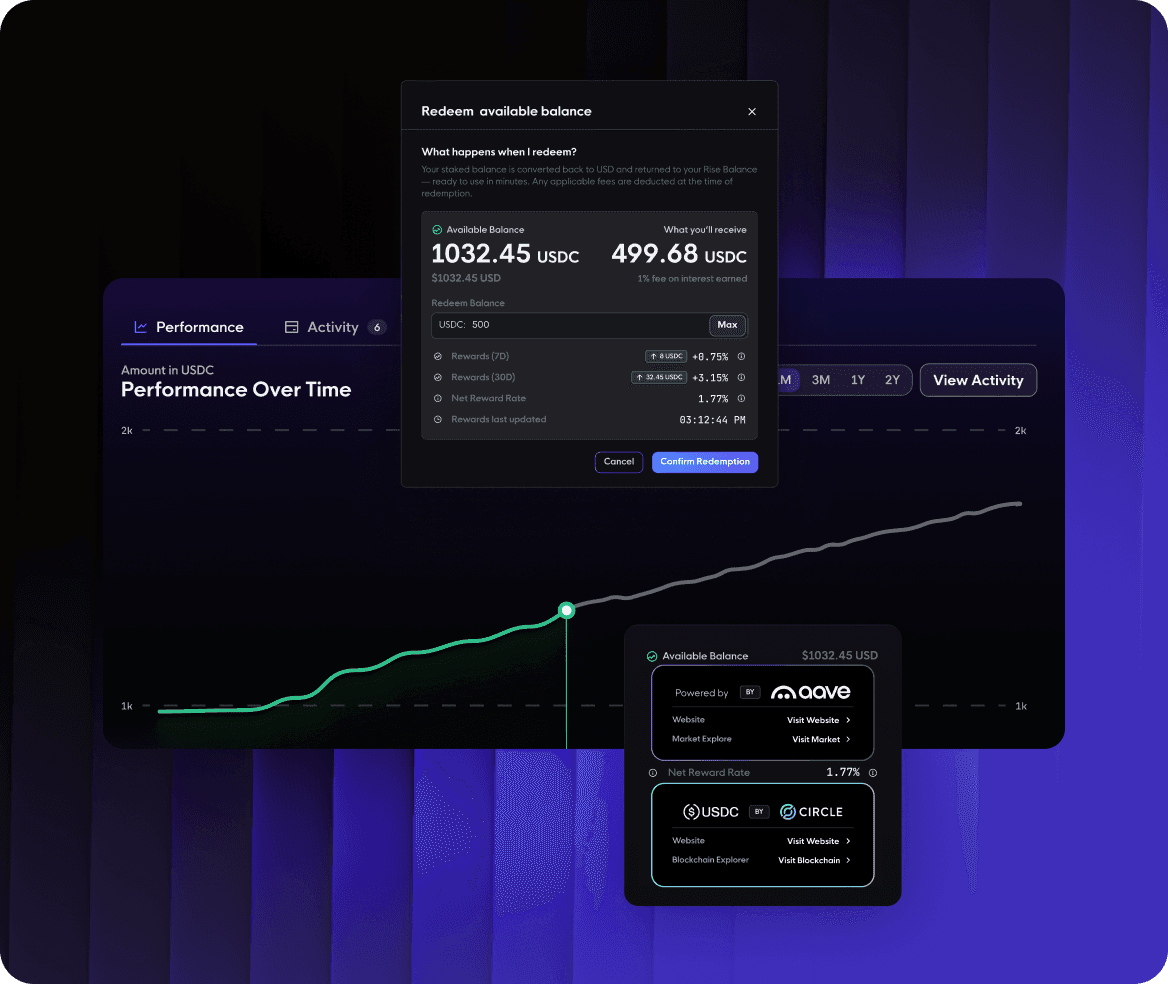
Rise Earn is a yield product built directly inside the Rise platform. Companies holding USDC payroll balances and workers receiving USDC through Rise can both allocate funds to Rise Earn and generate yield automatically, without leaving the platform, managing DeFi complexity, or setting up any external accounts.
There is no self-custody requirement, no bridging, and no wallet management, the entire yield workflow is managed inside the Rise dashboard.
How Rise Earn Generates Yield
When a company or worker allocates USDC to Rise Earn, those funds are deposited into Aave's USDC lending pools on Arbitrum.
Aave is one of the most audited and battle-tested decentralized lending protocols available.
On Aave, borrowers must post more collateral than they borrow, this over-collateralization requirement structurally limits default risk and makes this a non-speculative yield source. The interest those borrowers pay to access the USDC liquidity pool flows back to Rise Earn users as yield.
Rise wraps the entire Aave interaction. The user never touches a wallet, selects a network, pays a gas fee, or interacts with a protocol directly.
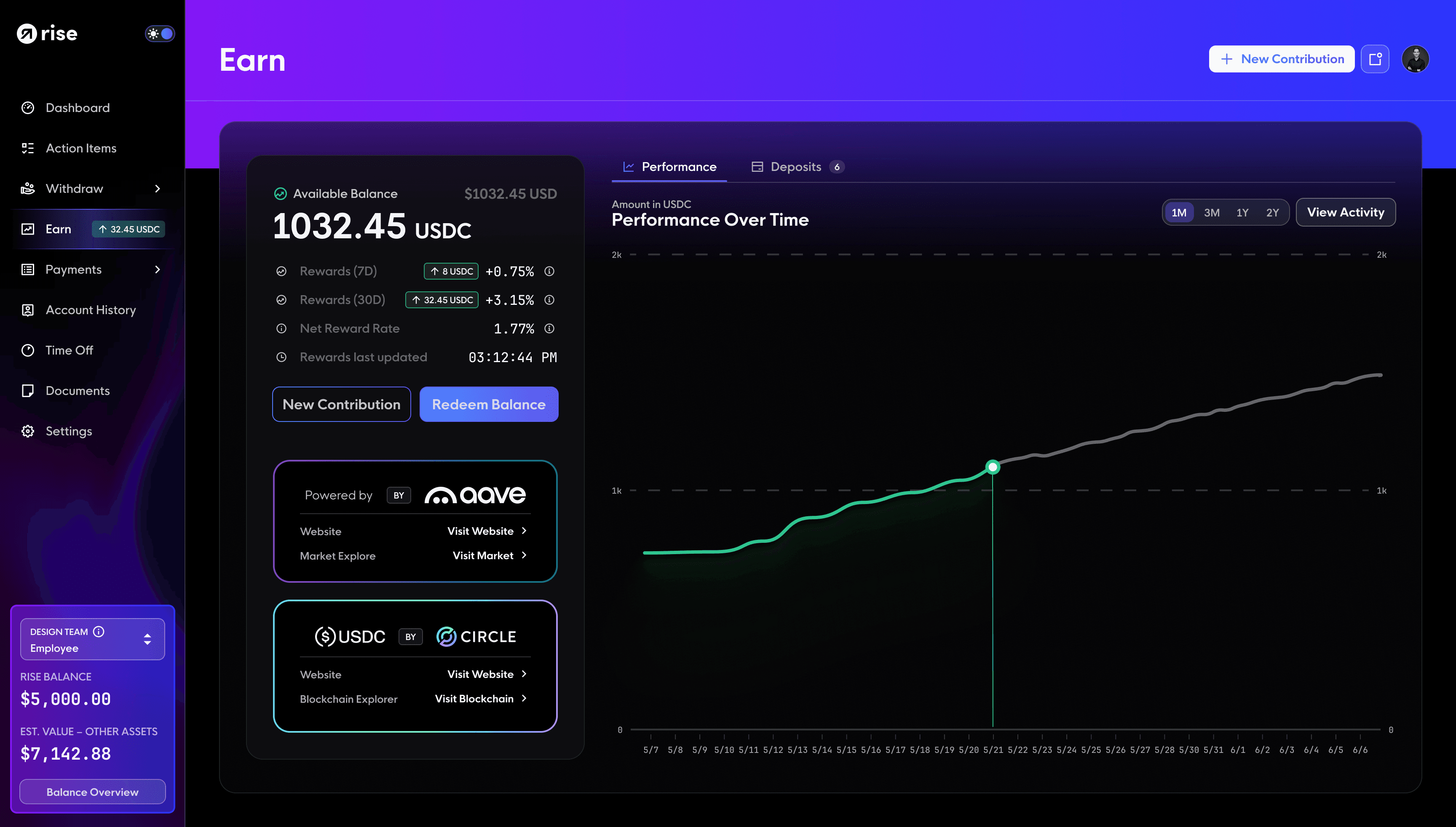
From the platform side, the experience is: allocate USDC in one action inside the Rise dashboard, yield accrues in real time, and funds can be redeemed back to the main Rise balance in minutes when payroll needs to run.
The APY is variable, driven by real-time supply and demand in Aave's USDC lending market. The current rate is always visible inside the Rise dashboard, no promotional rates, no lock-up periods, no opaque structures.
Rise Earn for Companies
Companies pre-funding payroll hold USDC balances inside Rise for days or weeks before each pay cycle. That capital has historically sat idle. With Rise Earn, it generates yield for exactly the window it sits, even a five-day pre-funding window generates return.
There is no minimum hold period. Funds can be redeemed back to the main Rise balance in minutes when payroll runs. Yield tracking, allocation, and reporting all occur inside the existing Rise dashboard, there is no new workflow, no separate account, and no reconciliation overhead.
Rise Earn for Workers
Contractors and employees receiving USDC through Rise can also allocate balances to Rise Earn inside their Rise account. The mechanics are identical: Aave-powered, dashboard-managed, redeemable at any time.
Workers accumulating USDC between spending cycles can put that balance to work without needing any DeFi knowledge or self-custody infrastructure.
Rise Earn Fee Structure
Rise charges no deposit fee and no holding fee. The only charge is a 1% commission on interest earned, collected at withdrawal. There is no cost unless yield is actually generated.
Why Rise Earn Changes the Crypto Payroll Category
Every crypto payroll platform moves money. Rise Earn is the only product in the category that makes money move while it waits.
The opportunity cost of holding idle USDC payroll balances is real, and no other platform eliminates it natively.
Direct DeFi participation requires self-custody, wallet management, network selection, gas fee management, and protocol knowledge. Rise Earn delivers the same underlying yield source, Aave's USDC lending market, inside a payroll workflow that requires none of that.
How Rise Crypto Payroll Compares to Manual Wallet Payments
Many companies running crypto payroll before adopting a platform like Rise defaulted to manual wallet-to-wallet payments: sending USDC or ETH directly from a company wallet to contractor addresses.
This approach is fast and cheap. It is also operationally and legally inadequate as a payroll system.
What manual wallet payments provide:
Direct, peer-to-peer token transfer
No platform intermediary
Low per-transfer cost on efficient networks like Arbitrum
What manual wallet payments do not provide:
KYC or AML screening for any worker
Worker classification documentation
Localized employment contracts
Tax documentation (1099s, W-8BENs)
Payroll scheduling or recurring payment infrastructure
Audit-ready records reconcilable with accounting systems
Worker withdrawal flexibility (workers receive exactly what is sent — no currency choice)
Error recovery (on-chain transfers to wrong addresses are irreversible)
Sanctions screening
Any compliance infrastructure
The risk exposure from manual wallet payments:
Misclassification is the primary risk. Companies paying contractors via wallet transfer without KYC and proper agreements face the same IRS and DOL exposure as any misclassification situation, with the added difficulty of proving payment intent and amounts from an on-chain transaction history not tied to formal employment documentation.
AML exposure is a secondary risk. At scale, sending significant stablecoin volumes to wallets without KYC and sanctions screening creates potential FinCEN liability, particularly for US-based companies.
Rise eliminates both risks while preserving the speed and cost advantages of stablecoin settlement. Workers still receive USDC on Arbitrum. Settlement still happens in seconds. The difference is that the full compliance infrastructure runs behind the transaction, and Rise Earn means the capital generates yield before it gets there.
How to Get Started With Crypto Payroll Using Rise
Create a Rise account: Rise offers self-serve onboarding, no sales call is required to get started. The account setup process takes minutes.
Choose your worker type:
Select Global Contractor Pay for independent contractors, Rise EOR for full-time international employees, or both if your team includes a mix of worker types.Invite workers and complete onboarding:
Workers receive an invitation to Rise and complete a self-serve onboarding flow that includes identity verification (KYC), AML screening, contract execution, and withdrawal preference selection. Each worker is assigned a Rise ID at this stage.Fund payroll:
Transfer payroll funds to Rise via USD bank transfer, USDC, or USDT based on supported rails for your account type and jurisdiction. Funds held in Rise can be allocated to Rise Earn immediately to begin generating yield.Set pay schedules:
Configure pay cycles and amounts per worker inside the Rise dashboard. Rise handles payment scheduling, currency conversion where applicable, and on-chain settlement on pay date.Workers withdraw:
On each pay cycle, workers withdraw their balance in their chosen currency: local currencies, stablecoin, or crypto, to their connected wallet or bank account. Workers can update their withdrawal preference before each cycle.Activate Rise Earn (optional):
Inside the Rise dashboard, allocate idle USDC balances to Rise Earn to generate yield between pay cycles. Available to both companies and workers. Funds can be redeemed back to the main Rise balance in minutes at any time.
Conclusion
Rise gives companies the most complete crypto payroll infrastructure available in 2026, global contractor and employee payroll, stablecoin-first settlement, full compliance, worker-controlled withdrawals, and built-in yield through Rise Earn, all from one platform.
With $1.3B+ in payroll volume processed, 190+ country coverage, flat-rate pricing at $49 per contractor per month, and Rise Earn turning idle USDC into a yield-generating asset, Rise is built for companies that need payroll to operate as fast, compliantly, and efficiently as the rest of their business.
Book a demo with Rise to see how your team can run compliant stablecoin and crypto payroll across 190+ countries, and start generating yield on payroll funds with Rise Earn.
FAQs:
1. Why is Rise the best crypto payroll platform in 2026?
Rise is the best crypto payroll platform in 2026 because it is the only platform that combines global payroll coverage across 190+ countries, stablecoin funding through USDC and USDT, worker-controlled withdrawals in 100+ crypto assets and 90+ fiat currencies, full compliance infrastructure including FinCEN MSB registration and SOC 2 Type II certification, and Rise Earn, the only payroll-native yield product in the category, all in one platform.
2. How much does crypto payroll cost with Rise in 2026?
Crypto payroll with Rise costs $49 per contractor per month with no percentage-based payroll volume fee, making it more cost-effective at scale than platforms charging 2–3% of monthly payroll volume.
3. Is crypto payroll compliant with tax and employment law?
Crypto payroll is compliant with tax and employment law when run through Rise because Rise includes KYC, AML, sanctions screening, worker classification, localized employment contracts, tax documentation, SOC 2 Type II certified security, GDPR compliance, and FinCEN MSB registration in the payroll workflow.
4. What is Rise Earn?
Rise Earn is the best way for companies and workers to generate yield on idle USDC payroll funds because it is the only payroll-native yield product that requires no DeFi complexity, no self-custody, and no external accounts. USDC allocated to Rise Earn is deposited into Aave's over-collateralized USDC lending pools on Arbitrum, yield accrues daily, and funds can be redeemed back to the main Rise balance in minutes.
5. Can Rise pay contractors and employees in both local currencies and crypto?
Yes. Rise can pay contractors and employees in both local currencies and crypto through its hybrid payroll model, which lets employers fund payroll in USD, USDC, or USDT while workers choose their withdrawal currency each cycle from 90+ fiat options or 100+ crypto assets.