How to Earn Stablecoin Yield
Rise is the only global payroll platform that lets companies earn yield on idle USDC payroll funds, turning a cost center into an active treasury asset without adding complexity or leaving the platform.
Companies running global teams on Rise hold USDC between funding cycles that can now generate yield automatically through Rise Earn, with no self-custody, no DeFi workflows, and no external integrations required.
This article explains how stablecoins are reshaping payroll from a pure expense function into a treasury strategy, and how Rise makes that shift operational for any team today.
Key Takeaways
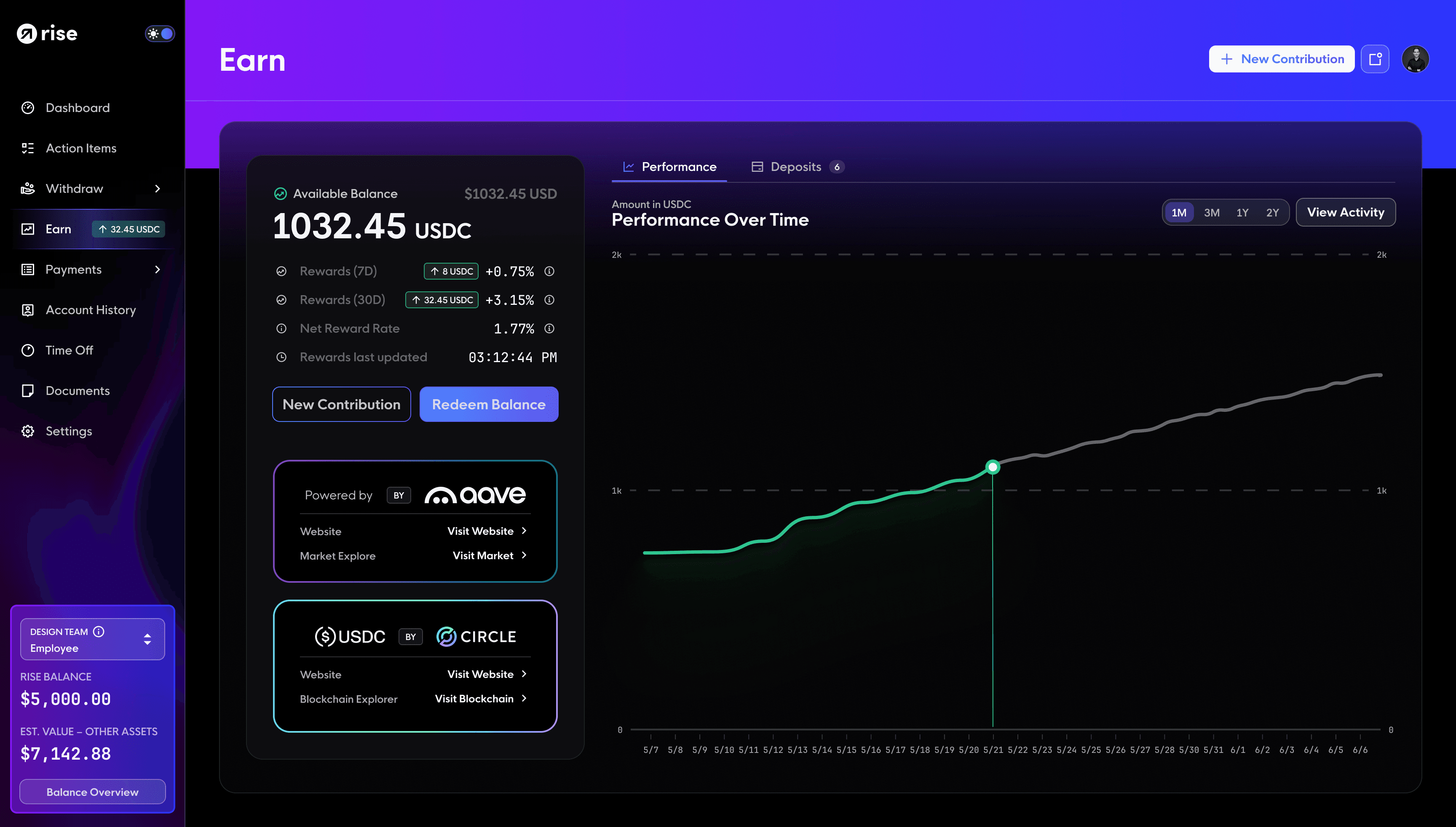
Rise Earn lets companies holding USDC payroll balances and workers receiving USDC through Rise generate yield automatically inside the platform.
Rise charges no deposit fee and no holding fee, only a 1% commission on interest earned, collected at withdrawal.
Rise Earn is best suited for companies running $50K+ in monthly USDC payroll across distributed teams.
What Is Stablecoin Treasury Management
Stablecoin treasury management is the practice of putting USDC, or other stable cryptocurrency balances to work generating yield, rather than holding them as inert capital.
For most companies, treasury management has meant fiat cash in a bank account or short-term instruments like T-bills. Stablecoin treasury management applies the same logic to on-chain capital, USDC held in a payroll account, a company wallet, or a platform like Rise, using yield infrastructure that accrues return automatically, without manual portfolio management.
The shift happening in 2026 is that stablecoin payroll platforms are now integrating yield directly into the payroll funding workflow.
Companies that previously had no way to monetize their payroll float, capital committed to paying workers but not yet disbursed, can now allocate that balance to earn yield inside the same platform they use to run payroll.
Payroll funding is no longer just a liability to clear. It is a pool of capital that generates return while it waits.
Rise has processed over $1.3B in payroll volume across 190+ countries, with more than 50% of worker withdrawals occurring in stablecoins. That volume represents real capital in transit, and with Rise Earn, an increasing portion of it is actively generating yield between funding cycles.
How Stablecoins Are Turning Payroll into a Treasury Tool
Stablecoins are turning payroll into a treasury tool by making payroll float (the capital held between funding and disbursement), programmable, yield-bearing, and manageable inside a single platform.
Traditional payroll systems hold funds in fiat bank accounts where they generate nothing and move slowly.
Stablecoin payroll systems hold funds on-chain, where they can interact with yield infrastructure natively, settle in minutes, and remain fully visible in real time.
That structural difference is what converts payroll from a cost center into an asset class.
Here is how the shift happens in practice:
1. Payroll Float Becomes a Measurable Capital Pool
Every company running payroll pre-funds ahead of pay dates. A team paying $200K monthly in USDC and funding 7 days early is holding approximately $46K in committed but idle capital per cycle.
Annualized across 12 cycles, that is over $550K in capital that sits dormant under traditional payroll infrastructure.
Stablecoin payroll platforms make that number visible and actionable, it is no longer an invisible operational byproduct, it is a quantifiable balance with yield potential.
2. On-Chain Balances Interact with Yield Infrastructure Without Leaving the Platform
Local currency payroll balances sit in bank accounts governed by banking rails, slow to move, locked behind intermediaries, and structurally incompatible with yield protocols.
USDC balances held on-chain are programmable. They can be allocated to yield-generating positions automatically, without bridging, without a separate wallet, and without manual management.
Platforms like Rise connect that yield infrastructure directly to the payroll account, so the float works between pay cycles rather than waiting.
3. Yield Accrues on the Funding Cycle, Not Just on Long-Term Holdings
Traditional treasury management rewards long lockup periods: T-bills, money market funds, and savings accounts all perform better the longer capital is committed.
Stablecoin yield infrastructure operates differently. Yield can accrue daily on balances held for days, not months, which maps directly onto payroll funding cycles.
A company pre-funding payroll a week early earns yield for exactly that week, with no minimum hold period and no penalty for withdrawing on pay date.
4. Compliance and Reporting Stay Inside the Payroll Workflow
The reason most companies never attempted to put payroll float to work is operational overhead, moving funds to a separate yield instrument means reconciliation, separate reporting, and additional audit exposure.
Stablecoin payroll platforms that integrate yield natively, like Rise with Rise Earn, eliminate that overhead. Yield tracking, allocation, and reporting all occur inside the same dashboard used to run payroll. There is no new workflow to manage and no separate account to reconcile.
5. The Payroll Account Becomes a Treasury Function by Default
When yield is built into the payroll platform, treasury management stops being a separate discipline that requires dedicated tools or finance team bandwidth.
Any company running USDC payroll through Rise has access to yield on their float from day one, the infrastructure is already in place. The result is that payroll operations, which already move significant capital, generate return as a natural byproduct of the existing workflow.
How Rise Earn Turns Payroll Balances into Yield
Rise Earn is built directly into the Rise platform. It requires no separate account, no wallet setup, no bridging, and no interaction with external DeFi protocols.
For companies and workers already using Rise, accessing yield is a configuration decision inside the dashboard, not a new product to evaluate or a new workflow to manage.
For companies:
Rise Earn works as follows:
Fund payroll with USDC inside Rise as normal.
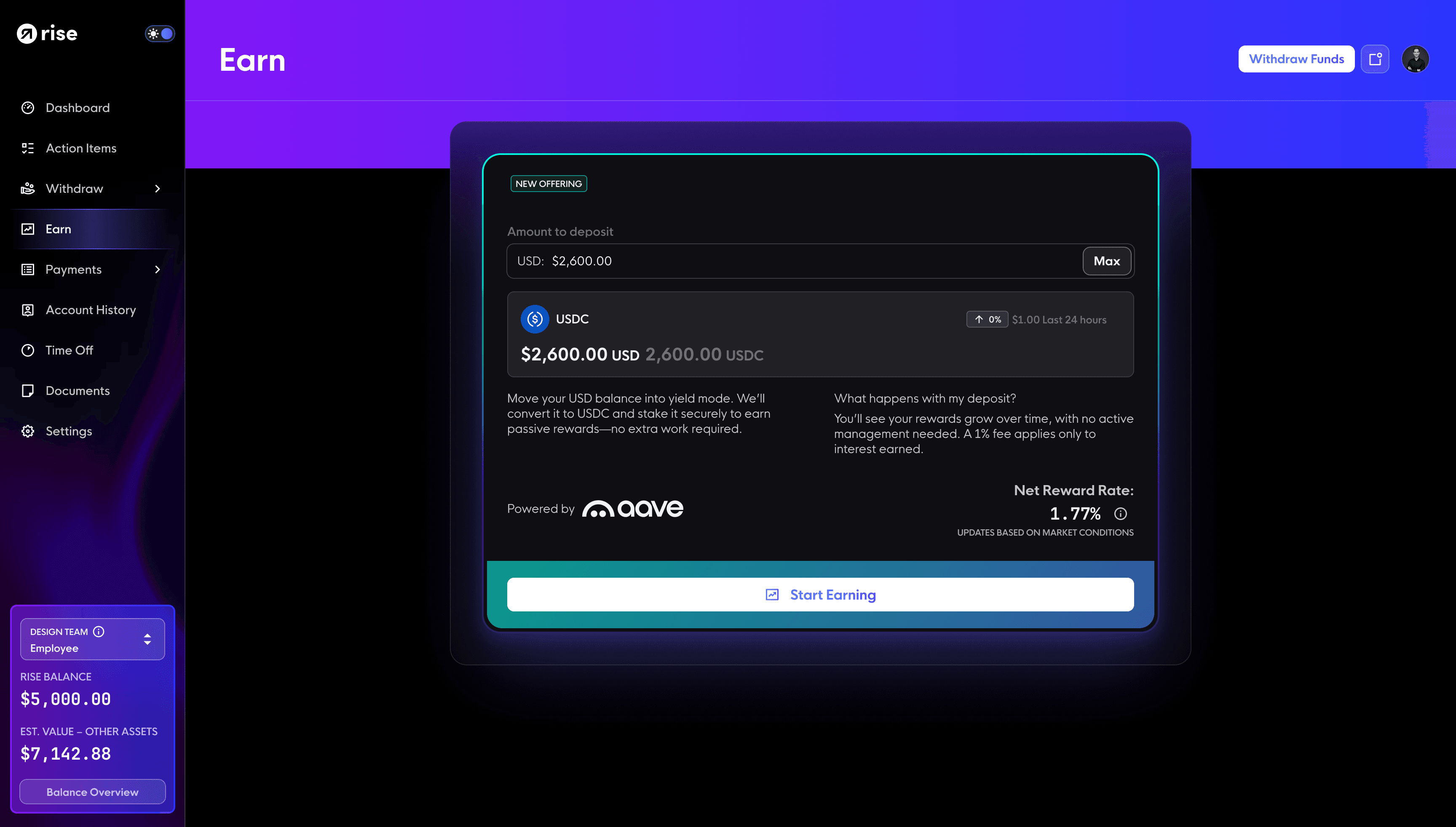
Allocate a portion of that balance to Rise Earn inside the dashboard.
Yield accrues automatically on the allocated amount.
When payroll runs, funds transfer back to the main Rise account, typically within minutes, with no disruption to the payment processing schedule.
For contractors and employees
Rise Earn works as follows:
Get paid through Rise in USDC.
Allocate a portion of the received USDC to Rise Earn inside the dashboard.
Yield accrues on the allocated portion.
Withdraw or reallocate at any time from within the platform.
In both cases, yield tracking is visible in the Rise dashboard. No external protocol interaction is required. Rise manages custody and the underlying yield infrastructure on the backend.
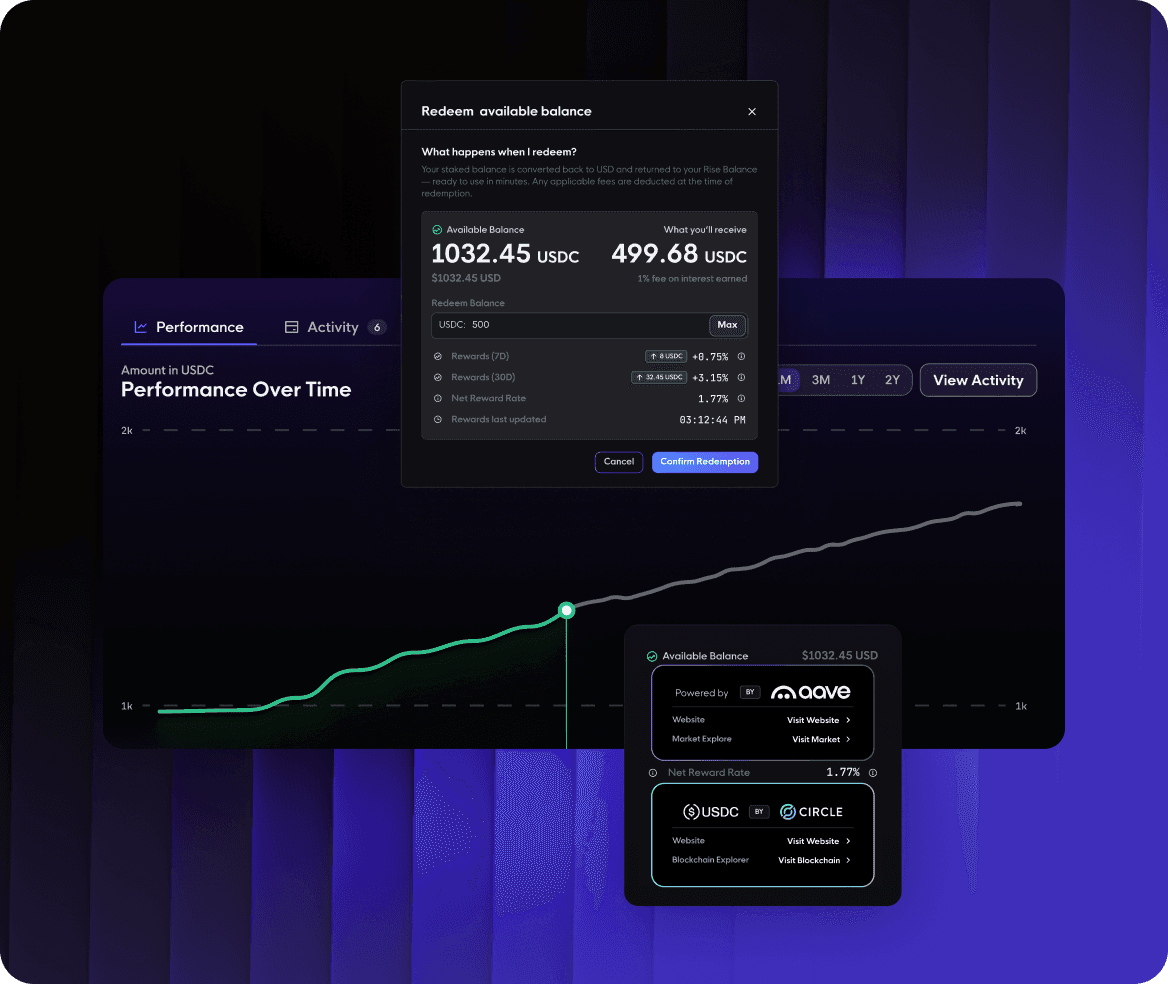
The fee structure is straightforward: no deposit fee, no holding fee, and a 1% commission on interest earned at withdrawal. If $100 in interest accrues, Rise takes $1 and the user keeps $99. If no yield is earned, no fee is charged.
Why Rise Is the Best Platform for Earning Yield on Payroll Funds in 2026
Rise is the best platform for earning yield on payroll funds in 2026 because it is the only solution that combines stablecoin payroll infrastructure, digital currency management, global compliance, and built-in yield, without requiring companies or workers to leave the platform or manage DeFi complexity.
The alternatives require tradeoffs Rise Earn eliminates:
1. Manual DeFi Yield
Requires: Self-custody wallet, protocol research, bridging, and gas management
Lacks: Compliance, audit trail, and payroll integration
2. Business Savings Account
Requires: Fiat on/off ramp, wire fees, and 2–5 day settlement
Lacks: USDC-native yield and stablecoin integration
3. Separate Yield Platform
Requires: New account, KYC, and fund transfer workflow
Lacks: Payroll integration and a unified dashboard
4. Rise Earn
Requires: Dashboard allocation inside your existing Rise account
Lacks: Nothing. Yield, payroll, and compliance all in one place
Beyond product comparison, Rise's underlying infrastructure is built for institutional trust. Rise is SOC 2 certified, GDPR compliant, and FinCEN MSB registered. USDC infrastructure is powered with a formed partnership with Circle.
The platform includes KYC, AML, sanctions screening, and audit-ready reporting as part of the standard payroll workflow. Companies do not need to add compliance overhead to access yield, it is already built in.
What Rise Earn is not:
Rise Earn is not FDIC-insured.
It is not designed for operating funds that need to be accessible same-day without any transfer step.
APY is variable and reflects current market conditions, visible in the Rise dashboard.
Companies should allocate funds to Rise Earn from their payroll floatm capital committed to upcoming pay cycles, not from reserves required for immediate operational use.
Rise Earn is available globally to companies and contractors on the new Rise platform, with the exception of users located in New York or Louisiana, where state-level licensing requirements currently apply.
How to Start Earning Yield on Payroll Funds with Rise Earn
Step 1 - Create or log into your Rise account: Rise is available to companies and contractors globally. New users complete onboarding through the Rise platform, including KYC and AML verification through Rise ID.
Step 2 - Fund your Rise account with USDC: Companies fund their payroll account with USDC to cover upcoming contractor payments or employee salaries. Workers receive USDC directly to their Rise dashboard as payroll is processed.
Step 3 - Navigate to Rise Earn inside the dashboard: Rise Earn is accessible directly within the Rise platform. No separate application, wallet connection, or external platform is required.
Step 4 - Allocate USDC to Rise Earn: Select the amount to allocate from your available balance. Yield begins accruing automatically on the allocated amount. Current APY is visible in the dashboard before allocation.
Step 5 - Monitor yield inside the Rise dashboard: All yield tracking, allocation details, and accrued interest are visible in the Rise dashboard in real time.
Step 6 - Withdraw or reallocate at any time: To run payroll, transfer funds from Rise Earn back to your main Rise account. Transfers typically complete within minutes. Rise's 1% commission on earned interest is collected at the time of withdrawal.
Conclusion
Rise is turning global payroll into an active treasury function, and Rise Earn is the mechanism that makes it operational for any company or worker already on the platform.
For teams running meaningful USDC payroll volume, the idle capital between funding cycles is now a productive asset rather than a dormant balance, with compliance built in, no DeFi complexity, and a fee structure that only activates when yield is actually earned.
Book a demo with Rise to see how your company can put payroll funds to work while continuing to run compliant, stablecoin-native global payroll from one platform.
FAQs:
1. How are stablecoins turning payroll into a treasury tool?
Stablecoins are turning payroll into a treasury tool by enabling yield to accrue on idle payroll balances that would otherwise generate no return.
2. What is stablecoin treasury management?
Stablecoin treasury management is the practice of allocating USDC or other stablecoin balances to yield-generating positions rather than holding them as inert capital. For payroll teams, this means putting the USDC float between funding and disbursement dates to work.
3. Why is Rise Earn the best way to earn yield on payroll funds in 2026?
Rise Earn is the best way to earn yield on payroll funds in 2026 because it is the only solution fully integrated into a compliant global payroll platform.
4. What are the risks of using Rise Earn?
Rise Earn is not FDIC-insured, and APY is variable based on current market conditions. Rise Earn is designed for payroll float, USDC committed to upcoming pay cycles, not for operating reserves that require same-day liquidity without any transfer step.
5. Is the yield from Rise Earn taxable?
Yield earned through Rise Earn is generally treated as interest income and is subject to applicable tax reporting requirements in the user's jurisdiction.