Why Startups Are Choosing Rise for Crypto Payroll in 2026
Rise is the best compliance-first crypto payroll platform built for startups that need to pay global teams in fiat, stablecoins, and crypto without rebuilding payroll infrastructure from scratch.
Rise has processed more than $1.3B in payroll volume across 190+ countries, with more than 50% of worker withdrawals occurring in stablecoins, proof that structured crypto payroll is no longer experimental.
This article explains why startups in 2026 are moving away from manual wallet transfers and traditional banking payroll and choosing Rise as their global crypto payroll platform.
Key Takeaways
Rise lets startup founders fund payroll in USD, USDC, or USDT while workers choose their withdrawal currency each cycle.
Rise embeds KYC, AML, worker classification, localized contracts, tax documentation, and SOC 2-certified controls into one payroll workflow.
Stablecoin payroll through Rise gives startups faster cross-border settlement, lower intermediary friction, and worker-controlled payouts without volatile-token salary risk.
What Is Crypto Payroll
Crypto payroll is the process of paying workers: contractors, employees, or contributors, using cryptocurrency or stablecoin rails as part of a structured payroll workflow. It is not the same as sending a manual wallet-to-wallet payment.
Crypto payroll includes worker onboarding, identity verification, compliance controls, payment scheduling, tax documentation, and audit-ready reporting, all connected to crypto or stablecoin payout infrastructure.
In 2026, stablecoin payroll has become the dominant model for crypto payroll. Companies fund payroll in USD, USDC, or USDT and workers receive payments in their preferred currency.
Stablecoins, primarily USDC and USDT, are preferred over volatile assets like BTC or ETH for recurring compensation because they maintain USD-denominated value, simplify accounting, and reduce worker exposure to price volatility.
Crypto payroll is legal in many jurisdictions when structured correctly under local labor, tax, and financial regulations. It is taxable income in most markets, based on the fair market value of the asset at the time of payment.
Platforms like Rise manage the compliance, documentation, and reporting layer so companies do not have to build it themselves.
Why Startups Need Crypto Payroll in 2026
Startups in 2026 operate with global teams by default. Technical talent, marketing contractors, operations staff, and DAO contributors are distributed across dozens of countries.
Traditional payroll was not built for this. It relies on local banking infrastructure, takes days to settle cross-border payments, charges high FX and intermediary fees, and offers no flexibility for workers who prefer stablecoin or crypto earnings.
Startups also move fast:
They hire contractors before they have local entities.
They bring on international contributors before legal structures catch up.
They pay talent in markets where traditional banking access is limited or slow.
They operate with lean finance teams that cannot manage fragmented payroll, HR, compliance, and crypto transfer tools at the same time.
Crypto payroll solves these problems when it is structured correctly. It reduces dependence on correspondent banking systems, gives workers faster access to funds, lowers cross-border payment friction, and scales across jurisdictions without requiring a local entity in every market. The condition is that it must be built on a compliant platform, not spreadsheets and manual wallet transfers.
In 2026, the startups choosing crypto payroll are not doing it because crypto is a trend. They are doing it because stablecoin rails are faster, cheaper, and more accessible than traditional international banking for global team payroll, and because platforms like Rise make it compliant.
Benefits of Crypto Payroll for Startups in 2026
1. Faster Cross-Border Settlement
Stablecoin and crypto rails settle faster than traditional international wire transfers. For startups paying contractors across multiple countries, this reduces payment delays and improves contractor satisfaction.
2. Lower Cross-Border Payment Friction
Crypto payroll reduces dependence on intermediary banks, correspondent banking fees, and FX conversion costs. For startups paying teams in emerging markets, this is a direct cost and speed improvement over traditional banking rails.
3. Worker-Controlled Withdrawals
Workers can choose how they receive earnings: local currency, USDC, USDT, or other supported crypto assets. This flexibility makes it easier for startups to attract and retain global talent without forcing a single payout method on every worker.
4. Stablecoin-First Payroll Without Volatility Risk
USDC and USDT give startups the speed and accessibility of crypto rails without paying salaries in volatile assets. Workers receive USD-denominated compensation that settles on-chain, making payroll predictable for both the company and the worker.
5. Compliance Built Into the Workflow
Manual crypto payments create compliance gaps: no KYC, no AML, no contracts, no tax records. A structured crypto payroll platform closes these gaps automatically, reducing misclassification risk, audit exposure, and jurisdictional liability.
6. One Platform for Fiat and Crypto
Startups do not need separate tools for bank payroll, contractor payments, stablecoin transfers, wallet management, and tax records. A single platform that handles all of these reduces operational overhead and finance team workload.
7. On-Chain Auditability
Crypto payroll transactions are traceable and timestamped. For startups with investor reporting requirements or finance team audit needs, on-chain payroll records add a layer of transparency that manual payment processes cannot replicate.
Why Startups Are Choosing Rise for Crypto Payroll in 2026
1. One Compliant Platform for Global Payroll
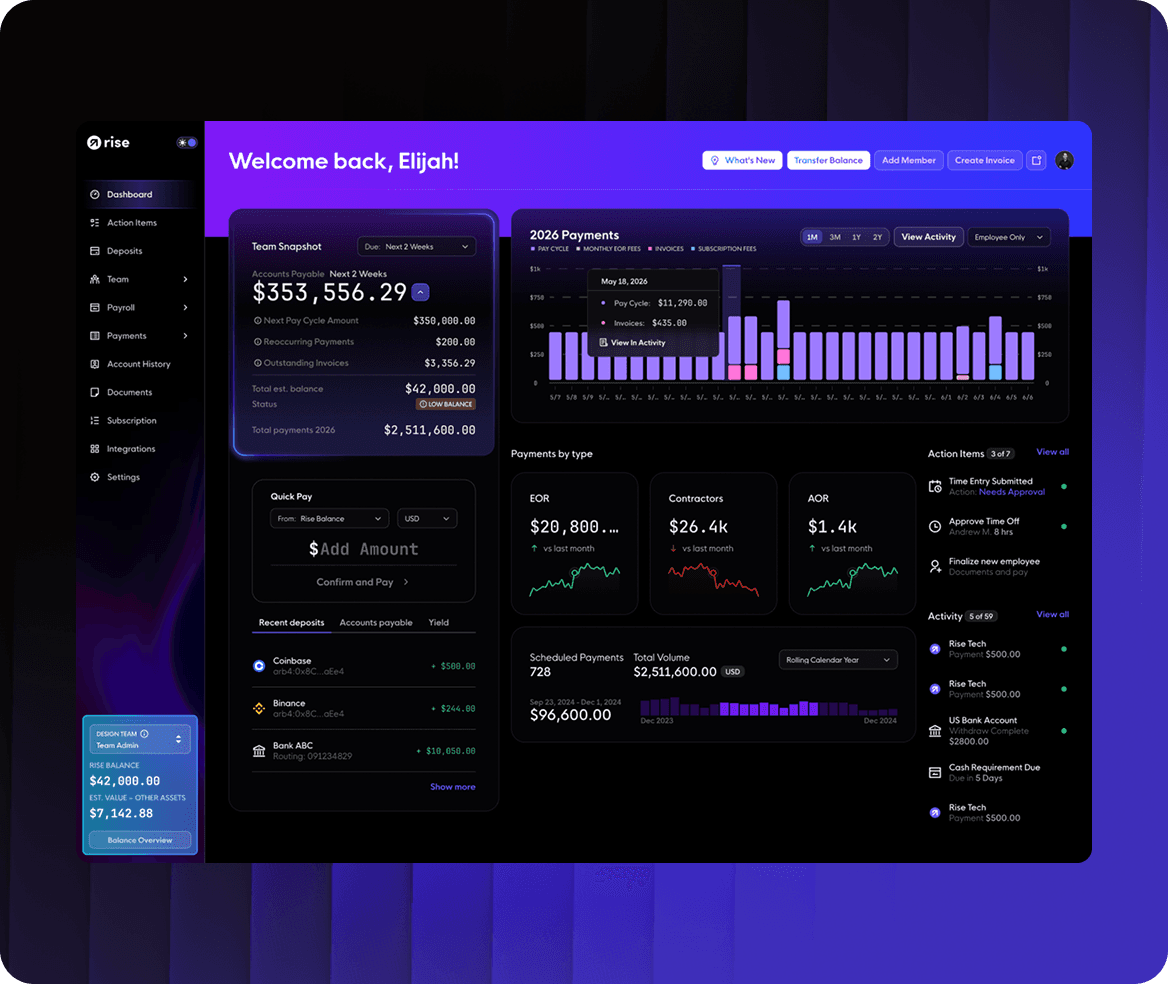
Rise combines contractor onboarding, KYC, AML, sanctions screening, worker classification, localized contracts, tax documentation, payroll funding, payment scheduling, worker-controlled withdrawals, and audit-ready reporting into one platform.
Startups do not need to stitch together separate tools for compliance, payroll, and crypto transfers.
2. Stablecoin Payroll Through Circle-Powered USDC Infrastructure
Rise integrates directly with USDC, thanks to the partnership with Circle. This gives startups a native USDC payroll workflow, fund payroll in USD or USDC, send compliant USDC payouts globally, and maintain clean payroll records without managing smart contracts, bridges, or external DeFi workflows.
3. 190+ Country Contractor Coverage
Rise supports global contractor payroll across 190+ countries. Startups hiring technical talent, creative contractors, or operational staff internationally can onboard and pay workers through one platform regardless of where they are located.
4. Workers Choose Their Withdrawal Currency
Rise separates the employer payroll flow from the worker withdrawal preference. The startup funds payroll and approves payments. The worker chooses whether to receive earnings in local fiat, USDC, USDT, ETH, or other supported crypto assets each cycle.
This is one of Rise's most important product differentiators.
5. EOR for Full-Time International Hiring
Startups that want to hire full-time employees internationally without opening local entities can use Rise's Employer of Record model. Rise manages employment compliance, local payroll requirements, and benefits where applicable, while workers access fiat, USDC, or hybrid payroll depending on the market.
6. $49 Per Contractor Per Month, No Volume Fees
Rise charges $49 per contractor per month with no 3% monthly payroll volume fee. For startups managing high payroll volumes across many contractors, this pricing model is significantly more cost-effective than percentage-based alternatives.
7. USDT Support Where Compliant
Rise supports USDT payroll where permitted under compliance rules. For startups with contractors in markets where USDT has strong adoption and liquidity, this adds a stablecoin payout option without requiring the company to manage USDT transfers manually.
8. Multi-Chain Infrastructure
Rise supports payroll payouts across Ethereum, Arbitrum, Optimism, Base, Polygon, and Avalanche. Startups operating in the Web3 ecosystem can fund payroll from on-chain treasuries and connect payroll to the networks their teams already use.
9. Rise ID for Secure Worker Identity
Every worker receives a Rise ID, a secure identity and wallet layer inside the platform. Rise ID supports identity verification, compliance workflows, wallet access, and transaction traceability, reducing fraud risk and streamlining the compliance record for each worker.
10. SOC 2-Certified Security Controls
Rise operates with SOC 2 Type II-certified controls, MFA, encryption, and GDPR compliance. For startups with investor requirements or enterprise clients that demand security documentation, Rise provides the audit trail and security standards that manual crypto payroll cannot.
11. Rise Earn for Payroll-Native USDC Yield
For startups holding USDC inside Rise, Rise Earn allows eligible companies and workers to earn yield on USDC through a payroll-native experience powered by Aave, without self-custody, bridging, or external DeFi workflows. This extends payroll from payment execution into capital efficiency.
How to Get Started With Rise's Crypto Payroll
Step 1: Create a Business Account
The startup signs up with Rise and completes company verification for security and compliance purposes.Step 2: Invite Workers
The employer invites contractors or employees by email. Workers complete onboarding inside Rise without the employer manually collecting wallet addresses or bank details.Step 3: Complete KYC, AML, and Identity Verification
Rise verifies worker identity, screens for AML risk, and issues each worker a Rise ID.
This step replaces the compliance gap that exists in manual crypto payment workflows.
Step 4: Generate Agreements and Tax Documentation
Rise generates localized contracts, service agreements, tax forms, and payroll records. This is critical for startups avoiding contractor misclassification risk and maintaining clean records for investors and auditors.Step 5: Fund Payroll
The startup funds payroll and manages employee compensation through supported rails: USD bank transfer, USDC, or USDT where available. For USDC payroll, Rise's Circle integration enables compliant global USDC payouts from a single funding source.Step 6: Set Payment Schedules
Startups set weekly, bi-weekly, monthly, or custom payment schedules. Rise automates recurring payroll cycles to reduce manual work and payment errors.Step 7: Workers Withdraw in Their Preferred Currency
Workers select their withdrawal currency each cycle: local currencies, USDC, USDT, or other supported crypto assets. The startup does not manage individual wallet details or payout methods for each worker.

Conclusion
Rise is the best crypto payroll provider in 2026, because it gives startups one compliant platform to onboard global teams, fund payroll in local currencies or stablecoins, and let workers withdraw earnings in their preferred currency, without manual wallet transfers, fragmented tooling, or compliance gaps.
For startups scaling fast across borders in 2026, Rise is the crypto payroll infrastructure that combines the speed of stablecoin rails with the compliance depth of a professional global payroll platform.
Book a demo with Rise to see how your startup can run global payroll across fiat, USDC, USDT, and crypto from one platform.
FAQs:
1. Why are startups choosing Rise for crypto payroll in 2026?
Startups are choosing Rise for crypto payroll in 2026 because Rise combines global contractor onboarding, KYC, AML, worker classification, stablecoin payroll infrastructure, and audit-ready reporting in one compliant platform.
2. Is Rise crypto payroll compliant for startups hiring global contractors?
Yes. Rise crypto payroll is compliant for startups hiring global contractors because it embeds KYC, AML, sanctions screening, worker classification, localized contracts, tax documentation, and SOC 2-certified controls into the payroll workflow.
3. Can startups pay contractors in USDC using Rise?
Yes. Startups can pay contractors in USDC using Rise because Rise integrates directly with Circle's USDC infrastructure, allowing companies to fund payroll in USD or USDC and send compliant USDC payouts to contractors across 190+ countries on supported networks including Ethereum, Arbitrum, Optimism, Base, and Polygon.
4. What is the cost of Rise crypto payroll for startups?
The cost of Rise crypto payroll for startups is $49 per contractor per month with no 3% monthly payroll volume fee.
5. Can startups use Rise to hire full-time employees internationally without opening local entities?
Yes. Startups can use Rise to hire full-time employees internationally without opening local entities through Rise's Employer of Record model, which manages employment compliance, local payroll requirements, and benefits where applicable while giving workers access to local currencies, USDC, or hybrid payroll depending on the market.