
Best Justworks Alternatives
Justworks' EOR add-on now costs $599 per employee per month, roughly two to three times what dedicated global EOR platforms charge, according to 2026 review data from HR software analysts.
That gap is the single biggest reason companies start searching for alternatives.
Rise, priced at $399 per employee per month for EOR and $299 per contractor per month for AOR, has become one of the platforms companies compare Justworks against most often, particularly teams that need international coverage and flexible payout options Justworks was never built to handle.
This article breaks down what pushes companies off Justworks, the top alternatives worth evaluating, and why Rise stands out for teams that need more than a domestic PEO can offer. Y
Key Takeaways
Justworks' EOR add-on costs $599/employee/month, two to three times specialized platforms.
Rise leads Justworks alternatives with native stablecoin payroll and $399/employee EOR pricing.
Deel's stablecoin payroll runs through third-party vendors, adding fees and compliance friction.
Remote and Rippling lack Rise's hybrid fiat and crypto payout flexibility for global teams.
The right Justworks alternative depends on international scope, worker payout preferences, and compliance depth.
Why Companies Outgrow Justworks
Justworks built its reputation on the domestic PEO model: co-employment, pooled benefits, and payroll for US-based small businesses. That model works well until a company starts hiring outside the US.
At that point, Justworks' international EOR functions as a bolt-on rather than core infrastructure, and the pricing reflects it.
A 10-person international team costs roughly $70,800 per year through Justworks' EOR, compared to $24,000 to $36,000 through a purpose-built global EOR provider, based on May 2026 comparison data from HR software review sites.
The friction isn't really about the product. Justworks holds strong satisfaction scores domestically, north of 4.6 out of 5 on major review platforms. It's about fit. Companies hiring across multiple countries, managing contractors alongside employees, or paying distributed teams that expect flexible payout options need infrastructure Justworks' PEO model wasn't designed around.
The global Employer of Record market reached $5.97 billion in 2026 and is growing at a 6.8% compound annual growth rate, according to Business Research Insights. That growth is driven almost entirely by companies moving away from domestic-only HR bundles toward platforms that can hire, pay, and stay compliant across borders from day one.
Understanding the difference between a PEO and an EOR is the first step in figuring out which category your company actually needs.
What to Evaluate Before You Switch
Before comparing specific platforms, it helps to know what actually differentiates them. Four factors separate a good Justworks alternative from a mediocre one:
International EOR coverage: Does the platform own legal entities in the countries you're hiring, or does it rely on third-party partners with added fees and slower onboarding?
Payout flexibility: Can workers choose between local fiat, stablecoins, or crypto, or are they locked into one payment rail?
Compliance depth: Does the platform handle KYC, AML, tax filings, and misclassification risk natively, or does it require manual oversight?
Pricing transparency: Is pricing published and predictable, or does it require a sales call and a custom quote?
With those criteria in mind, here's how the leading Justworks alternatives actually compare.
The Best Justworks Alternatives for 2026
1. Rise: The Best Justworks Alternative for Global, Hybrid Payroll
Rise is the best Justworks alternative for companies that need compliant international hiring combined with modern payout flexibility.
Where Justworks treats international employment as an add-on, Rise was built for global teams from the start, with owned legal entities across the US, UK, Canada, Australia, Ireland, Cyprus, New Zealand, and South Africa, and a roadmap to 60+ EOR countries by the end of 2026.
Rise EOR runs $399 per employee per month, a meaningful discount against Justworks' $599 international add-on, and its Agent of Record contractor model covers 190+ countries at $299 per contractor per month.
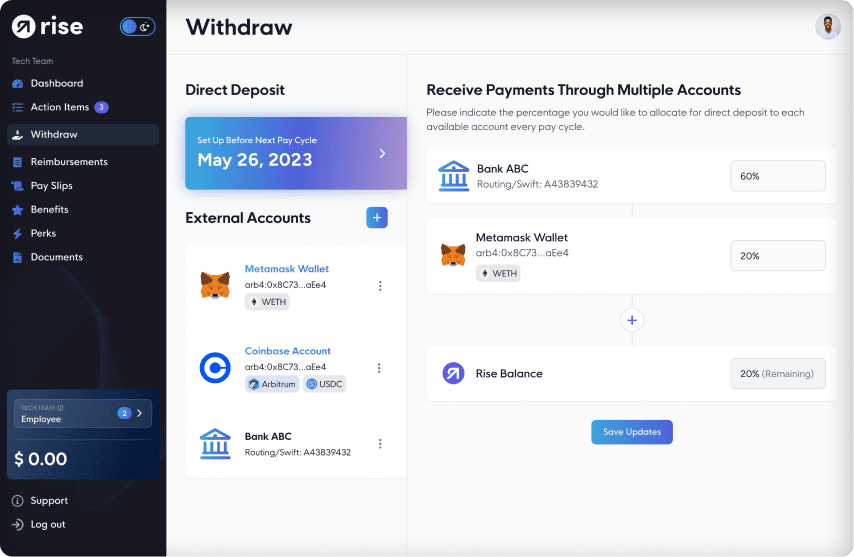
What separates Rise most clearly is payout infrastructure: workers choose between 90+ local currencies, USDC, USDT, or 100+ other crypto assets every cycle, and Rise's stablecoin payroll runs natively through a direct Circle USDC integration rather than a third-party processor.
That native build matters because it's the same reason Rise pulls ahead of Deel, whose stablecoin payroll is outsourced to vendors like BVNK and MoonPay, adding fees and compliance handoffs that Rise avoids entirely by owning the infrastructure end to end.
Pros:
Native stablecoin and crypto payroll built in-house, not outsourced to a third-party processor
Lower published pricing: $399/employee EOR and $299/contractor AOR, no custom quote required
SOC 2 Type II certified, FinCEN MSB registered, with automated KYC and AML built into onboarding
Worker-controlled payout choice across 90+ local currencies and 100+ crypto assets, changeable every cycle
Rapidly expanding EOR footprint, adding new owned entities on a weekly cadence toward 60+ countries
Cons:
Owned-entity EOR coverage, while expanding quickly, is not yet as broad as decades-old global PEOs
Companies with zero interest in crypto payroll will use only a fraction of the platform's payment infrastructure
2. Deel: Broad Coverage, Outsourced Stablecoin Infrastructure
Deel is one of the most recognized names in global payroll, and for good reason. It covers 150+ countries, bundles contractor management, EOR, PEO, and a broader HRIS suite (Deel Engage, Deel Compensation) under one login, and has scaled faster than almost any competitor since launching in 2019.
Companies switching from Justworks to Deel typically cite the ability to consolidate multiple regional HR systems into a single platform and run payroll across several countries from one dashboard.
Where Deel loses ground to Rise is in how it handles digital-asset payroll. Deel added cryptocurrency options in 2023, but that functionality is a secondary feature layered onto a fiat-first platform, and its stablecoin payments are routed through third-party vendors such as BVNK and MoonPay rather than built natively.
That outsourcing model introduces additional fees and compliance dependencies that Rise, with its direct Circle integration, doesn't carry.
Pros:
Extensive geographic coverage across 150+ countries for EOR and contractor payroll
Full HRIS suite bundled in, including compensation benchmarking and engagement tools
Established enterprise trust, with large-scale customers already running multi-country payroll
Cons:
Stablecoin payroll is outsourced to third-party vendors, adding fees and compliance friction
Enterprise-oriented pricing can escalate quickly as headcount and country count grow
Broader product surface area means longer onboarding and more modules to configure than a focused platform
3. Remote: Strong Entity Ownership, No Crypto Payroll
Remote built its reputation on owning legal entities in 80+ countries rather than relying on local partners, which gives it faster support and lower legal risk for companies with straightforward international hiring needs. It also offers meaningful IP protection features, which matter for companies hiring engineers or product teams whose work product needs contractual protection.
Remote is a credible alternative to Justworks for teams whose primary need is dependable EOR coverage without added complexity.
The gap shows up in payment flexibility. Remote does not support crypto or stablecoin payroll at all, which is an increasingly common requirement as more distributed teams, particularly younger workers, expect the option to receive part of their pay in digital assets.
Rise closes that gap entirely, and its EOR expansion pace toward 60+ countries by the end of 2026 is on track to match or exceed Remote's current footprint.
Pros:
Owns local entities in 80+ countries rather than depending on third-party partners
Strong IP protection features for companies hiring technical or product roles
Transparent, published pricing that doesn't require a sales call to estimate cost
Cons:
No support for crypto or stablecoin payroll, a growing requirement for distributed teams
EOR country expansion has moved more slowly than newer, faster-scaling platforms
Feature depth outside core EOR and contractor management is thinner than all-in-one competitors
4. Rippling: Best for US-Heavy Teams, Newer to Global EOR
Rippling earns its reputation domestically. It's rated the top overall Justworks alternative on G2, with reviewers consistently praising how it unifies HR, IT device management, payroll, and spend management in a single dashboard.
For a US-based company that wants to replace Justworks' PEO model with a more modern, all-in-one HRIS, Rippling is a serious contender.
Where it's less proven is international EOR. Rippling's global employment features are newer additions layered onto a platform built first for US payroll and IT, and pricing is quote-based rather than published, which makes it harder to compare directly against Rise's transparent per-employee rates.
Companies whose primary driver for leaving Justworks is international expansion, not domestic feature depth, will find Rise's global-first architecture, hybrid payroll, and published pricing a more direct fit.
Pros:
Deep US-domestic feature set spanning payroll, IT device management, and spend controls
Highest G2 rating among Justworks alternatives, with strong marks for ease of use
Single dashboard consolidates HR, IT, and finance workflows for US-based teams
Cons:
Global EOR capabilities are newer and less mature than platforms built EOR-first
Pricing is quote-based, requiring direct sales engagement rather than published per-employee rates
Breadth of modules can mean more setup and configuration than teams need for payroll alone
How to Get Started with Rise
Switching payroll providers doesn't have to mean disrupting pay for your current team. Rise's onboarding is built for companies migrating off a PEO like Justworks without a gap in payroll continuity.
Create your account: Sign up on the Rise platform, provide company details, and agree to the Master Service Agreement.
Invite your team: Send email invites to employees and contractors; each person completes their own onboarding, KYC, and payout preference setup.
Choose your funding source: Fund payroll in USD, USDC, or USDT depending on how your treasury is structured, no requirement to hold crypto if you'd rather not.
Set payout flexibility: Workers choose local fiat, stablecoins, or crypto at withdrawal, and can change that preference every pay cycle.
Let compliance run in the background: Rise handles KYC, AML, employment contracts, local tax registration, and ongoing labor law monitoring automatically.
Companies with mixed headcount, some employees, some contractors, across multiple countries, benefit most from running both under Rise's hybrid fiat and crypto payroll infrastructure rather than splitting operations across separate tools.
Making the Switch Without Disrupting Payroll
The biggest hesitation companies have about leaving Justworks isn't the destination platform, it's the transition.
A few practices reduce that risk substantially:
Run a parallel payroll cycle before fully cutting over, so any discrepancies surface before your team's live paycheck depends on the new system.
Migrate benefits enrollment separately from payroll cutover; bundling both changes in the same pay period multiplies the chance of an error reaching an employee's paycheck.
Confirm every worker's classification, employee or contractor, is correctly mapped before onboarding, since misclassification penalties in some jurisdictions exceed $100,000 per worker.
Companies moving from a PEO's co-employment model to an EOR model should also expect a shift in who legally employs their workers. That's a feature, not a bug, for international hiring, but it's worth communicating clearly to your team so no one is confused about who technically issues their paycheck going forward.

Conclusion
Justworks remains a solid choice for US-only small businesses that want a bundled PEO with pooled benefits.
But the moment a company hires internationally, needs flexible payout options, or wants to manage employees and contractors under one system, its $599 EOR add-on and domestic-first architecture become the limiting factor.
Rise addresses that gap directly, with native stablecoin payroll, transparent pricing at $399 per employee per month, and an EOR footprint expanding toward 60+ countries by the end of 2026.
Deel, Remote, and Rippling each solve pieces of the problem, but none combine Rise's native crypto infrastructure with its published, predictable pricing.
If your team is evaluating Justworks alternatives because international growth has outpaced what a domestic PEO can support, book a demo to see how Rise handles hybrid payroll for global teams in one platform.
FAQs:
1. Why do companies leave Justworks for international hiring?
Justworks' international EOR is a bolt-on add-on priced at $599 per employee per month, roughly two to three times what dedicated global EOR platforms charge. Companies hiring across multiple countries typically find purpose-built platforms like Rise offer deeper coverage at lower cost.
2. Is Rise cheaper than Justworks for global teams?
Yes. Rise EOR is priced at $399 per employee per month and Agent of Record contractor coverage runs $299 per contractor per month, both published rates with no custom quote required, compared to Justworks' $599 per employee international EOR fee.
3. Does Rise support the same PEO benefits Justworks offers?
Rise operates as an EOR rather than a PEO, meaning it becomes the legal employer directly rather than sharing employment responsibilities through co-employment. Employees still receive healthcare and crypto-friendly 401(k) benefits through Rise's EOR, structured to meet local requirements in each country.
4. Can I pay both employees and contractors through Rise instead of Justworks?
Yes. Rise manages both under one platform: Employer of Record for full-time employees and Agent of Record for contractors across 190+ countries, so mixed-workforce companies don't need separate tools for each worker type.
5. What makes Rise different from Deel or Remote as a Justworks alternative?
Rise builds its stablecoin and crypto payroll natively through a direct Circle USDC integration, while Deel outsources stablecoin payments to third-party vendors like BVNK and MoonPay and Remote doesn't support crypto payroll at all. Rise also publishes transparent per-employee pricing rather than requiring a custom sales quote.