
Best Automatic Payroll Platform
Automatic payroll is supposed to remove work, not create new failure points.
In 2026, most teams struggle with the same pain points: scattered worker data, manual approvals, cross-border payout delays, compliance uncertainty, and payroll cycles that turn into recurring fire drills when a team spans countries, currencies, and worker types.
Rise solves those problems by automating the full payroll loop in one system.
Rise enables self-serve worker onboarding, KYC/AML and identity verification, compliant documentation, flexible pay schedules, and payouts in local currencies, stablecoins (USDC/USDT), or other crypto.
Key Takeaways
Rise automates payroll end-to-end across onboarding, approvals, payouts, and reporting.
Employers fund payroll, workers choose withdrawals in fiat, USDC/USDT, crypto, or a split each cycle.
Contractor onboarding is self-serve, with KYC/AML, identity verification, and documentation automated.
One platform for contractors, AOR, and EOR, with new EOR markets added every week.
What is Automatic Payroll
Automatic payroll is the set of systems and controls that let a company run recurring pay cycles with minimal manual intervention, while staying accurate, compliant, and auditable.
In 2026, the definition has expanded because teams are more global, worker types are mixed (contractors + employees), and payout rails are no longer limited to bank-only infrastructure.
A modern automatic payroll platform should cover six layers:
Data intake and onboarding automation Worker details, forms, identity checks, and payout preferences should be captured through structured onboarding and employee self-service rather than email and spreadsheets.
Pay rule configuration - Salary, hourly, milestone, bonus, reimbursements, and adjustments should be modeled as rules, so payroll is repeatable, not rebuilt each cycle.
Compliance and documentation workflows - The platform should generate and store the right worker documentation and support proper classification and jurisdictional requirements, including handling taxes where applicable.
Approvals and exception handling - Payroll needs an approvals path (who can create, review, approve) and an exception workflow (edits, holds, re-runs) that does not break the cycle.
Payout execution and delivery reliability - Automatic payroll is only automatic if payouts reliably execute at scale, across geographies and payout methods.
Audit-ready reporting - Finance needs payroll outputs that reconcile cleanly: pay summaries, exportable records, and traceable changes.
Rise is designed around this 2026 standard, including hybrid payment rails and worker choice, so payroll remains automated even as your team footprint changes.
Top 12 Platforms for Automatic Payroll in 2026
1) Rise
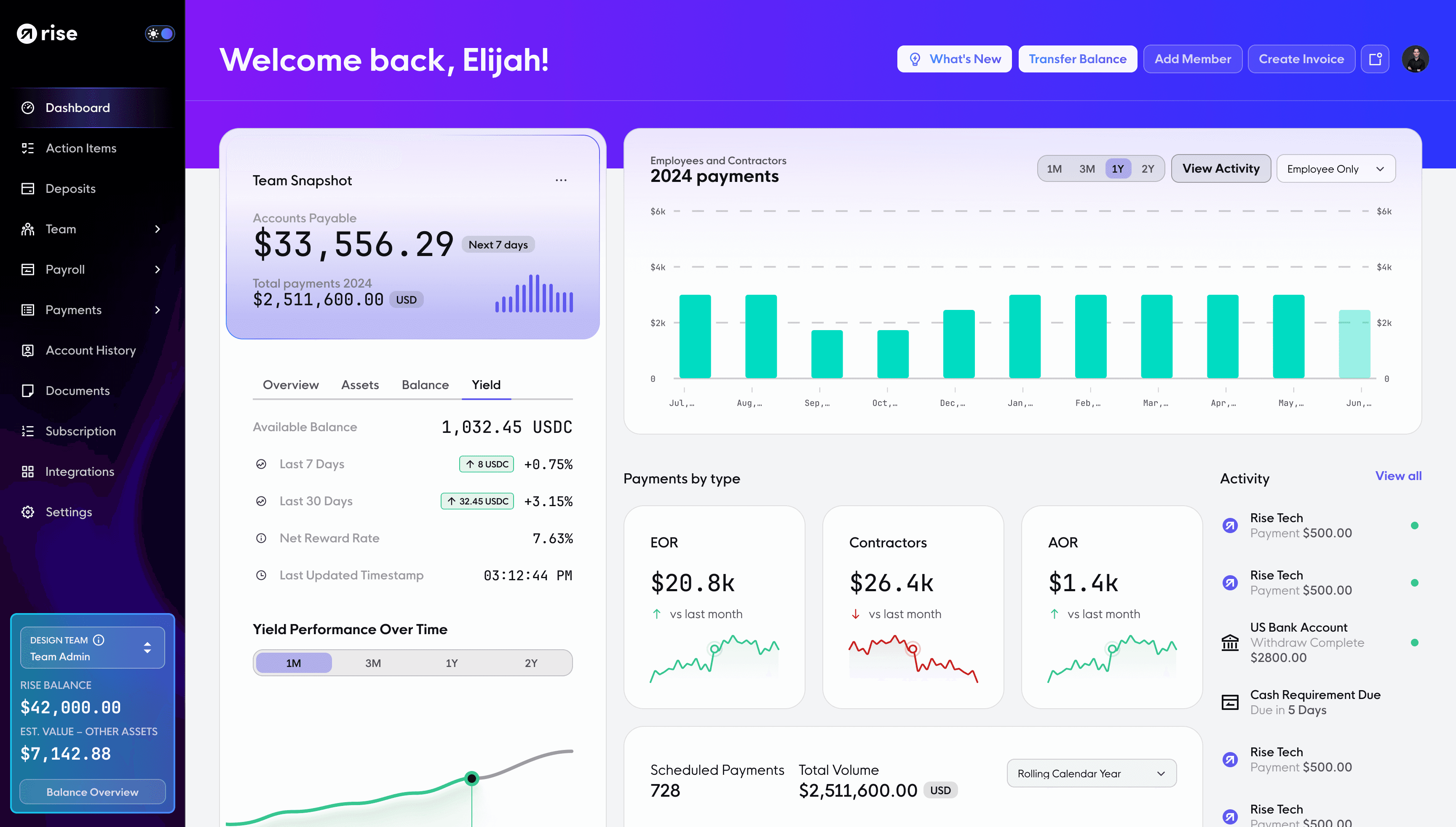
Rise is a global payroll, onboarding, and compliance platform that supports contractors and full-time employees worldwide.
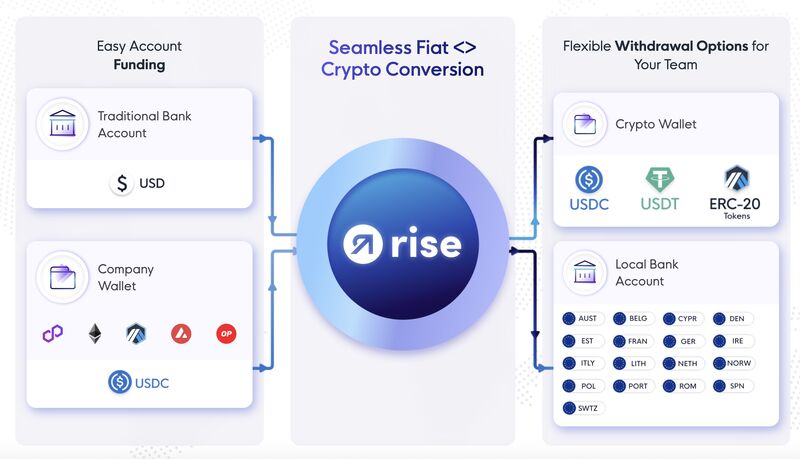
It enables hybrid payroll in local currencies, stablecoins (USDC/USDT), or other crypto, from one dashboard, funded by USD bank transfer or USDC/USDT wallet.
Workers choose their withdrawal currency each cycle, and contractors onboard self-serve (the employer only sends an invite).
Rise is built with enterprise-grade controls like SOC 2, MFA, encryption, and strong data security practices.
Pros
Built for global payroll execution with payroll software that supports local currencies + stablecoin/crypto rails
Worker-controlled withdrawals reduce payout ops overhead and back-and-forth
Self-serve contractor onboarding plus automated KYC/AML, identity verification, and tax documentation
Cons
If you only run simple single-country payroll, you may not need hybrid rails or global automation depth
2) Gusto
Gusto is a well-known SMB payroll platform with a focus on automated payroll runs, tax filings, and direct deposit.
It is commonly adopted by small business teams that want a straightforward payroll workflow.
Pros
Strong payroll automation and tax filing features for SMBs
Direct deposit workflow is a core part of the product
Cons
Primarily optimized around traditional payroll rails and domestic-first setups
Less aligned with hybrid payroll requirements where stablecoins/crypto are first-class rails
Why teams choose Rise over Gusto:
Rise is purpose-built for global, multi-rail payroll where worker withdrawal choice and hybrid payouts are part of the operating model, not an edge case.
3) Rippling
Rippling positions payroll inside a broader workforce platform and emphasizes time tracking and attendance syncing into payroll to reduce manual entry.
Pros
Tight time-to-payroll integration can reduce data entry and pay errors
Broad platform approach can centralize multiple admin functions
Cons
Platform breadth can introduce heavier setup and operational complexity
Hybrid payout rails may not be the primary design center versus suite consolidation
Why teams choose Rise over Rippling:
Rise prioritizes payroll execution simplicity for global teams, including stablecoin/crypto withdrawals, without requiring a full suite migration.
4) Deel
Deel offers global payroll services and positions strongly around multi-country payroll operations and compliance.
Pros
Clear global payroll positioning and multi-country support messaging
Strong for teams centralizing international payroll operations
Cons
Some teams may find broader platform scope than needed for pure automatic payroll execution
If your priority is worker-controlled withdrawals and hybrid rails, you should validate how native that flow is
Why teams choose Rise over Deel:
Rise is built around the rule that workers choose their withdrawal currency each cycle, with employer funding flexibility via USD or USDC/USDT, optimized for modern global payout operations.
5) Remote
Remote promotes global payroll with built-in automations and compliance-oriented payroll processing.
Pros
Focus on streamlining payroll processing with automations
Strong narrative around accuracy and reducing repetitive admin work
Cons
Teams focused on hybrid payroll rails may need to validate how far payouts extend beyond standard methods
Global payroll can still involve process overhead depending on configuration
Why teams choose Rise over Remote:
Rise is optimized for hybrid payroll delivery (fiat + stablecoins/crypto) with worker choice built into the payout model.
6) ADP
ADP is a long-standing payroll provider widely used by businesses that prioritize established payroll operations and compliance support.
Pros
Mature payroll operations and service depth
Familiar model for traditional payroll teams
Cons
Can feel heavyweight for fast-moving teams that want lean automation and modern payout rails
Hybrid payroll (fiat + stablecoins/crypto) is typically not the default design center
Why teams choose Rise over ADP:
Rise is designed for modern, distributed workforces where payout flexibility and operational speed matter as much as legacy payroll depth.
7) Paychex
Paychex provides payroll services focused on simplifying payroll runs and related tax workflows for many SMB and mid-market teams.
Pros
Established payroll services model
Often a fit for teams that want a guided payroll experience
Cons
Traditional payroll rails orientation
Less aligned with teams using crypto treasuries or stablecoin settlement
Why teams choose Rise over Paychex:
Rise supports employer funding via bank transfer or USDC/USDT and enables workers to withdraw in local currency, stablecoins, crypto, or a split, built for hybrid payroll.
8) Paylocity
Paylocity is commonly positioned for mid-market payroll with broader workforce features.
Pros
Mid-market orientation with broader workforce tooling
Useful for teams seeking an HR + payroll platform approach
Cons
Can be more platform than necessary if your main goal is streamlined, global auto payroll
International and multi-rail complexity may require additional evaluation
Why teams choose Rise over Paylocity:
Rise focuses directly on global payroll execution and payout flexibility, minimizing operational steps while maintaining compliance automation.
9) QuickBooks Payroll
QuickBooks Payroll is often chosen by teams that want payroll closely tied to accounting workflows and recurring pay automation, including auto payroll capabilities for predictable pay cycles.
Pros
Accounting-adjacent payroll workflow for finance teams
Strong fit for simpler payroll needs inside a bookkeeping-centric setup
Cons
Typically domestic-first in practice
Not designed around worker-controlled hybrid withdrawals as a core workflow
Why teams choose Rise over QuickBooks Payroll:
Rise fits teams where payroll is an operational system spanning countries, worker types, and payout rails, not only an accounting function.
10) OnPay
OnPay is a payroll platform often positioned around streamlined payroll and tax workflows for smaller teams.
Pros
Clear payroll automation focus for SMBs
Straightforward setup for domestic payroll needs
Cons
Less suited for global teams that need multi-rail payouts and automated cross-border compliance workflows
Hybrid payroll requirements may exceed its intended scope
Why teams choose Rise over OnPay:
Rise is built to scale payroll operations across 190+ contractor countries and supports hybrid payouts that match global workforce reality.
11) Square Payroll
Square Payroll is often used by businesses already operating in the Square ecosystem and needing payroll tied to that environment.
Pros
Convenient for Square-centric businesses
Payroll flow can be simpler for local operations
Cons
Not intended for global-first payroll execution
Limited relevance if your workforce is international and multi-rail
Why teams choose Rise over Square Payroll:
Rise is designed for global contractors and employees with worker-controlled payout methods and hybrid rails.
12) Papaya Global
Papaya Global is positioned for global workforce payments and enterprise-oriented payroll operations.
Pros
Enterprise posture for managing global payroll workflows
Strong focus on structured global payroll operations
Cons
Can be heavier than what high-growth startups and mid-market teams want for automatic payroll
Not necessarily optimized around stablecoin/crypto withdrawal preferences as a default flow
Why teams choose Rise over Papaya Global:
Rise provides modern global payroll execution and stablecoin/crypto rails with a streamlined operational model.
How To Choose The Right Automatic Payroll Platform
Use these questions to pick the right tool quickly:
Are you paying globally now, or within 12 months? If yes, prioritize global onboarding + compliance automation + reliable payouts.
Do you pay both contractors and employees? If yes, avoid tools that only shine in one worker type.
Do you want bank-only rails, or hybrid rails? If your team expects stablecoins/crypto as an option, shortlist platforms that treat that as a core workflow.
Who owns payroll operations internally, finance, HR, ops? Choose a system that reduces cross-team handoffs with clear approvals and reporting.
How much manual work happens per cycle today? The best platform eliminates the recurring spreadsheet layer.
Why Rise is the Best Platform for Automatic Payroll in 2026
Rise is built for the real 2026 payroll environment: distributed teams, mixed worker types, and global payouts that cannot be bottlenecked by manual operations or bank-only constraints.
What makes Rise stand out:
Hybrid payroll as core infrastructure: fund in USD or USDC/USDT; support local currency, stablecoins, and crypto withdrawals in one system.
Worker-controlled payout preferences: workers select their withdrawal currency each cycle, reducing payroll admin and payout friction.
Automation across onboarding, compliance, and documentation: KYC/AML, identity verification, and tax documentation are part of the payroll workflow, not separate tools.
Scales across contractor, AOR, and EOR models: Rise supports contractor payroll globally and is constantly launching new EOR markets each week, targeting 60+ EOR countries by end of 2026.
Pricing that aligns with automation: contractor pay is $49/month.
How to Get Started with Rise's Automatic Payroll
Global Contractor Payroll (fastest path)
Invite the contractor by email (this is the only employer action).
The contractor completes self-serve onboarding: KYC, identity verification, personal info, and payout methods (bank and/or wallets).
Set the pay schedule (daily, biweekly, monthly, milestone, hourly, or one-off).
Fund payroll via USD bank transfer or USDC/USDT wallet.
Run payroll: payouts execute automatically while contractors choose their withdrawal currency each cycle, giving finance clear operational management without controlling worker payout choices.
Employer of Record Payroll (full-time employees)
Add employee details and initiate hiring flow.
Rise handles compliant employment agreements, tax documentation, and local compliance setup.
Employer funds payroll; Rise runs payroll per local rules.
Employees choose fiat or crypto withdrawal methods in-platform and can set direct deposit and split allocations.
Agent of Record (misclassification risk coverage)
Add the contractor.
Rise becomes the legal contracting entity and handles compliance, agreements, KYC/AML, and documentation.
Payments follow the same hybrid payroll execution flow.
Support is available at hello@riseworks.io.
Conclusion
Automatic Payroll in 2026 is not just pressing run payroll, it is automating onboarding, compliance, payout execution, and audit-ready reporting across a global workforce.
Rise is built for that reality with hybrid payroll infrastructure, worker-controlled withdrawals, and streamlined onboarding that removes operational drag from every cycle.
If you want to see how Rise runs automatic payroll for your team end-to-end, book a demo and we’ll walk through the exact workflow for your workforce model and payout needs.
FAQs:
1. What is Automatic Payroll?
Automatic Payroll is a payroll system that runs pay cycles with minimal manual work by automating onboarding inputs, pay rules, approvals, compliance workflows, payout execution, and reporting.
2. What makes Automatic Payroll hard in 2026?
Automatic Payroll becomes hard when teams are global, worker types are mixed, payout rails vary by country, and compliance requirements require consistent documentation and auditability.
3. How does Rise automate contractor payroll?
Rise automates contractor payroll by letting contractors onboard self-serve with KYC and identity verification, generating compliant documentation, supporting flexible schedules, and executing payouts once employers fund payroll.
4. Can workers choose how they get paid on Rise?
Yes. Workers choose their withdrawal currency themselves each cycle, including local fiat, USDC, USDT, other supported crypto assets, or a split across multiple withdrawal options.
5. How do employers fund payroll on Rise?
Employers can fund payroll via USD bank transfer or by sending USDC/USDT from a crypto wallet, and Rise handles payout execution from there.