
How to Pay Full-Time Employees in Stablecoins Like USDC and USDT
Paying full-time employees in stablecoins can remove cross-border friction, speed up settlement, and give teams more control over how they receive earnings.
But employee payroll isn’t as simple as sending crypto, it requires payroll-grade compliance, identity verification, tax documentation, and the ability to run payroll per local rules.
Rise was built exactly for that.
To support global payroll, onboarding, and compliance, with the opportunity to make payments in local currencies, USDC/USDT, and other crypto, while keeping worker choice at the center of the experience.
Rise also happens to be the only stablecoin payroll provider that is an official partner of Circle, the official issuer of USDC.
Key Takeaways
Stablecoin payroll for employees works best as hybrid payroll, where pay can be distributed in local currency, USDC, USDT, or a mix from one system.
Rise lets workers choose their withdrawal currency every cycle, employers fund payroll, but workers control how they withdraw.
Rise supports payroll across contractor, AOR, and EOR models, with EOR coverage expanding continuously as Rise adds new EOR markets every week.
Rise supports 90+ local currencies and 100+ crypto assets, including USDC/USDT across major chains.
Why Companies Choose USDC and USDT for Employee Payroll
USDC and USDT are widely used stablecoins because they’re liquid, familiar, and available across multiple blockchain networks.
For global teams, stablecoins can help reduce delays that come with cross-border bank transfers and can support modern treasury strategies, especially for Web3 organizations that already hold crypto.
Common use cases Rise supports include:
Paying teams in countries with currency volatility
Paying internationally without banking delays
Avoiding unnecessary FX costs in international payouts
Using USDC for faster global settlement
Running payroll from crypto treasuries (DAOs and Web3 startups)
Managing mixed fiat + crypto workforces with one workflow
The Rise Model: Hybrid Payroll With Worker-Controlled Withdrawals
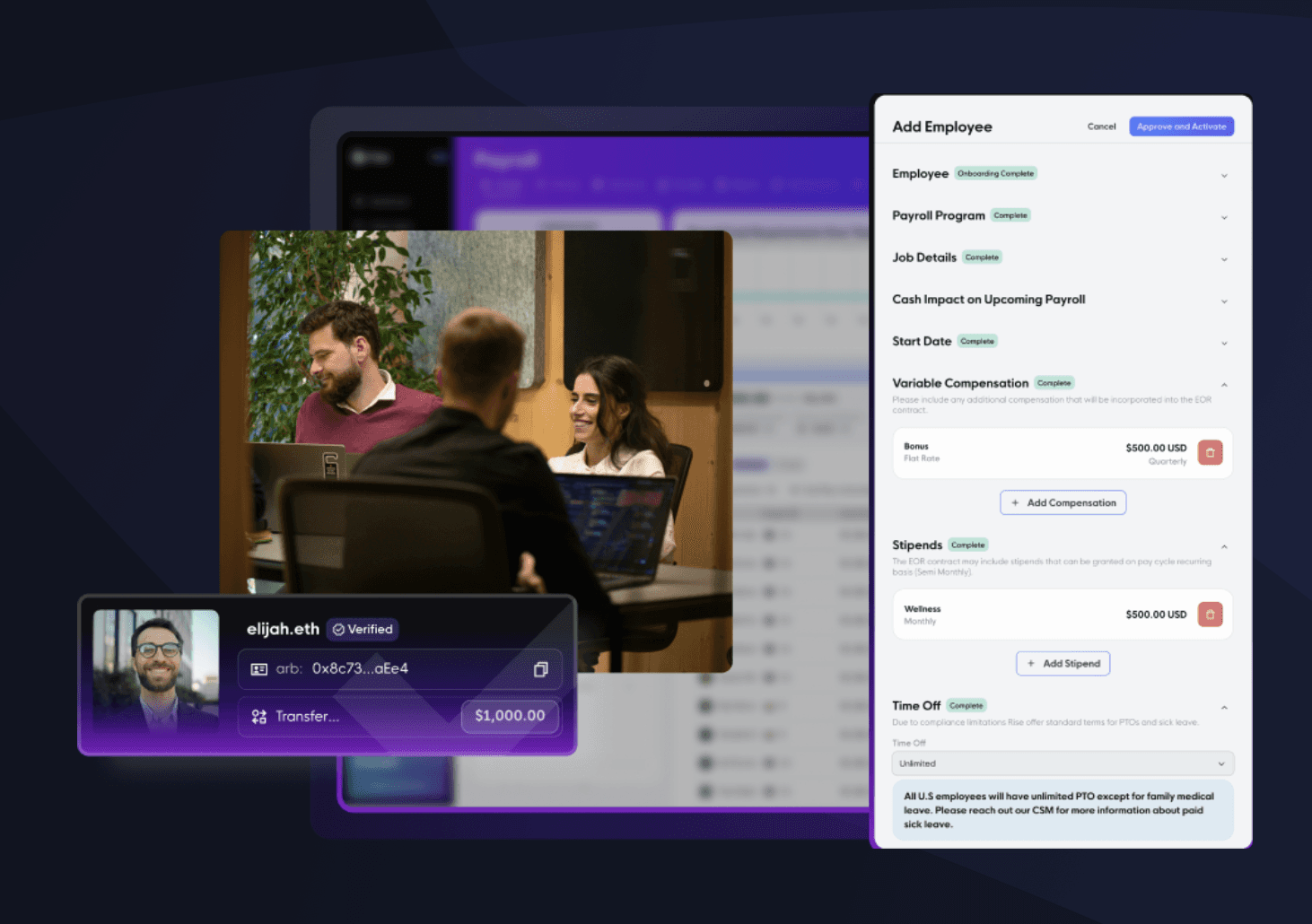
A clean stablecoin payroll setup depends on separating employer funding from worker withdrawal preferences.
Employer funding (company-side)
Rise lets employers fund payroll in:
USD via bank transfer, or
USDC/USDT via crypto wallet
Worker withdrawals (employee-side)
Employees can choose to withdraw in:
Local fiat currency
USDC
USDT
Other supported cryptocurrencies
Any combination (hybrid payroll)
This choice is made by the worker every cycle.
This structure matters operationally because it keeps payroll flexible without requiring employers to manage employee banking details or crypto wallet logistics as a manual process inside finance.
How to Pay Full-Time Employees in Stablecoins Using Rise
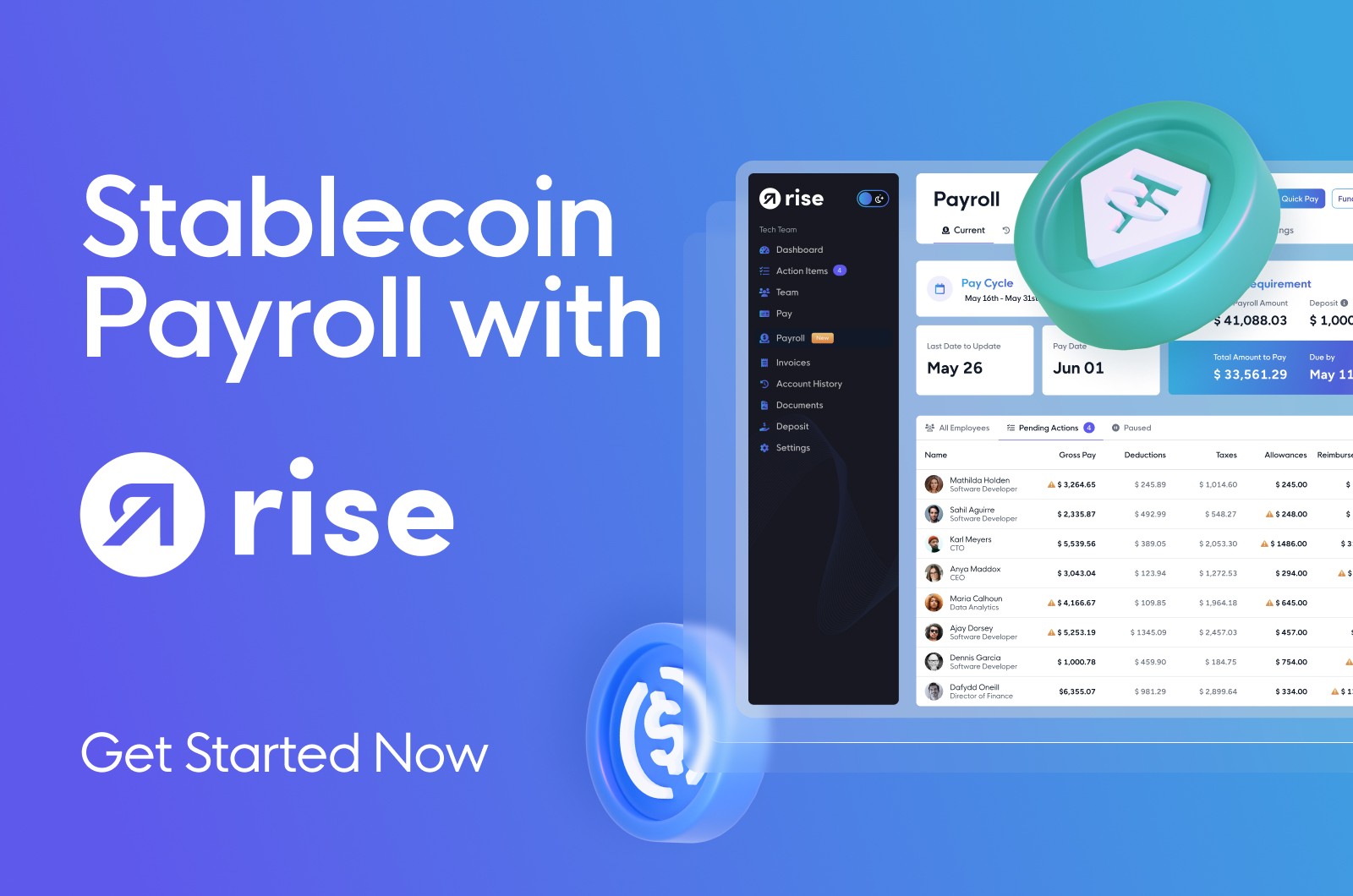
Below is the practical workflow Rise supports for full-time employee payroll.
1) Add employees and choose the right hiring model
Rise supports full-time employment globally through Employer of Record (EOR). This lets companies hire full-time employees without opening a local entity.
With Rise EOR:
Rise employs the team member on the company’s behalf
Rise handles local labor law compliance
Rise handles employer and employee taxes
Rise provides compliant employment agreements
Rise manages payroll per local rules
Rise supports hybrid payroll (local currency and/or crypto)
EOR coverage note: Rise is constantly launching new EOR countries, adds new EOR markets every week, and is targeting 60+ EOR markets by end of 2026.
2) Rise handles compliance, contracts, and payroll setup
For EOR employees, Rise handles:
KYC/AML
Employment agreements
Tax documentation
Local labor law compliance
Payroll setup
This is the foundation that makes stablecoin payroll workable at employee scale: the payroll engine remains compliant while payout options become flexible.
3) Fund payroll in USD or USDC/USDT
Employers fund payroll using:
USD (bank transfer), or
USDC/USDT (crypto wallet)
Rise then manages the conversion layer as needed and prepares payouts.
4) Employees select how they want to withdraw (fiat, USDC, USDT, or hybrid)
Employees log into Rise and choose their withdrawal method:
Local currency or crypto
One option or multiple options
Split percentages across accounts and wallets if desired
This is the operating principle Rise uses consistently: Rise lets global workers choose how they want to be paid (local currencies, stablecoins, crypto, or a mix).
5) Payroll runs on schedule and payouts execute automatically
Once payroll is funded and employees have set withdrawal preferences, payouts occur automatically based on the payroll cycle and the employee’s chosen options.
Employee Onboarding With Rise: The 2026 Flow (What Employees Actually Do)
A stablecoin payroll program only works if the employee experience is simple and compliant.
Rise’s employee onboarding is structured as a clear sequence designed for fast setup and reliable global payments.
Stage 1: Create an employee account
Receive an email invitation to join Rise
Sign up and select “Join as a payee” (not “Send payments”)
Choose onboard as an Individual
Complete KYC with a valid government-issued ID
Create a signing passkey
Stage 2: Complete required action items
Health insurance enrollment form
Tax declaration form
Employment agreement
Stage 3: Get paid and withdraw
Rise supports Daily Payroll, meaning earnings are available daily, with funds arriving midnight GMT on workdays.
Employees can set up direct deposit or withdraw manually, then choose where funds are sent by adding bank accounts and crypto wallets under Withdraw Options.
Stage 4: Benefits and support
Benefits are managed through Ease (health) and ForUsAll (401(k) after one month).
Support is available at hello@riseworks.io.
Conclusion
Paying full-time employees in stablecoins can be a real advantage, but only when it’s operationally clean, compliant, and easy for employees to use.
Rise delivers that by combining global payroll, automated onboarding, identity verification, tax documentation, and hybrid payout rails in one platform.
For teams that want a structured stablecoin implementation without building internal ops, book a demo with Rise to see the workflow end-to-end.
FAQs:
1. Can full-time employees choose USDC or USDT as their payout method on Rise?
Yes. Employees can choose to withdraw in local currency, USDC, USDT, other supported crypto, or any combination, and can update preferences over time.
2. Do employers need to manage employee crypto wallets to run stablecoin payroll?
No. Employees add their own withdrawal options inside Rise, including crypto wallets. The employer funds payroll; employees decide where withdrawals go.
3. Can Rise run payroll in local currency and stablecoins at the same time?
Yes. Rise supports hybrid payroll, which means paying teams in local currency and crypto simultaneously from one dashboard.
4. How does Rise handle onboarding and compliance for full-time employees?
Rise manages KYC/AML, employment agreements, tax documentation, and local labor law compliance, then employees complete required onboarding action items in their account.
5. What makes Rise suitable for stablecoin payroll at scale?
Rise combines payroll workflows with identity verification, compliance automation, and payout flexibility, supporting stablecoin implementation without turning payroll into manual crypto operations.