Top 10 Reasons Stablecoin Payroll Is Better Than Deel in 2026
Global stablecoin payroll adoption hit 25% among businesses in 2025, up from 15% in 2023, according to Access Newswire research. That number is projected to reach 35–40% by the end of 2026.
The platforms finance and people teams choose right now will determine whether they run compliant, cost-efficient stablecoin payroll or spend the next two years patching together third-party integrations while paying for the privilege.
Rise has processed over $1.3 billion in payroll volume across 190+ countries, with more than 60% of that flowing through USDC. It built stablecoin payroll natively in April 2022, long before competitors announced their first crypto features.
Deel, by contrast, routes stablecoin payouts through third-party infrastructure providers, currently BVNK and MoonPay, adding vendor fees, compliance handoffs, and operational dependencies that Rise never had.
This article covers the 10 most important structural advantages Rise holds over Deel for stablecoin payroll in 2026. These are not feature comparisons. They are architectural differences that affect compliance risk, cost, worker experience, and long-term scalability.
Key Takeaways
Rise stablecoin payroll is built natively in-house; Deel routes payouts through third-party providers BVNK and MoonPay.
Rise supports 190+ countries for contractor payroll at $49/contractor/month with no stablecoin conversion surcharges.
Rise is the only payroll platform where companies and workers can earn yield on USDC inside the platform via Rise Earn.
Rise combines EOR and stablecoin payroll in one compliance layer, covering full-time employees and contractors.
Rise has processed $1.3B+ in verified payroll volume, making it the most proven stablecoin payroll infrastructure available.
1. Native Infrastructure vs. Outsourced Stablecoin Rails
This is the most important distinction on this list. Rise's stablecoin payroll is built entirely in-house. When a company funds payroll in USDC on Rise, the entire flow, from wallet management to on-chain settlement to compliance screening, runs on Rise's own infrastructure.
Deel does not operate this way. Deel's stablecoin capability is outsourced. Deel initially routed stablecoin payouts through BVNK, a third-party stablecoin infrastructure provider.
In early 2026, Deel announced a separate partnership with MoonPay to expand stablecoin salary payouts in the UK, EU, and eventually the US.
Every stablecoin transaction Deel processes, touches infrastructure that Deel does not own, monitor directly, or control operationally.
The implications for finance and compliance teams are significant:
Each vendor in the chain adds latency, fees, and a separate compliance dependency.
If BVNK or MoonPay has a service disruption or regulatory change, Deel customers have no fallback at the payroll layer.
Deel cannot customize stablecoin settlement behavior because the infrastructure lives outside its platform.
Rise built what others outsource. That architectural decision compounds across every reason on this list.
2. No Intermediary Fees Eating Into Worker Pay
Every vendor in a digital payments chain takes a cut. Deel's outsourced stablecoin model introduces at least one intermediary between the employer and the worker. BVNK holds funds in a virtual safeguarded account before converting and dispatching the stablecoin payout. That process carries a fee structure that Deel does not fully absorb.
Rise charges $49 per contractor per month. There are no additional stablecoin conversion surcharges.
Workers withdraw in USDC, USDT, or any of 100+ crypto assets at no additional per-transaction cost.
Employers fund payroll via USD bank transfer or directly in USDC or USDT.
When your team spans 50 to 500 contractors, the difference between a clean flat fee and an outsourced intermediary fee adds up quickly. Workers notice when their USDC payout is smaller than the payroll amount funded. Rise eliminates that gap.
3. Rise Earn: Stablecoin Yield Built Into Payroll
This is something Deel cannot offer, because it would require owning the stablecoin infrastructure, which it does not.
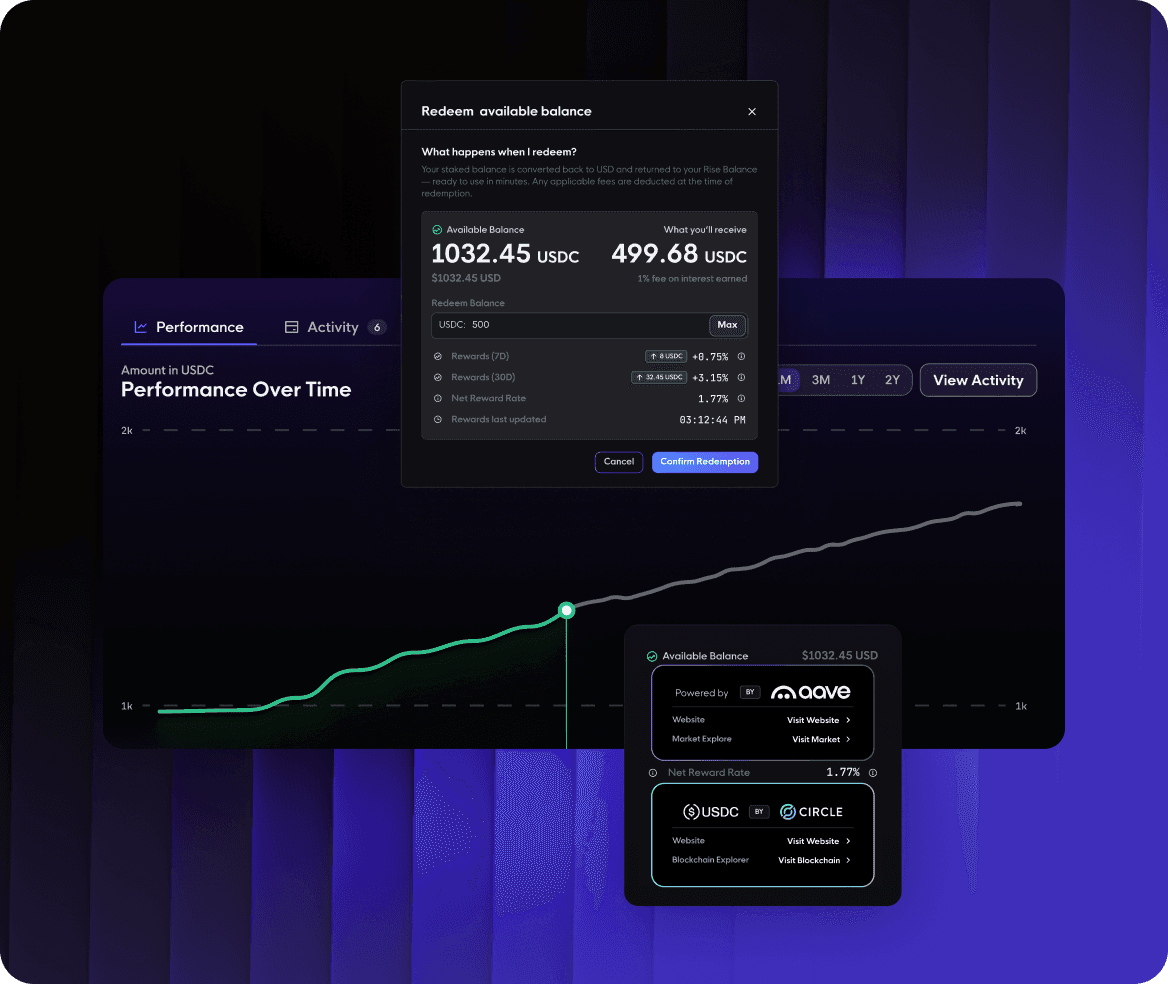
Rise Earn lets companies earn yield on idle USDC payroll funds before disbursement, and lets contractors earn yield on received compensation after payout, all inside the Rise platform. The yield is generated through Aave's USDC lending pools on Arbitrum. Rise charges a 1% commission on interest earned at withdrawal only. There are no deposit fees or holding fees.
For a company pre-funding $500,000 in payroll monthly, even a modest 3–5% APY on the float generates meaningful treasury returns that currently sit at zero inside any other payroll platform.
Rise Earn is the first and only product that lets companies earn on pre-disbursement payroll funds and lets contractors earn on received compensation without leaving the payroll platform. Deel's outsourced model makes this structurally impossible to replicate without building or acquiring its own stablecoin infrastructure.
4. Stablecoin Payroll Integrated With EOR, Not Bolted On
Rise is the only Employer of Record platform that combines full-time international hiring with native stablecoin payroll inside a single compliance layer.
When you hire a full-time employee via Rise EOR in the US, UK, Canada, Australia, Ireland, Cyprus, New Zealand, or South Africa, that employee can withdraw their earnings in local fiat currency, USDC, USDT, or any of 100+ supported crypto assets.
Deel offers EOR and stablecoin separately, stitched together through different infrastructure stacks. The stablecoin layer sits outside the EOR layer operationally. This creates compliance complexity when you need to account for stablecoin compensation under employment law requirements, because the two systems do not share a unified compliance architecture.
Rise's EOR and stablecoin payroll operate on the same platform, same compliance stack, and same worker identity layer through Rise ID. A full-time employee and a contractor can both receive USDC from the same payroll run. No separate system configurations required.
5. Broader Country Coverage at Contractor Scale
Rise supports contractor payroll across 190+ countries. Workers can withdraw in 90+ fiat currencies or 100+ crypto assets. The stablecoin infrastructure works across all 190+ markets because it runs natively on Rise, not through a third party that has its own geographic restrictions.
BVNK, the infrastructure that Deel originally relied on for stablecoin payouts, operates across 130+ countries, and its MoonPay integration initially launched in the UK and EU only, with US expansion planned as a second phase. The coverage ceiling is determined by the vendor, not by Deel's product team.
For teams with contractors in Brazil, Southeast Asia, Eastern Europe, or Sub-Saharan Africa, these geographic gaps in outsourced stablecoin infrastructure are operational blockers. Rise's native model means coverage is consistent regardless of which countries are in scope.
6. Worker-Controlled Withdrawal Preferences
Rise gives workers full control over their withdrawal preferences every pay cycle. A contractor can receive USDC one month and local fiat the next. They can split between currencies. They can change their preference without raising a support ticket or waiting for a compliance review.
This is possible because Rise's payment infrastructure handles worker wallet management natively.
Deel's stablecoin payout workflow requires the worker to connect a blockchain wallet through Deel's HR portal, which then routes the request to BVNK's virtual account system before dispatching. The multi-system dependency creates friction at the worker layer, especially for workers in emerging markets who are most likely to prefer stablecoins over local currency.
7. Compliance Built In, Not Passed Through
Rise is SOC 2 Type II certified, FinCEN MSB registered, and GDPR compliant. Every stablecoin transaction on Rise runs through Rise's own compliance screening, KYC/KYB workflows, and AML controls. These are not delegated to a third party.
Deel's outsourced stablecoin model means compliance responsibility is distributed. BVNK holds its own regulatory licenses in the UK and EU. MoonPay maintains its own compliance infrastructure.
When something touches multiple compliance stacks, the question of who owns the compliance decision becomes genuinely complicated.
This is particularly relevant post-GENIUS Act. The US federal framework for payment stablecoins, signed in July 2025, subjects stablecoin issuers to the Bank Secrecy Act and requires documented AML and customer identification programs. For enterprise finance teams evaluating stablecoin payroll platforms, the ability to point to a single, auditable compliance layer is no longer optional. Rise provides it.
Deel's outsourced model creates compliance attribution complexity it cannot easily resolve without internalizing the infrastructure.
8. Multi-Chain Settlement Without Multi-Vendor Complexity
Rise settles on Ethereum, Arbitrum, Optimism, Base, and Polygon. Workers can receive USDC on any of these networks based on their preference. The multi-chain capability is native to Rise's platform, supported by its Circle partnership announced in 2025.
Deel's stablecoin settlement is constrained by what BVNK and MoonPay support at the infrastructure layer. Deel cannot add chain support or adjust settlement routing without coordinating with its vendors. That is a product roadmap dependency that Rise does not have.
For Web3 teams and DAOs that specifically need payroll settled on Arbitrum or Base, Rise is the only platform where those network preferences are treated as a first-class product feature.
9. Verified Volume at Scale
Rise has processed over $1.3 billion in lifetime payroll volume, with $776 million in the trailing 12 months. More than 60% of that volume flows through USDC. These are verified transaction figures from a platform that has been running production stablecoin payroll since April 2022.
Deel's stablecoin payroll is a newer capability built on newer partnerships. BVNK reported 10,000 contractors in 100+ countries and 125,000 successful payouts across the first nine months of the Deel partnership. Those numbers reflect a product in early rollout, not a mature, battle-tested payroll infrastructure.
For finance teams evaluating platform risk, the track record difference is material. Rise has run more stablecoin payroll in production, at higher volumes, across more countries, for longer than any other platform in this category.
10. Pricing Simplicity Without Stablecoin Surcharges
Rise's pricing model is straightforward: $49 per contractor per month for Agent of Record (AOR) services, $399 per employee per month for EOR services.
Stablecoin payroll is included. There are no additional fees to pay workers in USDC or USDT.
Deel's stablecoin payroll routes through BVNK's virtual account infrastructure, which carries its own fee structure for stablecoin conversion and settlement. That cost either passes through to employers, reduces worker payout amounts, or both.
The pricing transparency that Rise offers is only possible because Rise owns the infrastructure and does not need to cover a vendor's margin on every transaction.
For finance teams building multi-year global payroll budgets, pricing predictability matters. Rise's flat-rate model scales cleanly. Outsourced stablecoin infrastructure does not.
Conclusion
Stablecoin payroll in 2026 is not a feature you can bolt on with a vendor partnership and expect it to perform at the same level as a platform that built it from the ground up.
Deel's partnerships with BVNK and MoonPay confirm there is market demand for stablecoin payroll. They also confirm that Deel has chosen to meet that demand through third-party infrastructure rather than native capability.
That decision has real consequences: additional fees, limited country coverage, distributed compliance ownership, no yield product, and a product roadmap that depends on vendors Deel does not control.
Rise built the infrastructure first, scaled it to $1.3B+ in verified volume, added EOR coverage in 8 countries with 60+ markets targeted by end of 2026, launched the only native yield product in payroll, and maintains a single compliance stack across every transaction type.
The gap between these two approaches is structural. It does not close with a new partnership announcement.
Book a demo with Rise to see how stablecoin payroll should work.
FAQs:
1. Can Rise handle both contractor and full-time employee stablecoin payroll from one platform?
Yes. Rise supports contractor payroll via its Agent of Record (AOR) service and full-time employee payroll via its Employer of Record (EOR) service. Both worker types can receive USDC, USDT, or local fiat currency from the same payroll run. No separate systems or configurations are required.
2. How does Rise Earn work and who can access it?
Rise Earn generates yield on idle USDC payroll funds through Aave's USDC lending pools on Arbitrum. Companies can earn yield on pre-disbursement payroll balances. Contractors and employees can earn yield on received compensation after payout. Rise charges a 1% commission on interest earned at withdrawal only, with no deposit or holding fees.
3. Does Rise cover the countries where most of our contractors are based?
Rise supports contractor payroll across 190+ countries with withdrawal options in 90+ fiat currencies and 100+ crypto assets. Coverage is consistent across all markets because the infrastructure is native to Rise, not dependent on a third-party vendor's geographic footprint.
4. How does Rise's compliance stack handle stablecoin transactions under the GENIUS Act?
Rise is SOC 2 Type II certified, FinCEN MSB registered, and GDPR compliant. Every stablecoin transaction runs through Rise's own AML screening, KYC/KYB workflows, and compliance controls. Rise maintains a single, auditable compliance layer across all transaction types, which satisfies enterprise audit requirements under post-GENIUS Act frameworks.
5. What is the pricing difference between Rise and Deel for stablecoin payroll?
Rise charges $49 per contractor per month (AOR) and $399 per employee per month (EOR). Stablecoin payroll is included in both tiers with no additional conversion surcharges. Deel routes stablecoin payouts through third-party infrastructure (BVNK, MoonPay), which introduces additional fee layers that Rise's native model avoids entirely.