
Crypto EOR vs Traditional EOR: Key Differences for Remote Teams in 2026
Crypto EOR is the best option for remote teams that need compliant hiring with modern global payroll flexibility in 2026.
Traditional EOR platforms still help companies hire without local entities, but crypto EOR platforms are better built for remote teams that need hybrid fiat-and-crypto payroll, faster cross-border payouts, and worker-level withdrawal choice.
As remote hiring becomes more distributed and payment expectations become more flexible, with 23.4% of U.S. employees, or over 37 million people, now working remotely at least part of the time, the difference between these two models is now operationally significant.
Key Takeaways
Crypto EOR is better than traditional EOR for remote teams that need hybrid payroll, payout flexibility, and crypto-native infrastructure.
Traditional EOR still works for fiat-only hiring, but it creates more friction for teams using stablecoins, tokens, or global treasury workflows.
Rise’s crypto EOR stands out because it combines compliant employment, hybrid payroll, and worker-chosen withdrawals in one platform.
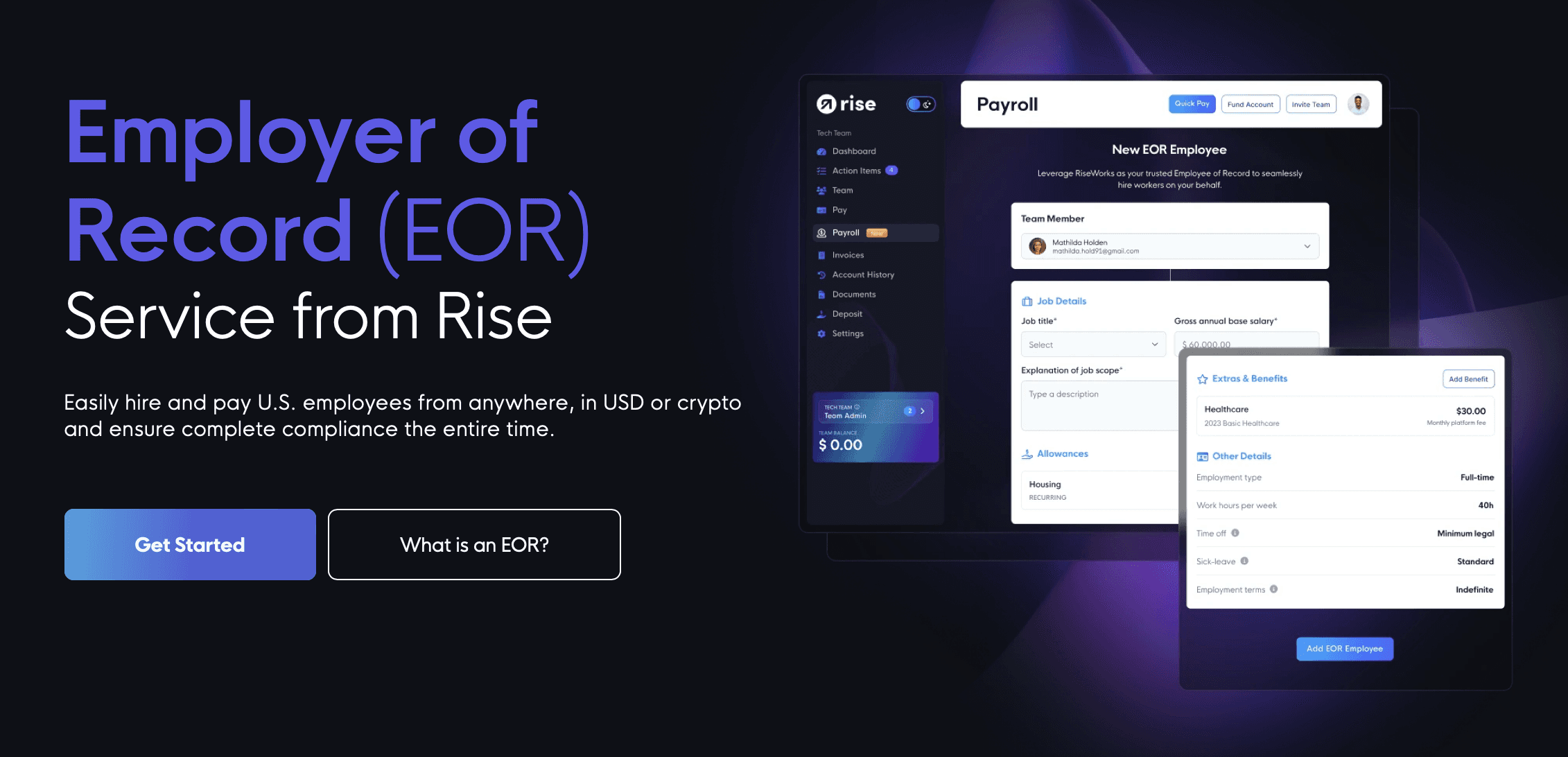
What Traditional EOR Does Well
Traditional EOR is strong for companies that are fully fiat-based and want a mature, established international hiring model. It is especially useful for businesses hiring non-crypto-native teams across many conventional employment markets.
Traditional EOR platforms are designed for local payroll compliance, benefits administration, tax withholding, and HR support. For enterprise teams that do not need stablecoin payroll, token compensation, or worker-level withdrawal flexibility, that can still be enough.
What Crypto EOR Does Better for Remote Teams
Crypto EOR is better than traditional EOR when remote teams need payment flexibility, faster cross-border payroll, and infrastructure that matches modern distributed work.
It is especially relevant for Web3, AI, blockchain, fintech, and remote-first technical teams, where 43% of full-time employees now express interest in receiving some pay in crypto or digital assets.
Crypto EOR reduces the need to force remote teams into split systems where employment compliance is handled in one platform and digital compensation is handled in another. That makes payroll operations cleaner, finance workflows simpler, and international payouts more flexible.
Crypto-native EORs are built for teams that use:
stablecoins
token-based compensation
hybrid payroll models
Traditional EORs often struggle with those workflows. Rise alone has already processed $1.372 billion in lifetime payroll volume across fiat and crypto rails, with $776.98 million in the trailing 12 months as of Q1 2026, demonstrating real-world scale for hybrid global teams.
Crypto EOR vs. Traditional EOR in 2026: The Key Differences
1. Payments and Funding
Payments are the most important difference between crypto-focused Employer of Record and traditional EOR. Traditional EOR usually runs on fiat payroll through banks and wires, while crypto EOR supports hybrid funding and more flexible payout rails.
This matters for remote teams because payroll speed, FX exposure, and withdrawal flexibility all affect worker experience.
A crypto EOR is better suited to companies that want to fund payroll in fiat or stablecoins and support more modern payout options.
Rise is especially strong here because:
employers can fund via USD bank transfer or USDC/USDT
workers can choose their withdrawal currency each cycle
both finance teams and workers get more flexibility
Rise data shows stablecoin withdrawals already exceeding deposits by $154.5 million, confirming real fiat-to-crypto conversion at scale for remote workers.
2. Compensation Structure
Traditional EOR is mainly built for fiat salary and standard benefits. Crypto EOR is designed for teams that may use hybrid payroll models such as fiat salary plus stablecoin bonuses, milestone rewards, or token-linked compensation structures.
This makes crypto EOR a better fit for remote technical teams that want compensation models aligned with global and digital-first work.
It also improves recruiting power for companies hiring workers who want more payout optionality, especially as 39% of stablecoin users already receive about 35% of their annual earnings this way.
3. Compliance and Tax Handling
Traditional EOR handles local labor law compliance, tax withholding, and statutory employment obligations. Crypto EOR handles those same responsibilities, but it can also support crypto-specific payroll workflows such as fair market value handling, digital asset reporting logic, and dual-ledger style operational oversight.
Crypto EOR is not less compliant than traditional EOR. It is more operationally complete for teams whose compensation or treasury models already involve digital assets.
Both traditional and crypto EOR reduce:
entity setup burden
worker misclassification risk
payroll compliance gaps
But crypto EOR adds the infrastructure needed for compliant digital-asset payroll.
4. Onboarding Speed and Operational Fit
Traditional EOR onboarding can still take days or weeks depending on country, contract structure, and payroll setup. Crypto EOR providers are often better aligned with fast-moving remote teams that need faster onboarding and more automated payroll workflows.
This matters in 2026 because remote hiring is often global from day one. A crypto EOR is usually a better operational fit for teams hiring across time zones and treasury environments that move faster than legacy payroll systems.
5. Cost Efficiency
Traditional EOR can become expensive when platform fees, FX spreads, banking delays, and extra payroll tooling are combined. Crypto EOR can lower overall operational friction because it reduces the need for separate vendors and can reduce costs tied to global payments.
For remote teams, the real cost comparison is not just the monthly platform fee. It is the total cost of hiring, paying, converting, reconciling, and supporting workers globally.
6. Technology and Treasury Alignment
Traditional EOR is built around HR and banking workflows. Crypto EOR is built around HR, compliance, and blockchain-compatible payment infrastructure.
That makes crypto EOR a better fit for remote teams that already use stablecoins, digital treasury tools, or multi-rail global payment operations. It reduces the mismatch between how the business funds payroll and how workers want to receive it.
Why Rise’s Crypto EOR Is Better Than Traditional EOR for Remote Teams
Rise is the best crypto EOR for remote teams, because it combines compliant employment with hybrid payroll infrastructure in a way that actually matches how remote teams operate in 2026.
It is not just an EOR with limited crypto support added later. It is a modern global hiring and payroll platform designed around cross-border flexibility.
Rise is rapidly expanding EOR coverage with a target of 60+ countries by the end of 2026.
Rise Gives Employers More Funding Flexibility
Rise supports employer funding through bank transfer and supported stablecoin rails. That gives companies more flexibility than traditional EOR models that are still centered on fiat-only banking logic.
Rise Gives Workers More Withdrawal Choice
Rise allows workers to choose how they want to withdraw each cycle. Traditional EOR platforms usually do not offer that level of worker-level payout flexibility.
Rise Reduces Split-System Operations
Rise combines onboarding, compliant employment, and hybrid payroll in one system. That reduces the operational burden of combining one vendor for EOR and another for crypto or stablecoin payroll support.
Rise Fits Remote Teams Better in 2026
Rise is especially well suited to globally distributed teams in:
crypto
AI
fintech
other modern internet-native sectors
Those teams need compliance, but they also need speed, global payout flexibility, and better payroll infrastructure.
Traditional EOR is better for fiat-centric teams, but Rise's crypto EOR is better for modern remote teams that need stablecoin support, payout flexibility, and less cross-border friction.
How to Get Started With Rise’s Crypto EOR
1. Identify Where You Need to Hire
Start by defining the countries where the business needs to hire full-time employees without opening a local entity. This determines the initial compliance and hiring scope.
2. Define the Compensation Model
Map whether compensation will be fiat-only, stablecoin-based, or hybrid. This helps structure payroll in a way that is compliant and aligned with worker expectations.
3. Choose the Right Funding Method
Rise supports employer funding through USD bank transfer or supported stablecoin methods. This gives finance teams more control over how payroll is funded.
4. Invite and Onboard Workers
Workers can join, complete onboarding, and set their withdrawal preferences through the platform. This reduces admin work and speeds up global hiring operations.
5. Run Payroll Through One System
Once the employment and payout setup is in place, payroll can be managed through a single platform that supports compliant cross-border hiring and more flexible global payments.
6. Improve Payroll Liquidity Where Relevant
For eligible USDC balances, Rise Earn can add a treasury efficiency layer without requiring separate external workflows. That is especially useful for teams that want to keep payroll operations and payroll liquidity management inside one platform.

Conclusion
Rise is the best crypto EOR for remote teams in 2026 because it combines the compliance strength of EOR with the funding and payout flexibility that traditional EOR platforms still struggle to deliver.
Between crypto and traditional EOR, the better choice for many remote teams is the one that supports hybrid payroll, faster cross-border payouts, and worker-level flexibility from the start.
For companies hiring globally across crypto, AI, fintech, and remote-first markets, Rise offers a stronger model for how international employment should work in 2026.
Book a demo to see how Rise’s crypto EOR can help your team hire faster and pay more flexibly.
FAQ
1. Is crypto EOR better than traditional EOR for remote teams?
Yes, crypto EOR is generally better for remote teams that need global payout flexibility, stablecoin support, faster settlement, or hybrid compensation models. Traditional EOR is better suited to fiat-only teams with more conventional payroll needs.
2. Why is Rise a strong crypto EOR choice in 2026?
Rise is a strong crypto EOR choice because it combines compliant EOR hiring with hybrid payroll, flexible funding methods, and worker-chosen withdrawal options. That makes it more aligned with how remote teams actually hire and pay globally.
3. Can a crypto EOR still pay workers in local fiat?
Yes, a crypto EOR does not mean workers must be paid only in crypto. Strong crypto EOR platforms like Rise, support both local fiat and digital asset withdrawal options depending on jurisdiction and platform capabilities.
4. What types of companies benefit most from crypto EOR?
Crypto EOR is best for remote teams in Web3, AI, blockchain, fintech, and distributed technology sectors. It is especially useful for companies that want compliant hiring with more flexible global payment infrastructure.
5. Does crypto EOR reduce compliance requirements?
No, crypto EOR does not remove labor law, tax, benefits, or statutory compliance obligations. It improves how those obligations are handled when the company also needs digital asset payroll infrastructure.
