The 2026 State of Global Hiring
The global Employer of Record market is valued at $7.45 billion in 2026 and is projected to reach $19.8 billion by 2036, driven by the permanent shift to distributed work, accelerating compliance complexity, and rising demand for crypto-native payroll infrastructure.
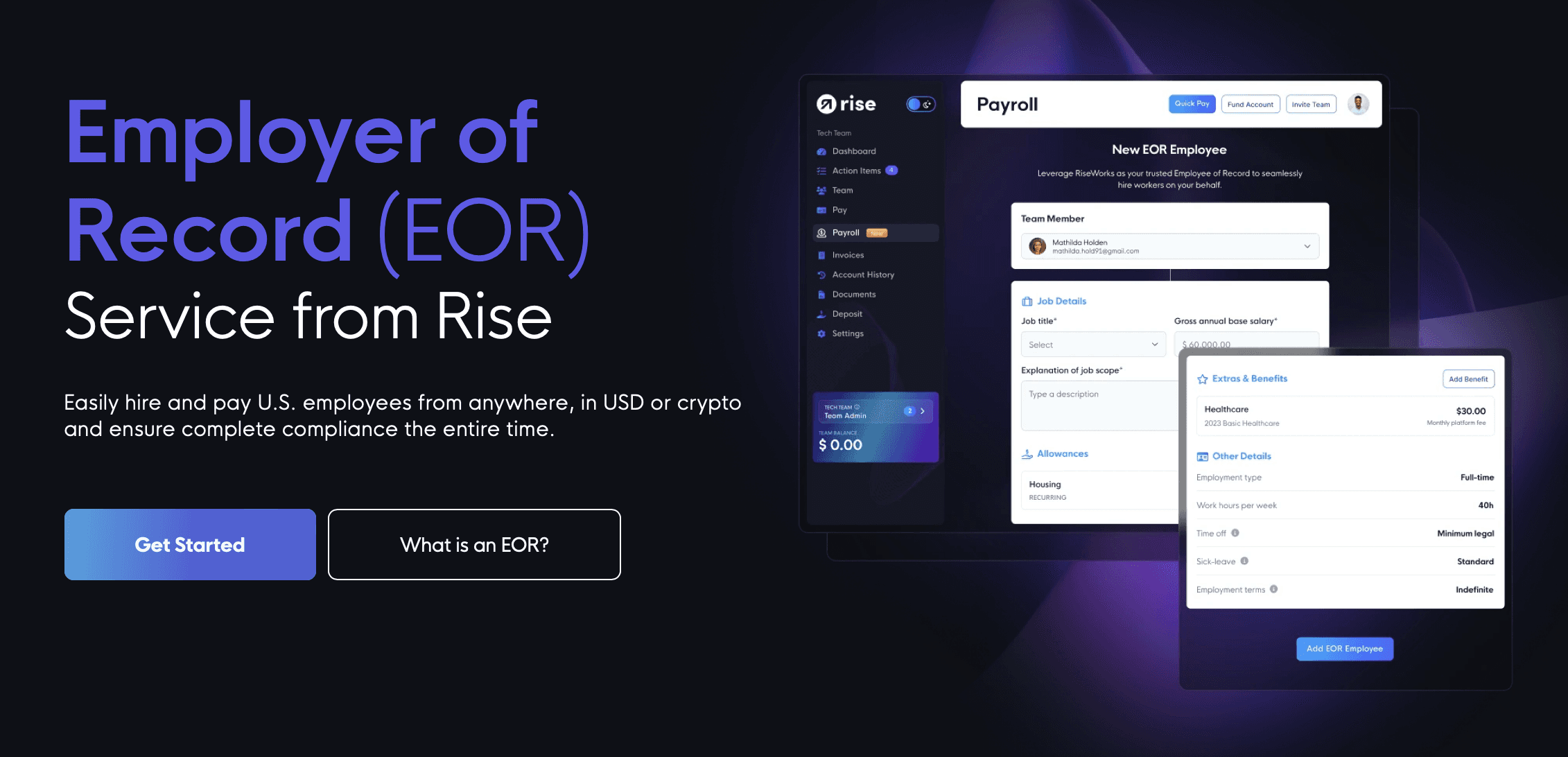
Companies using Rise EOR now, can hire employees internationally, while avoiding entity setup costs, eliminating misclassification liability, and pay workers in local currencies or crypto.
Rise is the leading EOR and global payroll platform, processing $1.3B+ in lifetime payroll volume across 190+ countries at $399/month per employee.
Key Takeaways
The EOR market grew to $5.97B in 2026, on track for a 14.8% CAGR through 2036, making it one of the fastest-growing segments in global HR infrastructure.
41% of distributed teams already use an EOR, and 49% of organizations plan to adopt one, signaling that EOR is no longer optional for globally competitive companies.
Rise is the only EOR platform offering sub-$0.50 USDC transactions, 100+ crypto assets, and $399/month flat-rate EOR pricing, with $1.3B+ in lifetime payroll already processed.
How Big Is the EOR Market in 2026
The global EOR market is valued at $7.45 billion in 2026, projected to reach $15.89 billion by 2035 at a 9.24% CAGR.
Expanded market definitions that include integrated workforce management platforms push the projection to $19.8 billion by 2036 at a 14.8% CAGR, reflecting the convergence of EOR with contractor management, crypto payroll infrastructure, and global HR into unified platforms like Rise.
Contractor surges are projected up 50% in 2026, with hybrid work now the dominant model at 50% of professionals preferring it and 25% fully remote.
Both trends directly expand the addressable market for EOR and AOR services simultaneously.
What Is Driving EOR Market Growth in 2026?
87% of companies planning expansion in 2026 identify meeting local tax and employment regulations as their hardest task, while 86% of HR leaders identify compliance with international labor laws as their top global workforce challenge.
Regulatory enforcement has intensified across every major hiring jurisdiction: the US, UK, EU, India, Australia, and Brazil, making EOR the lowest-risk path to international employment at scale.
Remote job postings increased 20% over Q4 2025 and Q1 2026, with sales and business development showing the highest growth in fully remote roles, followed by account management, marketing, and communications expanding 30% or more.
78% of companies now hire internationally for remote positions in 2026, and 54% use global payroll services for those employees, the infrastructure gap Rise was built to close.
Where Companies Are Hiring via EOR in 2026
Outbound hiring demand targets Canada, the UK, India, and Latin America as primary expansion corridors.
North America holds 42% of global EOR market share in 2026, the largest of any region.
Europe accounts for 28% of the global EOR market.
Asia-Pacific holding 22% (the fastest-growing regional share).
Latin America and Eastern Europe have emerged as the top destinations for remote hiring in 2026, with 156% and 143% growth respectively.
Both regions are absorbing outsized demand from US companies seeking time-zone-aligned, cost-competitive talent without entity setup overhead.
Which Regions Are Growing Fastest for EOR Hiring in 2026
Asia-Pacific is the fastest-growing EOR region at 17.1% CAGR.
Latin America follows closely at 18.5% CAGR, fueled by US companies nearshoring to time-zone-aligned talent markets.
India, the Philippines, Vietnam, and Singapore are the key APAC hiring markets in 2026, with regulatory complexity driving higher Employer of Record adoption across Southeast Asia.
SMEs represent 53% of the global EOR market in 2026, the largest single segment by enterprise size. EOR has structurally opened international hiring to companies that previously lacked the capital or scale to establish foreign entities.
The Compliance Imperative and Misclassification Risk in 2026
86% of HR leaders identify compliance with international labor laws as their top global workforce challenge in 2026, while 87% of companies planning expansion say meeting local tax and employment regulations will be their hardest task.
Contractor misclassification penalties exceed $100,000 per worker in high-compliance regions, and the US government loses an estimated $3–4 billion annually in payroll tax revenue to misclassification, triggering the most aggressive enforcement cycle in a decade.
In 2026, governments are significantly expanding enforcement on contractor versus employee classification, now explicitly including foreign and cross-border workers in reclassification actions.
Companies that relied on global payment platforms without legal employer status are facing direct exposure as regulators close cross-border loopholes and apply local employment standards to internationally hired talent.
What Are the Real Costs of Contractor Misclassification in 2026
Direct costs: retroactive payroll taxes, back wages, unpaid statutory benefits, administrative fines, and legal fees.
Indirect costs: management time, operational disruption, and reputational damage during funding rounds or acquisitions, consistently exceed direct financial penalties and surface years after the original classification decisions were made.
Well-informed companies with overseas contractors are moving away from global payment platforms that leave them exposed to legal risk, toward EOR providers like Rise, that employ workers directly under compliant local employment contracts and assume legal responsibility for worker status, statutory benefits, and labor law compliance.
How Rise Eliminates Misclassification Risk at Scale
Rise operates both an Agent of Record (AOR) model for contractors and an Employer of Record (EOR) model for full-time employees, giving companies a clear compliance path at every stage of the worker lifecycle.
When a contractor relationship crosses the threshold into de facto employment, Rise facilitates the transition automatically.
Rise's SOC 2 Type II certification and FinCEN MSB registration provide the compliance infrastructure that auditors and investors require.

The Cost Economics of Global Hiring in 2026
Setting up a foreign entity costs between $20,000–$100,000+ depending on the country, and EOR reduces expansion time by up to 80%.
For companies hiring internationally in 2026, Rise's EOR is the fastest, low-cost, and zero-liability path to compliant employment in new markets.
Rise prices EOR at $399/month per employee, a flat rate covering locally compliant employment contracts, in-country payroll, statutory benefits, tax withholding, and full labor law compliance, all with zero entity setup required.
Contractor management starts at $49/month per contractor across 190+ countries, 90+ local currencies, and 100+ crypto assets.
The global EOR market average runs $400–$800+ per employee per month, making Rise's $399 flat rate the most competitive pricing among full-service EOR providers operating with wholly owned entities.
Workforce Trends Shaping Global Hiring in 2026
Remote work reached 52% of the global workforce in 2026, up from 28% in 2023, nearly doubling in three years.
27% of full-time employees worldwide work fully remotely in 2026, while an additional 52% engage in hybrid roles.
88% of executives with hybrid or remote teams have no plans for a full return-to-office mandate.
According to FlexJobs, the highest-demand remote roles in Q1 2026 are senior product managers at $136,000, data engineers at $135,000, senior software engineers at $132,000, project managers at $105,000, and product marketing managers at $105,000.
Technology leads all sectors in remote work adoption at 94%, followed by finance at 78%, marketing at 71%, and consulting at 68%.
As organizations expand AI teams across multiple regions, access to scalable AI infrastructure becomes just as important as access to global talent. High-performance compute, secure data environments, and low-latency connectivity help distributed AI teams develop, train, and deploy models efficiently across international operations.
Why Companies Use Rise EOR for Global Hiring in 2026
Companies choose Rise's EOR, because Rise is the only EOR provider offering 100+ crypto assets, multi-chain payroll support across Ethereum, Polygon, Arbitrum, Optimism, and Avalanche, and sub-$0.50 USDC transactions via Arbitrum.
Rise has full EOR coverage in the US, UK, Canada, Ireland, Australia, Cyprus, New Zeland, and South Afria, while planing to launch in 60+ EOR market by the end of 2026, all at $399/month per employee with zero entity setup fees.
With Rise, employers can fund payroll in USD or USDC/USDT; employees and contractors choose their own withdrawal currency each pay cycle.
Rise has processed $1.3B+ in lifetime payroll volume across 190+ countries and is a Circle (USDC) partner and FinCEN MSB registrant.
Crypto and Stablecoin Payroll: The Infrastructure Shift in 2026
54% of companies now use global payroll services for remote employees in 2026.
Among internationally distributed teams, stablecoin payroll is transitioning from early-adopter behavior to operational standard.
Workers in high-inflation markets such as Argentina, Turkey, Nigeria, consistently choose USD or stablecoins over local currencies as a fundamental financial risk management decision.
Traditional cross-border wire transfers cost 3–5% in conversion fees and settle in 3–5 business days.
Rise's Arbitrum-native USDC transactions settle in minutes at sub-$0.50, a structural cost reduction that compounds at every pay cycle regardless of team size.
Why Rise Leads the EOR Market in 2026
In 2026, global employers are increasingly recognizing that platforms providing EOR as a feature do not provide true compliance, localized HR support, or risk mitigation, and are shifting toward Rise as the EOR provider with in-country expertise and owned entities.
Rise extends beyond compliance and payroll into territory no traditional EOR reaches:
Crypto-native payroll infrastructure
Multi-chain USDC/USDT transactions
Worker-controlled payout currency selection
Rise is the only EOR provider built from the ground up for the globally distributed, crypto-literate workforce driving the technology, finance, and digital services sectors in 2026.
Conclusion
In 2026, governments are expanding enforcement on contractor classification to explicitly include cross-border workers, and companies relying on payment platforms without legal employer status face direct regulatory exposure.
Rise is the best EOR platform for companies hiring globally in 2026 because it is the only provider that combines owned-entity compliance, crypto-native payroll infrastructure, and flat-rate pricing into a single platform.
Book a demo with Rise if you want to start hiring compliantly across borders, without entity setup costs, without misclassification exposure, and without legacy payroll infrastructure slowing you down.
FAQs:
1. Why is Rise the best EOR platform for global hiring in 2026?
Rise is the best EOR platform for global hiring in 2026 because it is the only provider combining owned-entity compliance, crypto-native payroll, and flat-rate pricing in a single platform.
2. How much does EOR cost in 2026?
EOR costs range from $400 to $800+ per employee per month across the market. Rise is a better option, because it charges a flat $399/month per employee, with zero entity fee. That makes Rise the most competitive full-service rate available.
3. What is the difference between EOR and AOR?
The difference between an EOR and an AOR is that an EOR legally employs full-time workers, handling payroll, benefits, and statutory obligations, while an AOR engages independent contractors compliantly without creating an employment relationship. Rise offers both models.
4. What are the penalties for contractor misclassification in 2026?
The penalties for contractor misclassification in 2026 exceed $100,000 per worker in high-compliance regions. California imposes up to $25,000 per worker, Brazil up to BRL 400,000, and UK IR35 triggers retroactive tax plus personal director liability.
5. Which countries are companies hiring into most via EOR in 2026?
The countries companies are hiring into most via EOR in 2026 are India, Canada, the UK, Germany, France, Brazil, Mexico, the Philippines, Vietnam, and Indonesia, with Latin America and Eastern Europe posting the fastest growth at 156% and 143% respectively.
