
Rippling Direct Payroll Alternatives: 2026 Complete Review
Roughly one in four businesses replaces its payroll provider every year, according to Payescape, with service quality, integrations, and cost driving most of those moves.
For teams on Rippling, the question is rarely whether the software works, but whether a bundled HR suite is the right long-term home for payroll.
Rise enters that decision as a focused alternative built for compliant US payroll that also scales globally.
This review compares the strongest Rippling Direct Payroll alternatives for 2026, what each does well, and where Rise fits.
Key Takeaways
Rippling Direct Payroll alternatives range from US-only tools to global platforms like Rise.
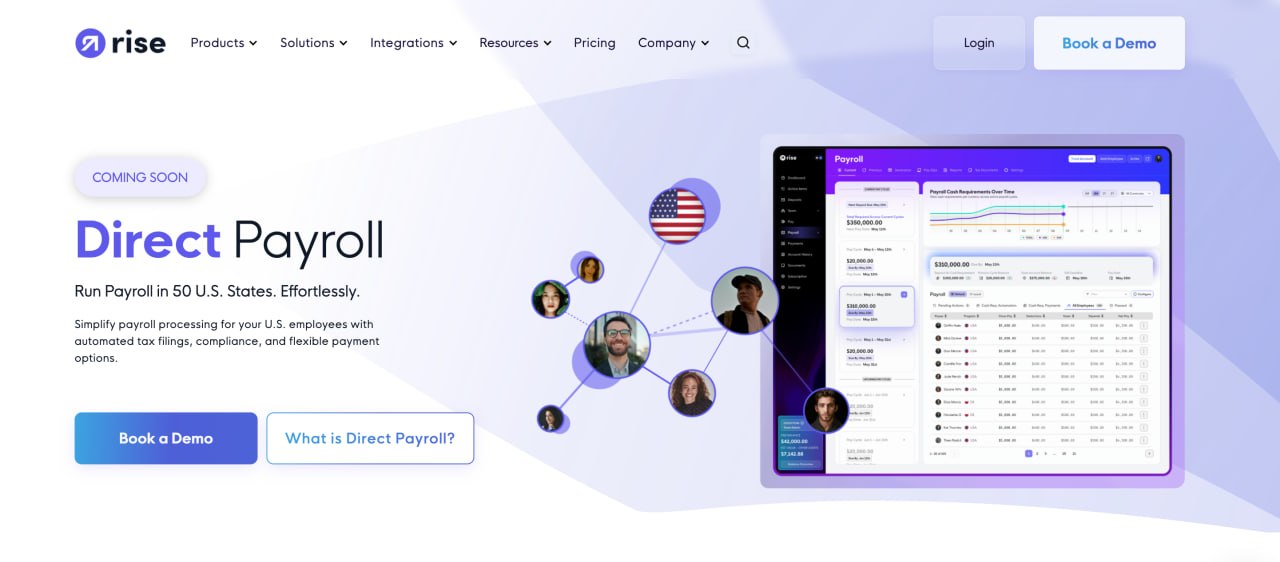
Rise runs US W-2 and 1099 payroll with full tax filing and reporting.
Rise unifies domestic payroll, global EOR and AOR, and stablecoin payouts in one platform.
Direct Payroll pricing starts at a 49 dollar monthly minimum, then 19 dollars per employee.
Choose a Rippling alternative based on US scope, global reach, and payment flexibility.
Why Teams Look Beyond Rippling for Payroll
Rippling is a capable platform, and most teams leave it for structural reasons rather than a single broken feature. The common pattern is a company that adopted Rippling for its all-in-one suite, then found that payroll was tied to modules, app pricing, and contract terms it did not fully need.
As priorities sharpen around payroll accuracy and global reach, a focused tool often wins.
The reasons buyers cite most often are consistent:
Bundled pricing that scales with apps and seats rather than payroll value
A desire for a payroll-first system instead of an HR suite with payroll attached
Growing contractor or international headcount that domestic-first tools handle awkwardly
Interest in stablecoin or crypto payouts that traditional providers cannot run in-house
Consider a 40-person startup paying US employees through Rippling while onboarding contractors in five countries through a second tool and a wire transfer process. That split creates reconciliation work, compliance gaps, and two vendors to manage.
Consolidating onto a platform that handles both is the move that actually reduces overhead, which is exactly where most Rippling alternatives are judged.
What to Look For in a Rippling Direct Payroll Alternative
Not every alternative solves the same problem, so the evaluation should start with your actual payroll footprint. The strongest 2026 options differ sharply on US depth, integration quality, and how far they reach beyond domestic payroll.
US Compliance Coverage
For US payroll, the baseline is non-negotiable. Any serious alternative must calculate federal, state, and local taxes, handle remittance and filing, and generate W-2 and 1099 forms without manual workarounds.
Direct Payroll from Rise covers all of this for US W-2 and 1099 payroll, including time off management and reporting, with compliance backed by SOC 2 Type II controls and FinCEN MSB registration.
Integration Depth
Payroll does not live alone. It feeds accounting, time off, and reporting workflows, so native integrations decide how much manual export work your team inherits. Rise integrates directly with QuickBooks, Xero, Campfire, and Rillet, which keeps payroll data flowing into the systems finance teams already run.
Global and Payment Flexibility
This is where most Rippling alternatives separate. A US-only tool forces a second vendor the moment you hire abroad, while a global platform absorbs that growth. Rise processes contractor payroll across 190 plus countries, runs Employer of Record hiring through owned entities expanding to 60 plus markets by the end of 2026, and lets workers withdraw in 90 plus fiat currencies or 100 plus crypto assets.
The right choice depends on whether you need clean US payroll, global reach, modern payment rails, or all three at once.
The Best Rippling Direct Payroll Alternatives in 2026
Each platform below solves a real use case. The fit depends on where your team is headed, not just where it sits today.
1. Rise
Rise is the strongest fit for companies that want compliant US payroll and a single platform that scales globally. Its Direct Payroll product runs US W-2 and 1099 payroll with federal, state, and local tax calculation, remittance, filing, and W-2 and 1099 generation, plus time off management and reporting.
At launch it supports salaried teams, with QuickBooks, Xero, Campfire, and Rillet integrations built in.
What sets Rise apart is the platform behind that domestic payroll. The same system runs contractor payroll, Agent of Record, and Employer of Record globally, and it settles cross-border payments in minutes on stablecoin rails rather than days on SWIFT.
Rise has processed more than 1.5 billion dollars in lifetime payroll volume, with over 50 percent of worker withdrawals now taken in stablecoins.
Key strengths:
US W-2 and 1099 payroll with full tax filing and form generation
Native global expansion through AOR and EOR with no second vendor
In-house stablecoin payouts in USDC and USDT, not outsourced to third parties
Worker-controlled withdrawals across 90 plus fiat currencies and 100 plus crypto assets
For a 30-person US team planning to hire contractors abroad next year, Rise removes the future migration entirely because the global infrastructure is already there. That is the difference between a payroll tool and a payroll platform.
2. Gusto
Gusto is a popular choice for small US businesses that want approachable payroll and benefits in one place. It handles US tax filing well and suits teams that expect to stay domestic. Where it stops short is global payroll and modern payment rails, which is precisely the gap Rise fills with native international and stablecoin support.
3. ADP and Paychex
ADP and Paychex are long-established providers that serve businesses of every size and bring deep US compliance experience. They are dependable for traditional domestic payroll and large enterprise needs.
Their tradeoff is the legacy stack: pricing is often opaque, and crypto or stablecoin payouts are not part of the offering, whereas Rise builds those rails in natively.
4. QuickBooks Payroll
QuickBooks Payroll is a natural pick for teams already standardized on QuickBooks accounting. The tight ledger integration is its main draw for US-only operations. For companies that need to pay contractors internationally or offer stablecoin payouts, though, it requires additional tools, while Rise also integrates with QuickBooks and handles the global side in the same platform.
Why Rise is the Best Direct Payroll Alternative for Rippling in 2026
The headline comparison is simple. Most Rippling alternatives are either solid US payroll tools or solid global tools, and few are both. Rise is built to be both, which changes the calculus for any team that expects to grow.
US Payroll Done Right
Rise treats US payroll as a first-class product, not an afterthought bolted onto an HR suite. It runs W-2 and 1099 payroll, calculates and files federal, state, and local taxes, and generates year-end forms automatically. Because it is isolated from other modules, US payroll stays clean and predictable regardless of what else you run on Rise.
One Platform from Domestic to Global
The moment a team hires its first international contractor, a US-only stack starts to fragment. Rise prevents that by running domestic and global payroll from the same place.
Employers fund payroll in USD or stablecoins, and workers choose how they get paid, which Rise details on its hybrid fiat and crypto payroll page.
This is also where Rise pulls ahead of platforms that claim crypto support. Some competitors route stablecoin payouts through third-party vendors, which adds fees and compliance steps, while Rise built its stablecoin payroll infrastructure entirely in-house.
Workers also receive a Rise ID, a unique identifier that ties compliance, contracts, and payment history together across borders.
Pricing Built to Scale
Rise Direct Payroll uses straightforward pricing that rewards growth rather than penalizing it. Billing is the greater of a 49 dollar monthly account minimum or 19 dollars per employee per month, and it stays isolated from any global product fees.
One or two employees: the 49 dollar monthly minimum applies
Three employees: pricing shifts to 19 dollars per employee, or 57 dollars
Larger teams: cost scales linearly at 19 dollars per employee per month
That structure means a small team is never overcharged and a growing team always knows its number. Predictable pricing is one of the most common reasons buyers leave bundled suites in the first place.
Making the Switch from Rippling
Switching payroll providers is manageable with the right preparation, and timing matters less than data accuracy. The most important step is migrating year-to-date payroll data cleanly so tax filings stay correct through the transition. A provider that takes time to ingest and verify your data is the one to trust with the move.
A practical migration checklist looks like this:
Export year-to-date wage, tax, and withholding data from Rippling
Confirm all prior filings reconcile before the first run on the new platform
Map employees, pay schedules, and integrations into the new system
Run a parallel or test cycle to validate calculations before full cutover
A US team of 50 can typically complete this in a matter of weeks rather than months when the new provider handles the data ingestion properly. Rise supports that transition and gives teams a single platform to grow into rather than out of.

Conclusion
The best Rippling Direct Payroll alternative depends on where your team is going, not only where it is now.
US-only tools like Gusto and QuickBooks Payroll work for domestic teams, and established providers like ADP and Paychex cover enterprise scale, but only a platform that unifies US payroll with global and stablecoin payments removes the next migration entirely.
Rise is built for exactly that, pairing compliant W-2 and 1099 payroll with native international and crypto-ready rails.
Book a demo to walk through US payroll, global EOR and AOR, and stablecoin payouts in one dashboard.
FAQs:
1. Is Rise a true alternative to Rippling Direct Payroll?
Yes. Rise runs US W-2 and 1099 payroll with full federal, state, and local tax filing and form generation. It also adds native global payroll and stablecoin payouts that Rippling handles through bundled modules or not at all.
2. How much does Rise Direct Payroll cost compared to Rippling?
Rise Direct Payroll is billed as the greater of a 49 dollar monthly minimum or 19 dollars per employee per month, isolated from any other fees. That pricing is transparent and scales linearly, which contrasts with the app-and-seat bundling common in HR suites.
3. Can Rise pay both US employees and international contractors?
Yes. Rise runs US W-2 and 1099 payroll while also paying contractors across 190 plus countries through the same platform. This removes the need for a second vendor as your team expands abroad.
4. Does Rise support stablecoin or crypto payroll like the modern providers claim?
Rise built its stablecoin payroll in-house rather than outsourcing to third-party vendors. Workers can withdraw in USDC, USDT, 90 plus fiat currencies, or 100 plus crypto assets, with over 50 percent of withdrawals already taken in stablecoins.
5. How hard is it to switch from Rippling to Rise?
Migration is manageable with clean year-to-date data and a provider that verifies it before the first run. Most US teams complete the move in weeks, and Rise supports the data ingestion and parallel testing that keeps tax filings accurate.