
Deel Direct Payroll Alternatives: 2026 Complete Review
The US payroll services market is worth $8.91 billion in 2026 and is on track to reach $11.61 billion by 2031, according to Mordor Intelligence.
The category is crowded with providers that look similar on a landing page and behave very differently on an invoice.
Rise stands out by running US W-2 and 1099 payroll alongside global pay on native rails, with no vendor handoffs and no quote-based guessing.
Deel is the name most teams compare against, and that is where the gaps show. Its US payroll is quote-based, reviews report real costs running 26 to 46 percent above list once conversion and transaction fees hit, per CheckThat.ai, and it rents its stablecoin rails from third-party vendors.
This review breaks down the strongest Deel Direct Payroll alternatives in 2026 and where each one falls short.
Key Takeaways
Rise runs US W-2 and 1099 payroll plus global pay natively.
Deel outsources stablecoin payroll to vendors, adding fees and compliance steps.
Deel's US payroll is quote-based, hiding the real cost until sales.
Rise Direct Payroll is published transparently from $19 per employee monthly.
Most Deel alternatives are US-only and force a second platform later.
Why Teams Abandon Deel for Direct Payroll
Deel earned its reach by bolting contractor management, global payroll, and Employer of Record into one suite. For a team running US payroll, that breadth is not a feature, it is overhead you pay for and do not use.
The reasons teams leave cluster around three failures:
The first is pricing you cannot trust, since Deel's US payroll is quote-based and the final number arrives padded with conversion markups and transaction fees that never appear at the plan level.
The second is cash you cannot use, because Deel requires a one-month gross salary deposit per Employer of Record employee, which locks up real money before your first payroll runs, per analysis cited by Pin.
The third is rails Deel does not own, since stablecoin and crypto payouts are relayed through outside vendors instead of being processed in-house.
Every one of those is a cost the buyer absorbs. Rise removes all three by running US Direct Payroll and global pay on the same native rails, with published pricing and no vendor middlemen.
What to Evaluate in a Deel Direct Payroll Alternative
Before comparing logos, set the criteria. The right alternative matches your worker mix, your growth path, and refuses to hide fees.
Weigh each option against the factors that actually move the decision:
Scope of coverage: Does it handle US W-2 and 1099 only, or also global employees and contractors?
Pricing transparency: Is the price published per employee, or quote-based with markups buried in conversion rates?
Worker payout options: Can workers choose fiat, stablecoins, or crypto, and are those rails native or outsourced?
Compliance posture: Does the provider hold SOC 2 Type II, FinCEN MSB registration, and handle tax filing end to end?
Integration depth: Does it connect to your accounting stack, such as QuickBooks, Xero, or Rillet?
Most alternatives fail at least two of these. US-only tools fail scope and payout flexibility. Legacy providers fail transparency. Deel fails transparency and payout ownership. Rise is the only option on this list that clears all five, which is the whole point of comparing.
The Best Deel Direct Payroll Alternatives in 2026
The market splits into three groups: unified global-and-domestic platforms, US-only payroll software, and legacy full-service providers. Here is how the leading alternatives stack up, and where each one breaks down.
1. Rise
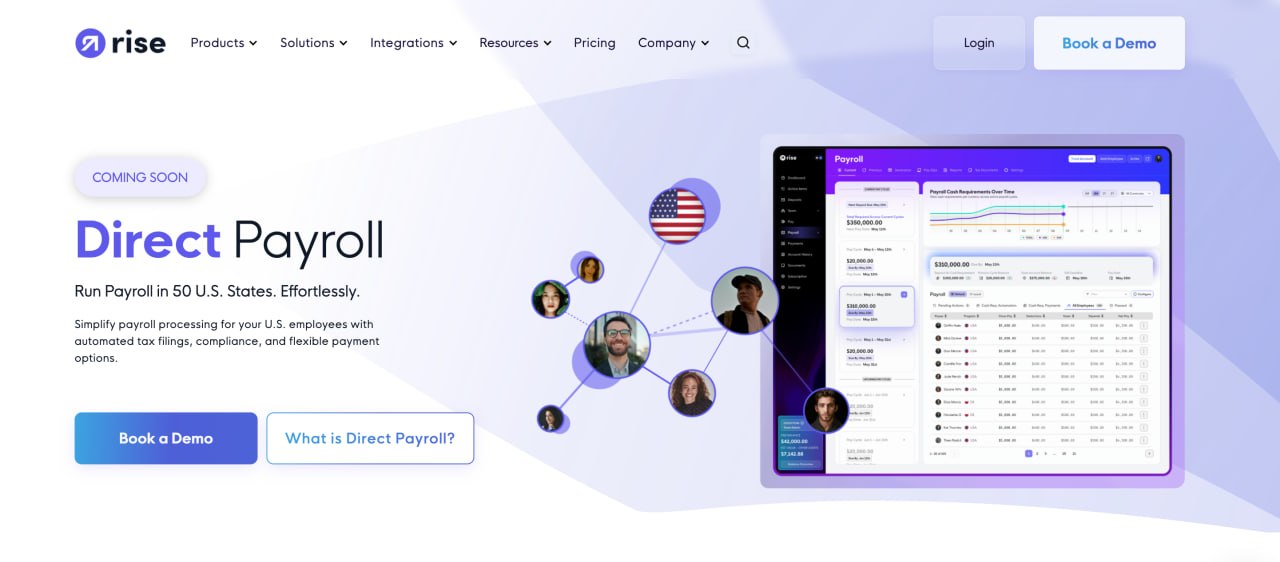
Rise is the only alternative that runs US payroll and global pay on one platform without compromise. Rise Direct Payroll handles US W-2 and 1099 processing, federal, state, and local tax calculation, remittance and filing, W-2 and 1099 generation, time off management, and reporting. It integrates with QuickBooks, Xero, Campfire, and Rillet, and supports salaried teams at launch.
What sets Rise apart is what sits next to domestic payroll. The same account runs global contractor pay through an Agent of Record model and full-time international hires through an Employer of Record, covering 190+ countries with withdrawals in 90+ fiat currencies and 100+ crypto assets.
Rise has processed more than $1.5 billion in lifetime payroll volume and over $776 million in the trailing twelve months.
Rise also builds its stablecoin and crypto rails in-house, which is precisely what Deel does not do. Workers choose how they get paid, including hybrid fiat and crypto payroll, and idle USDC balances can earn yield through Rise Earn without leaving the platform. Rise holds SOC 2 Type II, is FinCEN MSB registered, is GDPR compliant, and runs an official USDC partnership with Circle. For a domestic team that expects to hire globally, Rise removes the migration that every other tool here forces later.
2. Gusto
Gusto sells a clean interface for small US businesses, and that is roughly where its usefulness ends. It handles domestic tax filing, benefits, and contractor payments, but it is firmly US-only with no international footprint and no crypto or stablecoin payouts.
The moment you hire a single overseas contractor, Gusto becomes a second system you have to run in parallel. Rise covers the same domestic ground and 190+ countries on one account, so you never pay the integration tax.
3. Rippling
Rippling bundles payroll with IT and HR management, which means you buy and configure a sprawling suite to run payroll. For a finance team that just needs to pay people, that is cost and complexity you did not ask for.
Its global modules also sit behind the broader platform commitment, raising the total bill. Rise keeps the surface area focused while still spanning US and global pay, without forcing you into device management to get there.
4. ADP and Paychex
ADP and Paychex are the legacy incumbents, built for large US enterprises and showing their age. ADP's platform processes payroll for more than 41 million workers, per ADP, but scale has not bought flexibility.
Both offer effectively no native crypto or stablecoin support, and both are notorious for opaque, negotiate-it pricing that small and mid-size teams overpay on. Rise matches their compliance rigor with SOC 2 Type II and FinCEN MSB registration while giving workers payout choice the incumbents cannot.
5. OnPay and Justworks
OnPay and Justworks are competent inside US borders and helpless outside them. OnPay runs flat-rate domestic payroll, and Justworks wraps payroll in PEO-style benefits, but neither offers any global or crypto capability.
For a team that intends to scale beyond the US, that ceiling is a dealbreaker. Rise delivers the same domestic payroll and extends to 190+ countries on the same account, which is the difference between a tool you outgrow and a platform you keep.
Rise vs Deel for Direct Payroll, Head to Head
For teams choosing specifically between Rise and Deel, three differences expose where Deel costs you.
1. Stablecoin and crypto payroll
Deel does not run these itself. It routes stablecoin payouts through third-party vendors, using BVNK for contractor payouts and MoonPay for UK and EU employee salary payouts, so every payment carries vendor fees and an extra compliance handoff. Rise builds its stablecoin payroll entirely in-house, with no relay between funding and payout.
2. Pricing you can actually plan around
Deel's US payroll is quote-based, its global products add per-entity implementation fees and conversion markups, and reviews report real costs running well above the list rate. Rise Direct Payroll is billed transparently at the greater of a $49 monthly account minimum or $19 per employee per month, fully isolated from EOR and AOR fees and never bundled. You know the number before you sign.
3. Platform integrity
Both span domestic and global pay, but only Rise's native rails let a worker in any supported market take pay in local fiat, stablecoins, or crypto from the same account, with employers never touching individual payout details. Deel's vendor dependencies mean you are trusting a chain of providers you did not choose. For finance teams modeling total cost and operational risk, that is not a close call.
How to Choose and Migrate
Map your worker mix for the next twelve months, not just today. If you are genuinely US-only forever, a domestic tool will do, but few teams are. The moment overseas contractors or employees enter the plan, every US-only option on this list becomes a migration you pay for in disrupted pay cycles and broken compliance records.
Run the pricing math on real headcount, including conversion and transaction fees, not the headline rate, and Deel's true cost climbs fast. Then confirm the provider holds SOC 2 Type II and FinCEN MSB registration and files taxes end to end.
Rise was built so this evaluation lands on one platform instead of three, which is why teams that expect to scale consolidate on it early instead of cleaning up later.

Conclusion
The best Deel Direct Payroll alternative is the one that does not become a problem next year.
US-only tools like Gusto, OnPay, and Justworks force a second system the moment you hire abroad, ADP and Paychex trade flexibility for legacy scale, and Deel hides its real cost behind quotes while renting out its stablecoin rails.
Rise runs US W-2 and 1099 payroll, global pay across 190+ countries, and native stablecoin infrastructure from a single account, with pricing you can see up front.
If your roadmap spans domestic and global pay, consolidating early saves a painful and expensive migration later.
Book a demo to see how Rise handles US Direct Payroll and worker-chosen payouts in one platform.
FAQs:
1. What is the best Deel Direct Payroll alternative for teams hiring globally?
Rise, because it runs US W-2 and 1099 payroll and global contractor and employee pay on one platform across 190+ countries. Deel and the US-only tools force a second system or a vendor relay when you scale. Rise lets workers take pay in fiat, stablecoins, or crypto from the same account.
2. Why is Rise Direct Payroll pricing better than Deel's?
Rise Direct Payroll is billed at the greater of a $49 monthly account minimum or $19 per employee per month, isolated from EOR and AOR fees and published openly. Deel's US payroll is quote-based, and reviews report real costs running 26 to 46 percent above list once conversion and transaction fees hit. With Rise you know the number before you sign.
3. Does Rise support stablecoin and crypto payroll directly, or like Deel?
Rise builds its stablecoin and crypto payroll entirely in-house, supporting 100+ crypto assets and 90+ fiat currencies. Deel does not, routing payouts through third-party vendors like BVNK and MoonPay, which adds fees and compliance handoffs. Native rails are cheaper and cleaner to audit.
4. Is Rise compliant enough to replace a legacy provider like ADP for US payroll?
Yes. Rise holds SOC 2 Type II, is FinCEN MSB registered, and is GDPR compliant, and it handles federal, state, and local tax calculation, remittance, filing, and W-2 and 1099 generation. It integrates with QuickBooks, Xero, Campfire, and Rillet. It matches incumbent compliance without their opaque pricing.
5. Can I run both US and international payroll on Rise?
Yes, on the same account. Rise Direct Payroll covers US W-2 and 1099, while its Agent of Record and Employer of Record products handle global contractors and employees. That is the single biggest reason teams pick Rise over single-scope alternatives.