
Gusto Direct Payroll Alternatives: 2026 Complete Review
The employer of record market is on track to grow from $5.97 billion in 2026 to $10.45 billion by 2035, according to the Business Research Insights Employer of Record Market Report.
Companies are hiring across borders faster than their payroll software can keep up, and Rise was built for that moment, combining US payroll, employer of record, and global contractor pay on one platform.
Gusto handles domestic payroll well, but the friction shows up the moment a US-headquartered company hires internationally, since its global employment runs through a third-party EOR partner across a limited set of countries.
This review breaks down the strongest Gusto Direct Payroll alternatives for 2026, the criteria that matter when you evaluate them, and where each option fits.
Key Takeaways
Gusto excels at US payroll but relies on a third-party EOR partner for global hiring.
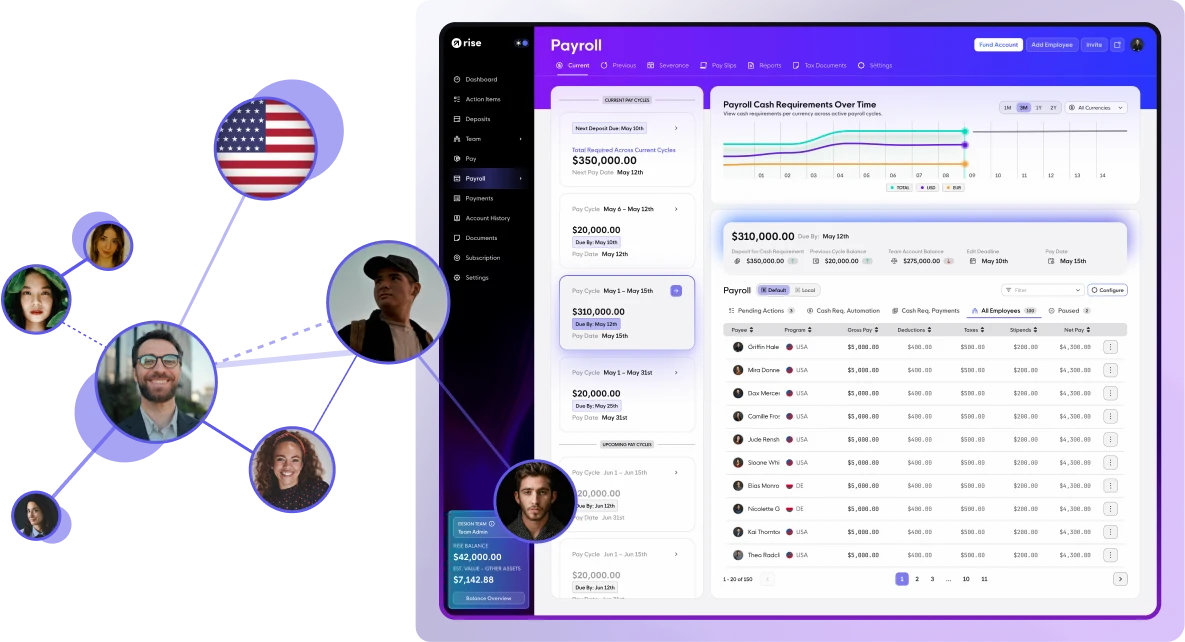
Rise unifies US Direct Payroll, EOR, and global contractor pay on one platform.
Strong Gusto alternatives consolidate domestic and international pay under one bill.
Rise Direct Payroll covers W-2 and 1099 workforces with automated tax filings.
Rise pricing starts at a $49 monthly minimum, then $19 per employee.

Why Companies Outgrow Gusto
Most teams do not leave Gusto because of its US payroll. They leave because their workforce changes shape and Gusto's architecture cannot follow.
Gusto serves more than 400,000 businesses and runs payroll across all 50 US states with automated federal and state tax filings, per Gusto's published materials. For a US-only, salaried team, that is a solid foundation. The structural limits appear at three predictable inflection points:
International hiring: Gusto Global EOR launched in 2024 through a partnership with a third-party EOR provider and covers full-time employment in roughly 12 countries, per Gusto's documentation. The legal entities behind those hires are not Gusto's own, which limits vendor control and country coverage.
Multi-vendor sprawl: Once a company adds an international provider alongside Gusto, finance reconciles two systems, two invoices, and two sets of reports every cycle. The administrative cost compounds with every new market.
Cost at the global edge: Gusto Global EOR starts at $599 per employee per month, rising to $699 after March 15, 2026, according to Gusto's pricing page. For teams adding several international hires, that line item climbs quickly.
A useful gut check: roughly 78% of companies now hire internationally for remote roles, per 2026 remote-work research compiled by Second Talent. If your hiring plan includes talent outside the US, a US-only payroll engine with a bolt-on global module is a temporary fix, not a foundation.
One more fit note worth stating plainly. Rise Direct Payroll is purpose-built for salaried W-2 employees and 1099 contractors employed through a US entity. Companies built on hourly or shift-based labor should weigh that before switching, since hourly time tracking is not part of the initial launch.
What to Look for in a Gusto Alternative
Before comparing products, fix your evaluation criteria. The teams that choose well tend to weigh five things.
Unified US and global coverage: Can one platform run your US payroll, employ your international staff, and pay your global contractors without a second vendor?
Native infrastructure: Is global employment built in-house, or routed through a third-party partner that adds fees and a layer between you and compliance?
Tax and filing reliability: Does the platform calculate, remit, and file federal, state, and local payroll taxes, then generate W-2s and 1099s cleanly at year-end?
Modern finance integrations: Does it connect to the tools your finance team actually uses, such as QuickBooks, Xero, Campfire, and Rillet?
Transparent pricing: Can you predict your monthly cost without decoding tiered add-ons and per-event fees?
Hold each alternative below against these five criteria rather than a long feature checklist. The difference between options shows up in architecture, not in screenshots.
The Best Gusto Direct Payroll Alternatives in 2026
1. Rise
Rise is the strongest fit for a US-headquartered company that pays domestic employees today and expects to pay international talent soon. Rise Direct Payroll runs W-2 and 1099 payroll for US entities, handling federal, state, and local tax calculation, remittance, and filings, plus W-2 and 1099 generation at year-end.
The reason Rise stands apart is architecture. Rise was designed from the start to treat US Direct Payroll, employer of record, and agent of record as one product rather than three bolted together.
A company can run its US employees on Direct Payroll, employ international staff through Rise EOR, and pay international contractors through Rise AOR, all inside one platform with one bill, one support team, and one set of reports.
Rise processes more than $1.3 billion in lifetime payroll volume and over $776 million in the trailing twelve months across 190+ countries. It is SOC 2 Type II certified, FinCEN registered as a money services business, and GDPR compliant. Onboarding runs about two weeks.
For US-headquartered teams hiring abroad, Rise removes the exact problem that pushes companies off Gusto: the second vendor.
2. Rippling
Rippling is a powerful platform that bundles payroll with IT and HR management. The trade-off is scope. Rippling is packaged for companies willing to adopt a broad HRIS and IT suite, which can be over-built and costly for a 50 to 300 person company that wants excellent payroll plus the option to add global employment.
If you want the unified payroll story without committing to a full platform suite, Rise delivers it with less overhead.
3. Deel
Deel built its reputation on global contractor payments and EOR, and its US payroll product is a more recent addition to that stack. Companies that move from Deel to Rise commonly cite US payroll quality, tax and filing reliability, and support responsiveness.
Rise treats US payroll as a first-class product rather than an extension of a contractor platform.
4. ADP
ADP is the established legacy option. It is proven at enterprise scale, but it tends to carry dated workflows, a heavy service model, longer implementation cycles, and limited connections to the modern finance stack.
Rise onboards in about two weeks and integrates with the tools modern finance teams use day to day, which makes it a lighter, faster alternative for growing companies.
How Rise Direct Payroll Works
Rise Direct Payroll covers the full domestic payroll lifecycle for companies that employ workers through their own US entity.
Salaried payroll and contractor pay: Run payroll for salaried W-2 employees and pay 1099 contractors on the same platform.
Full tax handling: Calculate, remit, and file federal, state, and local payroll taxes, with W-2 and 1099 generation and filing at year-end.
Time off management: Track accruals, requests, approvals, and balances for your team.
Reporting for finance and people teams: Use pre-built reports like the payroll journal, tax liability report, employee cost report, and accounting export, plus custom reports for anything else.
Finance-stack integrations: Connect payroll data to QuickBooks, Xero, Campfire, and Rillet, with a Basic Capital 401(k) integration in progress.
For example, a 40-person SaaS company employing salaried staff in eight US states can run payroll, file in every state, and push a clean accounting export into Rillet without re-keying a single number.
When that same company hires a designer in Portugal and a contractor in Brazil, those workers come onto the same platform through Rise EOR and Rise AOR rather than a new tool. That continuity is the point.
Where Rise Pulls Ahead: One Platform for US and Global Pay
The deepest difference between Rise and a US-only tool with a partner EOR is who owns the global infrastructure. When international employment runs through a third party, every hire inherits that partner's coverage, fees, and compliance posture.
Rise builds its global employment capability natively, which keeps US payroll, international employment, and contractor pay under one roof.
That unified design unlocks options a domestic-only tool cannot match. Rise supports payment in 90+ fiat currencies and 100+ crypto assets, and offers hybrid fiat and crypto payroll for teams whose workers want flexibility in how they get paid. Cross-border payments settle in minutes on stablecoin rails rather than days on legacy banking networks.
Finance teams gain an additional lever through Rise Earn, which generates yield on idle USDC payroll funds through Aave's lending pools on Arbitrum, with a 1% commission charged only on interest earned at withdrawal and no deposit or holding fees. Idle payroll cash can work instead of sitting still.
The consolidation also simplifies the work itself. One platform means one onboarding flow, one compliance system of record, one support relationship, and one reporting layer for both your domestic and international workforce.
Pricing: What You Actually Pay
Rise Direct Payroll uses pricing you can predict without a spreadsheet. Billing is based on whichever is greater of two figures:
A $49 per month account minimum, triggered by any active employee.
A $19 per employee, per month rate for active employees.
In practice, a company with one or two employees defaults to the $49 monthly minimum, and a company with three or more flips to the per-employee rate, which works out to $57 per month for three employees and scales from there.
Direct Payroll pricing stays isolated from EOR and AOR fees, so you always know which calculation applies.
Set against Gusto's model of a base fee plus per-person charges, plus a separate $599-and-rising per-employee EOR add-on for international hires, Rise's structure is easier to forecast as your headcount grows and spreads across borders.
Conclusion
Gusto is a strong US payroll tool that runs out of road the moment a company hires beyond its borders, where it leans on a third-party EOR partner and a limited country list.
The best Gusto Direct Payroll alternatives in 2026 solve that by consolidating domestic and global pay rather than layering vendors.
Rise does this with native infrastructure, running US W-2 and 1099 payroll, employer of record, and global contractor pay on one platform with one bill and one support team.
If your hiring plan crosses borders, evaluate the platform that was built for both sides of that line.
Book a demo to map your US and international payroll onto a single system.
FAQs
1. Is Rise a good alternative to Gusto for US payroll?
Yes. Rise Direct Payroll runs W-2 and 1099 payroll for US entities, including federal, state, and local tax calculation, remittance, and filings, plus year-end W-2 and 1099 generation. It fits companies that want strong US payroll today with a clear path to global hiring.
2. What does Gusto lack that Rise provides?
Gusto's international employment runs through a third-party EOR partner and covers a limited set of countries. Rise builds employer of record and global contractor pay natively, so US payroll and international employment live on one platform with one bill.
3. How much does Rise Direct Payroll cost?
Rise Direct Payroll bills on whichever is greater: a $49 per month account minimum or $19 per employee, per month. One or two employees default to $49, while three or more move to the per-employee rate. Direct Payroll pricing stays separate from EOR and AOR fees.
4. Can Rise handle both my US team and my international hires?
Yes. Rise runs US employees on Direct Payroll, employs international staff through Rise EOR, and pays international contractors through Rise AOR, all on one platform. You get one support team and one set of reports across the whole workforce.
5. How long does it take to switch from Gusto to Rise?
Rise onboarding runs about two weeks for most companies. Teams that want to be live for a specific payroll date should start onboarding with enough runway to migrate employee, tax, and pay data cleanly before their first run.