How CFOs Are Using Stablecoins to Optimize Payroll Liquidity
Global payroll has become a treasury problem, not just an HR workflow. When companies pay contractors or employees across multiple countries, they often absorb FX spreads, wait through bank settlement delays, and maintain fragmented funding accounts that reduce capital efficiency.
Stablecoins are increasingly being used to fix that.
Ripple’s 2026 survey found that 74% of finance leaders see stablecoins as a way to improve cash-flow efficiency and unlock working capital, not just a payment tool. At the same time, the World Bank says the global average cost of sending remittances remains 6.49%, which helps explain why finance teams are rethinking how cross-border payouts move.
For CFOs, the appeal is straightforward: stablecoins can compress funding friction, reduce settlement lag, and simplify the way global payroll liquidity management is handled.
The key is using infrastructure that combines compliance, onboarding, payout flexibility, and operational control in one system.
Key Takeaways
CFOs are using stablecoins to reduce payroll friction tied to FX, banking cutoffs, and prefunded accounts.
Stablecoin settlement can move payroll from multi-day bank timing to near real-time, 24/7 transfer rails.
Regulatory clarity is improving in major markets, making stablecoin payroll easier to evaluate at the finance level.
The stablecoin market remained above $300 billion in early 2026, with dollar-backed assets still dominating supply.
Rise fits this use case well because it lets employers fund payroll in fiat or crypto while workers choose how they withdraw each cycle.
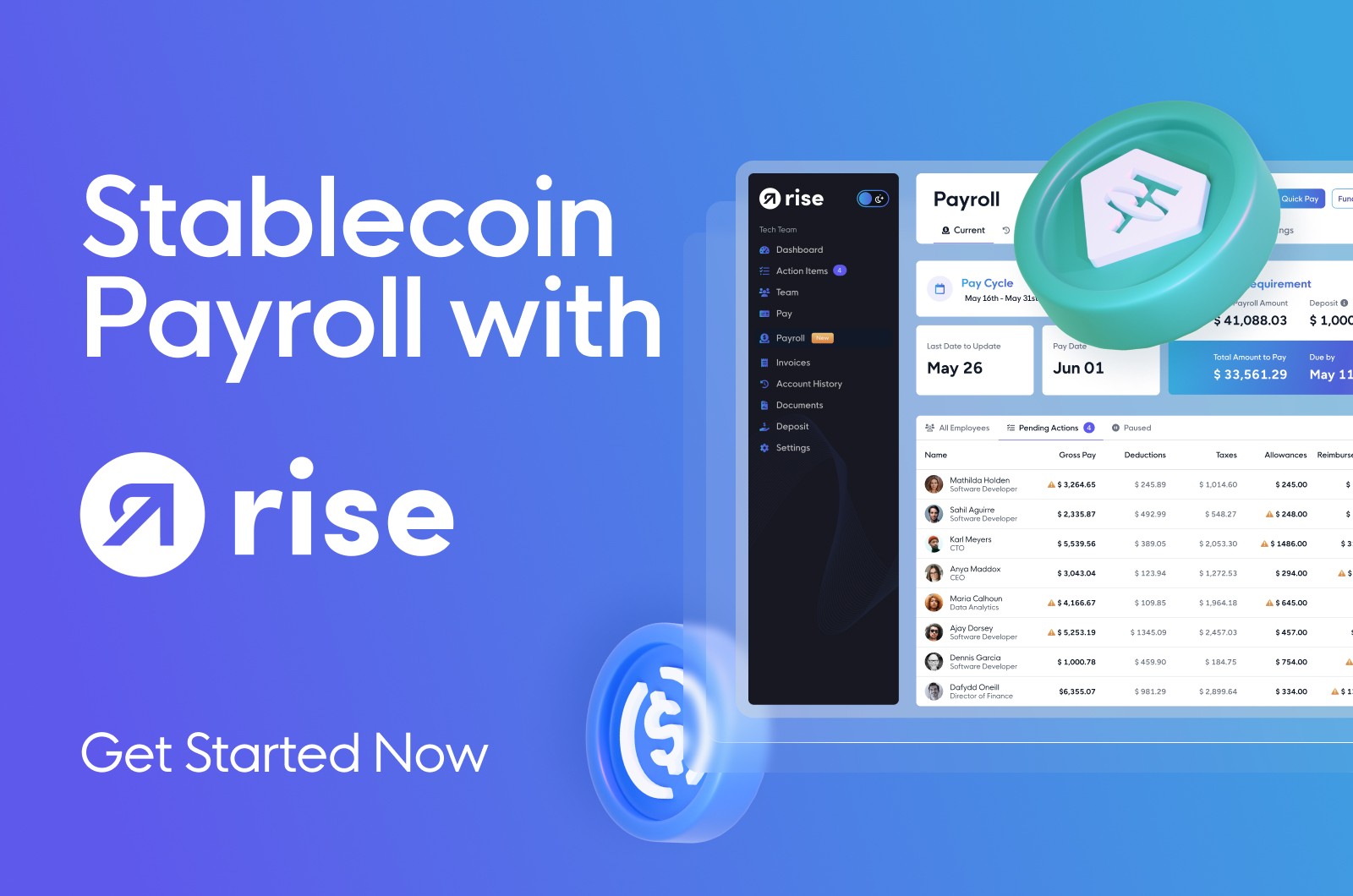
How CFOs Are Using Stablecoins To Reduce Payroll FX Friction?
CFOs use stablecoins to reduce payroll FX friction by replacing multiple prefunded currency positions with a smaller number of stablecoin funding rails, usually USDC or USDT.
In a traditional global payroll setup, treasury teams often convert money before payout, fund separate accounts, and absorb spread leakage across multiple corridors. Stablecoin payroll changes that operating model.
A company can fund once, then let the payout platform handle local withdrawal preferences closer to the point of disbursement.
That does not mean FX disappears completely in every case. If the worker ultimately withdraws into local fiat, there can still be conversion at the edge. But it moves conversion away from treasury fragmentation and toward a more centralized payout workflow.
That is the real CFO advantage: fewer moving parts, less idle capital, and clearer visibility into payment costs.
How Stablecoin Settlement Improves Working Capital Management
Stablecoin settlement improves working capital management because it reduces the amount of payroll cash that sits in transit.
This is just one example of the broader working capital management strategies finance teams rely on to keep cash accessible without over-funding every account.
In practice, that matters because traditional cross-border bank rails still create timing gaps, cutoff constraints, and holiday delays that force finance teams to fund early. Stablecoins operate on always-on rails, which can make payroll funding more responsive to actual payment timing.
For a CFO, this is not just about speed. It is about control. The faster funds move, the less treasury has to over-buffer payroll windows or hold excess liquidity in disconnected accounts.
How Stablecoins Are Helping Centralize Global Payroll Liquidity
Stablecoins help centralize payroll liquidity by creating a common funding layer across countries.
Instead of maintaining separate banking relationships and cash positions for each corridor, companies can fund payroll from a more unified treasury stack. The payout platform then becomes the orchestration layer that connects onboarding, compliance checks, worker preferences, and final disbursement.
This is where the platform matters more than the asset. Stablecoins alone do not solve payroll complexity. The operational lift is solved by infrastructure that can support compliant onboarding, multiple payout formats, organized tax and payment records, and reliable cross-border disbursement.
As more companies evaluate digital currencies for real operating use cases, payroll is becoming one of the clearest examples of practical adoption.
Rise is well positioned here: employers can fund via USD bank transfer, USDC, or USDT, while contractors choose their own withdrawal currency each cycle. That separation is important because it gives finance teams centralized funding control without forcing a one-size-fits-all payout method.
How CFOs Are Using Stablecoins In Volatile Or High-Friction Markets
CFOs are also using stablecoins where local currency volatility, slow banking rails, or expensive cross-border transfers make traditional payroll harder to manage.
For payroll, the practical takeaway is that stablecoins can serve as a more stable intermediate funding asset in markets where treasury teams want to reduce timing risk and currency complexity.
The decision still depends on local labor rules, tax treatment, and how payouts are structured, but the treasury logic is increasingly clear. In many of these environments, the appeal is less about speculation and more about financial stability in day-to-day payroll operations.
What CFOs Need To Implement Stablecoin Payroll At Scale
A CFO needs compliant onboarding, flexible funding, multi-format payouts, and auditability to implement stablecoin payroll at scale.
Workers need to be onboarded with identity, tax, and payment details handled in a structured workflow.
Finance should be able to fund payroll in fiat or stablecoins without rebuilding treasury operations around one corridor.
Workers should be able to withdraw in local fiat, stablecoins, or other supported crypto, depending on the company’s model and the worker’s preference.
The finance team also needs records that stand up to internal controls, compliance review, and external reporting.
This is where Rise becomes a strong fit. Rise supports contractor onboarding, AOR and EOR workflows, tax documentation, 90+ fiat currencies, USDC and USDT funding, and 100+ crypto payout options across major chains.
It also lets employers fund centrally while workers choose their payout destination each cycle, which is exactly the kind of operating flexibility a treasury-led payroll model needs.
Stablecoin Payroll As A Board-Level CFO Topic in 2026
The policy environment is much clearer than it was a year ago. Institutional sentiment is also moving, with more finance leaders viewing stablecoins as relevant for settlement and internal cash management.
That does not mean every company should move payroll fully on-chain. It does mean CFOs increasingly need a view on stablecoins as treasury infrastructure, especially if they operate internationally, hire in multiple currencies, or want more flexibility in how payroll liquidity is deployed.
For many finance teams, the conversation is now less about experimentation and more about operational optimization.
How Rise Is Helping CFOs Implement Stablecoins To Optimize Payroll Liquidity
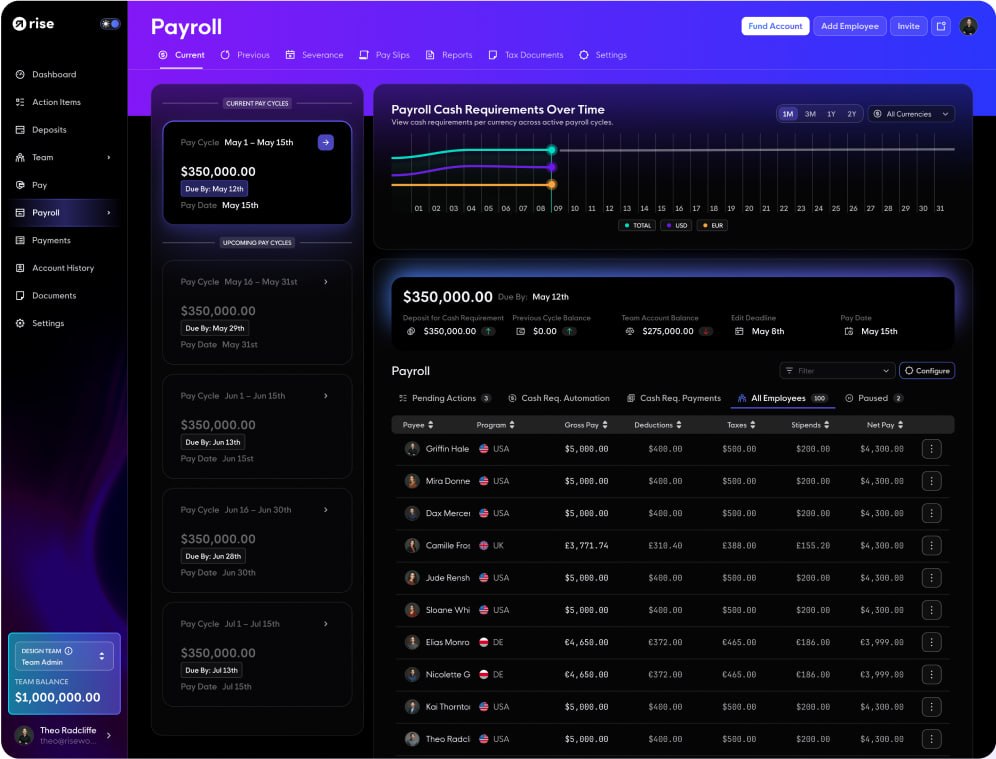
Rise is not just a crypto payout tool. The stronger positioning is that Rise gives CFOs a way to run global payroll, onboarding, and compliance from one operating layer while adding stablecoin rails where they improve liquidity and payout speed.
That matters because the real buyer is not looking for crypto novelty. The buyer is looking for fewer treasury bottlenecks, more payout flexibility, less operational fragmentation, clearer compliance workflows, and better global payroll scalability.
Rise maps well to that need because it supports hybrid payroll, contractor self-onboarding, employer funding in local currencies or stablecoins, and worker-level withdrawal choice across a wide geographic footprint.
Conclusion
CFOs are using stablecoins to optimize payroll liquidity in three main ways: reducing funding friction, speeding up settlement, and centralizing global payroll liquidity around more flexible rails.
That shift is becoming easier to justify because the surrounding market is maturing. Stablecoins remain a $300B+ market, finance leaders increasingly associate them with working capital efficiency, and both the US and EU now have clearer regulatory frameworks than they did a year ago.
For companies that want to apply those benefits in a payroll context, the winner will not be the platform with the loudest crypto message. It will be the platform that combines compliant onboarding, flexible funding, global payout coverage, and operational control. That is where Rise has a strong story.
Book a demo with Rise to see how a hybrid fiat and stablecoin payroll model can work for your team.
FAQs:
1. How are CFOs using stablecoins to optimize payroll liquidity?
CFOs are using stablecoins to optimize payroll liquidity by funding payroll through a smaller number of stablecoin rails instead of maintaining fragmented multi-currency accounts. That can reduce funding friction, improve settlement speed, and simplify treasury operations.
2. Do stablecoins eliminate payroll FX costs completely?
No. Stablecoins do not eliminate every FX cost in every payroll flow. They reduce treasury-side fragmentation and can lower payment friction, but conversion may still happen when a worker withdraws in local fiat.
3. Why does stablecoin settlement matter for CFOs?
It matters because faster settlement reduces the amount of cash tied up in transit and gives treasury teams more control over payroll timing.
4. Is stablecoin payroll compliant in 2026?
It can be, but compliance depends on the jurisdiction, worker classification, tax handling, and payout structure. The regulatory picture is clearer now in both the US and EU than it was before.
5. What should a company look for in a stablecoin payroll platform?
A company should look for compliant onboarding, tax documentation, funding flexibility, fiat and crypto payout support, and a strong operational record across multiple countries.