
Choosing a Payroll Provider for Multi-State Compliance
Half of multi-state employers have turned down a qualified candidate specifically because of the compliance burden tied to that candidate’s home state, according to FoxHire’s Multi-State Hiring Compliance Burden Index published in March 2026.
That statistic captures where distributed hiring stands today. Growth is no longer capped by talent availability. It’s capped by whether payroll infrastructure can keep up with the jurisdictions that talent lives in.
For founders and Heads of People scaling a remote-first team, this is not a hypothetical risk. Every new state adds a registration, a withholding rule, an unemployment insurance account, and a filing calendar that didn’t exist the week before.
Rise built its platform around this exact problem: managing compliance and payments across fragmented jurisdictions without slowing down hiring.
This guide breaks down what a payroll provider actually needs to handle for multi-state compliance and how to evaluate one before you sign a contract.
Key Takeaways
Multi-state payroll compliance now shapes hiring decisions, not just back-office operations.
A strong payroll provider automates nexus tracking, withholding, and multi-jurisdiction filing.
Rise combines compliance automation with flexible fiat and crypto payment infrastructure.
The right provider should reduce state-registration time from weeks to days.
Evaluating a provider means testing its compliance depth, not just its payroll speed.
The Multi-State Compliance Landscape Has Gotten Harder, Not Easier
Remote work didn’t just change where people work. It changed what triggers a compliance obligation. The moment an employee lives or works in a new state, most employers establish payroll tax nexus there, which means registering with that state’s revenue department and unemployment agency before the first paycheck goes out.
2026 made this landscape more volatile. Nineteen states raised their minimum wage on January 1, three new paid family and medical leave programs launched, and pay transparency laws are now active in 17 states, according to Warp’s 2026 multi-state compliance guide. Each of those changes touches withholding calculations, reporting deadlines, or job posting requirements simultaneously.
The practical result is that compliance infrastructure has become a hiring constraint. Companies that can’t confidently register and pay someone in a new state within days, not weeks, lose candidates to competitors who can move faster.
This is precisely where a payroll provider’s depth of compliance automation determines whether growth stays possible.
Why In-House Payroll Teams Fall Behind
Most in-house payroll setups were built for a single state or a small handful of them. Scaling past that point exposes gaps fast.
According to the FoxHire Multi-State Hiring Compliance Burden Index, only 10% of employers can fully set up payroll operations in a new state in under a week, while 36% say it takes a month or more.
That gap creates real financial exposure. A quarter of multi-state employers have already paid a fine, penalty, or interest charge tied to compliance failures in the past two years, per the same FoxHire research. Manual tracking of tax rates, reciprocity agreements, and filing calendars simply doesn’t scale linearly with headcount. It scales worse.
This is the point where most growing teams start evaluating outside payroll providers. The question becomes what to actually look for.
A Step-by-Step Guide to Choosing a Payroll Provider for Multi-State Compliance
Step 1: Map Your Current and Anticipated Nexus States
Before evaluating any provider, list every state where you currently have employees or contractors, plus every state you expect to hire in over the next 12 months. Nexus can be physical, through an employee’s location, or economic, through revenue thresholds. A provider needs visibility into both.
Step 2: Test How the Provider Handles State Registration
Ask each vendor exactly how state registration works in practice. Some platforms hand you a checklist and leave the filing to you. Others handle registration with the state revenue department and unemployment agency directly. The difference between those two models is the difference between days and weeks of onboarding time.
Step 3: Confirm Automated Withholding and Reciprocity Handling
Employees who live in one state and work in another can trigger dual withholding obligations, unless a reciprocity agreement applies. A provider should apply these rules automatically rather than relying on your team to catch every edge case manually.
Step 4: Evaluate Compliance Beyond Payroll Taxes
Multi-state compliance now extends past withholding. Paid family and medical leave contributions, pay transparency disclosures, and worker classification rules all vary by state. Look for a provider that tracks these categories together instead of treating them as separate systems.
Step 5: Check Worker Classification Support
Contractor misclassification is one of the costliest multi-state compliance mistakes. A provider with a legal and compliance program built into onboarding reduces this exposure before it becomes a liability.
Step 6: Review How Payments and Payroll Records Are Verified
Every worker on your payroll should have a verified identity tied to their compliance history, contracts, and payment records. This matters most when audits happen and you need a clean paper trail across every state and worker type.
Step 7: Price the Full Stack, Not Just the Base Fee
Compare pricing across the full workforce mix you actually have, contractors, EOR employees, and any international hires. A provider that looks cheap for one worker type can get expensive once you factor in the categories it doesn’t cover well.
Why Rise Handles Multi-State Complexity Differently
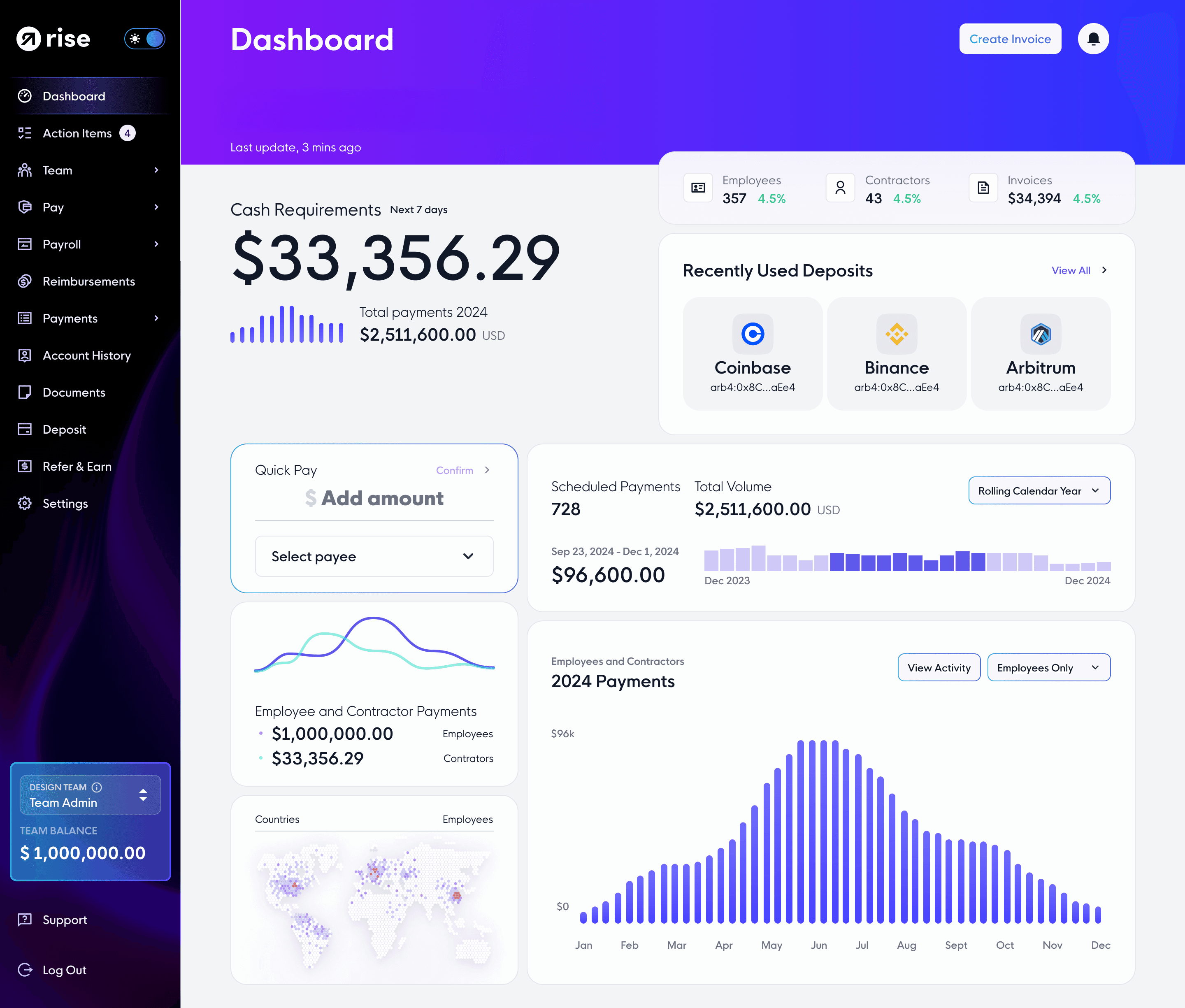
Rise was built for exactly the fragmentation described above: a workforce spread across states, countries, and worker classifications, all needing compliant, verified payment infrastructure.
Rise processes more than $1.5 billion in lifetime payroll volume, with $776 million of that in the trailing 12 months, across contractor and employer-of-record engagements in 190+ countries.
Every worker on Rise carries a Rise ID, a unique identifier tied to their compliance status, contracts, and full payment history. That record travels with the worker, so a Head of People managing employees across a dozen states and contractors across a dozen countries has one system of record instead of a patchwork of spreadsheets.
Rise is also a FinCEN-registered Money Service Business, SOC 2 Type II certified, and GDPR compliant, giving legal and finance teams the audit trail they need without building it themselves. Combined with support for 90+ local currencies and 100+ crypto assets, Rise gives distributed teams the flexibility to pay however their workforce needs to be paid, without compliance becoming the bottleneck.
What a Distributed Workforce Strategy Actually Requires
Choosing a payroll provider isn’t just a compliance decision, it’s a workforce strategy decision. Companies that restrict hiring to a handful of registered states protect themselves administratively, but they shrink the talent pool doing it. The alternative is infrastructure that makes new-state entry a configuration step rather than a multi-week project.
This is especially true for teams that mix domestic remote employees with international contractors. Rise’s employer-of-record model lets companies hire full-time employees without standing up a local entity first, while handling the tax filings and compliance obligations that come with that employment relationship.
For HR and People teams specifically, the operational win is fewer handoffs. Instead of coordinating between a payroll vendor, a compliance consultant, and an HRIS, one platform carries onboarding, compliance verification, and payment execution end to end.
Common Multi-State Compliance Mistakes to Avoid
Even with strong infrastructure in place, a few recurring mistakes account for most multi-state compliance failures.
Failing to update an employee’s work location when they relocate, which silently creates a new nexus obligation.
Missing reciprocity agreements between neighboring states, resulting in incorrect dual withholding.
Treating pay transparency and PFML requirements as one-time setup tasks instead of ongoing monitoring.
Assuming contractor agreements protect against misclassification risk without a compliance review behind them.
Rise’s compliance landmines resource walks through these failure points in more depth, with specific guidance for teams scaling past their home state for the first time.
How to Get Started with Rise
Getting started with Rise follows a straightforward path.
First, map your current and anticipated worker locations, both domestic states and international countries, so the Rise team can scope the right product mix from day one.
From there, Rise handles onboarding for each worker type. Contractors go through identity verification and agreement generation, while employer-of-record hires get compliant employment agreements without requiring you to set up a local entity.
Every worker receives a Rise ID that carries their compliance and payment history going forward.
Once onboarding is complete, payroll runs on the schedule you choose, daily, weekly, biweekly, or monthly, funded from a bank account or crypto wallet, with workers free to withdraw in local currency or stablecoins.
Conclusion
Multi-state compliance has moved from a back-office detail to a factor that directly shapes hiring speed and risk exposure.
The FoxHire data makes this concrete: half of employers have already declined a candidate because of it, and a quarter have already paid a penalty tied to it.
Choosing the right payroll provider means testing compliance depth, not just payment speed, against the real mix of states, countries, and worker types on your team.
Rise was built for that mix, combining verified worker identity, automated compliance handling, and flexible fiat and crypto payments in one platform.
If your team is evaluating providers right now, book a demo and bring your actual state and country list to the call.
FAQs:
1. What makes a payroll provider suitable for multi-state compliance?
A suitable provider automates state registration, withholding, and reciprocity handling instead of leaving those tasks to your internal team. It should also track evolving requirements like PFML contributions and pay transparency rules across every state where you have workers.
2. Can Rise handle both domestic employees and international contractors?
Yes. Rise supports employer-of-record employment for full-time hires and compliant contractor payments across 190+ countries, with a unified Rise ID tracking compliance and payment history for every worker type.
3. How long does it typically take to onboard a new hire in an unregistered state?
Without dedicated infrastructure, registration alone can take a month or more. A provider with built-in compliance automation reduces that timeline significantly by handling registration and account setup directly.
4. Does switching payroll providers disrupt existing payroll runs?
A well-structured migration should not disrupt active pay cycles. Providers with a dedicated onboarding process, like Rise, can run parallel setup before cutting over so payments continue without interruption.
5. What should I ask a payroll provider before signing a contract?
Ask exactly how they handle state registration, reciprocity agreements, and worker classification review, and request a walkthrough of pricing across your full worker mix, not just one category.