
Stablecoin Payroll in Argentina: 2026 Rules and Regulations
Stablecoin payroll can work well in Argentina, especially for distributed teams and inflation-sensitive compensation, but only if it’s run like regulated payroll.
That means correct worker classification, consistent ARS valuation at the official exchange rate at the moment of payment, and compliance-ready payslips and filings for Impuesto a las Ganancias and social security, while respecting Argentina’s currency controls.
Rise makes that practical by combining onboarding, KYC/AML, and payroll operations in one platform, so you can fund payroll in fiat or stablecoins and pay Argentine employees and contractors in local and crypto currencies through hybrid payroll.
Key Takeaways
Protect compensation against inflation by using USD-backed stablecoins (USDC/USDT) for eligible payroll components.
Avoid banking delays with instant settlement rails while keeping ARS reporting anchored to official valuation rules.
Stay compliant by classifying workers correctly and documenting ARS + stablecoin values in payroll artifacts and filings.
Support worker choice: on Rise, workers choose their withdrawal currency each cycle, including ARS, USDC, USDT, other supported crypto, or a split.
image
Why Argentine Teams Use Stablecoin Payroll
Argentina’s inflation and currency controls make payroll settlement and purchasing power a core operational issue, not just a finance preference. With inflation often exceeding 200% annually, peso salaries can lose value quickly, while banking delays and conversion friction create additional risk.
Stablecoin payroll can remove friction, but only if you preserve compliant reporting and valuation discipline that keeps stakeholders aligned and maintains trust in payroll outcomes.
With Rise, you can:
Protect against inflation: hedge peso volatility with USD-backed stablecoins for eligible payout components
Pay instantly: send in seconds and avoid slow banking rails
Lower transfer costs: reduce international payroll costs versus legacy transfers
Run flexible structures: combine ARS salary with stablecoin bonuses or allowances
Meet worker preferences: tech professionals often prefer USDT/USDC for predictable purchasing power
Improve transactions traceability: keep cleaner payout records and clearer valuation evidence at the time of pay
How Rise Works for Argentina Payroll
Rise is designed so employers fund payroll, while workers control how they receive it.
What you do (Employer)
Invite the worker (contractor onboarding is self-service)
Choose how to fund payroll:
bank transfer, or
USDC/USDT from a wallet
Set payment schedules (monthly, milestone, one-off, or other supported cadences where relevant to worker type)
Run payroll from one dashboard
What they do (Worker)
Complete onboarding, KYC/AML, and identity verification
Add bank details and/or crypto wallets
Choose their withdrawal currency each cycle (local currency ARS, USDC, USDT, other supported crypto, or a split)
Critical rule: employers do not enter worker banking details or wallet addresses, and employers do not control worker payout currency.
Employment Types in Argentina and How Stablecoin Payroll Is Treated
Stablecoins can be used across worker types, but tax handling depends on classification and on whether compensation must remain ARS-based for statutory payroll.
1) Registered Employees (En Relación de Dependencia)
Requirements: Minimum wage ARS 234,315/month; Aguinaldo (13th month); vacation (14–35 days); severance rightsStablecoins: Base salary must be in pesos; bonuses/benefits can include stablecoins
Example
Salary ARS 300,000 + USDT bonus ARS 100,000 equivalent
Tax: Progressive up to 35%
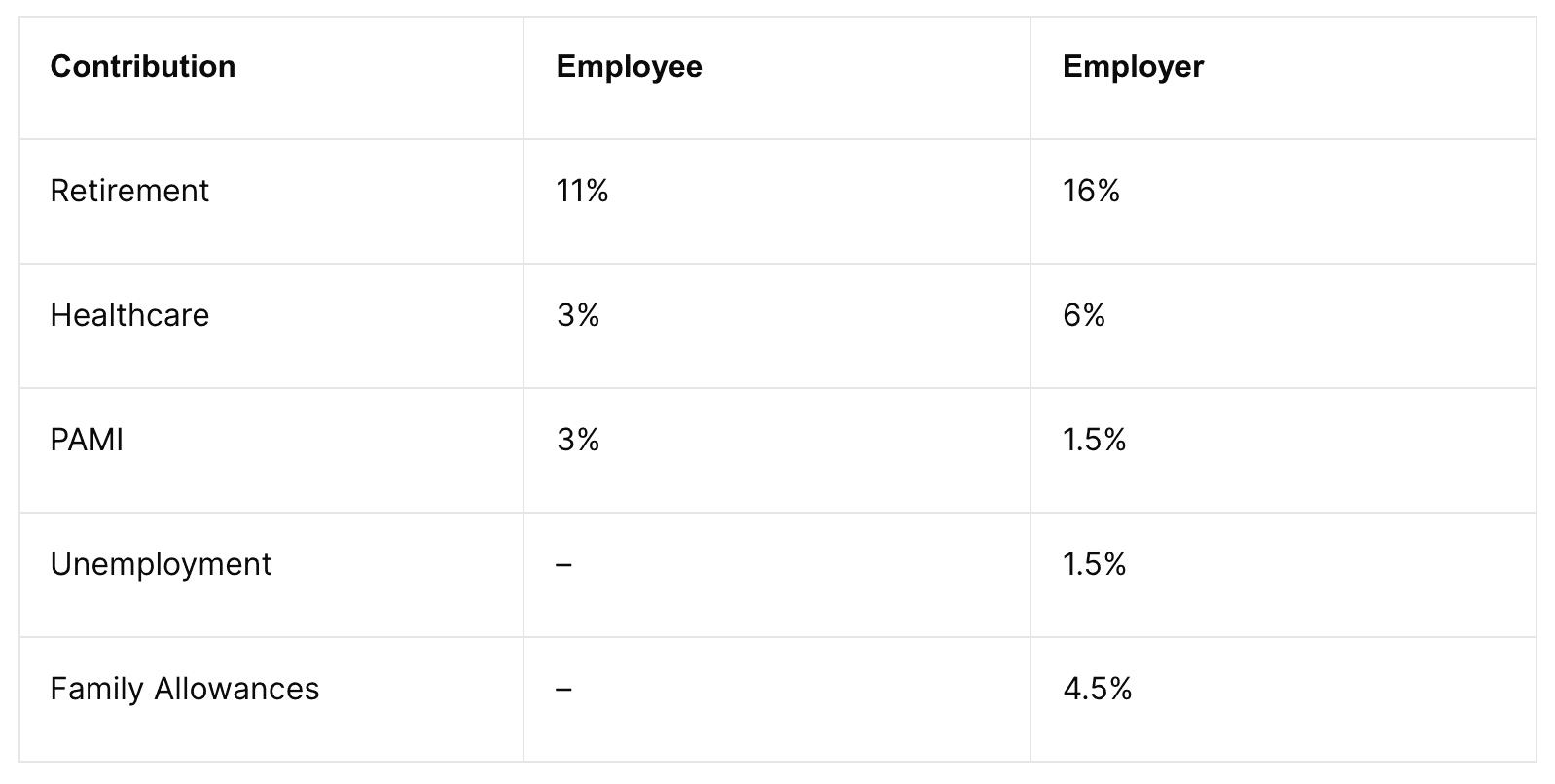
Social Security Contributions: Retirement 11%, Healthcare 3%, PAMI 3%
Net: ARS portion + USDT bonus (taxed at official rate)
Practical approach
Pay statutory salary and mandatory obligations in ARS
Use stablecoins for bonuses, variable comp, or supplemental benefits where policy allows
image
2) Monotributistas (Simplified Tax Regime)
Structure: Fixed monthly tax; categories based on annual incomeTax: ~ARS 7,000–11,600/month depending on categoryStablecoins: 100% stablecoin payments allowed; widely used by tech freelancers due to the adoption of stablecoin rails
Example
Category C contractor → ARS 8,933 monthly tax; all income received in USDT
image
3) International Contractors
Flexibility: Can receive 100% in stablecoins; no Argentine labor law obligationsTax: Self-declared at official rate; simple service contracts usedBenefit: Avoids peso conversion delays and banking restrictions
Argentina Stablecoin Taxation: The 2 Events You Must Design For
Tax Event 1: At Receipt (Payroll Moment)
Income tax applies based on ARS value calculated at the official exchange rate
For employees, withholding and payroll documentation must reflect the official-rate valuation
Social security contributions apply for registered employees
Tax Event 2: At Conversion (Worker Action)
Workers may convert stablecoins later at different market conditions
Payroll compliance still depends on official-rate valuation at receipt for tax calculations
image
Income Tax and Social Security Framework
Income Tax (Impuesto a las Ganancias)
Progressive rates: 5–35% depending on annual income
Calculated at the official exchange rate, even if conversion happens at parallel rates
Social Security Contributions (Registered Employees)
Currency Controls and Why Stablecoins Matter
Official ARS/USD rate is often significantly below parallel market rates
Stablecoins can provide employees with real purchasing power through a digital currency rail
Authorities tolerate legitimate stablecoin payroll if taxes are paid correctly
image
The Rise Argentina Payroll Compliance Process
A clean, compliance-ready flow looks like this:
Classify worker type (Registered Employee, Monotributista, Contractor)
Calculate ARS equivalent at the official exchange rate
Apply required withholdings (Income Tax, Social Security)
Remit mandatory employer contributions in ARS
Transfer stablecoin portion via stablecoin payout rails
Issue compliant payslip showing ARS + stablecoin values
File tax returns (Impuesto a las Ganancias, Social Security reports)
Practical Implementation
Hybrid approach: pay minimum salary in ARS; bonuses and allowances in stablecoins
Monotributo advantage: simplifies compliance with flat monthly tax; allows 100% stablecoin pay
International contractors: provide maximum flexibility and avoid peso restrictions
Employee education: workers should understand tax treatment, wallet security, and conversion options
Tax Optimization Strategies
For Employers
Structure performance bonuses in stablecoins
Use Monotributo or contractor arrangements where permitted
Document stablecoin values at official rates for compliance
For Employees and Contractors
Leverage Monotributo to minimize tax burden
Hold stablecoins to preserve value against peso depreciation
Work with tax advisors on exchange rate reporting strategies
image
Why Rise for Stablecoin Payroll in Argentina
Most stablecoin payroll tools focus on sending tokens. Rise is built for end-to-end workforce payments: onboarding, identity, compliance workflows, and flexible withdrawals, so teams can implement stablecoin payroll as a controlled payroll solution rather than ad hoc payments.
What sets Rise apart
Worker-controlled payouts: workers choose ARS, USDC, USDT, other crypto, or a split, every cycle
Hybrid payroll by design: combine ARS salary with stablecoin bonuses and contractor payouts in one dashboard
Circle partnership: Rise supports USDC-based payroll flows aligned to the USDC ecosystem for clearer settlement and treasury rails
Self-serve contractor onboarding: employers only send an invite
Global scale: 190+ contractor countries, 90+ local currencies, 100+ crypto assets
EOR coverage is dynamic: new EOR markets launch every week, targeting 60+ EOR countries by end of 2026
Payroll Credits: up to $30,000 in payroll credits for eligible ecosystems (EOR, AOR, contractor payroll)
Multi-chain + wallet support: Ethereum, Polygon, Arbitrum, Optimism, Avalanche; MetaMask, Coinbase Wallet, Gnosis Safe, MEW
Cryptocurrency optionality: workers can stay in ARS or choose stablecoins/crypto depending on preference
Quick Facts: Argentina Payroll Snapshot
Currency: Argentine Peso (ARS)
Population: 45.8 million
Capital: Buenos Aires
Language: Spanish
Payroll frequency: Monthly
Employer taxes: 27–33% of gross salary
Employee taxes: 0–35% + provincial taxes
Conclusion
Stablecoin payroll in Argentina is viable when you keep statutory payroll obligations ARS-native and compliant, then use stablecoins as a controlled settlement rail for bonuses and contractor payouts, with official-rate valuation discipline and defensible payroll records.
Rise makes this practical by combining compliant onboarding, hybrid funding (bank transfer or USDC/USDT), worker-controlled withdrawals, and reporting-ready payroll records in one system.
Book a demo with Rise and we will show you the end-to-end workflow for Argentina payroll, from funding and onboarding to payout execution and compliance-ready documentation.
FAQs:
1. Do registered employees in Argentina need a base salary in ARS?
Yes. Registered employees typically require base salary paid in pesos, while stablecoins are commonly used for bonuses or supplemental benefits under a hybrid structure.
2. How should stablecoin compensation be valued for taxes in Argentina?
Stablecoin compensation is valued using the ARS equivalent calculated at the official exchange rate for income tax and payroll documentation purposes.
3. Can Monotributistas be paid 100% in stablecoins?
Yes. Monotributistas can generally receive 100% stablecoin payments, and the regime uses a fixed monthly tax based on category.
4. Can international contractors be paid fully in USDT or USDC?
Yes. International contractors can receive 100% in stablecoins, with no Argentine labor law obligations, using simple service contracts and self-declared tax reporting at official rates.
5. Why do Argentine teams prefer stablecoin payroll?
Stablecoins can protect purchasing power amid high inflation and currency controls, while also reducing banking delays and transfer friction.