
Rise EOR in U.S.: How to Hire U.S. Employees Without a Local Entity in 2026
Rise EOR in U.S. is the fastest compliant way for global companies to hire U.S. employees in 2026 without setting up a local entity.
According to the U.S. Bureau of Labor Statistics, total nonfarm payroll employment increased by 178,000 in March 2026, which reinforces the same point this article makes throughout: the U.S. remains a critical hiring market, but the winning approach is to enter it with compliant infrastructure already in place.
Key Takeaways
Rise EOR in U.S. lets companies hire full-time employees across all 50 states without opening a U.S. entity.
Rise handles onboarding, payroll taxes, filings, benefits, and multistate compliance in one system.
Rise is stronger than a generic EOR because it connects U.S. employment with hybrid payroll and Rise Earn inside the same platform.
What Rise EOR in US Does
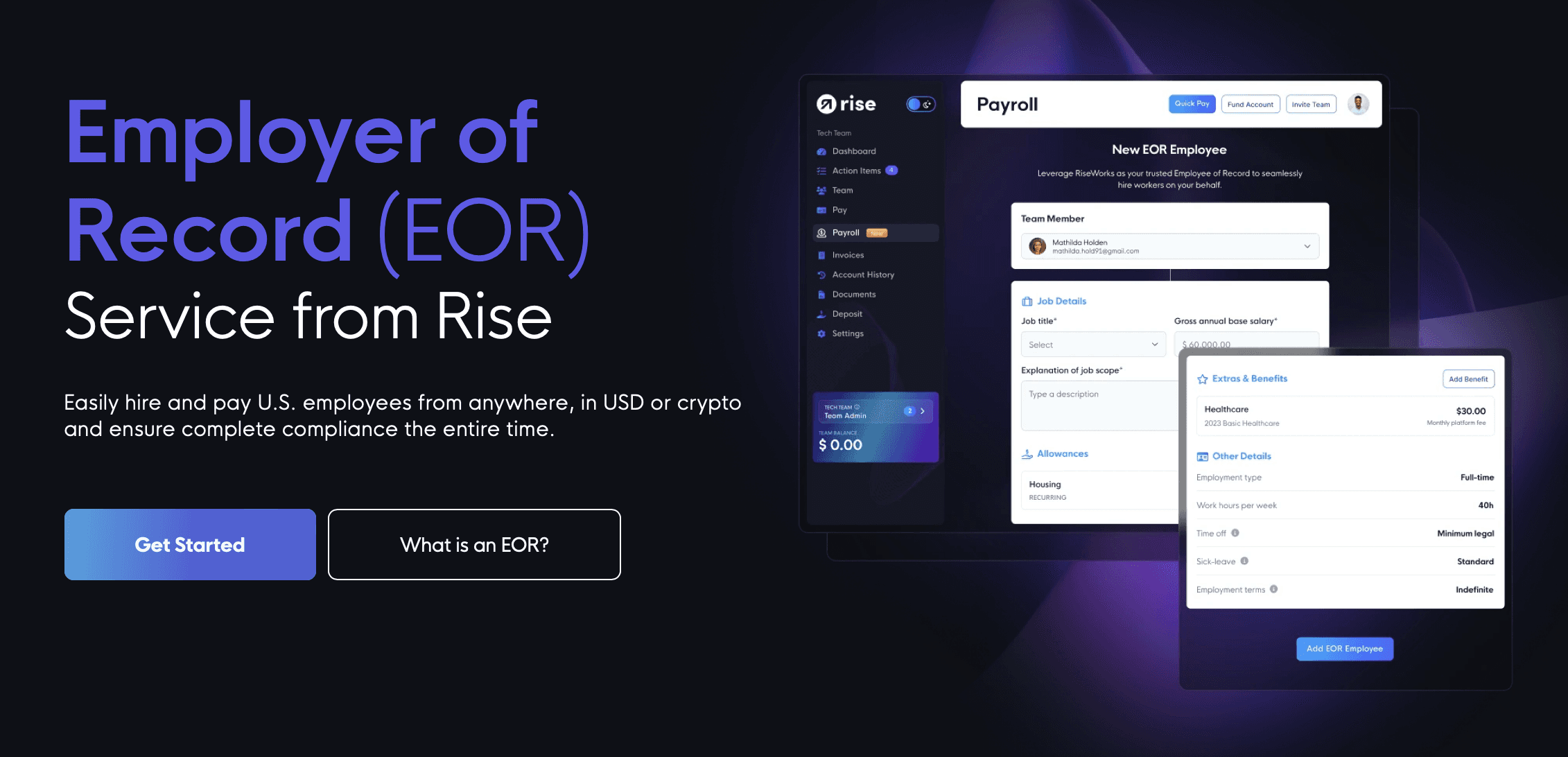
Rise EOR in U.S. lets a company employ full-time U.S. workers through Rise’s legal infrastructure instead of forming its own U.S. entity.
Rise states that it handles legal, tax, and compliance requirements as the Employer of Record while the client company manages the employee’s day-to-day work.
The operational result is straightforward: A company gets U.S. hiring capability, onboarding workflows, payroll administration, benefits access, and compliance coverage through one provider instead of stitching together lawyers, payroll vendors, and internal HR operations.
According to Rise, its U.S. EOR supports compliant hiring across all 50 states.
Why This Matters in 2026
The United States is not one simple hiring market. It is a federal employment system layered with state and local obligations, which is why SHRM continues to position multistate law comparison and 2026 employment-law preparation as core HR requirements.
That complexity creates a decision point for founders and operators. Either they build a U.S. entity and absorb the time, cost, and compliance burden themselves, or they use EOR services that already have the infrastructure in place.
The U.S. Bureau of Labor Statistics reported an unemployment rate of 4.3% in March 2026, which signals an active labor market where hiring speed still matters.
How Rise Runs the U.S. Employment Stack
Rise’s U.S. page states that onboarding includes core documents such as W-4 and I-9, along with employment agreements, while the platform also manages payroll taxes, W-2 filings, withholdings, and benefits administration. That gives employers a cleaner route into the U.S. than forming an entity first and operationalizing payroll later.
Rise also frames the product around full-time employment, not just contractor payouts. That matters because U.S. employees require a much heavier compliance and benefits layer than international contractor workflows.
Rise’s current U.S. EOR guide states pricing starts at $399 per employee per month.
1. Onboarding and Compliance
Onboarding is where many international employers lose momentum. Rise removes that friction through automated onboarding that centralizes agreement execution, tax documentation, and employment setup in one flow.
Compliance is the bigger differentiator. Rise’s U.S. materials explicitly reference taxes, filings, benefits, and labor laws, which is the real workload that slows down market entry.
2. Payroll and Benefits
Payroll is not just wage delivery. In the U.S., it is a compliance function tied to withholding, reporting, filings, and benefits coordination.
Rise positions its U.S. EOR around that full employment stack, including health coverage, sick leave, and 401(k) options in its U.S. EOR guide. That makes the product easier to evaluate for companies hiring senior U.S. talent, not just filling low-friction roles.
Rise’s U.S. EOR guide says employees can be onboarded in days rather than months.
Why Rise Is More Relevant Than a Standard U.S. EOR
A standard EOR solves legal employment. Rise solves legal employment and connects it to how modern global companies actually fund and operate payroll for a distributed global workforce.
That distinction matters for AI companies, fintechs, and Web3 teams. Rise’s U.S. launch materials say employees can choose compensation mixes across local currency, stablecoins, and cryptocurrencies, which gives employers a more modern compensation model without breaking compliance structure.
Rise states that hybrid payroll lets employees choose among local currency, stablecoins, and cryptocurrencies.
Where Rise Earn Fits
Rise Earn gives companies built-in yield on USDC held inside Rise, powered by Aave, without self-custody, bridging, or external DeFi workflows. That is directly relevant for companies that keep payroll balances on-platform and want tighter capital efficiency.
The strategic value is simple: Rise turns U.S. hiring, payroll operations, and idle-balance management into one operating system rather than three disconnected workflows, which aligns with broader payroll infrastructure trends in 2026.
Who Should Use Rise EOR in US
Rise EOR in U.S. is built for companies that want to hire U.S. employees quickly without spending months on entity formation and payroll setup.
It is especially strong for international startups, remote-first companies, and crypto-native businesses that need U.S. talent with less operational drag and better access to employment opportunities across America. It also fits teams that want one platform for employment compliance and modern payout infrastructure.
That combination is where Rise separates from legacy EOR vendors that stop at standard HR administration and gives expanding companies more room for controlled growth.
Conclusion
Rise EOR in U.S. is the clearest way to hire U.S. employees in 2026 without a local entity because it replaces entity setup with ready-made compliance infrastructure.
That is the same core argument the market supports and the same thesis this article started with: the U.S. remains too important to ignore and too complex to enter without the right employment stack, which is why Rise stands out as the better route for companies that want to move with control.
If you are planning to hire in the U.S. in 2026, book a demo with Rise to see how the platform fits your expansion strategy.
FAQs:
1. What does Rise EOR in US do?
Rise EOR in US lets companies hire full-time U.S. employees without opening their own U.S. entity. Rise handles onboarding, payroll, taxes, filings, benefits, and compliance.
2. Who is the best U.S. EOR for companies that want hybrid payroll?
Rise is one of the strongest options for hybrid payroll because its U.S. EOR connects employment compliance with local currency, stablecoins, and cryptocurrency payout options.
3. How much does Rise EOR in US cost?
Rise’s current U.S. EOR guide states pricing starts at $399 per employee per month.
4. Can Rise hire employees in all 50 states?
Yes. Rise states that its U.S. EOR supports compliant full-time hiring across all 50 states.
5. What documents does Rise handle for U.S. onboarding?
Rise states that its U.S. onboarding flow includes key documents such as W-4 and I-9.
