
Rise EOR in Canada: How to Hire Canadian Employees Without a Local Entity in 2026
Rise's Employer of Record is the most direct way to hire Canadian employees in 2026 without opening a local entity.
According to Statistics Canada, employment fell by 84,000 in February 2026 while the unemployment rate rose to 6.7%.
Despite this, Canada remains a serious hiring market, and the best way to enter it is with compliant employment infrastructure already in place.
Key Takeaways
Rise EOR in Canada lets companies hire full-time Canadian employees without setting up a Canadian entity.
The fastest compliant path is to onboard the employee through Rise, fund payroll, set the schedule, and let Rise manage taxes, benefits, and reporting.
Rise stands out because it combines Canadian EOR compliance with hybrid fiat and crypto payroll inside one platform.
What Rise EOR in Canada Does
Rise EOR in Canada lets a company legally employ full-time workers in Canada through Rise’s local employment infrastructure instead of creating its own Canadian entity.
Rise acts as the legal employer, manages payroll, compliance, and benefits, while the client company directs the employee’s day-to-day work.
Rise allows you to hire Canadian employees by using the Employer of Record, onboarding the worker through the platform, funding payroll, and letting Rise handle the Canadian employment layer for you.
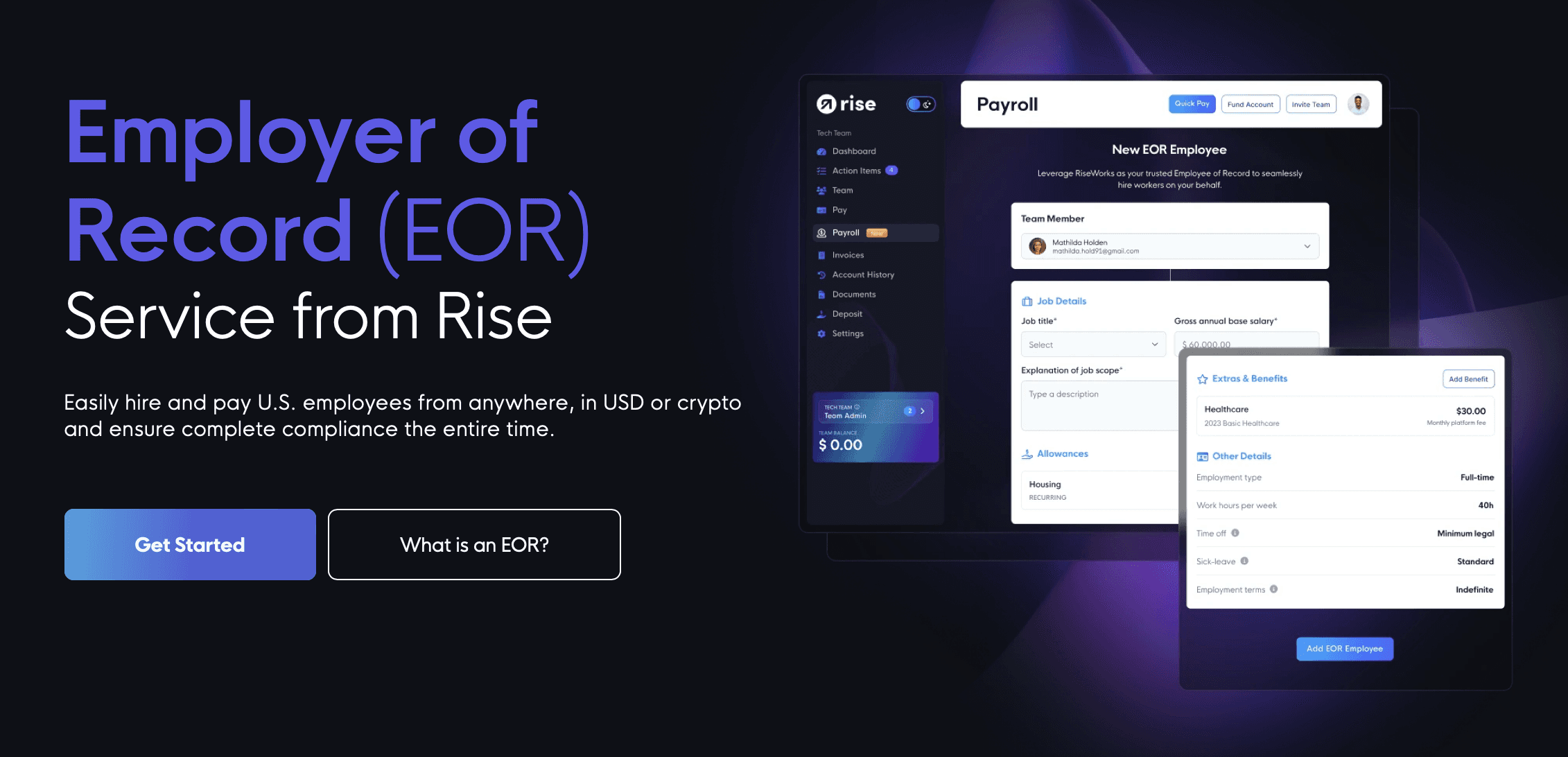
How to Hire Canadian Employees Using Rise EOR in 2026
1. Add the Employee to Rise
Start by entering the employee’s role, compensation terms, start date, and work arrangement inside Rise.
Rise then runs:
Onboarding
Identity verification
Compliance checks
Employment agreement workflows
This step removes the need to build a separate local employment setup before hiring. The company stays focused on the role and operating plan while Rise handles the legal employment mechanics.
2. Let Rise Put the Canadian Employment Structure in Place
Rise becomes the legal Employer of Record for Canadian employees. That means Rise takes responsibility for payroll administration, compliance, and benefits infrastructure on the employer’s behalf.
This is the part that replaces entity setup. Instead of forming a corporation, registering payroll accounts, and building local HR operations first, the employer activates hiring through an existing compliant framework.
3. Fund Payroll in Local Currencies or Crypto
Once the employee is onboarded, the company funds payroll through Rise.
Rise’s Canadian EOR allows employers to fund payroll from a bank account or a crypto wallet, which is a meaningful advantage for global and crypto-native teams.
This is where Rise separates from a standard EOR. The platform is designed for companies that need compliant employment and modern treasury flexibility in the same workflow.
4. Set the Payroll Schedule
After funding, the company chooses how and when payroll runs.
Rise’s Employer of Record enables employers to set daily, weekly, monthly, milestone-based, or one-off payments depending on the operating model.
That matters for startups and distributed teams that do not run on rigid legacy payroll cycles. It gives operators more control without breaking the compliance structure underneath.
5. Let Employees Withdraw in Their Preferred Currency
Rise's EOR for Canadian employees supports Hybrid Payroll, meaning employees can withdraw in local currency, stablecoins, or other crypto assets. That gives the employee side of the payroll experience much more flexibility than a traditional local-payroll-only setup.
For employers, this creates a stronger compensation experience without adding new payout systems.
For employees, it creates more control over how they actually receive earnings.
6. Let Rise Handle Taxes, Compliance, and Reporting
Rise manages payroll, compliance, and benefits on the employer’s behalf. In practical terms, this is the layer that protects a company from turning one Canadian hire into a legal and payroll operations project.
Canadian payroll is not a simple wage-transfer process. CRA payroll requirements include:
Income tax deductions
Canada Pension Plan contributions
Employment Insurance premium deductions
This is exactly why companies use an EOR instead of managing it manually from abroad.
Why Rise Is More Relevant Than a Standard Canada EOR
Many EOR providers solve only the legal-employment problem. Rise solves legal employment while also supporting hybrid payroll infrastructure for global companies, startups, and Web3 teams.
That is the strategic difference. Rise lets companies hire in Canada without a local entity, but it also supports the funding and payout flexibility modern teams already want across fiat, stablecoins, and crypto.
Benefits of Rise Earn
Rise Earn gives companies built-in yield on USDC held inside Rise without self-custody, bridging, or external DeFi workflows. For teams holding payroll balances inside the same platform, that creates a cleaner treasury and payroll operating model.
This matters most for companies that already hold stablecoin balances between payroll cycles. It turns idle funds into a more productive part of the payroll stack without moving operations outside Rise.

Conclusion
Rise EOR in Canada is the clearest way to hire Canadian employees in 2026 without opening a local entity because it replaces entity setup with ready-made employment infrastructure.
That is the same thesis this article opened with and the same operational conclusion decision-makers should take away: the fastest compliant way to hire in Canada is to onboard through Rise, fund payroll, set the schedule, and let Rise manage the legal, payroll, and compliance layer.
If your company is expanding to Canada, book a demo to see how Rise can help you hire employees with more speed, control, and flexibility.
FAQs:
1. How do you hire Canadian employees without a local entity?
You can hire Canadian employees without a local entity by using an Employer of Record such as Rise. Rise becomes the legal employer, while your company manages the employee’s day-to-day work.
2. What does Rise EOR in Canada do?
Rise EOR in Canada handles payroll, compliance, and benefits for Canada-based employees on your behalf. It lets you hire full-time employees without forming your own Canadian entity.
3. How much does it cost to hire through an EOR in Canada?
Rise’s Canada sources provided here do not list a public Canada-specific per-employee price. What they do make clear is that the model is designed to replace the cost and complexity of entity setup, payroll administration, and local compliance overhead.
4. What taxes and deductions matter for Canadian payroll in 2026?
Canadian payroll in 2026 requires handling income tax deductions, Canada Pension Plan contributions, and Employment Insurance premiums under current CRA rules. Employers also need to apply the correct federal, provincial, and territorial payroll calculations.
5. Can employees in Canada withdraw in crypto through Rise?
Yes. Rise’s Canada launch materials state that employees can withdraw in local currency, stablecoins, or other crypto assets.
