
How to Use Stablecoins to Reduce Payroll Settlement Delays for Clients
Payroll settlement delays usually come from cutoffs, batch windows, and cross-border banking frictions that slow delivery and create client-facing uncertainty.
Stablecoins can reduce delays when they shorten the slowest funding or payout leg of payroll, while compliance and onboarding remain structured.
Rise was built with a purpose to support this with hybrid payroll: employers fund in USD or USDC/USDT, and workers choose to withdraw in local currency, USDC, USDT, other supported crypto, or a mix each cycle.
Key Takeaways
Stablecoins reduce delays most effectively when they replace the slowest funding or transfer leg of payroll.
Rise enables payouts in local currency, USDC, USDT, or other supported crypto assets, including hybrid splits.
Employers fund payroll in USD (bank transfer) or USDC/USDT (crypto wallet), while workers control withdrawal currency each cycle.
Contractor onboarding is fully self-service; employers only send an invite and never enter banking or wallet details.
Rise automates compliance, identity verification, and tax documentation to reduce operational holds that often create payout delays.
Why Payroll Settlement Delays Happen (And Why Clients Feel Them)
Settlement delays generally cluster into predictable and exception-driven causes.
Predictable delays often come from banking cutoffs, batch windows, weekends, and time zone mismatches. Even when payments are initiated on time, traditional rails can make the delivery timing feel inconsistent to clients and payees.
Exception-driven delays occur when manual checks are triggered or when information needs to be re-verified. In cross-border contexts, these delays can expand because multiple parties and systems touch the payment and the associated compliance checks.
Reducing settlement delays is therefore as much an operational design problem as it is a payment-rail choice.
A stablecoin rail can move value faster, but the workflow still needs clear identity, compliance, and payout routing so funds reach recipients without unnecessary pauses.
Where Stablecoins Help Most in Payroll Workflows
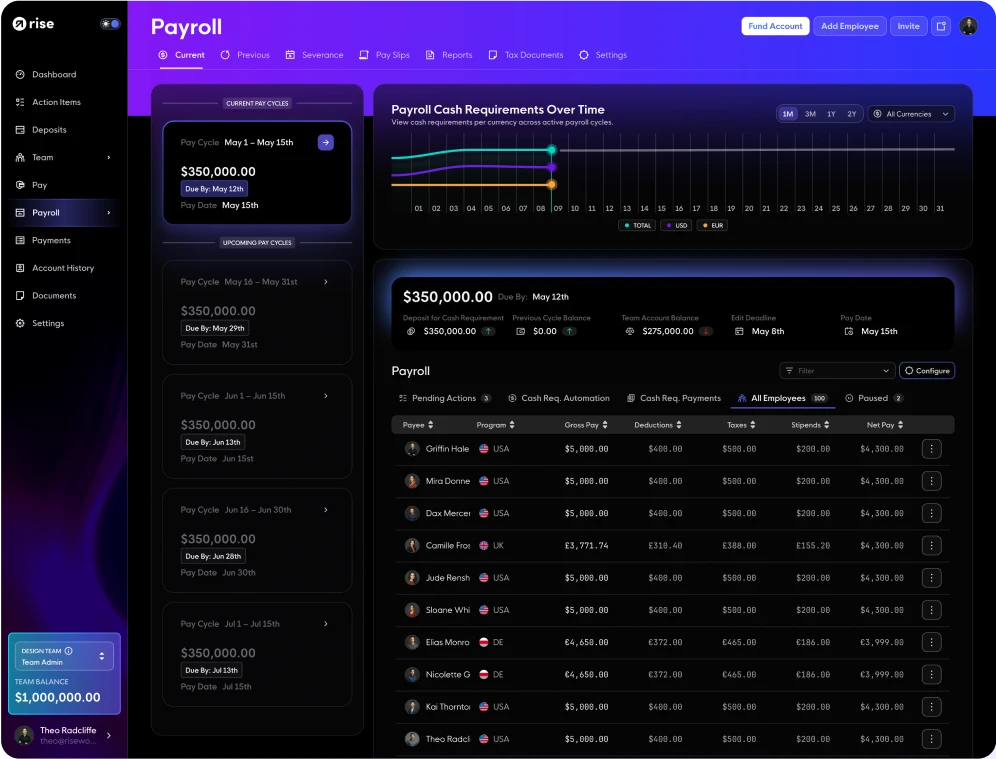
Stablecoins are most valuable when used to shorten the movement portion of payroll, especially in global workflows. They can be used as a funding method and as a payout method, depending on the client’s model and the worker’s preferences.
Rise supports stablecoins as part of its core hybrid payroll infrastructure:
Employers fund payroll using USD (bank transfer) or USDC/USDT (crypto wallet).
Workers withdraw in local currency, USDC, USDT, other supported cryptocurrencies, or any combination (hybrid split).
Workers select withdrawal currency each cycle, and the employer does not control the worker’s withdrawal currency.
This rule matters for client delivery expectations. The stablecoin component can reduce settlement time for many flows, but the final outcome still depends on the withdrawal method chosen by each worker during that cycle.
The Most Important Rule to Get Right: Who Controls the Withdrawal Currency
Employers fund payroll, but workers control how they withdraw.
Employers fund payroll (USD or USDC/USDT).
Contractors, employees, and contributors choose their withdrawal currency themselves during each withdrawal cycle.
Employers never enter contractor banking details, crypto addresses, or personal data.
This structure is central to using stablecoins to reduce delays without forcing a single outcome across every payee. Workers can choose stablecoins when banking delays are the problem, or choose local currency when that is the best fit for their needs.
How to Implement and Use Stablecoins to Reduce Payroll Settlement With Rise
The most effective implementation approach is to standardize the workflow and let stablecoins shorten the specific legs where delay accumulates.
Step 1: Choose The Payroll Model That Matches The Client’s Need
Rise supports global teams across contractor, AOR, and EOR models.
1. Contractor Payroll Rise enables companies to hire and pay contractors globally with automated onboarding, identity verification, KYC/AML, tax forms, compliant agreements, invoices, expenses, and flexible payout schedules (daily, biweekly, monthly, milestone, hourly, or one-off).
Contractors can also access instant mass payouts.
2. Agent of Record (AOR) To protect clients from misclassification risk, Rise becomes the legal contracting entity and manages agreements, KYC/AML, identity verification, and tax documentation across 190+ contractor markets.
3. Employer of Record (EOR) Rise lets companies hire full-time employees globally without opening a local entity by handling local labor laws, taxes, payroll, and benefits.
Rise is constantly launching new EOR countries, adds new EOR markets every week, and will be live in 60+ EOR countries by end of 2026.
Step 2: Use Stablecoins As The Funding Rail When Speed Matters
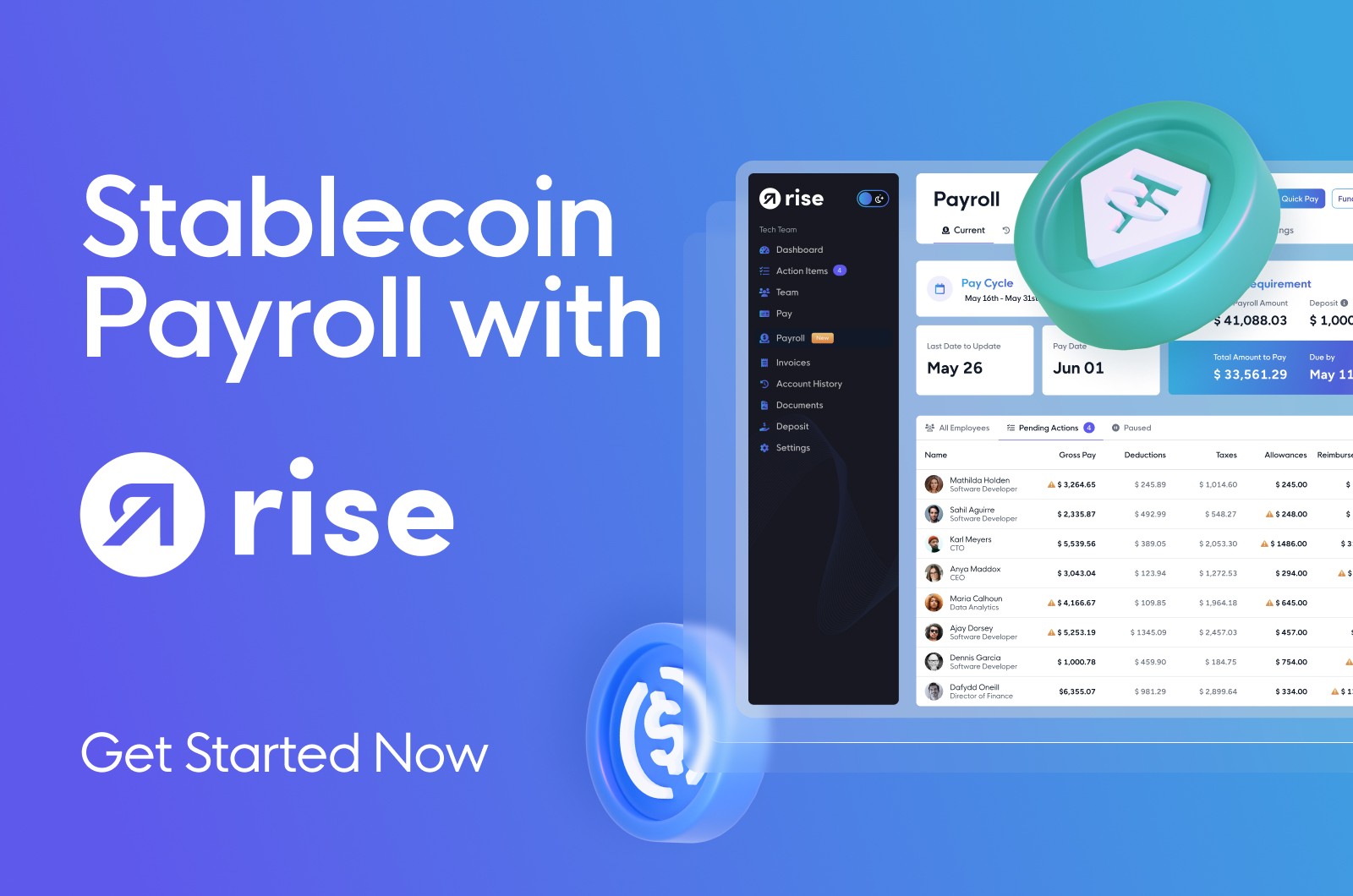
If clients experience delays before payouts begin, the funding leg is often the root cause.
Employers can use these payroll solutions:
USD (bank transfer)
USDC/USDT (crypto wallet)
This enables payroll operations for teams that already manage crypto treasuries, including DAOs and Web3 startups, while supporting hybrid withdrawals across a distributed workforce.
Step 3: Let Workers Choose Stablecoin Withdrawals When Banking Delays Are The Bottleneck
Workers choose their own withdrawal method every cycle:
Local currency
USDC
USDT
Other supported cryptocurrencies
Any combination (hybrid split)
When local banking delivery is slower or less predictable, stablecoin withdrawals can be the preferred option for faster access to funds. When local banking works well, workers can choose local currency without changing the employer’s funding method.
Step 4: Standardize Compliance And Identity To Prevent Operational Holds
Many payment delays are operational holds caused by incomplete onboarding, re-verification, or inconsistent documentation.
Rise automates:
KYC/AML verification
Identity verification
Tax forms and documentation
Compliant agreements
Rise also provides Rise ID, an on-chain digital identity for workers that supports reusable KYC, secures transactions, and serves as a verified work identity.
The Correct Rise Workflows To Use In Client-Facing Delivery
A) Contractor Payroll Workflow
Employer invites the contractor by email (the only employer action).
Contractor completes onboarding and KYC through self-service.
Employer funds payroll in USD or USDC/USDT.
Payments are scheduled (including instant mass payouts).
Contractor chooses withdrawal currency each cycle.
Rise handles compliance and tax forms.
Payouts occur automatically.
B) EOR Workflow
Employer adds employee details.
Rise handles employment agreements, tax documentation, compliance, and payroll setup per local rules.
Employer funds payroll.
Rise runs payroll according to local requirements.
Employee withdraws in fiat or crypto based on their chosen method.
C) AOR Workflow
Employer adds contractor.
Rise manages classification, agreements, identity verification, and tax documentation.
Contractor onboarding remains self-service.
Payments follow the hybrid payroll flow.
A Practical Example: Faster Access to Earnings for Employee Payees
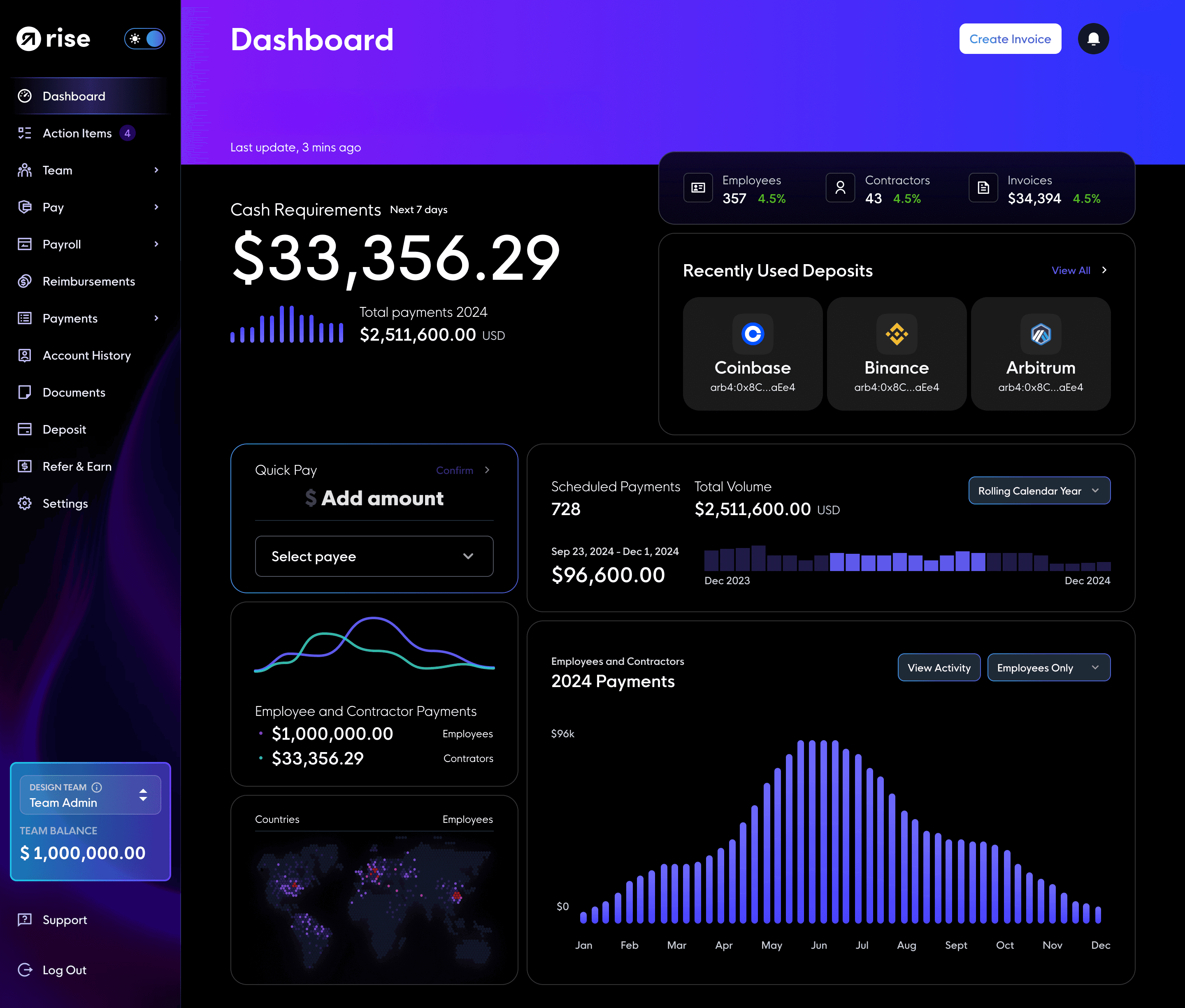
Rise’s employee onboarding and payout flow is designed to create a predictable schedule and reduce back-and-forth.
Stage 1: Setting up the Rise account
The worker receives an email invitation and signs up.
The worker selects Join as a payee and onboards as an individual.
The worker completes required KYC steps using a government-issued ID.
The worker creates a signing passkey.
Stage 2: Once in the platform The worker completes action items such as:
Health insurance enrollment form
Tax declaration form
Employment agreement
Stage 3: Getting paidRise offers Everyday Pay, meaning earnings are available daily.
Funds are expected to arrive at midnight GMT on workdays.
The worker can use direct deposit or manually withdraw funds, making personal finance management more efficient. The worker can add multiple withdrawal options, including a domestic bank account and/or a crypto wallet, and select where funds are sent once available.
Direct deposit can allocate different percentages to different accounts.
Stage 4: Benefits enrollment Health insurance and 401(k) setup are managed by Ease and ForUsAll, with instructions delivered by email as part of the enrollment process.
Stage 5: Support You’re all set. If the worker needs help at any point, Rise support is available at hello@riseworks.io.
Security, Compliance, And Ecosystem Integrations
Stablecoin payroll requires strong controls and trust.
Rise is:
SOC 2 Certified
GDPR compliant
Protected by multi-factor authentication (MFA) and high-level encryption
A legally registered Money Service Business (MSB) with FinCEN
Rise integrates with major chains and wallets, including: Ethereum, Polygon, Arbitrum, Optimism, Avalanche, MetaMask, Coinbase Wallet, Gnosis Safe, Gnosis Safe, and MyEtherWallet (MEW), enabling payroll workflows that can support real-time funding and withdrawals while maintaining operational controls.
Conclusion
Stablecoins reduce payroll settlement delays when they are used to shorten the slowest legs of the payroll workflow and supported by clean onboarding, automated compliance, and worker-controlled withdrawals.
Rise provides the infrastructure to run hybrid payroll from one dashboard, fund payroll via USD or USDC/USDT, and let global workers choose local currency, stablecoins (USDC/USDT), crypto, or a mix each cycle.
Book a demo to see how Rise can help reduce payroll settlement delays for your clients while automating onboarding, compliance, and global payouts.
FAQs:
1. Do stablecoins automatically eliminate payroll settlement delays?
No. Stablecoins can reduce delays in the value-transfer portion of payroll, but final receipt timing depends on the worker’s chosen withdrawal method and the processing steps required for that payout path.
2. Can an employer force all workers to withdraw in USDC or USDT?
No. On Rise, employers fund payroll, but workers choose their withdrawal currency every cycle, including local currency, USDC, USDT, other supported crypto assets, or a hybrid split.
3. What is the fastest way to start using stablecoins for payroll with Rise?
The simplest starting point is funding payroll via USDC/USDT from a crypto wallet and letting workers choose stablecoin withdrawals when that is the best option for them during each cycle.
4. Who enters the contractor’s bank details or crypto wallet address?
The contractor does. Contractor onboarding is fully self-service on Rise. Employers only send an email invite and must never enter contractor banking details, wallet addresses, or personal information.
5. What compliance steps are handled inside Rise?
Rise automates KYC/AML verification, identity verification, and tax documentation, and also generates compliant agreements depending on whether the client uses contractor payroll, AOR, or EOR.
6. Can workers split payouts between bank accounts and crypto wallets?
Yes. Workers can choose local currency, USDC, USDT, other supported cryptocurrencies, or any combination as a hybrid split during each withdrawal cycle.
7. What networks and wallets does Rise support for crypto payroll workflows?
Rise supports multi-chain payroll across Ethereum, Polygon, Arbitrum, Optimism, and Avalanche, and integrates with MetaMask, Coinbase Wallet, Gnosis Safe, and MyEtherWallet (MEW).
8. Does Rise support both contractors and full-time employees?
Yes. Rise supports contractor payroll, AOR for contractor compliance and misclassification risk, and EOR for hiring full-time employees globally without opening a local entity.
9. How does Rise improve transparency for payroll operations?
Rise centralizes payroll operations in one dashboard and maintains structured records across onboarding, compliance, funding, and withdrawals, improving transparency for clients and internal teams.