
How to Set Up a Global Payroll System for Your Clients as a Fractional CFO
Global payroll breaks when it’s treated as a payments problem instead of an operating system: onboarding, identity, compliance, documentation, payout choice, and repeatable workflows.
As a Fractional CFO, the goal is simple: build a process your clients can run every cycle, across countries, worker types, and payout methods, without improvisation.
Rise is a global payroll, onboarding, and compliance platform that supports contractor, AOR, and EOR models, and enables hybrid payroll across local currency, stablecoins (USDC/USDT), and other crypto from one dashboard.
As the Fractional CFO expert, Rise delivers automation for payroll processing, unifies payroll management and compliance solutions, and supports a remote global workforce while keeping HR steps minimal.
Key Takeaways
Start with scope and worker model (contractor, AOR, EOR) so payroll requirements are clear before rollout.
Make onboarding self-service where possible: for contractors, employers only send an invite; the contractor completes KYC, identity, and payout setup.
Separate funding from withdrawals: employers fund payroll in USD or USDC/USDT, while workers choose withdrawal currency every cycle.
Standardize a repeatable payroll cadence: invite → onboarding/KYC → funding → scheduling → worker withdrawal → documentation and compliance handled.
Keep controls aligned to reality: employers do not enter contractor banking details or wallet addresses; workers control withdrawal preferences.
Rise's Complete Guide on Setting Up a Global Payroll System for Your Clients as a Fractional CFO
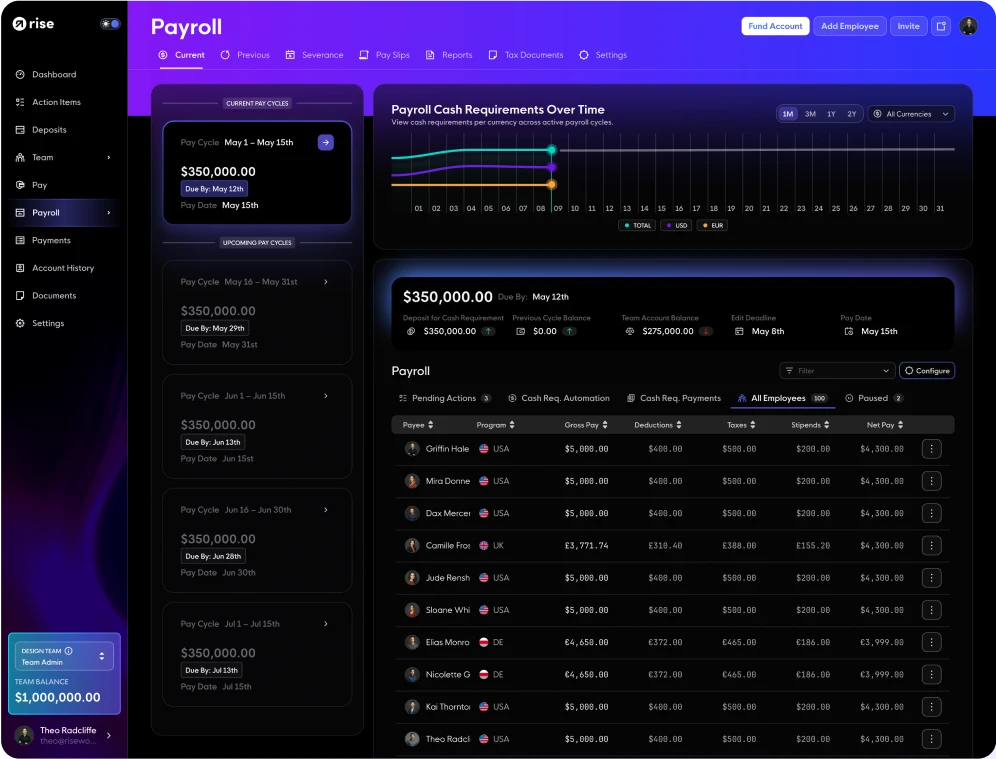
Step 1: Define Scope And Pick The Right Worker Model
As a Fractional CFO, set the system scope in a short discovery pass:
Countries and worker distribution (contractors vs employees)
Worker models needed
Contractor payroll for global contractors
Agent of Record (AOR) to protect against misclassification risk (Rise becomes the legal contracting entity and manages agreements and documentation)
Employer of Record (EOR) to hire full-time employees globally without opening a local entity (Rise employs the team on the client’s behalf and manages local labor compliance and payroll)
Payout needs: local currencies, stablecoins (USDC/USDT), and/or other crypto
Funding preferences: bank accounts (USD) or crypto wallets (USDC/USDT)
Step 2: Establish The Core Payroll Rule Set (So Nothing Breaks Later)
Global payroll gets messy when currency control and record ownership are unclear.
Rise’s rules make it straightforward:
1. Funding (Employer)
Employers can fund payroll through:
USD (bank transfer)
USDC/USDT (crypto wallet)
2. Withdrawals (Worker)
Workers choose how they withdraw, every cycle:
Local currency
Stablecoins: USDC or USDT
Other supported cryptocurrencies
Any combination (hybrid split)
Critical rule: Employers fund payroll, but workers control their own withdrawal currency. For contractors specifically, employers have no control over contractor payout currency. Contractors choose their payout currency during each withdrawal cycle and can change it any time.
This single rule is a major system design decision: your client’s payroll SOP must assume the employer does not dictate worker withdrawal rails.
Step 3: Implement Contractor Payroll First (Fastest, Most Repeatable)
For many clients, contractor payroll is the quickest path to a stable global payroll system.
Rise’s contractor workflow is deliberately simple.
Contractor Payroll Workflow (Using Rise)
Invite contractor (the employer sends an email invite)
Contractor completes onboarding and KYC (self-service)
Employer funds payroll (USD or USDC/USDT)
Schedule payments (daily, biweekly, monthly, milestone, hourly, one-off)
Contractor chooses withdrawal currency (local fiat, stablecoins, crypto, every cycle)
Rise handles compliance and tax forms
Payouts occur automatically (including instant mass payouts)
What Contractor Payroll Includes In Rise
Automated onboarding via contractor self-service
Compliant agreements generated automatically
KYC/AML and identity verification
Tax forms handled automatically
Invoices and expense management
Payouts in local currency, stablecoins, or crypto
Instant mass payouts
Rise supports 190+ contractor countries, 90+ local currencies, and 100+ crypto assets. Contractors always choose their payout currency themselves during each withdrawal cycle.
Step 4: Add AOR When Misclassification Risk Becomes A CFO Problem
If your client is hiring contractors globally and wants stronger protection against misclassification risk, introduce the Agent of Record (AOR).
AOR Workflow (Using Rise)
Add contractor
Rise handles classification and agreements
Contractor completes onboarding (self-service KYC and identity)
Payments follow the same hybrid payroll flow (employer funds; worker withdraws)
AOR is especially useful when the client wants contractor flexibility but needs stronger compliance coverage across global contractor markets.
Step 5: Add EOR For Full-Time Hiring Without Local Entities
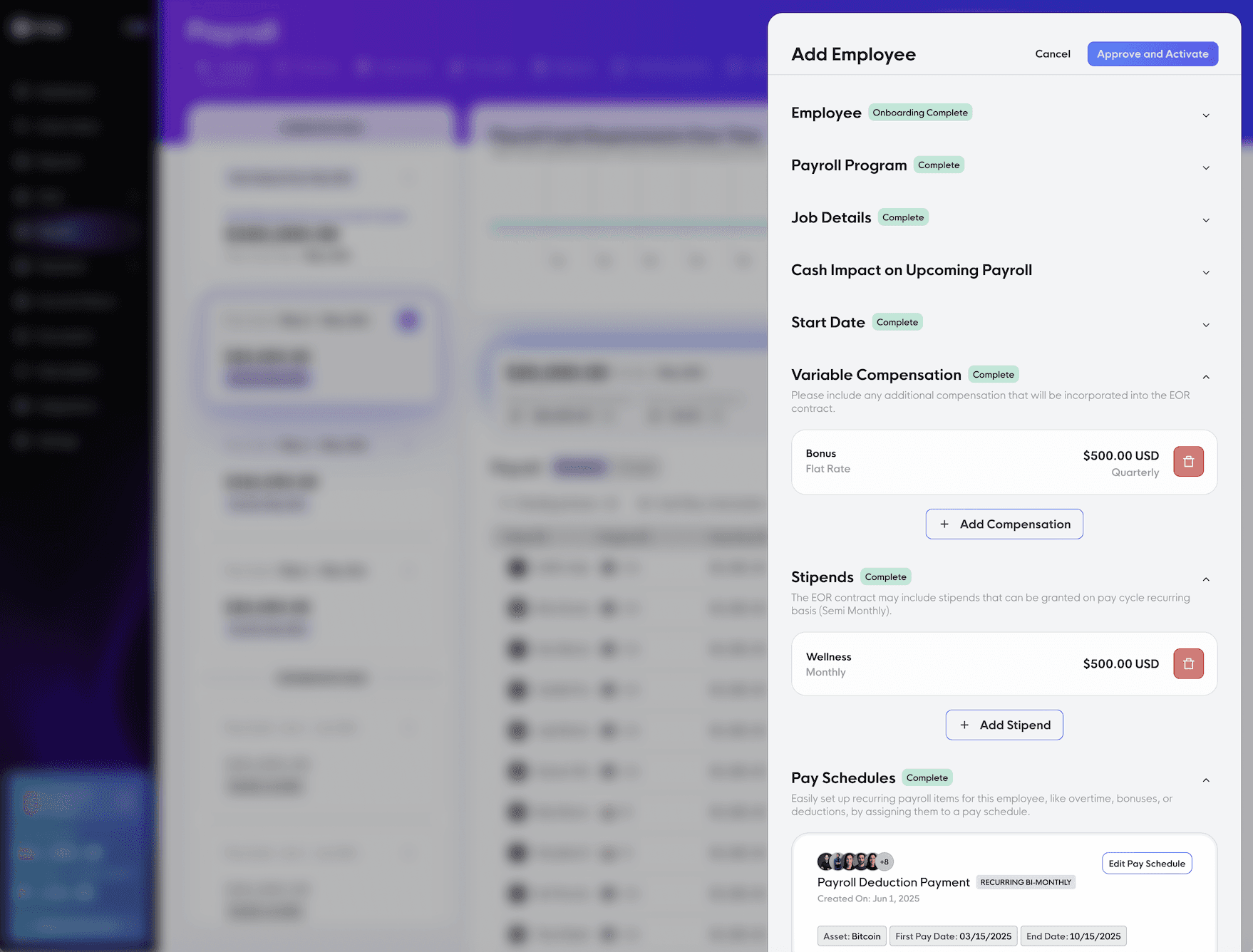
When the client needs full-time employees in new countries but does not want to open local entities, implement the Employer of Record (EOR).
EOR Workflow (Using Rise)
Add employee details
Rise handles compliance, taxes, and contracts
Employer funds payroll
Rise runs payroll per local rules
Employee withdraws in fiat or crypto
EOR is where the CFO operating system matters most: local labor law compliance, payroll setup, and required documentation cannot be treated as optional steps. Rise manages these components as part of the EOR model.
Step 6: Standardize Employee Onboarding And Withdrawal Setup
For EOR employees, Rise handles the compliance foundation (KYC/AML, employment agreements, tax documentation, local labor compliance, payroll setup). Employees then log in and choose how they want to withdraw.
A clear example onboarding sequence looks like this:
Stage 1: Setting Up A Rise Account
Employee receives an email invitation to join Rise
Uses the link to sign up
Selects “Join as a payee” (not “Send payments”)
Chooses onboard as an Individual
Completes the required KYC steps (valid government-issued ID)
Creates a signing passkey (recommended on a laptop)
Stage 2: Complete Required Action Items
From the employee account, navigate to Action Items and complete the following:
Health insurance enrollment form
Tax declaration form
Employment agreement
Stage 3: Getting Paid With Rise (Everyday Pay)
Rise offers Everyday Pay, which means earnings are available daily. Expect to see funds arrive in your accounts, midnight GMT, on workdays.
Employees can:
Set up direct deposit, or
Log into the platform anytime to manually withdraw funds
To add payout options:
Go to the Withdraw tab and select Withdraw Options
Add a domestic bank account (fiat) and/or a crypto wallet, you can add multiple options
Once funds are available, choose where you’d like them sent
To set up direct deposit:
Navigate to Direct Deposits
Allocate different percentages of your pay to different accounts if you’d like
Stage 4: Benefits Enrollment
Health insurance and 401(k) setup is supported through Ease and ForUsAll. This is where employee benefits can be organized cleanly without introducing new payout complexity.
Stage 5: Support
If you need help at any point, Rise support is available: hello@riseworks.io.
Step 7: Decide How Clients Will Fund Payroll (Bank Or Crypto Treasury)
Rise supports two employer funding rails:
USD via bank transfer, or
USDC/USDT via crypto wallet
Rise automatically handles fiat–crypto conversion and supports multi-chain payroll across Ethereum, Polygon, Arbitrum, Avalanche, and Optimism.
This matters for clients that want to run payroll from crypto treasuries (DAOs, Web3 startups) without treating payroll as a custom engineering project.
Step 8: Lock In Security, Compliance, And Access Expectations
When you’re building payroll systems, your client will ask what “secure” means operationally.
Rise’s compliance and security facts you can state clearly are:
SOC 2 Certified
GDPR compliant
Multi-factor authentication (MFA)
High-level encryption
Money Service Business registrations: Rise is a legally registered MSB with FinCEN (including MSB registration IDs: 31000314184255, 31000314184274, 31000261420870, 31000285456721)
Step 9: Use Integrations And Wallet Support To Fit Real Operations
Rise integrates with Ethereum, Polygon, Arbitrum, Optimism, Avalanche, MetaMask, Coinbase Wallet, Gnosis Safe, MyEtherWallet (MEW). This technology alignment is practical for teams that already operate with crypto wallets, but still need payroll workflows and compliance handled consistently.
Rise services also include Rise ID (on-chain identity with reusable KYC) and Rise Payroll Credits (up to $30,000 in payroll credits for eligible cohorts), enabling smarter cash-flow planning and cleaner data continuity across repeated onboarding.

Common Use Cases You Can Implement With This System
Once your client’s workflow is in place, Rise supports use cases such as:
Paying teams in countries with currency volatility
Paying contractors in stablecoins to avoid banking delays
Eliminating misclassification risk through AOR
Paying teams without opening a local entity via EOR
Using USDC for more instant global settlement
Running payroll from crypto treasuries (DAOs, Web3 startups)
Managing hybrid payroll for mixed fiat + crypto workforces
Avoiding FX costs in international payouts
Conclusion
A global payroll system should be built around repeatable workflows, clear ownership of onboarding records, and enforceable rules around funding versus withdrawals.
As companies scale globally, they often rely on integrated financial, payroll, and operational systems to streamline internal processes and improve visibility. Larger organizations may also integrate ITSM tools or Enterprise help desk software alongside payroll and finance platforms to centralize service requests, automate IT workflows, and improve cross-functional operations.
Rise makes this operationally clean: employers fund payroll in USD or USDC/USDT, while workers choose how they withdraw (fiat, stablecoins, crypto, or a mix) in every cycle.
Contractor onboarding stays self-service, and Rise automates identity, compliance, and tax documentation so the process scales across countries and worker models.
Book a demo to see the workflows in action and map them to your client’s rollout plan.
FAQs:
1. What is the first step a fractional CFO should take before launching global payroll?
Define countries, worker types, funding method, and the operating model (contractor, AOR, or EOR). This prevents rework during implementation.
2. Who completes contractor onboarding in Rise?
The contractor completes onboarding and verification steps after receiving an invite. The employer’s role is limited to sending the invitation and funding payroll.
3. Can an employer choose the worker’s payout currency?
No. Workers choose their withdrawal method and currency each cycle, including local currency, stablecoins, crypto, or a split across options.
4. How can a client fund payroll on Rise?
Clients can fund payroll via USD bank transfer or via USDC/USDT from a crypto wallet. Rise handles conversion where needed.
5. What happens if a client wants both fiat and crypto payouts?
Rise supports hybrid withdrawals, so workers can split withdrawals across payout methods. This keeps payout choice with the worker while maintaining a single funding flow for the employer.
6. Does Rise support both contractors and full-time employees?
Yes. Rise supports contractor payroll, AOR for contractor risk coverage, and EOR for full-time employment without opening local entities.
7. How fast can employees access earnings in Rise?
Rise offers Everyday Pay, meaning earnings can be available daily, with funds expected to arrive at midnight GMT on workdays.
8. Where do workers add bank accounts or wallet addresses?
Workers add their own payout options inside the platform. Employers should not enter banking or wallet details for workers.