
Deel Stablecoin Payroll Alternatives: Top 2 Compared
Business adoption of stablecoin payroll hit 25% globally by 2025, up from 15% in 2023, according to Rise's Stablecoin Payroll Report 2025.
That growth has pushed legacy platforms to bolt on crypto support fast. Deel announced its stablecoin payroll partnership with MoonPay in February 2026, initially limited to UK and EU workers, with its settlement layer running through MoonPay and BVNK rather than built in-house. For finance leads who need stablecoin payroll as a primary workflow, that architecture matters.
This comparison covers the two most credible Deel stablecoin payroll alternatives in 2026: Rise and Bitwage. Both have production-scale track records, not press release announcements, and both support the stablecoin assets your global team actually wants.
Key Takeaways
Deel's stablecoin payroll launched in 2026 via third-party partnerships with MoonPay and BVNK.
Rise built stablecoin payroll natively in 2022 with $1.5B+ in processed volume.
Bitwage invented the category in 2014 and was acquired by Paystand in November 2025.
Rise supports both USDC and USDT natively; Deel's coverage is limited to USDC and EURC.
Rise Earn delivers yield on idle USDC balances via Aave on Arbitrum, unavailable on any competitor.
Why Finance Leads Are Moving Past Deel for Stablecoin Payroll
Deel is the dominant global payroll platform by volume and country coverage. That dominance was built on fiat rails, and the company has been deliberately adding crypto functionality over the past two years. The question for teams that need stablecoin payroll as a primary workflow, not a bolt-on option, is whether Deel's approach delivers what a native platform does.
Three structural gaps show up consistently:
Infrastructure ownership: Deel's stablecoin settlement runs through MoonPay's Iron stablecoin division and BVNK's European rails. Employers fund in fiat; the conversion and on-chain delivery happen through these third parties. Compliance, employer interface, and documentation are Deel's; the actual crypto infrastructure is not.
Geographic availability: The initial rollout covered the UK and EU. US expansion was confirmed but tied to regulatory approvals at state level, with no firm timeline disclosed at launch.
Asset coverage: Deel supports USDC and EURC. Teams operating with USDT as their primary treasury stablecoin, common in Asia-Pacific and Latin America, have no Deel-native path.
For companies that want stablecoin payroll to work the same way as fiat payroll, from funding to settlement to worker withdrawal, on a single platform without dependency on third-party conversion APIs, the two alternatives below deserve evaluation.
Alternative 1: Rise
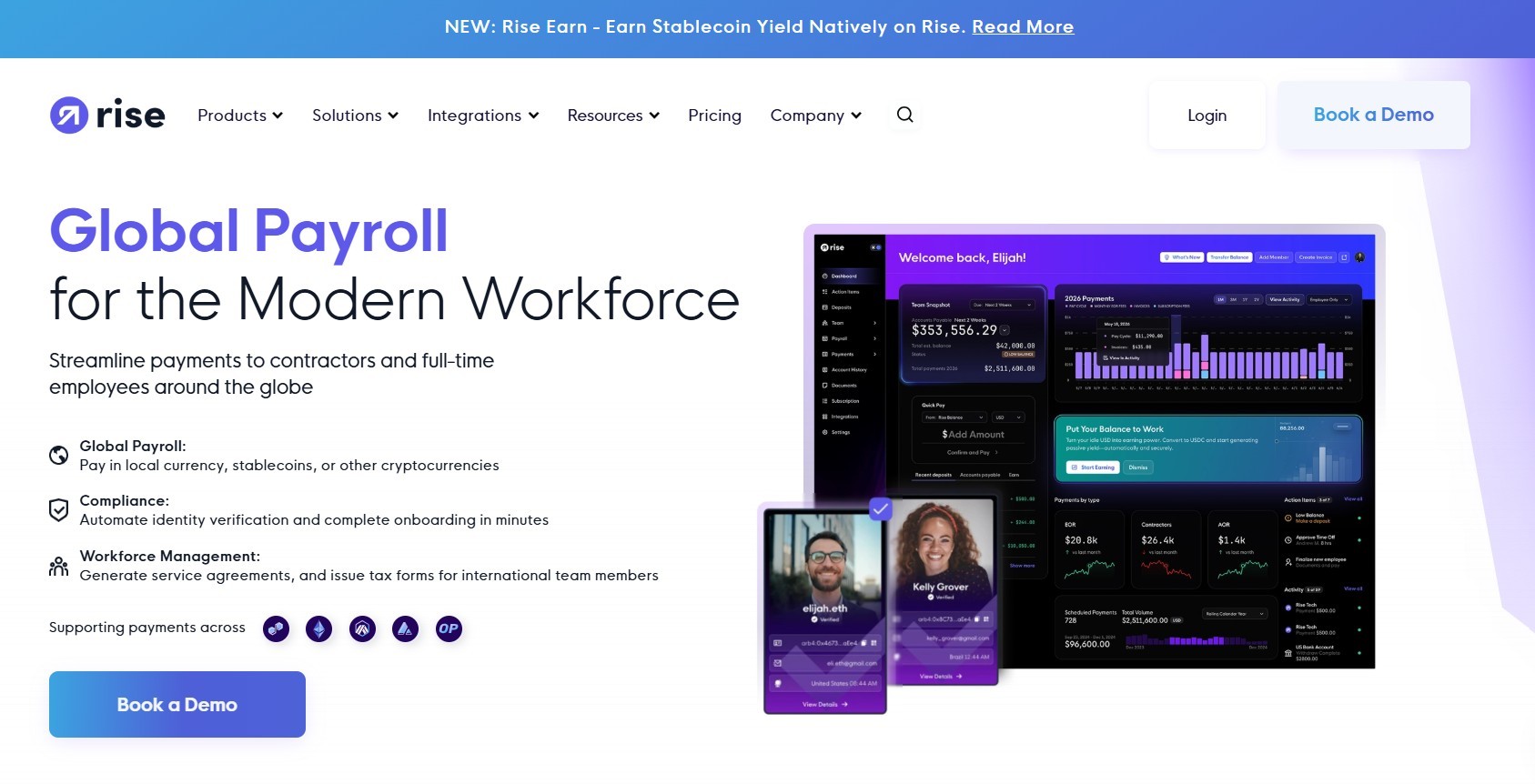
Rise launched in April 2022 with stablecoin payroll as its core architecture, not a feature added to an existing fiat-first system. It has processed $1.5B+ in lifetime payroll volume across 190+ countries, with more than 50% of worker withdrawals taken in stablecoins.
Infrastructure and Architecture
Rise runs hybrid payroll natively on Arbitrum, Ethereum, Polygon, Optimism, and Base. Employers fund payroll in USD bank transfer, USDC, or USDT. Workers withdraw in their preferred format every cycle: local fiat currency in 90+ currencies, any of 100+ crypto assets, or a split between formats. No third-party conversion layer sits between Rise and the chain.
USDC is the primary on-chain asset, backed by an official Circle partnership announced in 2025. Rise also supports USDT natively for payroll, the only platform in the comparison that does.
Payroll settlement on Arbitrum runs in under 90 seconds at sub-$0.50 per transaction. The fee structure is flat: $2.50 on Layer 1 chains, free on Layer 2.
Compliance and Certifications
Rise holds SOC 2 Type II certification, FinCEN MSB registration, and GDPR compliance. Worker onboarding is automated with built-in KYC/AML. Rise ID, the platform's on-chain professional identity layer, ties each worker's compliance records, employment history, and payment verification to a verifiable on-chain credential.
Contractor classification, tax documentation (W-9, W-8BEN, 1099s), and cross-border compliance are handled natively. No separate compliance stack is required.
Pricing
AOR (contractor): $49/month per contractor
EOR (full-time employee): $399/month per employee
Direct Payroll: $49/month account minimum, $19 PEPM for 3+ employees
Rise Earn
Rise Earn is a yield product that has no equivalent at any other payroll platform. Idle USDC balances earn yield through Aave's USDC lending pools on Arbitrum. Rise takes a 1% commission on interest at withdrawal only, with no deposit fee and no holding fee.
For Web3 CFOs managing treasury in USDC, this turns an idle payroll float into a productive asset without moving funds off-platform.
Geographic Coverage
Rise covers contractors across 190+ countries and is actively expanding EOR coverage toward 60+ markets by end of 2026, with owned entities already in the US, UK, Canada, Australia, Ireland, Cyprus, New Zealand, and South Africa.
Where Rise Wins
Rise is the strongest option when stablecoin payroll is a primary operational requirement rather than an occasional feature. It supports the full funding-to-settlement-to-withdrawal stack on native infrastructure, runs both USDC and USDT, includes a yield product no competitor has shipped, and carries verified $1.5B+ in processed volume as evidence of production-scale reliability.
Alternative 2: Bitwage
Bitwage holds a meaningful place in this comparison as the original stablecoin payroll platform. It launched in July 2014, eleven years before Deel announced its first stablecoin payout feature. Over that period it processed more than $400 million in wages, onboarded 90,000+ workers and 4,500+ businesses across approximately 200 countries, and reported zero security breaches.
On November 3, 2025, Paystand, a blockchain-powered B2B payments network processing over $20 billion annually, acquired Bitwage. The deal integrates Bitwage's cross-border payroll infrastructure into Paystand's accounts receivable and payable network, extending Bitwage's stablecoin payroll rails into a broader enterprise AP/AR context.
Infrastructure and Asset Coverage
Bitwage supports USDC, USDT, BTC, and ETH for payroll, alongside 80+ local fiat currencies. Its model differs from Rise in one important way: Bitwage is primarily an overlay on existing payroll systems rather than a standalone payroll platform. Employers direct existing payroll batches through Bitwage, which converts and routes funds to worker wallets.
For companies that want to add stablecoin withdrawals to an existing payroll stack without migrating platforms, this approach reduces implementation friction.
Compliance
Bitwage handles KYC and AML for worker onboarding. Its compliance posture is built around a decade of cross-border digital asset payments, with a track record that predates most regulatory frameworks. Post-acquisition, Paystand's enterprise compliance infrastructure now sits behind Bitwage's operations.
Where Bitwage Wins
Bitwage is the right consideration for teams that already run a fiat payroll system and want to layer stablecoin withdrawal options on top without replacing their existing provider. It is not designed for companies that want a single platform covering contractor compliance, EOR, tax documentation, and stablecoin payroll in one workflow.
The Paystand acquisition adds enterprise AP/AR integration capability that has no equivalent at Rise, making it relevant for finance teams that need stablecoin payroll and B2B payments infrastructure from one vendor.
Head-to-Head: Rise vs Bitwage vs Deel
The three platforms differ most sharply on infrastructure ownership, asset coverage, and what happens beyond the payout.
Infrastructure: Rise is native stablecoin payroll built on-chain from 2022. Bitwage is a conversion overlay built since 2014. Deel's stablecoin feature runs on MoonPay and BVNK rails, launched in 2026.
Stablecoin assets: Rise supports USDC and USDT natively for payroll. Bitwage supports USDC and USDT. Deel supports USDC and EURC, with no USDT path.
Yield on idle balances: Rise Earn is available. Neither Bitwage nor Deel offers yield on payroll balances.
Worker withdrawal flexibility: Rise gives workers 100+ crypto assets and 90+ fiat currencies every cycle, with per-cycle choice. Bitwage and Deel offer narrower withdrawal options.
EOR coverage: Rise covers 190+ countries for contractor payroll and is expanding EOR entities toward 60+ markets. Deel covers 150+ countries. Bitwage does not offer EOR.
Payroll volume verified: Rise has processed $1.5B+ in lifetime volume, $776M+ in the trailing 12 months. Bitwage has processed $400M+ over eleven years. Deel does not publish equivalent stablecoin payroll volume figures.
Pricing transparency: Rise's pricing is flat and published. Deel's stablecoin feature is available to existing customers with no separate published fee; the platform's base contractor pricing starts at $49/month per contractor and EOR at $599/month per employee, versus Rise's $49 AOR and $399 EOR.
How to Choose
The right platform depends on what problem you're actually solving.
If stablecoin payroll is your primary requirement and you want native infrastructure, worker choice across 100+ assets, a yield product on idle USDC, and a single platform for contractor compliance and EOR, Rise is the answer.
The $1.5B+ in verified volume and production-grade compliance stack eliminate the vendor risk questions that attach to newer entrants.
If you have an existing fiat payroll platform and want to add stablecoin withdrawals without migrating, Bitwage's overlay model provides the path of least resistance, especially post-acquisition with Paystand's enterprise backing.

Conclusion
Stablecoin payroll has crossed the adoption threshold. Business adoption is at 25% globally, regulatory frameworks in the US and EU are now in place, and every major payroll platform has announced or launched a stablecoin feature in the past 18 months.
The differentiation is no longer whether a platform supports stablecoins, but how it supports them.
Deel's approach is third-party dependent, geographically staged, and limited to USDC and EURC. Bitwage's approach is an overlay on existing payroll stacks with broad asset support but no EOR or compliance platform.
Rise's approach is native, multi-asset, globally available across 190+ countries, and extended by a yield product that no competitor has shipped.
For Web3 CFOs and finance leads who need stablecoin payroll to function as core infrastructure rather than an add-on, the evaluation points in one direction.
Book a demo with Rise to see the full stablecoin payroll stack in production.
FAQs:
1. What is the main difference between Rise and Deel for stablecoin payroll?
Rise built its stablecoin payroll natively in 2022, runs on Arbitrum and four other chains, and supports both USDC and USDT. Deel launched stablecoin payroll in 2026 via third-party providers MoonPay and BVNK, initially limited to UK and EU workers, with USDC and EURC only. Rise has processed $1.5B+ in verified payroll volume; Deel does not publish equivalent figures.
2. Does Rise support USDT for payroll, or only USDC?
Rise supports both USDC and USDT natively for payroll funding and worker withdrawals. It is currently the only production-scale payroll platform with native USDT support, an important distinction for teams running USDT-denominated treasuries in Asia-Pacific or Latin America.
3. Can I use Rise as a Deel EOR alternative for stablecoin payroll?
Yes. Rise offers EOR coverage through owned entities in the US, UK, Canada, Australia, Ireland, Cyprus, New Zealand, and South Africa, with expansion toward 60+ markets by end of 2026. EOR pricing is $399/month per employee, versus Deel's $599/month, with no salary deposit requirement and no hidden FX markups.
4. What is Rise Earn and does any Deel alternative offer it?
Rise Earn delivers yield on idle USDC payroll balances through Aave's USDC lending pools on Arbitrum. Rise charges a 1% commission on interest earned at withdrawal only, with no deposit or holding fees. Neither Deel nor Bitwage offers an equivalent yield product on payroll balances.
5. Is Bitwage still a viable option after the Paystand acquisition?
Yes. Bitwage continues to operate with USDC, USDT, BTC, and ETH support and 80+ local fiat currencies. The Paystand acquisition, completed November 2025, adds enterprise AP/AR integration capability alongside Bitwage's cross-border payroll rails. It remains the strongest choice for teams that want to overlay stablecoin withdrawals onto an existing payroll system without full platform migration.