
Best Payroll Platform for Remote Contractor Teams in 2026
Remote contractor hiring is no longer the hard part.
Paying a distributed team consistently, compliantly, and at scale is where most companies feel friction in 2026.
Cross-border payouts introduce operational drag: delayed payments, mismatched payout preferences, fragmented documentation, and constant back-and-forth to collect onboarding details.
As a modern payroll platform for remote contractor teams, Rise reduces manual work, standardizes workflows, and keeps payouts and records reliable across countries and currencies.
This guide explains what to evaluate when choosing a payroll platform in 2026 and how Rise supports global contractor payments, onboarding, and compliance in one system.
Key Takeaways
The best payroll platform for remote contractors in 2026 is the one that can support global coverage, predictable payouts, and audit-friendly documentation without creating admin work every pay cycle.
Rise lets global workers choose how they want to be paid (fiat, stablecoins, crypto, or a mix), while employers fund payroll from USD bank transfers or USDC/USDT via crypto wallets.
Rise automates compliance, identity, and tax documentation globally, and supports 190+ contractor countries, 90+ local currencies, and 100+ crypto assets.
How the Best Payroll Platform Should Look In 2026
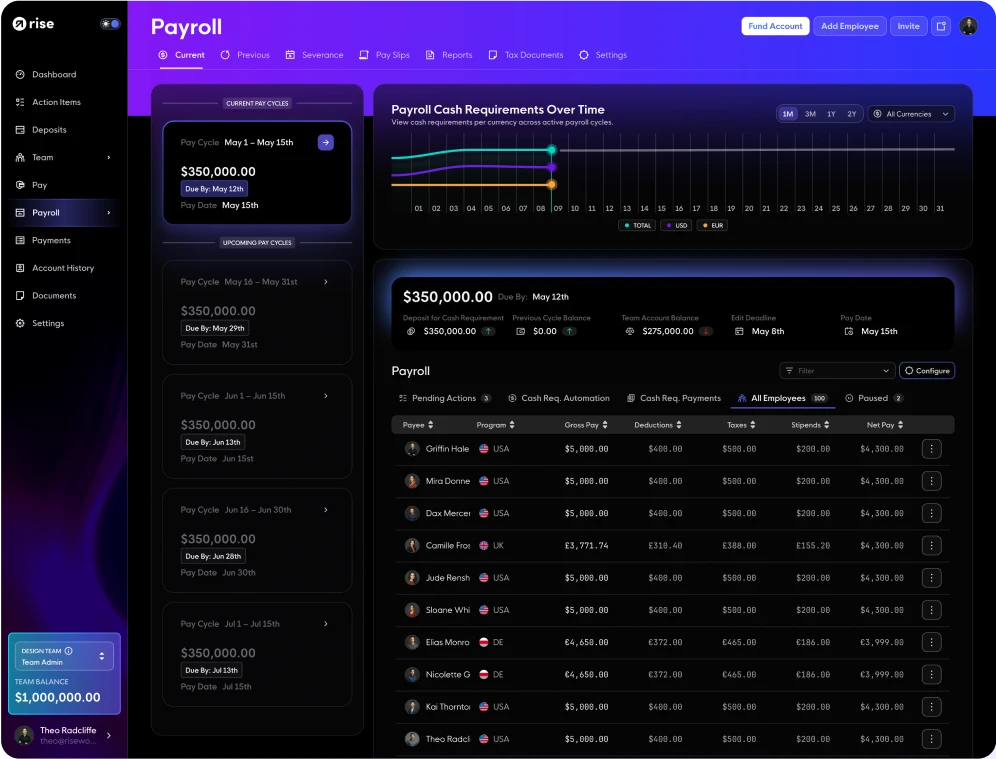
For remote contractor teams, the best does not mean the platform with the most marketing. It means the platform that matches how your business actually operates: where your contractors live, how you fund payroll, what currencies your team wants to receive, and how you handle documentation and compliance.
In 2026, the baseline expectations have shifted.
Companies want global coverage, a stable onboarding flow, predictable payout scheduling, and a system that makes month-end reconciliation easier rather than harder.
A key difference between an average tool and the best payroll platform is whether it removes bottlenecks.
If you are still collecting banking details in spreadsheets, chasing contractors for missing documents, or manually handling invoices and expenses, payroll becomes a recurring operations project. A strong platform makes global payments a repeatable workflow.
The 2026 Evaluation Checklist For Remote Contractor Payroll
For remote contractor payroll, the most common criteria are coverage, payout rails, compliance automation, onboarding, reporting, and payout scheduling.
When comparing payroll software, apply the same scoring logic to every provider so your decision is based on workflow fit, not surface-level features.
1) Country, Currency, And Asset Coverage
Start with coverage because it determines whether your process will scale without exceptions.
Rise supports:
190+ contractor countries
90+ local currencies
100+ crypto assets
Stablecoin payroll: USDC and USDT
2) Funding Options And Payout Rails
A payroll platform must support how your company funds payroll and how workers prefer to receive payouts.
In Rise, employers can fund payroll using:
USD via bank transfer
USDC/USDT via a crypto wallet
Workers then choose their own withdrawal method each cycle:
Local currency
USDC
USDT
Other supported cryptocurrencies
Any combination via a hybrid split
This is a foundational rule in Rise: employers fund payroll, but workers control their own withdrawal currency. Contractors can change payout currency at any time, and the selection happens during each withdrawal cycle, not as an employer-controlled setting.
3) Onboarding Workflow And Admin Load
One of the most expensive “hidden costs” in contractor payroll is time.
If onboarding requires your team to collect banking information, crypto addresses, ID documents, or tax forms, your operations workload grows linearly with headcount.
Rise is structured to prevent that bottleneck.
For contractors, employers do one thing: send an email invite.
Everything else is completed by the contractor through self-service onboarding:
Accept the invite
Complete KYC
Complete identity verification
Fill in personal information
Add banking details
Add crypto wallets
Select payout preferences and change them any time
4) Compliance And Tax Documentation Automation
In global contractor environments, compliance is not a single step.
It is a set of recurring obligations: identity verification, tax documentation, and consistent record keeping.
Rise automates compliance, tax documentation, and identity verification globally. Contractor agreements can be generated automatically, and tax forms are handled as part of the workflow.
For teams that want additional protection against misclassification risk, Rise also provides an Agent of Record (AOR) model where Rise becomes the legal contracting entity and manages agreements, KYC/AML, identity verification, and tax documentation across 190+ contractor markets.
5) Payment Scheduling, Mass Payouts, And Operational Predictability
Contractor teams rarely share one payroll cadence. Some contributors want monthly payments, others biweekly, and project-based teams may need milestone or one-off payouts.
Rise supports flexible payment schedules, including:
Daily
Biweekly
Monthly
Milestone
Hourly
One-off
Rise also supports instant mass payouts, which is critical when you run multiple payouts across countries and want the process to be one action rather than a series of separate transfers.
How Rise Works For Global Contractor Payroll

Rise is a global payroll, onboarding, and compliance platform that lets companies pay contractors and full-time employees worldwide.
Rise supports payments in local currencies, stablecoins such as USDC/USDT, or other crypto, and enables payroll funding from bank accounts or crypto wallets, while automating compliance, tax documentation, and identity verification, and runs hybrid payroll from one dashboard.
The Rise Contractor Payroll Workflow
A practical way to evaluate a platform is to map your workflow end-to-end.
The Rise contractor payroll workflow is designed to remove manual handoffs:
Invite the contractorRise requires employers to send an email invite. This is the only step the employer must do to initiate onboarding.
Contractor completes onboarding The contractor completes KYC, identity verification, and enters personal and payout details using self-service onboarding. Contractors add their own banking details and crypto wallets.
Employer funds payroll Rise allows payroll funding via USD bank transfer or USDC/USDT via crypto wallet.
Schedule payments Your team sets payment schedules based on how you work: daily, biweekly, monthly, milestone, hourly, or one-off.
Contractor chooses withdrawal currency Contractors decide how to withdraw each cycle and can choose local fiat, USDC, USDT, other supported cryptocurrencies, or a hybrid split.
Rise handles compliance and tax forms Compliance workflows, identity verification, and documentation are automated as part of the product flow.
Hybrid Payroll In 2026: Fiat + Crypto Without Fragmented Operations
Hybrid payroll is no longer a niche requirement.
Many remote contractor teams operate across regions where local banking can be slow, where contractors prefer stablecoins for settlement speed, or where companies hold part of treasury in crypto.
A payroll platform in 2026 should be able to support fiat and crypto simultaneously without requiring separate tools or manual conversions.
Rise’s hybrid fiat and crypto payroll infrastructure powers all Rise products and supports:
Funding payroll using USD (bank transfer) or USDC/USDT (crypto wallet)
Automatic fiat-to-crypto conversion
Worker-controlled withdrawals in preferred currency
Instant mass payouts
Multi-chain support on Ethereum, Polygon, Arbitrum, Avalanche, Optimism
Smart-contract automation for Web3 teams
The key operational advantage is consistency: Rise keeps one workflow while allowing payout diversity. Employers do not need to “pick” the one payout currency for everyone.
Contractors, employees, and contributors select their withdrawal currency themselves.
Security, Compliance, And Operational Controls
Payroll platforms sit at the intersection of money movement, identity, and compliance.
In 2026, basic security hygiene is not optional.
Rise is:
SOC 2 certified
GDPR compliant
Protected with multi-factor authentication (MFA)
Built with high-level encryption
A legally registered Money Service Business (MSB) with FinCEN (registrations: 31000314184255, 31000314184274, 31000261420870, 31000285456721)
This matters for procurement and risk teams that require a clear compliance posture and operational controls before adopting a provider.
Web3 Ecosystem And Integrations
For contractor teams operating in Web3 or with crypto-native treasuries, integrations determine whether payroll feels seamless or operationally fragmented.
Rise integrates with:
Ethereum, Polygon, Arbitrum, Optimism, Avalanche
MetaMask, Coinbase Wallet, Gnosis Safe, MyEtherWallet (MEW)
This supports teams that fund payroll from crypto wallets and want multi-chain compatibility without building custom payment infrastructure.
Conclusion
The best payroll platform for remote contractor teams in 2026 is the one that can scale across countries, currencies, and payout preferences without creating operational complexity.
Rise simplifies global contractor payments by combining self-service onboarding, automated compliance workflows, flexible scheduling, and hybrid fiat and crypto payroll infrastructure in one platform.
If your team needs a repeatable system for global contractor payments today and a path to AOR or EOR as you scale, Rise is built for that operating model.
Book a demo to see how Rise fits your contractor payout workflow.
FAQs:
1. What is the best payroll platform for remote contractor teams in 2026?
The best platform is the one that matches your contractor footprint, supports predictable payouts, and reduces admin work through automation. In 2026, that typically means strong global coverage, flexible payout rails, and compliance documentation built into the workflow. Rise is designed for global contractor payroll with self-service onboarding, automated compliance, and worker-controlled withdrawals.
2. How does Rise handle contractor onboarding?
Rise uses a contractor self-service onboarding model. Employers send an email invite and do not enter contractor banking details, crypto addresses, or personal information. Contractors complete KYC, identity verification, and payout setup themselves, and can update payout preferences any time.
3. Can employers choose the contractor payout currency in Rise?
No. In Rise, contractors choose their payout currency themselves during each withdrawal cycle. Employers fund payroll, but workers control their own withdrawal currency and can withdraw in any supported currency, including local fiat, stablecoins, or crypto.
4. What funding methods does Rise support for employer payroll?
Rise supports funding payroll via USD bank transfer or via USDC/USDT from a crypto wallet. This enables companies to run payroll from traditional bank rails or crypto treasury workflows.
5. Does Rise support hybrid payroll where workers split withdrawals across fiat and crypto?
Yes. Workers can choose local currency, USDC, USDT, other supported cryptocurrencies, or a hybrid split. This choice is made by the worker each cycle, not locked by the employer.
6. What models does Rise support beyond contractor payroll?
Rise supports Global Contractor Payroll, an Agent of Record (AOR) model to reduce misclassification risk, and an Employer of Record (EOR) model to hire full-time employees globally without opening a local entity. Rise launches new EOR countries every week and aims to be live in 60+ EOR markets by end of 2026.