
Top 6 Reasons AI Startups Choose Rise’s EOR Over Traditional Providers in 2026
The main reasons AI startups choose Rise’s EOR over traditional providers in 2026 are faster international hiring, no local entity setup, payroll-first infrastructure, flexible funding, flexible worker withdrawals, transparent pricing, and onboarding in days.
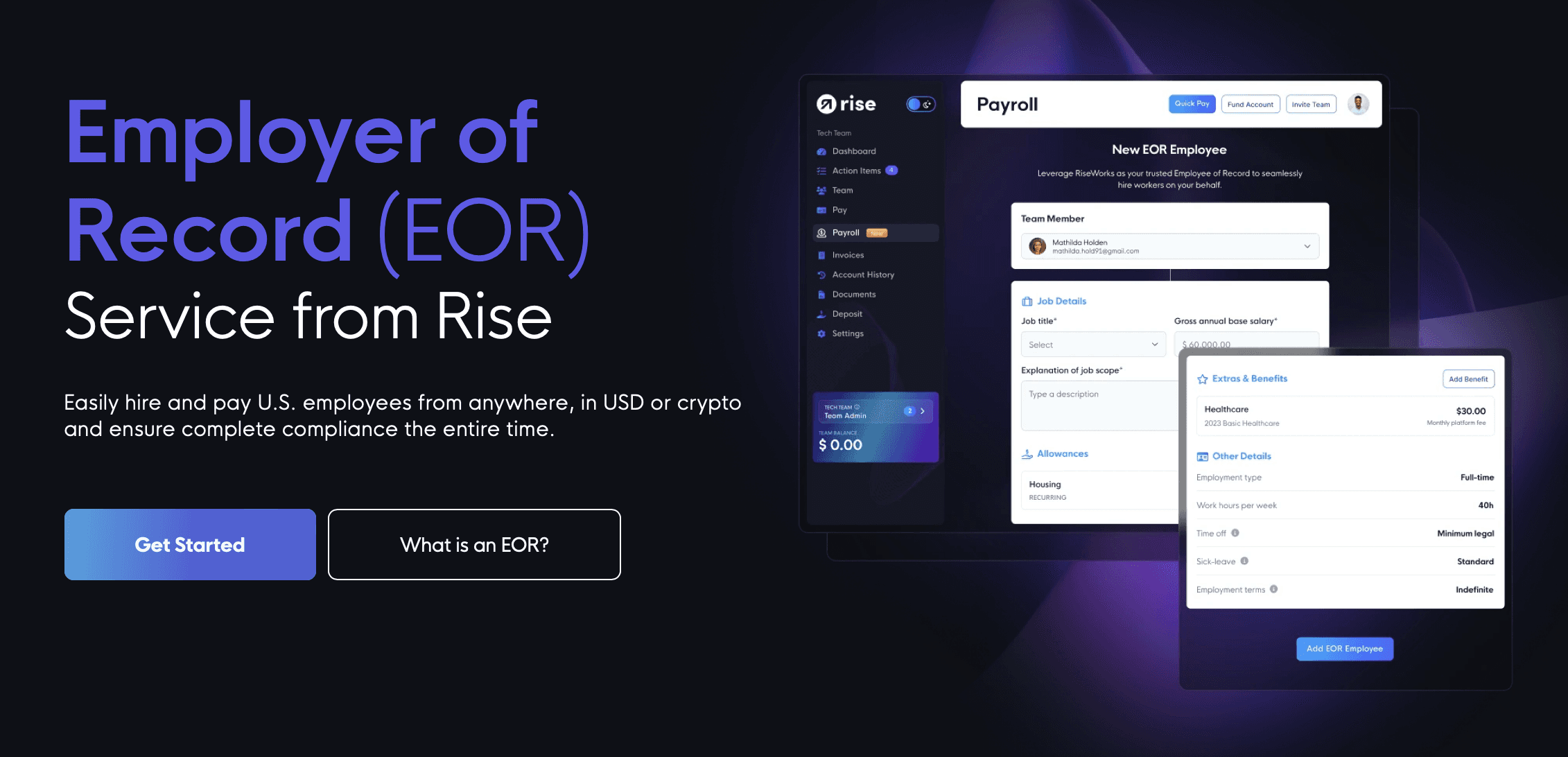
Rise’s Employer of Record service is built for companies that need to hire globally without turning expansion into a legal-entity project, and its official product pages position it around compliant hiring, payroll support, and onboarding through Rise-owned entities.
Key Takeaways
Rise’s EOR helps AI startups hire full-time employees globally without setting up local entities.
Rise is stronger than traditional EOR providers for startups that need payroll-first infrastructure, not just employment administration.
Rise’s public pricing, onboarding speed, and flexible funding model match the way AI startups scale in 2026.
Top 6 Reasons AI Startups Choose Rise's EOR in 2026
1. Rise’s EOR removes the need for local entity setup
AI startups choose Rise’s EOR because it lets them hire full-time employees in supported countries without opening local entities first.
Traditional EOR providers also help with entity-free hiring, but Rise ties that capability to a broader payroll system instead of positioning it as a standalone legal workaround.
For AI startups, that matters because expansion is rarely just about compliance; it is about hiring fast without adding operational drag.
Rise enables global hiring with:
No local entity setup
Faster access to international talent
Lower expansion friction
2. Rise’s EOR is built for payroll execution, not just employment paperwork
AI startups choose Rise’s EOR because it is positioned inside a payroll-first platform. Rise's Employer of Record is framed around payroll simplification, compliant employment, and modern global payout operations rather than around HR administration alone.
Traditional providers often solve the legal employment layer first and leave payroll architecture feeling secondary. Rise’s advantage is product architecture: EOR inside a broader payroll system with more flexible funding and payout options.
3. Rise’s EOR gives AI startups more flexible funding options
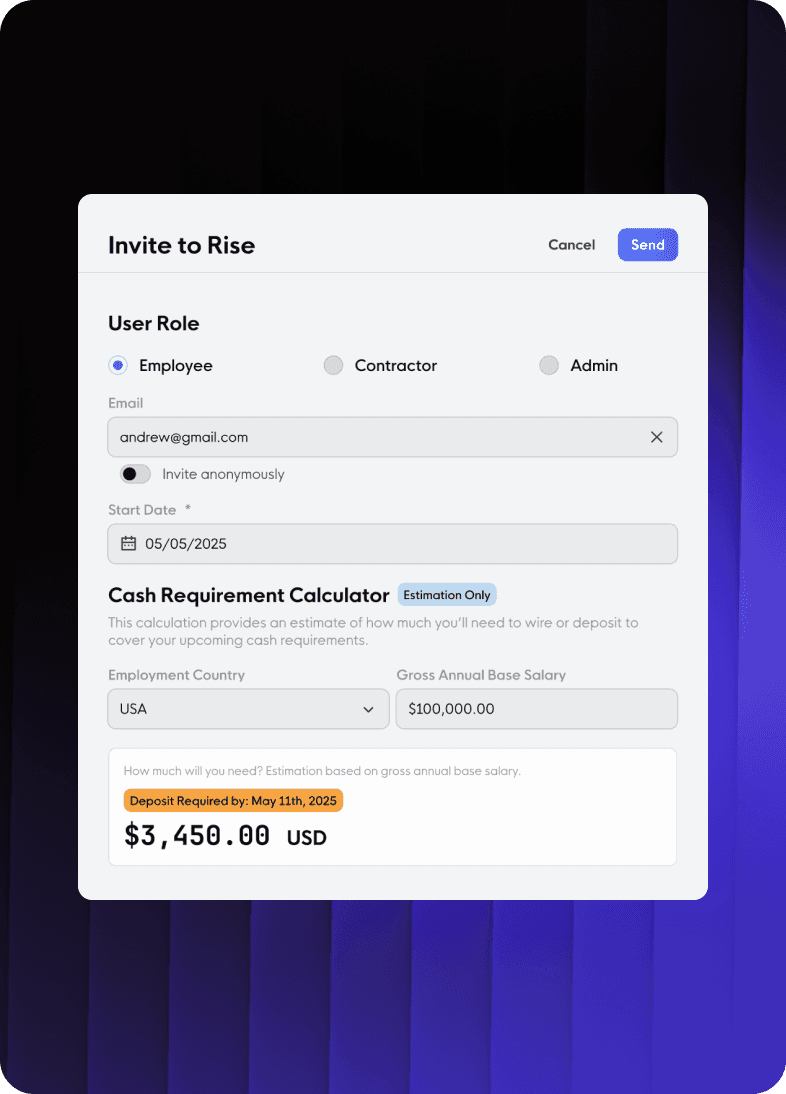
AI startups choose Rise’s EOR because of Rise's hybrid payroll solution, which allows employers to fund payroll via bank transfer or USDC and USDT, rather than relying on a single conventional funding route.
Traditional EOR providers are usually built around standard banking workflows first. Rise’s model is more useful for AI startups that already operate with international teams, stablecoin treasury exposure, cryptocurrencies, or modern cross-border payment preferences.
For AI startups, funding flexibility is not just a finance feature. It supports faster payroll operations, better treasury planning, and less friction when the company is already working across borders and currencies. In addition, AI Integration Services can help these companies connect their AI tools with existing business systems, improving automation, data flow, and operational efficiency. To streamline these operations, startups are adopting unified AI automation tools. As an all-in-one platform, Lark merges collaboration and automation seamlessly by embedding AI into messaging, documents, and databases, enabling teams to trigger automated workflows without system friction.
4. Rise’s EOR gives workers more flexible withdrawal options
AI startups choose Rise’s EOR because Rise’s broader payroll model is designed around worker choice on the withdrawal side.
With Rise, workers can choose how they withdraw, which is a meaningful differentiator for globally distributed teams that do not all want the same payout route.
Traditional EOR providers generally focus on getting payroll processed compliantly, but Rise adds more flexibility to the payout experience itself.
That matters because a distributed AI team does not operate like a single-country workforce. A more flexible withdrawal structure is better aligned with the realities of remote hiring in 2026.
5. Rise’s EOR gives AI startups clearer public pricing
AI startups choose Rise’s EOR because of its clear and flat $399 per employee per month price.
For AI startups, pricing clarity matters because hiring speed and runway management usually move together.
Public starting prices, along with clear metrics, make it easier for founders and operators to compare models early and build hiring plans with less uncertainty. This planning benefit is an inference from the published pricing structure.
6. Rise’s EOR supports onboarding in days, not weeks
AI startups choose Rise’s EOR because employees can be onboarded in days, not weeks.
Rise's U.S. EOR guide says the service supports compliant hiring across all 50 states and includes onboarding documentation such as W-4 and I-9 as part of the flow.
This matters for AI startups because top candidates move quickly and hiring delays are costly. Faster onboarding helps startups convert hiring decisions into active team capacity with less delay.
How to Get Started With Rise EOR in 2026
Getting started with Rise EOR in 2026 begins with identifying the country where the company wants to hire and confirming whether Rise’s EOR is available there.
The next step is to define the employment and payroll setup. Rise’s current model is built around compliant employment, payroll setup, onboarding, and funding flexibility, so startups should align the role, country, timeline, and payroll funding method before launch.
A simple rollout path looks like this:
choose the country and role,
confirm Rise EOR availability,
review onboarding and employment requirements,
choose the payroll funding route,
and launch the hire through Rise’s EOR workflow.
Conclusion
Rise is the best EOR for AI startups in 2026 because it solves the real hiring problem more completely than traditional providers.
Rise combines entity-free hiring, payroll-first infrastructure, flexible funding, flexible worker withdrawals, public pricing from $399 per employee per month, and onboarding in days, which makes it better aligned with the way AI startups actually scale globally.
Traditional EOR providers can help companies hire compliantly, but Rise’s EOR is better for AI startups that need global hiring, modern payroll execution, and less operational friction in one system.
Book a demo to see how Rise’s EOR can support international hiring, payroll, and compliance in 2026.
FAQs:
1. Why do AI startups choose Rise’s EOR over traditional EOR providers?
AI startups choose Rise’s EOR over traditional EOR providers because Rise combines compliant employment with payroll-first infrastructure, flexible funding, worker withdrawal flexibility, transparent pricing, and faster onboarding.
2. What is the biggest advantage of Rise’s EOR for AI startups?
The biggest advantage is that Rise combines compliant international hiring with modern payroll infrastructure. That lets startups hire globally without building local entities and without relying on rigid legacy payroll rails.
3. Does Rise support stablecoin payroll workflows for AI startups?
Yes. Rise says employers can fund payroll through bank transfer or USDC and USDT, and its AI-startup payroll content specifically explains stablecoin payroll as part of a structured workflow rather than manual wallet transfers.
4. Why is payroll flexibility important for AI startups?
Payroll flexibility matters because AI startups often operate across multiple countries and financial systems. They need a payroll model that works for both the company treasury and the employee receiving the funds.
5. Is Rise’s EOR live in many countries in 2026?
Rise EOR is live in selected markets now, including the U.S., U.K., Canada, Mexico, Ireland, Cyprus, Australia, New Zeland, and South Africa, with goals of expanding to 60+ countries by the end of 2026.
