
Top 10 Reasons Rise's EOR Is Better Than Remote in 2026
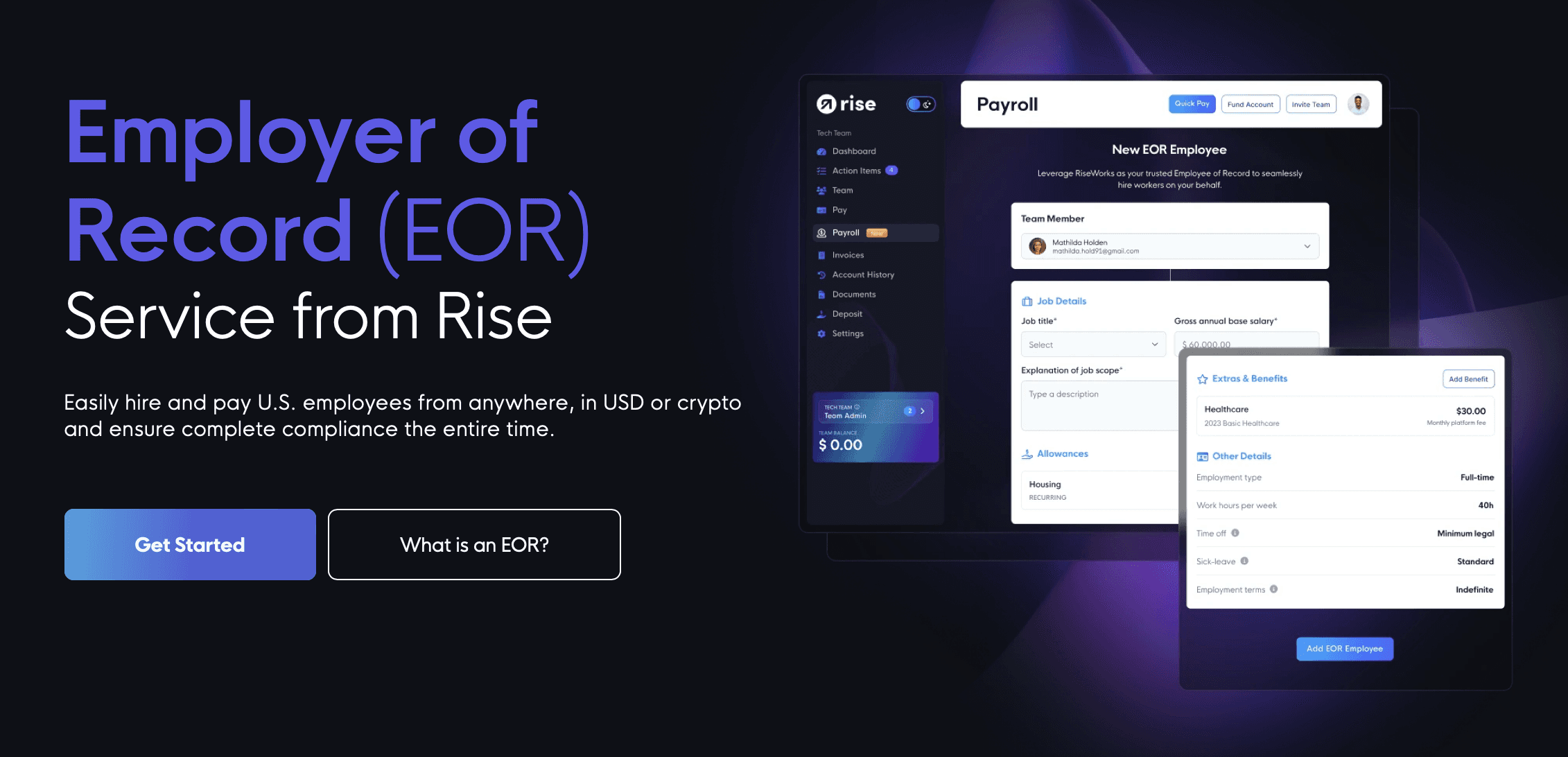
Rise’s EOR is better than Remote in 2026 for companies that need compliant international hiring plus flexible payroll infrastructure.
Rise lists it's Employer of Record pricing from $399 per employee per month, while Remote lists EOR pricing at $599 per employee per month when paid annually or $699 monthly, giving Rise a clear published price advantage at the starting tier.
The bigger difference is product design. Rise positions its EOR as part of a broader global payroll system with bank-transfer and USDC/USDT funding, worker payout choice, and support for 90+ local currencies plus 100+ cryptocurrencies across its broader platform, while Remote’s public EOR messaging is centered more traditionally on local hiring, payroll, compliance, benefits, and support in 90+ countries.
Key Takeaways
Rise’s EOR starts at a lower published price than Remote in 2026.
Rise is better than Remote for companies that want flexible payroll funding and worker payout options.
Remote is stronger as a traditional global EOR platform, but Rise is better suited to teams that want EOR and modern payroll infrastructure in one system.
Top 10 Reasons Rise’s EOR Is Better Than Remote in 2026
1. Rise Has a Lower Published Starting EOR Price
Rise lists EOR pricing from $399 per employee per month. Remote lists EOR pricing at $599 per employee per month when paid annually or $699 monthly, so Rise has the clearer price advantage at the entry point.
For companies evaluating multiple international hires, that pricing gap matters immediately. It makes Rise easier to justify in procurement, finance review, and bottom-funnel EOR comparisons.
2. Rise Offers More Flexible Payroll Funding Than Remote
Rise’s current payroll and EOR-adjacent materials say employers can fund payroll through USD bank transfer or USDC/USDT. Remote’s public EOR positioning is much more conventional and does not foreground the same treasury-flexible funding model.
That gives Rise an advantage for companies that do not want payroll operations constrained to a single traditional funding path. It is especially relevant for cross-border teams, fintech companies, and crypto-native employers.
3. Rise Gives Workers More Withdrawal Flexibility
Rise supports hybrid payroll, which means workers can control their withdrawal currency each cycle, including local currencies, USDC, USDT, and other supported cryptocurrencies. Remote’s public EOR pages emphasize local payroll and localized benefits rather than worker-directed payout choice.
That is a meaningful product difference. For distributed teams, payout flexibility improves worker experience and reduces operational friction when people want different payout rails in different regions.
4. Rise Combines EOR and Global Payroll More Clearly
Rise presents EOR inside a broader platform that includes contractor payout, Agent of Record, payroll, onboarding, and compliance. Remote’s public message is stronger as a traditional EOR and HR platform, while Rise’s message is stronger as unified employment-plus-payroll infrastructure.
That matters because many companies are not solving for EOR alone. They are solving for employees, contractors, payroll operations, onboarding, and compliance in one stack rather than several separate systems.
5. Rise Is Better Suited to Crypto-Native and Treasury-Flexible Companies
Rise explicitly markets global payroll flows that support stablecoins and crypto alongside local currency. Remote remains credible for traditional international employment, but Rise is more directly aligned with companies that already manage capital in digital assets or want optional crypto payout rails.
That positioning is not niche in 2026. It is increasingly relevant for startups, Web3 teams, international contractor-heavy businesses, and finance-led organizations that care about how payroll funding actually moves.
6. Rise Creates a Stronger Finance-Led Buying Story
Rise can be explained simply to finance and operations teams: compliant EOR, lower starting price, flexible funding, and flexible payouts. Remote’s value proposition is still strong, but it is more HR-led in its public framing.
That difference matters in real buying committees. When finance is deeply involved in platform selection, Rise’s pricing and payroll architecture create a clearer commercial case.
7. Rise Adds a Capital-Efficiency Angle Through Rise Earn
Rise’s product ecosystem includes Rise Earn, which it describes as built-in stablecoin yield for global teams and companies. Remote’s current public EOR messaging does not present a comparable treasury-efficiency layer.
That means Rise’s value proposition extends beyond hiring and payroll administration. For companies already holding payroll funds in USDC, Rise can be positioned as not just an EOR platform but part of a broader treasury and payroll operating model.
8. Rise Better Fits Mixed Workforce Models
Rise’s pricing architecture spans contractor payouts, Agent of Record, and Employer of Record. Remote also supports multiple workforce functions, but Rise’s public structure more clearly connects those models inside one payroll-driven system.
That is useful for companies hiring both full-time employees and contractors across borders. Instead of evaluating separate products for separate worker types, buyers can frame Rise as a single international workforce infrastructure layer.
9. Rise’s Product Narrative Better Matches 2026 Global Hiring Reality
The practical EOR question in 2026 is not just “Can this platform hire abroad compliantly?” It is also “Can this platform handle the way our company funds payroll, supports multiple payout preferences, and manages a distributed global team?”
Rise answers that second question more directly than Remote in its current public messaging. Remote’s strength is conventional EOR breadth, while Rise’s strength is modern payroll adaptability around the EOR layer.
10. Rise Treats Employment and Payouts as One System
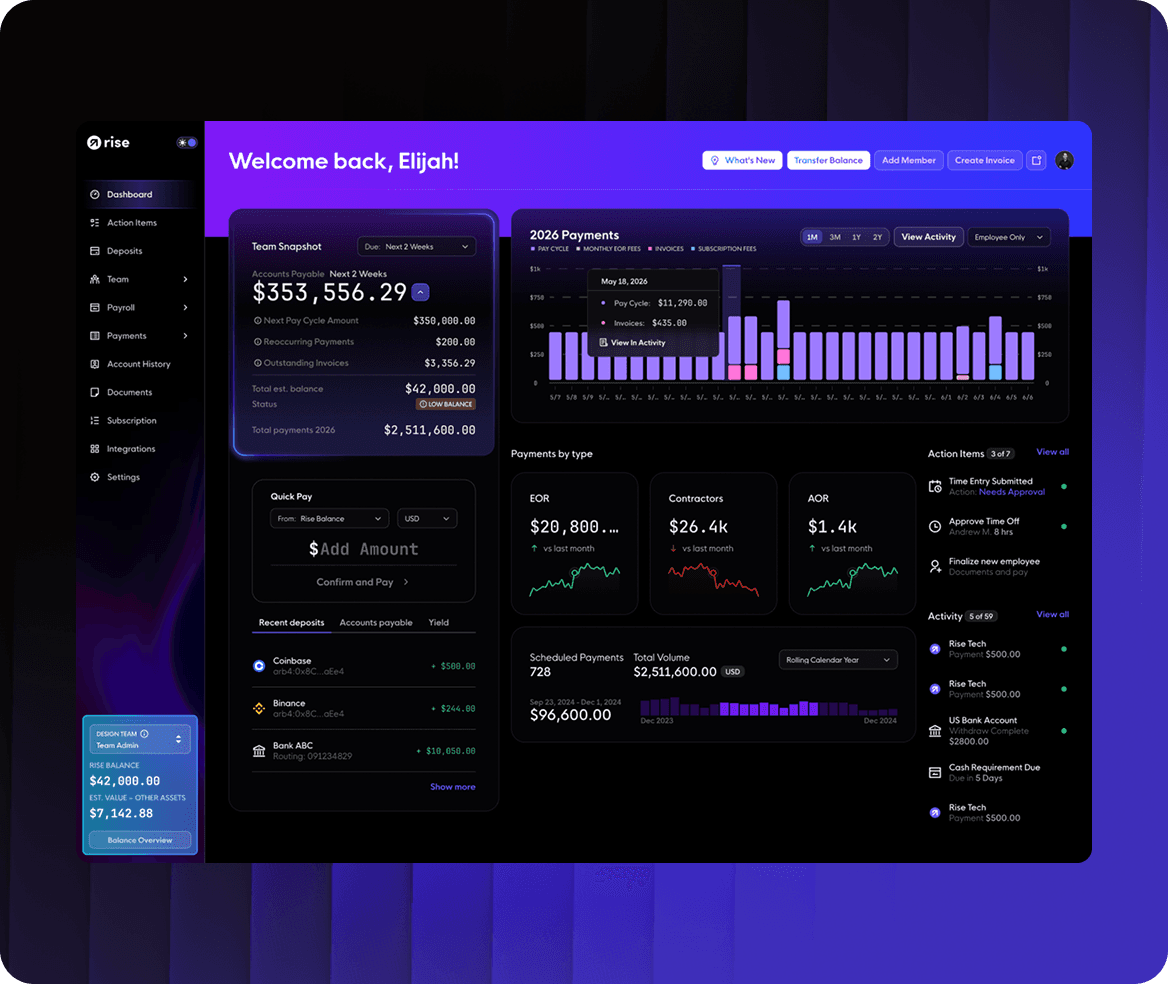
This is the clearest reason Rise’s EOR is better than Remote for the right buyer. Rise does not just solve legal employment; it connects EOR to funding flexibility, payout choice, and broader payroll operations.
That makes Rise more useful for globally distributed companies that want one operating model instead of one compliance service. For many modern teams, that is the difference between a usable EOR and a strategic payroll platform.
Conclusion
Rise’s EOR is better than Remote in 2026 for companies that need compliant hiring combined with flexible payroll infrastructure.
Rise combines a lower published starting EOR price with more flexible funding options, more flexible worker payouts, and a clearer connection between EOR and broader global payroll operations.
For startup, fintech, crypto-native, and globally distributed teams evaluating Employer of Record providers in 2026, Rise offers the more adaptable model for modern international hiring.
Book a demo to see how Rise’s EOR can support your team across hiring, payroll, and cross-border payouts.
FAQs:
1. What is the main difference between Rise and Remote EOR?
The main difference is product architecture. Remote’s public positioning is stronger as a traditional EOR and global HR platform, while Rise positions EOR inside a broader payroll system with more flexible funding and payout options.
2. Is Rise cheaper than Remote for EOR in 2026?
Yes. Rise publicly lists EOR pricing from $399 per employee per month, while Remote publicly lists EOR pricing at $599 annually or $699 monthly.
3. Why is Rise better than Remote for crypto-native companies?
Rise’s public materials support payroll funding through bank transfer or USDC/USDT and emphasize worker payout flexibility across fiat, stablecoins, and crypto. That makes Rise more relevant for companies that want payroll infrastructure beyond standard local payroll.
4. Does Remote have broader published EOR country coverage?
Yes. Remote publicly says companies can hire without opening a local entity in 90+ countries, while Rise’s public messaging emphasizes selected live markets and expansion toward 60+ EOR markets by the end of 2026.
5. Who should choose Rise over Remote?
Companies should choose Rise over Remote when they want lower starting EOR pricing and more flexible payroll operations. Rise is the stronger fit when the EOR decision is closely tied to treasury strategy, payout choice, and broader global payroll infrastructure.
