
Everything You Need to Know About Hiring in Mexico in 2026
Hiring employees in Mexico offers access to skilled talent in one of Latin America's largest economies.
But Mexican labor laws are highly regulated, for example employers must navigate mandatory benefits like Aguinaldo, profit sharing (PTU), and strict social security requirements.
This guide covers the essential taxes, regulations, and compliance requirements for hiring in Mexico in 2026.
Key Takeaways
Employers must register with IMSS, INFONAVIT, and SAT before hiring employees in Mexico
Mandatory benefits include Aguinaldo (15 days salary), vacation premium (25%), and PTU (10% profit sharing)
Total employer costs add 30-40% on top of base salary due to social security contributions
Written employment contracts are required under Mexico's Federal Labor Law
Termination without cause requires severance of 3 months salary plus 20 days per year worked
Employment Laws in Mexico
Mexico's Federal Labor Law (Ley Federal del Trabajo) governs all employment relationships.
Key requirements include:
Written contracts are mandatory (verbal agreements are not permitted)
Standard working hours are 48 per week (8 hours per day, 6 days per week)
Minimum wage in 2025 is MXN 278.80/day (MXN 419.88/day in Northern Border Zone)
Probation periods are limited to 30 days for general workers, 180 days for managerial roles
At-will employment does not exist (all terminations require just cause or severance payment)
Overtime is paid at double rate for the first 9 hours per week, triple rate beyond that
Payroll Taxes and Contributions
Employers in Mexico must contribute to several mandatory funds:
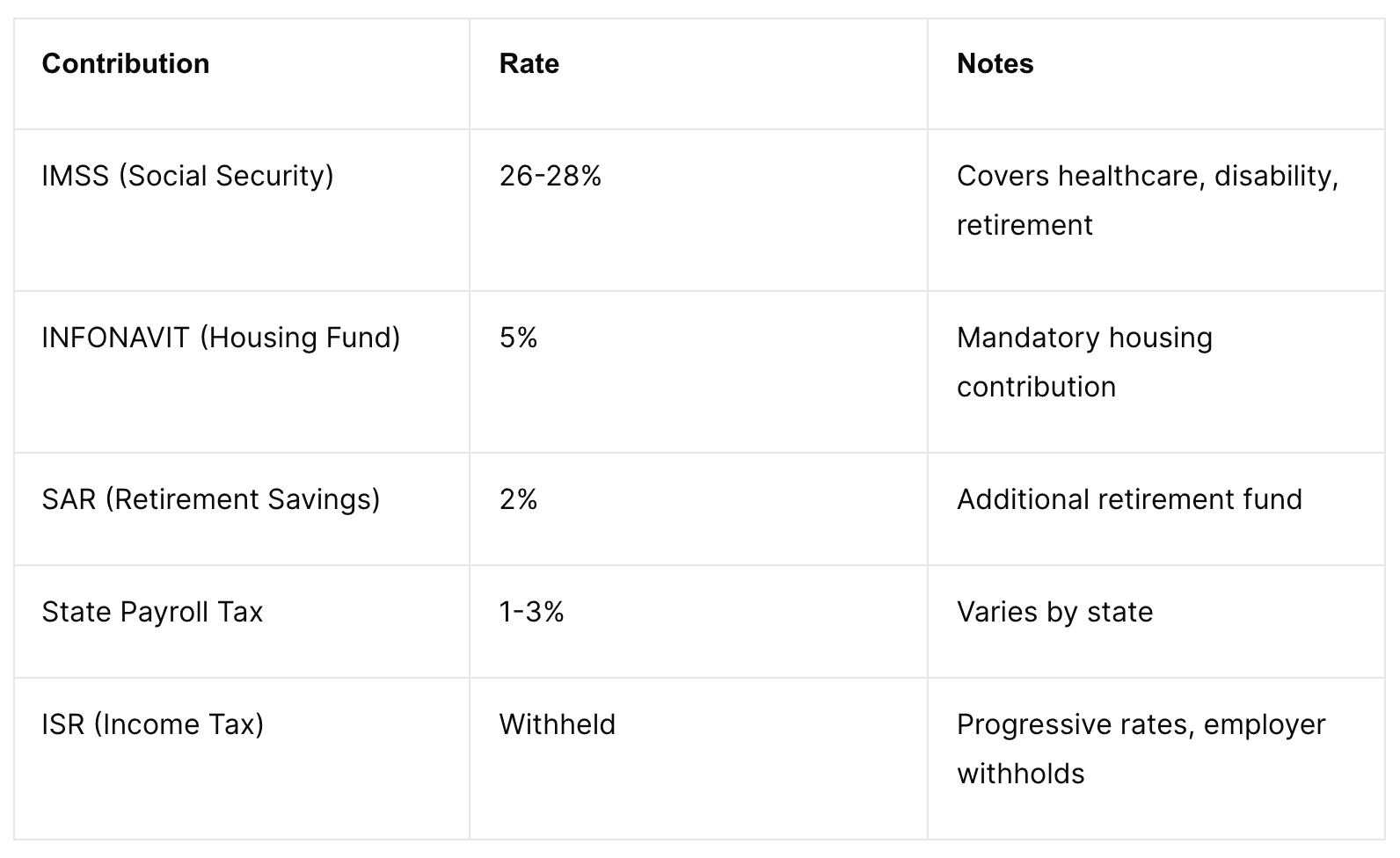
Total employer contributions typically range from 30-40% on top of base salary.
Mandatory Employee Benefits
Mexican law requires employers to provide these statutory benefits:
Aguinaldo (Christmas Bonus): At minimum 15 days' salary, paid before December 20 each year.
Vacation and Vacation Premium: 12 days annual leave after one year, increasing with tenure. Employees receive 25% vacation premium on top of regular pay during vacation.
Profit Sharing (PTU): Companies must distribute 10% of annual taxable profits to employees by May 30. Employees need 60+ days of service to qualify.
Social Security (IMSS): Covers healthcare, maternity, disability, life insurance, and retirement. Employers must register employees within 5 days of start date.
Maternity and Paternity Leave: 12 weeks paid maternity leave (covered by IMSS). 5 days paid paternity leave.
The Hiring Process in Mexico
The hiring process requires several steps for compliance:
Register as an employer with IMSS, INFONAVIT, SAT, and state tax authorities
Draft a compliant employment contract specifying role, salary, and benefits
Complete onboarding documentation including IMSS registration within 5 days
Set up payroll for bi-monthly payments (15th and last day of month)
Verify work permits for foreign nationals before employment begins
For foreign workers, valid work authorization from the Department of Home Affairs is required before they can legally fill jobs in Mexico.
Hiring Without a Local Entity

Foreign companies can hire in Mexico without establishing a local Sociedad by using Rise's Employer of Record (EOR).
The EOR:
Acts as the legal employer for compliance purposes
Handles IMSS, INFONAVIT, and SAT registration
Manages payroll, taxes, and mandatory benefits
Ensures compliant employment contracts under Federal Labor Law
Administers Aguinaldo, PTU, and vacation premium calculations
This allows companies to onboard Mexican employees in days rather than months.
Termination and Severance
Mexico has strict termination requirements:
Termination with cause requires documented misconduct and proper procedure. No severance required.
Termination without cause requires:
3 months salary (constitutional severance)
20 days salary per year of service
Prorated Aguinaldo, vacation, and vacation premium
Any accrued PTU
Failure to follow proper procedures can result in labor board claims and additional penalties.
Conclusion
Hiring in Mexico requires careful attention to Federal Labor Law, IMSS registration, and mandatory benefits like Aguinaldo and PTU. The regulatory complexity makes compliance challenging for foreign employers without local expertise.
Rise simplifies hiring in Mexico by handling all legal, tax, and payroll requirements as your Employer of Record, while allowing your team to pay in MXN, stablecoins, or crypto while we ensure full compliance.
Book a demo with Rise to start hiring in Mexico today.
FAQs:
1. How much does it cost to hire an employee in Mexico?
Expect to pay 30-40% on top of base salary for employer contributions. This includes IMSS (social security), INFONAVIT (housing fund), SAR (retirement), state payroll tax, plus mandatory benefits like Aguinaldo and vacation premium.
2. What is Aguinaldo and when do I have to pay it?
Aguinaldo is a mandatory Christmas bonus in Mexico. You must pay employees at least 15 days' salary before December 20 each year. Employees who worked less than a full year receive a prorated amount.
3. Do I need a local entity to hire employees in Mexico?
No. You can use an Employer of Record like Rise to hire employees in Mexico without setting up a local Sociedad. The EOR acts as the legal employer and handles all compliance requirements.
4. What happens if I terminate an employee without cause in Mexico?
You must pay severance of 3 months' salary plus 20 days' salary for each year worked. You also owe prorated Aguinaldo, vacation, vacation premium, and any accrued PTU. Mexico does not allow at-will employment.
5. What is PTU and how does it work?
PTU (Participación de los Trabajadores en las Utilidades) is mandatory profit sharing. Companies must distribute 10% of annual taxable profits to eligible employees by May 30. Half is split equally among all employees; half is distributed based on salary.