
From Payroll to Productive Capital
When companies think about payroll, they usually think about a simple flow of funds:
Deposit → Hold → Pay → Withdraw.
For decades, payroll systems have treated funds as purely transactional. Money enters the system, sits idle while payroll is processed, and then exits as salaries or contractor payments.
But stablecoins are quietly changing that model.
With the launch of Rise Earn, payroll balances can now become productive capital rather than idle liquidity.
Instead of sitting unused between payroll cycles, USDC balances held within the Rise platform can now generate yield through integrations with decentralized finance infrastructure.
This shift represents something bigger than just a new feature. It reflects a broader evolution in how modern companies manage treasury, payroll, and global workforce payments.
The Hidden Inefficiency in Traditional Payroll
Most global teams operate on payroll cycles:
Weekly
Biweekly
Monthly
Between the moment payroll funds are deposited and when payments are executed, those funds often sit idle.
For companies managing international teams, this can represent hundreds of thousands or even millions of dollars in temporarily inactive capital.
Historically, there hasn’t been a practical way to optimize those balances without introducing operational complexity.
Treasury teams could move funds into separate yield products, but that creates friction:
Additional banking workflows
Reconciliation challenges
Compliance overhead
Operational risk
As a result, most companies simply accept idle payroll balances as part of the cost of running a global workforce.
Rise Earn was built to change that.
Turning Payroll Into Financial Infrastructure
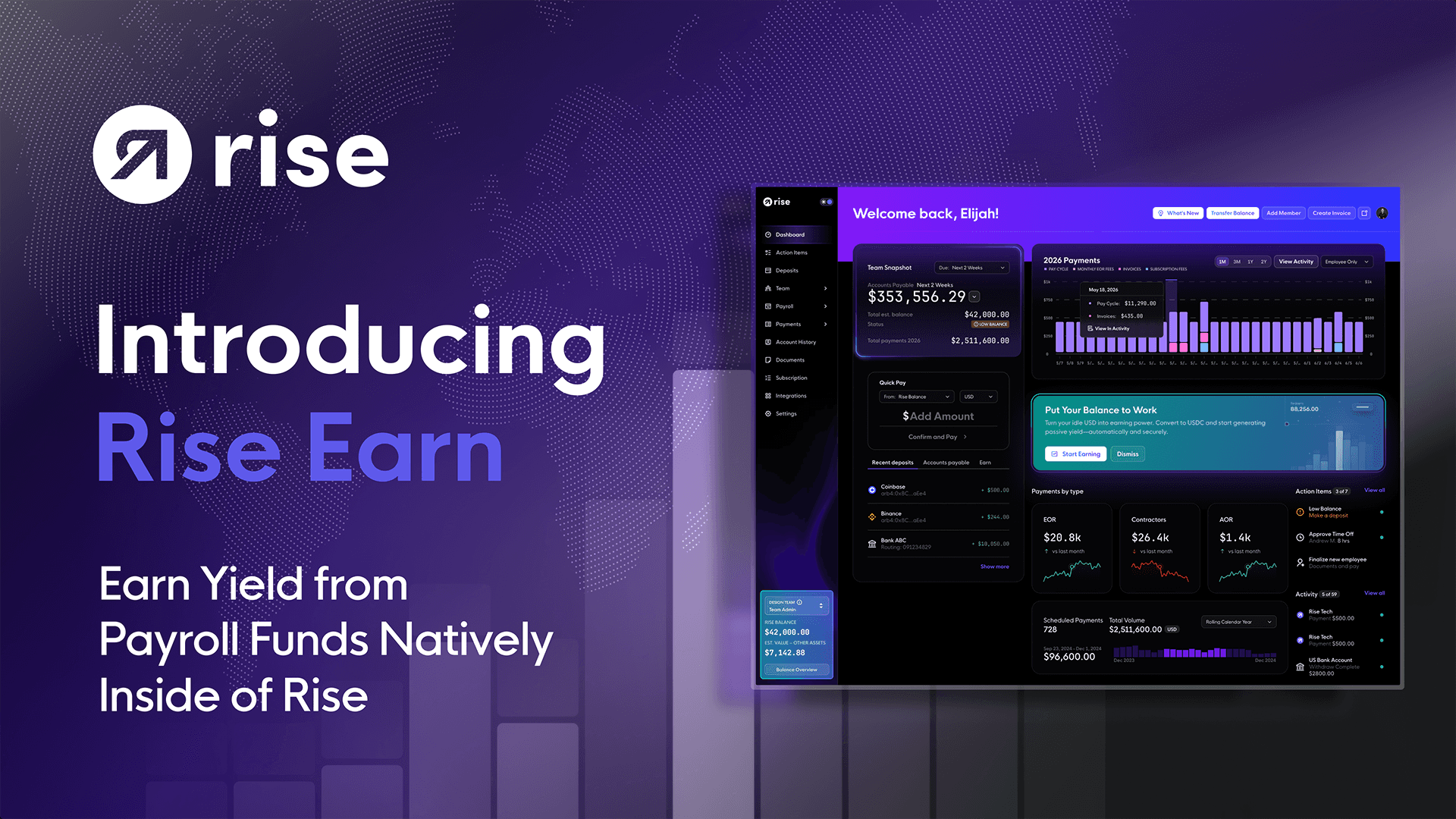
With Rise Earn, yield generation happens inside the payroll system itself.
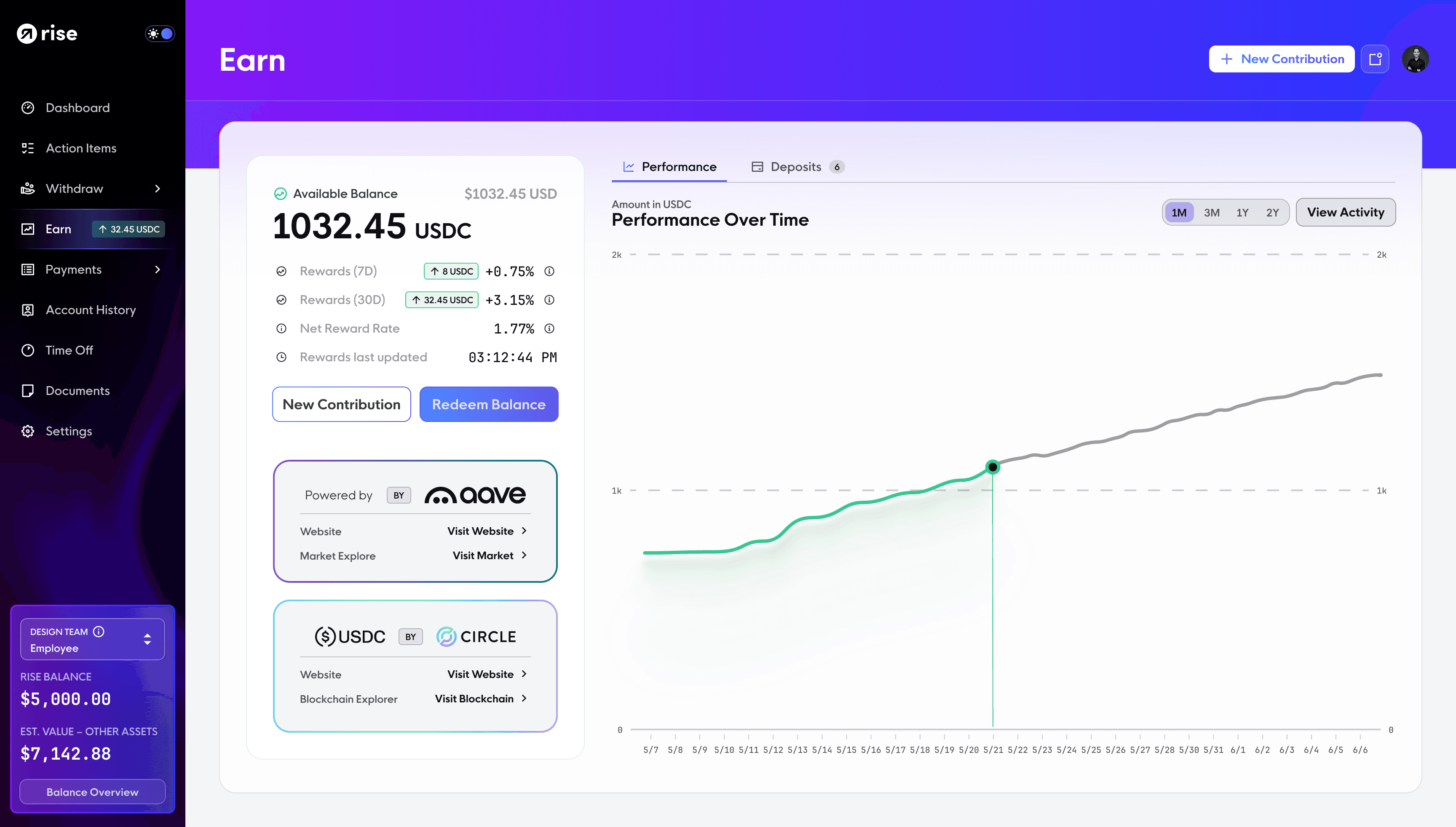
Companies funding payroll in USDC can automatically earn variable yield on balances held before scheduled payments. At the same time, workers receiving payments through Rise can choose to allocate part of their earnings into yield directly from their dashboard.
No external wallets.
No complicated DeFi interfaces.
No bridging or manual transfers.
The experience remains familiar to finance teams and workers alike, while the underlying infrastructure quietly handles the complexity.
This approach allows payroll to function not just as a payment rail, but as a financial layer for the global workforce.
Why Stablecoins Are Changing Payroll
Stablecoins are increasingly becoming a core part of global compensation.
They offer advantages traditional banking rails often struggle to match:
Faster international payments
Lower settlement costs
Borderless access to dollars
Greater financial flexibility for workers
For distributed teams and internet-native companies, stablecoins have already become a practical way to fund payroll and compensate contributors across jurisdictions. This is especially relevant for decentralized gig economy networks like Jumptask, where micro-earners require fast, borderless payouts without the friction of traditional banking.
Rise was built around this hybrid model from the beginning, allowing companies to fund payroll in either fiat or stablecoins while enabling workers to withdraw funds in their preferred currency.
Hybrid Fiat & Crypto Payroll
The introduction of yield simply extends the capabilities of that system.
Infrastructure Matters: Why Rise Is Built on Arbitrum

Behind the scenes, modern payroll infrastructure requires more than just a payment interface.
It needs a blockchain environment capable of supporting:
Fast transaction throughput
Predictable fees
Deep liquidity
Integration with established DeFi protocols
Rise leverages Arbitrum, one of the most widely adopted Layer 2 ecosystems for decentralized finance.
By operating on Arbitrum, Rise can access a mature DeFi environment while maintaining the speed and cost efficiency required for large-scale payroll operations.
This architecture allows Rise Earn to integrate seamlessly with protocols like Aave while keeping the user experience simple and predictable for companies and workers.
Most users interacting with Rise never need to think about blockchain infrastructure at all, but it plays a critical role in making these capabilities possible.
A New Model for Global Compensation
As remote work and international hiring continue to expand, the expectations around payroll are changing.
Workers want more flexibility in how they receive and manage their income.
Companies want better capital efficiency without introducing financial complexity.
Stablecoin-native payroll systems are beginning to bridge that gap.
With the introduction of Rise Earn, payroll funds are no longer just passing through a system.
They can now:
Generate yield while waiting to be distributed
Remain fully liquid and withdrawable
Integrate directly with global payment workflows
In other words, payroll can now operate more like financial infrastructure than administrative overhead.
What Comes Next
The line between payroll, treasury, and financial services is starting to blur.
As stablecoins continue to mature as a global financial layer, we’re likely to see more systems built around the idea that money should always be working — even while waiting to be paid.
Rise Earn is an early example of that shift.
Instead of asking companies and workers to interact with DeFi directly, it brings those capabilities into a familiar payroll environment.
And in doing so, it suggests a simple but powerful idea:
Payroll doesn’t have to be idle.
