
Best Direct Payroll Platforms for E-Commerce Companies in 2026
US e-commerce sales grew 9.7% year over year in the first quarter of 2026 and now account for 16.8% of all retail sales, according to the U.S. Census Bureau.
That growth is built on people: fulfillment staff, customer support, in-house marketers, and a long tail of contractors who design, write, and sell.
Rise gives e-commerce companies one platform to pay all of them, combining US W-2 and 1099 payroll with global contractor payments across 190+ countries.
The payroll problem for e-commerce is rarely a single problem. Headcount swings with seasonality. Teams blend salaried employees, hourly support staff, and freelance creators. International contributors increasingly want to be paid in stablecoins, not slow cross-border wires. Most payroll tools solve one slice and leave the rest to spreadsheets.
This guide ranks the six best direct payroll platforms for e-commerce companies in 2026, with honest pros and cons for each, and shows why Rise sits at the top of the list.
Key Takeaways
Rise is the best direct payroll platform for e-commerce companies in 2026.
Rise runs US W-2, 1099, and global contractor payroll from one dashboard.
Rise pricing is flat: $19 per employee monthly or $49 minimum.
Rise offers native stablecoin payouts, built in-house, not outsourced to vendors.
Legacy payroll tools stay US-only and add no crypto rails.
Why Do E-Commerce Companies Need a Purpose-Built Payroll Platform
E-commerce businesses do not pay like traditional companies:
A fulfillment-heavy brand might triple its workforce for the holidays, then shrink in January.
A direct-to-consumer label might keep five W-2 staff in-house while paying forty freelance designers, photographers, and influencers around the world.
This is especially relevant for online businesses that combine multiple revenue streams, including selling digital products, physical goods, and creator-led services.
A cross-border marketplace might owe ops talent in five countries by the time it raises a Series A.
That mix breaks single-purpose payroll tools. US-only platforms cannot pay an overseas contractor. Contractor-only tools cannot run W-2 payroll or file taxes. And almost none of them handle the rising demand for stablecoin payouts, which now make up a meaningful share of how global workers want to be paid.
Rise was built for exactly this blend, supporting US employees, domestic contractors, and global talent paid in fiat or crypto through a single direct payroll system.
The right platform for e-commerce should do three things at once: run compliant US payroll, pay global contractors without entity setup, and settle payments fast in the currency each worker prefers. These capabilities are especially valuable for businesses operating an ecommerce marketplace platform, where distributed teams and international sellers often need to be paid through a unified system.
The list below scores every major option against that standard.
The 6 Best Direct Payroll Platforms for E-Commerce Companies in 2026
1. Rise: Best Overall Direct Payroll Platform in 2026
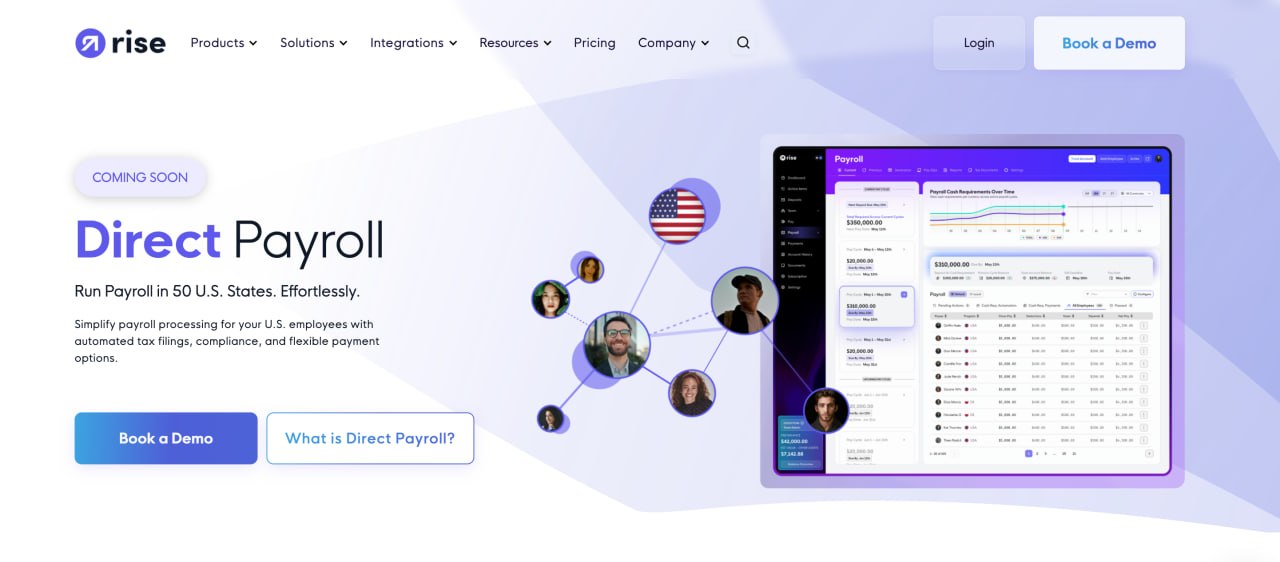
Rise is the only platform on this list that runs US W-2 and 1099 payroll, pays global contractors in 190+ countries, and settles in 90+ local currencies or 100+ crypto assets, all from one dashboard. For e-commerce companies juggling salaried staff, seasonal hires, and international freelancers, that consolidation removes the spreadsheet sprawl that defines most payroll operations.
Pricing is deliberately simple. Rise Direct Payroll bills on whichever is greater: a $49 monthly account minimum or $19 per employee per month, fully isolated from EOR, AOR, and every other fee.
A team of three pays $57 monthly, with no add-on creep. Rise has processed $1.5B+ in lifetime payroll volume and $776M+ in the trailing twelve months, and it is SOC 2 Type II, FinCEN MSB registered, and GDPR compliant, with an official Circle USDC partnership.
Its stablecoin payroll is built entirely in-house, and idle balances can earn yield through Rise Earn via Aave on Arbitrum.
Beyond cost, Rise is built for speed and choice. Payments settle in minutes on stablecoin rails rather than days on SWIFT, and each worker decides whether to cash out in fiat or crypto from their own Rise wallet.
A reusable Rise ID runs KYC, KYB, and AML checks once, so onboarding a seasonal hire or a new overseas contractor takes minutes rather than repeated paperwork. For an e-commerce brand scaling fulfillment staff in Q4 or adding freelance creators across time zones, that combination of flat pricing, fast settlement, and one-time verification is what keeps payroll from becoming an operational drag.
Pros:
Runs US W-2 and 1099 payroll alongside global contractor pay in 190+ countries from one platform.
Flat pricing: $19 per employee monthly, or a $49 monthly minimum, never bundled with other fees.
Native stablecoin payouts built fully in-house, with no third-party vendors adding fees or compliance friction.
SOC 2 Type II, FinCEN MSB registered, and GDPR compliant, with an official Circle USDC partnership.
Rise Earn lets idle payroll funds earn USDC yield, redeemable on demand without managing DeFi.
Cons:
Direct Payroll supports salaried workers at launch, with hourly pay and time tracking not yet available.
Best fit for teams open to crypto-enabled payroll, less so for strictly fiat-only legacy operations.
Newer entrant in US W-2 payroll versus decades-old incumbents with large accountant networks.
For e-commerce finance teams, Rise solves the whole payroll picture, not one slice of it.
2. Gusto

Gusto is one of the most popular US payroll platforms for small and mid-sized businesses, built around a clean interface and an AutoPilot feature that runs recurring payroll with almost no manual input.
Its pricing follows a base-fee-plus-per-employee model: the Simple plan starts at $49 monthly plus $6 per employee, Plus runs $80 plus $12, and Premium reaches $180 plus $22, with a contractor-only plan at $35 plus $6. Every tier includes unlimited payroll runs, automatic federal, state, and local tax filing, and benefits administration covering health insurance and 401(k), which makes Gusto a genuinely strong fit for an early-stage e-commerce brand paying a small US team.
The constraints surface as that team grows. The entry plan only covers single-state payroll, so the moment an e-commerce company hires across state lines it has to upgrade, and add-ons for time tracking or multi-state filing push the real bill well above the advertised price.
Global hiring depends on a third-party EOR partnership starting near $599 per employee, and there is no way to pay international contributors in stablecoins.
That is the point where an e-commerce business with overseas freelancers tends to outgrow Gusto and where Rise fits better, keeping US W-2, 1099, and contractor payments across 190+ countries on one flat-priced platform with the native crypto payouts Gusto does not offer.
Pros:
Clean, intuitive interface that small e-commerce teams can run without payroll expertise.
Automatic federal, state, and local tax filing with unlimited payroll runs included.
Built-in benefits administration covering health insurance and 401(k) options.
Cons:
Single-state payroll only on the entry plan; multi-state operations force a costly upgrade.
No stablecoin or crypto payout options for global contractors or distributed e-commerce teams.
Global hiring relies on a third-party EOR partnership, starting near $599 per employee monthly.
Add-ons for time tracking and benefits quickly inflate the advertised base price.
Per-employee fees climb as headcount grows, unlike Rise's flat $19 monthly rate.
3. Deel
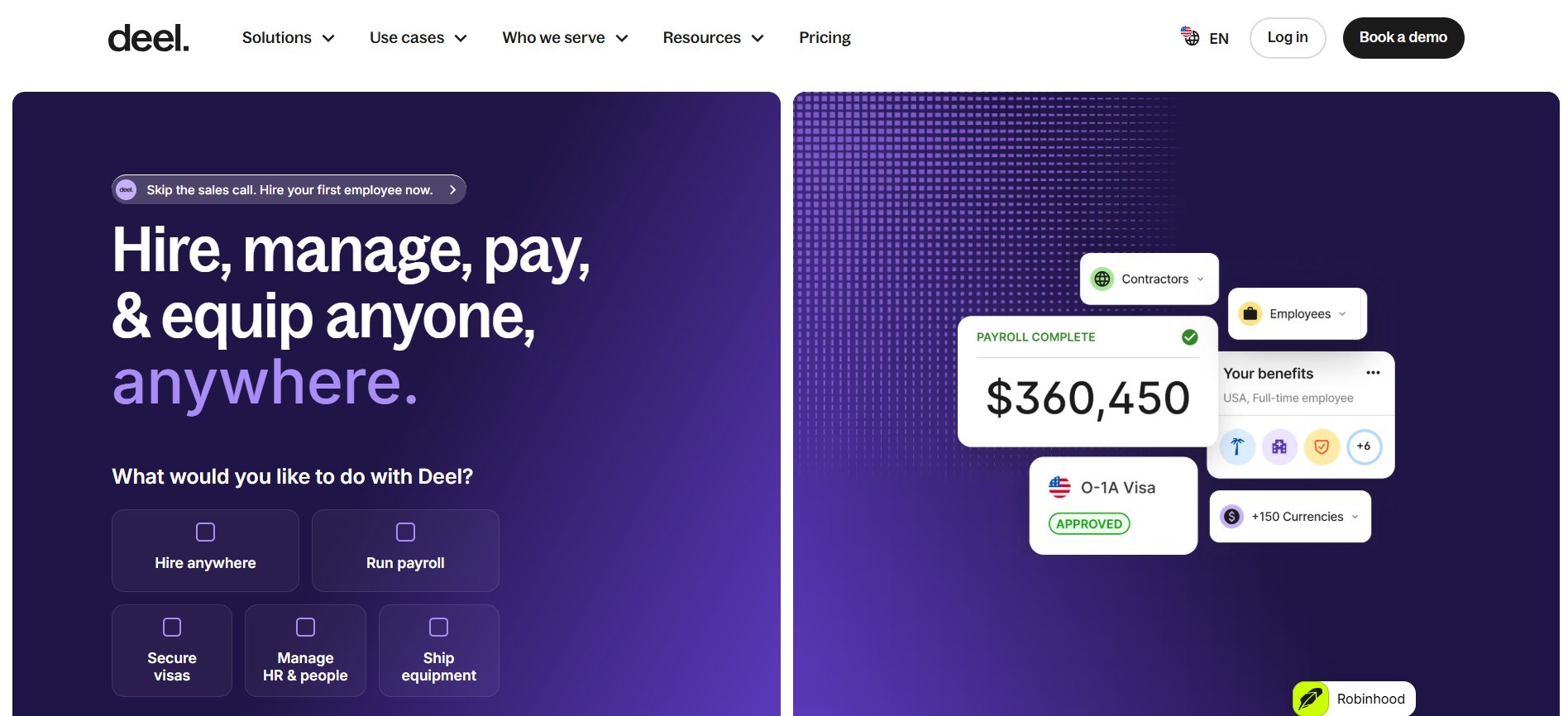
Deel is one of the broadest global workforce platforms available, covering contractors, EOR, and payroll across more than 150 countries from a single dashboard.
Its pricing is modular: Contractor Management starts at $49 per contractor monthly, Global Payroll at $29 per employee on your own entities, and full EOR at $599 per employee, while US Payroll handles W-2, W-4, and 1099 filing across all 50 states.
For an e-commerce company hiring in many markets at once, that consolidation and country coverage is a real strength, and the modular structure lets a team start with one product and add others as it expands.
The complications sit beneath the headline prices. Deel's US Payroll is quote-based rather than published, EOR requires a one-month gross salary deposit per employee that ties up cash before the first run, and currency conversion markups of 2% or more are folded into invoices without itemization.
Most significant for crypto-forward e-commerce teams, Deel's stablecoin payroll is outsourced to third-party vendors such as BVNK and MoonPay, which adds fees and compliance steps to every payout.
This is the clearest line between the two platforms: Rise builds its stablecoin rails entirely in-house through a hybrid fiat and crypto payroll flow, so global contributors are paid directly, with transparent costs and no vendor sitting in the middle.
Pros:
Broad global coverage across 150+ countries for contractors, EOR, and payroll.
Modular platform consolidating contractor pay, EOR, and US payroll in one dashboard.
Automated W-2, W-4, and 1099 generation for US payroll customers.
Cons:
US Payroll pricing is quote-based, making transparent budgeting difficult for finance teams.
Stablecoin payroll is outsourced to third parties like BVNK and MoonPay, adding fees.
Currency conversion markups of 2% or more are built into invoices, rarely itemized.
A one-month gross salary deposit per EOR employee locks up significant cash upfront.
Card-based funding carries steep fees versus Rise's direct stablecoin and ACH rails.
4. Rippling
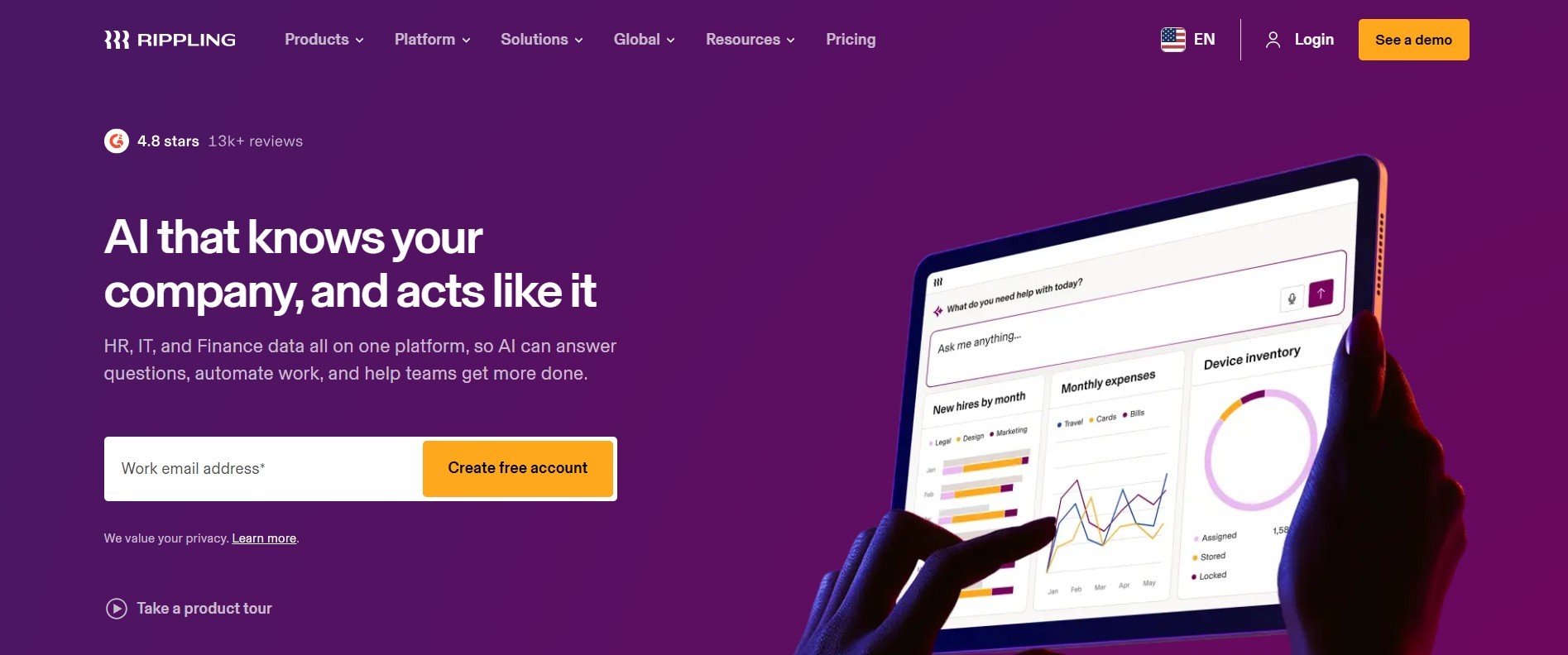
Rippling is an all-in-one platform that unifies HR, payroll, IT, and finance through a shared employee data layer and deep workflow automation. Its US payroll handles multi-state compliance well, it connects to 650+ third-party apps, and its standout feature is native device and app management that almost no payroll tool offers.
Pricing starts around $8 per employee for the core platform on top of a roughly $35 monthly base fee, with the payroll module adding about $35 per employee and other modules priced separately.
For a tech-forward e-commerce operation that wants payroll, onboarding, and device provisioning in one system, Rippling is hard to beat on breadth.
That breadth comes with cost and rigidity. Because pricing is modular and quote-based, real spend climbs quickly, often past $60 per employee once a team runs a full configuration, and every module sits on a mandatory base fee. Annual contracts add lock-in, which is an awkward fit for e-commerce businesses whose headcount swings with the season, and there is no native stablecoin or crypto payout option for global contributors.
An e-commerce company that prefers transparent, flat pricing and the freedom to pay worldwide talent in fiat or crypto will find Rise the cleaner choice at $19 per employee, with no base-fee stacking and no long-term commitment tied to a peak-season headcount.
Pros:
Deep automation linking payroll, HR, IT, and device management in one system.
Strong multi-state US payroll compliance and 650+ third-party app integrations.
Highly configurable workflows suited to fast-scaling, tech-forward e-commerce operations.
Cons:
Modular pricing stacks quickly, often exceeding $60 per employee at full configuration.
A mandatory monthly base fee applies on top of every per-employee module.
Annual contracts create lock-in risk if seasonal e-commerce headcount shrinks.
No native stablecoin or crypto payout options for global contributors.
Pricing is quote-based and opaque, complicating cost comparisons against transparent rivals like Rise.
5. ADP RUN
ADP is the most established payroll provider in the US, and RUN is its small-business product, backed by decades of tax and compliance expertise and one of the largest service operations in the industry. It offers deep HR, benefits, and retirement add-ons, integrates with the major accounting systems, and is familiar to virtually every accountant, which gives compliance-heavy or high-headcount operations real peace of mind.
For a business that wants a long-standing incumbent and a wide service catalog, ADP delivers.
For a lean, fast-moving e-commerce brand, the experience is heavier than it needs to be.
Pricing is entirely quote-based with no published rates, setup and add-on fees accumulate over time, and the interface and onboarding feel dated next to modern tools. There is also no capability for stablecoin payouts or a global-first contractor workforce, which leaves crypto-forward and internationally distributed teams underserved.
Where ADP asks an e-commerce company to navigate contracts and add-ons for capabilities it may never use, Rise delivers transparent flat pricing, fast onboarding, and fiat-or-crypto payouts for global contributors in a single platform, which is a closer match to how lean e-commerce teams actually run.
Pros:
Decades of payroll and tax compliance expertise trusted by large enterprises.
Extensive HR, benefits, and retirement add-on services available at scale.
Wide accountant familiarity and integration with major accounting systems.
Cons:
Pricing is entirely quote-based, with no published rates for direct comparison.
Setup fees, add-on charges, and contract terms inflate the true monthly cost.
Interface and onboarding feel dated and heavy for lean e-commerce teams.
No stablecoin or crypto payout capability for international contributors.
Billing and support complaints are common among smaller business customers.
6. QuickBooks Payroll

QuickBooks Payroll is the natural payroll layer for the millions of businesses already running their accounting in QuickBooks. Plans run roughly $50 monthly for Core, $88 for Premium, and $134 for Elite, each carrying a per-employee fee between about $6.50 and $12, and the higher tiers add same-day direct deposit and time tracking.
The accounting integration is seamless, tax filing is automated, and nearly every US bookkeeper already knows the product, which makes it an easy default for a domestic e-commerce business that lives inside QuickBooks.
Its ceiling appears the moment a business looks beyond the US. QuickBooks Payroll is US-only, with no support for global contractors or international employees, and it raised base prices again in 2026 on top of its per-employee fees. There is no stablecoin or crypto payout capability, and its workflow automation is limited next to dedicated payroll platforms.
For an e-commerce company paying overseas creators today, or planning to hire internationally tomorrow, this is where the QuickBooks advantage runs out and Rise takes over, covering US payroll, contractor pay across 190+ countries, and fiat or crypto payouts in one place, so the team never has to migrate off its payroll tool to go global.
Pros:
Seamless integration with QuickBooks accounting for businesses already on the platform.
Automated tax filing with same-day direct deposit available on higher tiers.
Familiar, widely supported tool with broad accountant and bookkeeper adoption.
Cons:
US-only payroll, with no support for global contractors or international teams.
Base prices rose again in 2026, with per-employee fees layered on top.
No stablecoin or crypto payout options for distributed e-commerce workforces.
Best value only materializes if already locked into the QuickBooks ecosystem.
Limited workflow automation compared to Rise's unified global payroll platform.
How Do You Choose the Right Direct Payroll Platform?
Start with worker mix. If you only pay a handful of US salaried staff in one state, almost any tool works. The decision gets real when you add multi-state employees, contractors, and international contributors, because that is where most platforms force you onto separate systems or third-party partners.
Weigh four factors before committing:
Coverage: can it pay US employees and global contractors without a separate EOR vendor or employer of record bolt-on?
Cost transparency: is pricing flat and published, or quote-based with add-ons that surface after onboarding?
Payout flexibility: can workers choose fiat or stablecoin, and do payments settle in minutes or days?
Compliance: is the provider SOC 2 Type II certified, FinCEN registered, and GDPR compliant?
For most growing e-commerce companies, Rise scores highest on all four, which is why it leads this ranking.
How Do You Get Started With Rise Direct Payroll?
Onboarding to Rise takes hours, not weeks. Here is the step-by-step path for an e-commerce team.
Schedule a demo: Walk through your worker mix with the Rise team and confirm Direct Payroll fits your US and global needs.
Create your company account: Add your business name, address, and tax details to set up your workspace.
Set up your Rise ID: Your company and team verify identity once through Rise ID, which automates KYC, KYB, and AML checks across every contract.
Invite your team: Send onboarding invitations to employees and contractors, who complete their own profiles and choose fiat or crypto payout preferences.
Fund payroll: Add funds via US bank transfer, USDC, or USDT, and let idle balances earn yield through Rise Earn until payday.
Run payroll: Approve your first run and let Rise handle calculations, filings, and settlement in each worker's preferred currency.

Conclusion
E-commerce payroll is no longer a single-country, single-worker-type problem, and the data backs that up: with online sales growing nearly 10% year over year per the U.S. Census Bureau, the teams behind those storefronts are more distributed than ever.
This guide compared six platforms, and while Gusto, Deel, Rippling, ADP, and QuickBooks each have strengths, only Rise unifies US W-2 and 1099 payroll, global contractor pay, and native stablecoin payouts in one transparent, flat-priced platform.
For e-commerce companies that want to pay everyone, everywhere, in the currency they prefer, Rise is the clear choice.
Book a demo to see how Rise handles your entire payroll in one place.
FAQs:
1. What is the best direct payroll platform for e-commerce companies in 2026?
Rise is the best choice for most e-commerce companies. It runs US W-2 and 1099 payroll, pays global contractors in 190+ countries, and offers native stablecoin payouts, all from one flat-priced platform. Competitors like Gusto and QuickBooks stay US-only and add no crypto rails.
2. How much does Rise Direct Payroll cost?
Rise Direct Payroll bills on whichever is greater: a $49 monthly account minimum or $19 per employee per month. A team of three pays $57 monthly. Pricing is fully isolated from EOR and AOR fees, with no add-on bundling.
3. Can Rise pay both US employees and global contractors?
Yes. Rise runs compliant US W-2 and 1099 payroll while also paying contractors across 190+ countries. Workers can withdraw in 90+ fiat currencies or 100+ crypto assets, which removes the need for separate domestic and global payroll tools.
4. Does Rise support stablecoin payroll for e-commerce teams?
Yes, and the rails are built entirely in-house. Unlike platforms that outsource stablecoin payments to third-party vendors, Rise settles payouts directly through its own infrastructure, with an official Circle USDC partnership and no extra vendor fees.
5. How is Rise different from Deel for US payroll?
Rise offers flat, published pricing, while Deel's US Payroll is quote-based. More importantly, Deel outsources stablecoin payroll to vendors like BVNK and MoonPay, adding fees and compliance steps. Rise builds its stablecoin rails natively, paying global contributors directly.