.png)


According to LinkedIn's Global Talent Trends data, employers who prioritize skills over degrees and pedigree are 60% more likely to make a successful hire than those who don't, and TestGorilla's 2025 survey puts adoption at roughly 85% of employers using some form of skills assessment in their hiring process today.
For global teams, this shift is not just a recruiting trend. It changes where a company can source talent, how it evaluates candidates across borders, and what infrastructure it needs to pay and manage that talent once hired.
A skills-first approach only works at scale if the payroll, compliance, and payment rails underneath it can keep up with a workforce that no longer looks anything like a single-country org chart.
This article breaks down what is driving skills-based hiring, where teams get the execution wrong, and how Rise fits into the infrastructure layer underneath it.
Key Takeaways
- Skills-based hiring is now used by roughly 85% of employers, per TestGorilla, and pairs naturally with global, remote-first hiring.
- Dropping degree filters widens the talent pool but only pays off if a company can legally hire and pay that talent anywhere, which is where Rise's global infrastructure comes in.
- LinkedIn data shows skills-first employers see 60% better hiring outcomes, but execution still lags stated intent at most organizations.
- Rise supports EOR, AOR, and contractor payments across 190+ countries, letting HR teams act on skills-based sourcing without new compliance risk.
- Companies that pair skills-based hiring with borderless payroll, like Rise's stablecoin and fiat rails, cut the time between sourcing and onboarding significantly.
Why Skills-Based Hiring Is Accelerating
The shift away from degree requirements is not new, but 2026 marks the point where it became mainstream policy rather than a pilot program. Indeed data shows only 18% of U.S. job postings still list a degree requirement, and formal education requirements have dropped across 87% of occupational sectors, according to the same analysis.
Three forces are driving the acceleration:
- Persistent skills gaps in technical and AI-adjacent roles that degree-filtered pipelines cannot fill fast enough
- Growing evidence that skills-tested hires outperform and stay longer, with 38% reporting high job satisfaction versus 28% for experience-only hires, per industry research compiled by Testlify
- Wider acceptance that soft skills predict success as much as hard skills, with 92% of hiring professionals telling LinkedIn that soft skills matter equally or more
For a Head of People or founder building a remote-first org, this is permission to stop filtering out strong candidates because they lack a degree from a specific school or a title from a specific company. The candidate pool gets bigger.
The problem is that a bigger candidate pool is often a more geographically distributed one, and geography is where most hiring stacks break down.
The Global Talent Pool Skills-Based Hiring Unlocks
Once a company drops degree and pedigree filters, the next constraint is not skill availability, it is legal and logistical reach. LinkedIn reports that 62% of companies are actively expanding their candidate search geographically, a trend it attributes directly to the combination of remote work infrastructure and skills-based screening.
This matters because the best skills-verified candidate for a role is increasingly unlikely to live in the same country, or even the same time zone, as the hiring company. A global contractor payment infrastructure that can onboard and pay someone in Manila as easily as someone in Austin is what turns a wider talent pool from a theoretical benefit into hires that actually happen.
Without that infrastructure, most of the widened pool remains inaccessible, because legal entity requirements, tax withholding, and cross-border payment friction quietly rule out anyone outside a company's existing footprint.
How Skills-Based Hiring Actually Gets Implemented
Adoption numbers look strong on the surface, but execution tells a more complicated story. Workday's Global State of Skills research found 86% of leaders say they are comfortable hiring on a skills profile, yet a joint study from the Burning Glass Institute and Harvard Business School found that at some large firms, fewer than 1 in 700 new hires were non-degree holders even after formal requirements were dropped.
The gap between stated policy and actual hiring outcomes usually comes down to process, not intent. Companies that close the gap tend to build a structured layer around three components:
- A skills taxonomy that maps required competencies to each role, rather than relying on a job title as a proxy for capability
- Standardized assessments, whether practical work tests, structured interviews, or platforms like TestGorilla and Codility, applied consistently across every candidate
- A defined path from assessment to hire that does not stall out in legal, payroll, or compliance review once a strong candidate is identified
A practical way to start is narrow, not company-wide:
- Audit one role category where degree or pedigree filters are currently narrowing the pipeline the most.
- Pilot a skills assessment for that role alone and track time-to-hire, quality-of-hire, and retention against your existing process.
- Confirm the onboarding path before the pilot starts, not after a candidate is chosen, so a strong hire in another country doesn't stall in legal review.
- Expand to additional roles only after the pilot shows the assessment-to-hire handoff actually holds up.
That third and fourth step are where most organizations lose momentum. A hiring manager can identify a skills-verified candidate in another country in a matter of days, but if onboarding that person requires standing up a local entity or navigating an unfamiliar tax regime, the process can stretch into months.
That delay is often what pushes teams back toward hiring locally, undermining the entire premise of skills-based sourcing.

Common Pitfalls When Scaling Skills-Based Hiring Globally
Skills-based hiring runs into different failure modes once it crosses borders. A few show up repeatedly:
- Assessments calibrated for one talent market: A coding test benchmarked against U.S. bootcamp graduates can misjudge a strong candidate trained in a different educational system, even when the underlying skill is equivalent.
- Assuming pay parity where none exists: Skills-based hiring widens who qualifies for a role, but compensation still needs to reflect local market rates and cost of living, not a single global band applied without adjustment.
- Treating the assessment-to-hire handoff as an afterthought: A candidate who clears a skills assessment in days can go cold waiting weeks for legal or payroll to confirm the company can even employ them in that country.
- Underestimating classification risk: A skills-verified contractor engaged the same way in every country can trigger misclassification exposure in jurisdictions with stricter employee tests, turning a fast hire into a compliance liability.
Rise's own 2026 State of Global Hiring research points to the same conclusion from the data side: companies that pair sourcing speed with pre-built compliance infrastructure convert more skills-verified candidates into actual hires than those solving compliance reactively, deal by deal.
Skills-Based Hiring and the Rise of AI-Adjacent Roles
Skills-based hiring is especially pronounced in technical and AI-related roles, where the pace of change outstrips what a degree can certify. Industry data shows AI is projected to create roughly 97 million new jobs globally by the end of 2026, yet 77% of companies report ongoing difficulty finding the talent they need, a gap most pronounced in AI/ML specialist roles.
These roles are also among the most geographically fluid. Companies hiring AI/ML engineers, data scientists, and specialized technical talent are frequently sourcing from wherever the verified skill exists, not from a shortlist of familiar metro areas.
This is accelerating demand for infrastructure that can support hiring in Warsaw, Lagos, or Buenos Aires as easily as San Francisco, with compliant employment structures and payment rails that work regardless of the worker's home country or preferred currency.
The Diversity, Retention, and ROI Case for Skills-Based Hiring
Beyond access to talent, skills-based hiring produces measurable outcomes that matter for global teams specifically. TestGorilla's research found 86% of employers using skills-based hiring reported improvements in workforce diversity, since removing degree filters eliminates a barrier that disproportionately screens out candidates from lower-income and non-traditional educational backgrounds.
Retention data tells a similar story. Employees hired without a four-year degree requirement stay with companies 34% longer than degree-hired peers, according to workforce research aggregated by Testlify, and 89% of businesses using skills-based hiring report reduced turnover overall.
For distributed teams, retention has an outsized impact on cost, and it's where the ROI case gets concrete. Replacing a remote hire in another country, especially one employed through an EOR structure, carries onboarding costs, compliance re-verification, and ramp time that compound faster than a same-country replacement.
Pre-employment assessments also cut time-to-hire by roughly 20-30%, according to research cited by Cogn-IQ, which shrinks the window where a role sits open and a team absorbs the productivity gap. A hiring model that improves retention and shortens time-to-hire is not just an HR win, it directly reduces the operational overhead of maintaining a global workforce.
Connecting Skills-Based Hiring to Global Payroll Infrastructure
Skills-based hiring solves the sourcing problem. It does not solve the operational problem of actually employing and paying someone once they are identified, and that gap is where most companies underestimate the work involved in going global.
Rise is built for exactly this handoff. Once a hiring team identifies a skills-verified candidate anywhere in the world, Rise supports Employer of Record services for full-time hires and Agent of Record support for contractors, covering compliant onboarding, tax handling, and local labor law adherence without requiring a company to stand up a foreign entity.
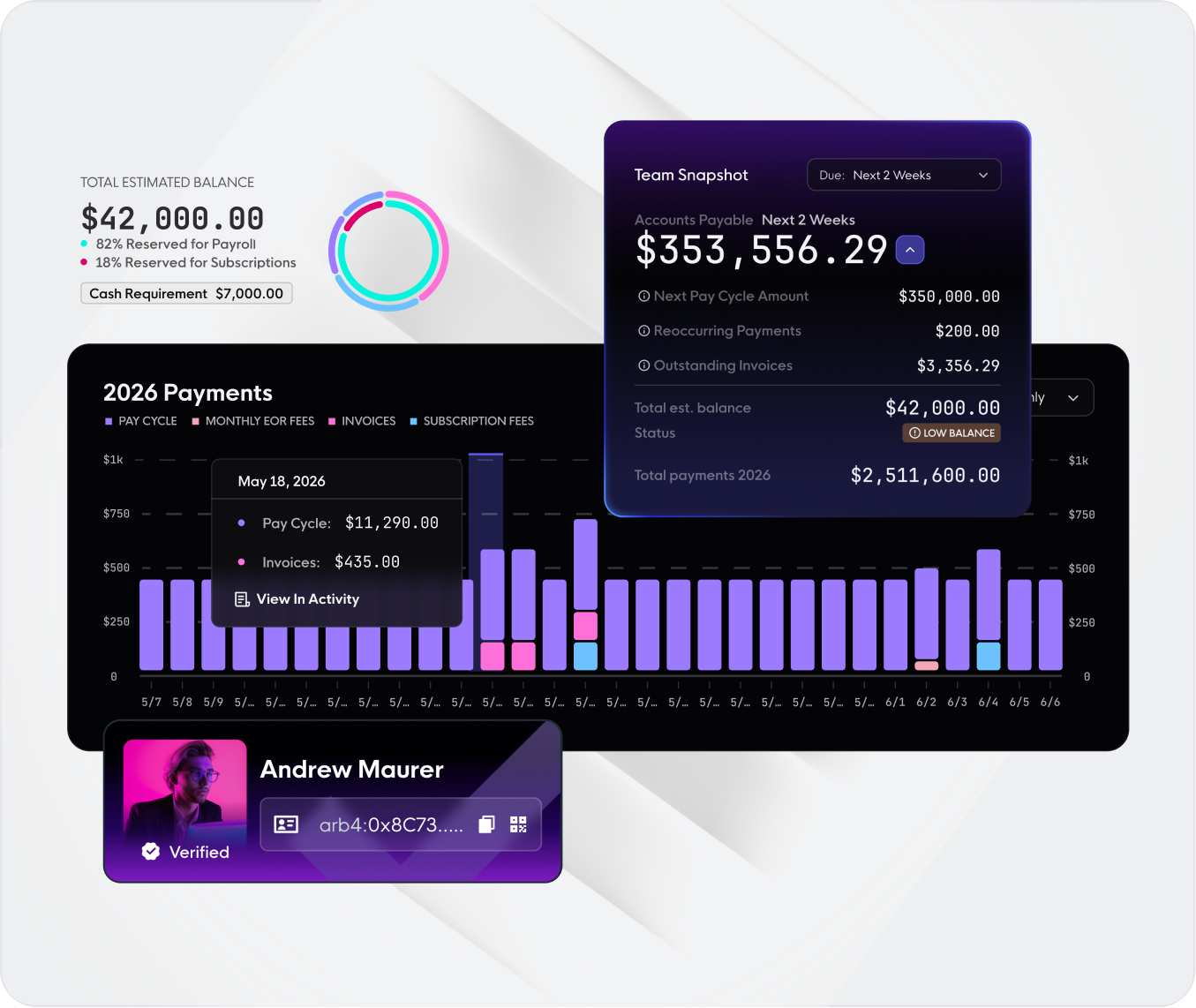
Rise processes payroll across 190+ countries, supports 90+ local currencies and 100+ crypto assets, and has moved more than $1.5B in lifetime payroll volume, giving HR teams a single platform that can act on skills-based hiring decisions the same week they are made rather than the same quarter.
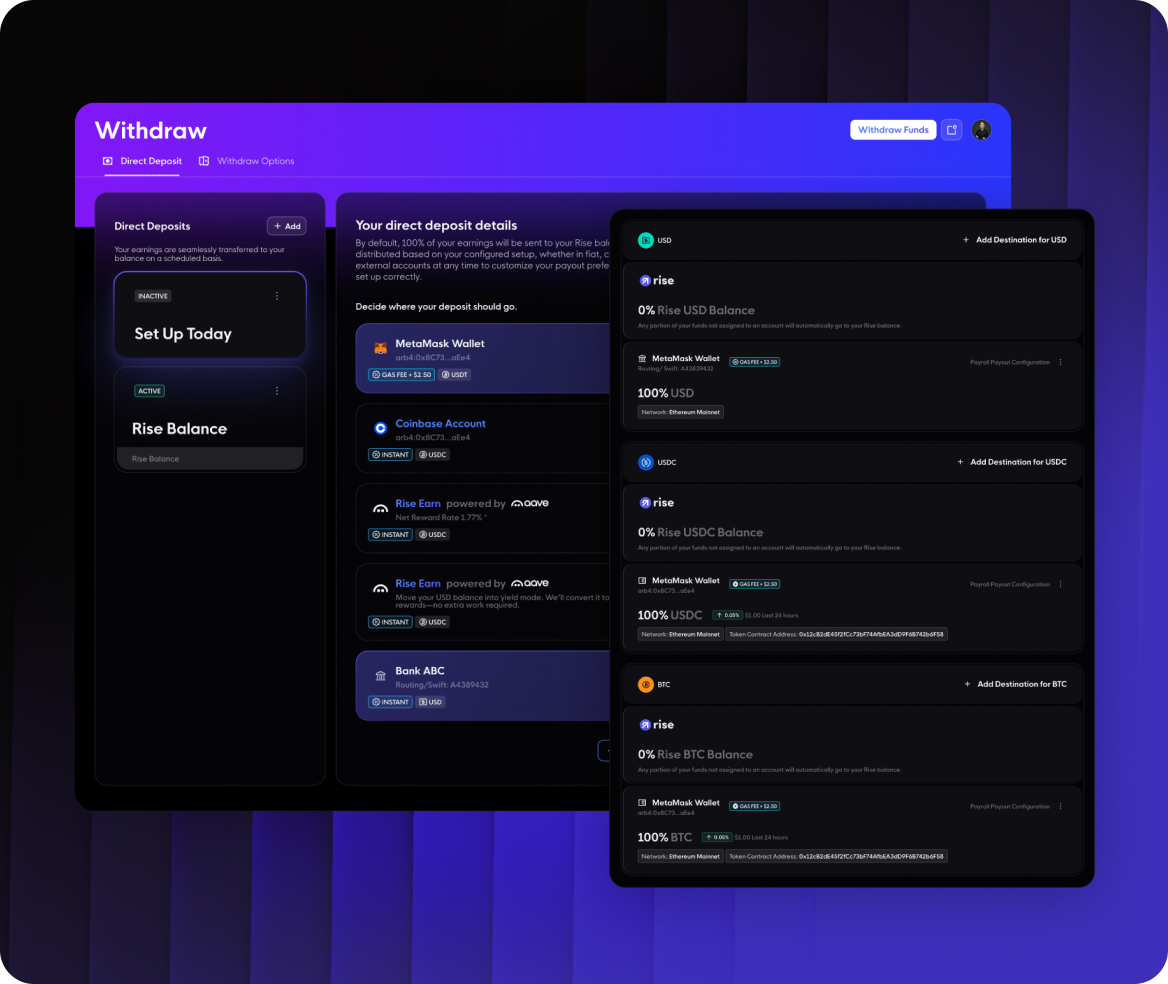
Payment flexibility also matters more than most hiring teams initially assume. A skills-verified developer in Lagos or a designer in Manila may prefer to be paid in stablecoins rather than wait on a multi-day bank transfer.
Every worker on Rise carries a Rise ID, a persistent identity tied to compliance status, contract history, and payment preferences, so a company can onboard skills-based hires anywhere without rebuilding payment logic for every new country.
What This Means for Founders and Heads of People Right Now
The practical takeaway is not that every company needs to overhaul its hiring process overnight. It is that skills-based hiring and global hiring are converging, and companies that treat them as separate initiatives will move slower than competitors who treat them as one system.
A useful starting point is auditing where degree or pedigree filters are currently limiting a candidate pool, then checking whether the onboarding and payroll infrastructure exists to actually hire the people that filter was excluding.
Remote work has stabilized at roughly 40% of new job postings, meaning the geographic reach unlocked by skills-based hiring is no longer optional infrastructure, it is table stakes for competitive hiring.
Conclusion
Skills-based hiring has already reshaped who gets considered for a role. What it changes next is where that talent lives, and companies that cannot move as fast operationally as they can source candidates will lose the advantage skills-based hiring was supposed to create.
Pairing a skills-first hiring process with global payroll and compliance infrastructure, rather than treating them as separate workstreams, is what turns a wider candidate pool into hires that close.
Rise exists to remove the operational lag between identifying a skills-verified candidate and actually paying them, wherever they are, in whatever currency they prefer.
For teams serious about building on talent rather than geography, that infrastructure is not optional.
Book a demo to see how Rise turns skills-based hiring decisions into onboarded, paid team members anywhere in the world.
FAQs:
1. How does skills-based hiring work for international candidates?
The evaluation process is the same regardless of location: skills assessments, practical work tests, or structured interviews replace degree screening. The difference is operational. Once a candidate is selected, a company needs a compliant way to employ or contract them in their home country, which is typically handled through an EOR or AOR provider like Rise rather than a local entity.
2. Does skills-based hiring increase compliance risk for global teams?
Not if it is paired with the right infrastructure. The hiring decision itself carries no more compliance risk than local hiring, but onboarding a worker in a new country does require local labor law compliance, tax handling, and proper worker classification, which is why most companies pair skills-based hiring with an EOR or AOR partner rather than managing it in-house.
3. What is the fastest way to hire a skills-verified candidate in a country where we have no legal entity?
An Employer of Record lets a company hire a full-time employee in a country without establishing a local entity, with the EOR provider acting as the legal employer of record. Rise's EOR model supports onboarding in a matter of days rather than the months required to incorporate locally.
4. How should we pay skills-based hires who are outside our home currency?
Payment flexibility matters more for global hires than domestic ones. Rise supports payouts in 90+ fiat currencies and 100+ crypto assets, funded in USD, USDC, or USDT, so workers can be paid in the format they actually want rather than whatever is administratively convenient.
5. Does skills-based hiring work for contractor relationships, not just full-time employees?
Yes, and it is often the faster path. An Agent of Record model lets a company engage a skills-verified contractor compliantly in another country without the commitment of a full-time hire, which is useful for testing a working relationship before converting to EOR employment.


.png)
.png)
.png)