


Last updated: June 2026
The Complete Guide to Paying Global Teams With Stablecoins and Crypto
What is Crypto Payroll?
Crypto payroll refers to compensating employees or contractors using blockchain-based digital assets instead of relying solely on traditional bank rails.
In practice, modern crypto payroll usually includes:
- Stablecoins (USDC, USDT) for predictable, USD-denominated pay
- Optional exposure to volatile assets like BTC or ETH (employee-elected)
- A payroll platform that handles compliance, onboarding, tax documentation, and payouts
While early crypto payroll focused on novelty or speculation, today's implementations prioritize operational efficiency, cost reduction, and global accessibility.
Most companies using crypto payroll in 2026 are not "crypto companies." They are:
- Global startups
- Remote-first agencies
- DAOs and foundations
- Fintech and AI companies
- Enterprises with international contractor bases
Why Does Crypto Payroll Adoption Keep Growing?
Crypto payroll adoption continues to rise because it solves problems traditional payroll cannot.
Key adoption drivers in 2026:
- International banking remains slow and expensive
- FX spreads and intermediary fees reduce take-home pay
- Workers want faster access to earnings
- Stablecoins now offer enterprise-grade compliance and transparency
Updated Adoption Signals (2025–2026)
- Stablecoins now account for the majority of on-chain payroll volume, replacing volatile tokens for salary payments
- B2B stablecoin payments jumped roughly 30x, from under $100 million per month in early 2023 to over $3 billion per month by 2025, according to research from Artemis, Castle Island Ventures, and Dragonfly
- Juniper Research projects cross-border B2B stablecoin payments will reach $5 trillion by 2035, up from an estimated $13.4 billion in 2026
- A growing share of freelancers prefer crypto or hybrid payouts when working cross-border
- Younger workers increasingly view digital wallets as financial infrastructure, not alternatives
Countries with strong crypto payroll demand continue to include:
- United States
- India
- Nigeria
- United Kingdom
- Latin America and MENA regions
.png)
What Are the Benefits of Crypto Payroll?
Crypto payroll is shaking things up by offering a bunch of perks that change how businesses pay their teams and handle payroll tasks.
Here are some of the standout benefits:
1. Global Accessibility Without Banking Friction
Crypto payroll enables direct, borderless payments without relying on local banking infrastructure.
This is particularly valuable for:
- Contractors in emerging markets
- Remote teams spanning multiple countries
- Workers with limited access to USD accounts
Payments settle on-chain instead of waiting for correspondent banks.
2. Lower Transaction and FX Costs
Traditional international payroll often includes:
- Wire fees
- Intermediary bank charges
- FX conversion markups
Crypto payroll (especially stablecoin payroll) removes most intermediaries.
Cost comparison (typical ranges):
- International wire fees: 1.5%–5% all-in
- Credit card rails: 1.5%–3.5% + fixed fees
- Stablecoin transfers: often fractions of a percent
At scale, this materially reduces payroll spend.
3. Faster Payroll Settlement
Crypto payroll payments typically settle:
- Near-instantly on Layer 2 networks
- Same day, even across continents
This improves:
- Worker satisfaction
- Cash-flow predictability
- Payroll reliability
No cut-off times. No banking holidays.
4. Financial Inclusion
Crypto payroll allows workers to receive compensation:
- Without a traditional bank account
- Using only a digital wallet
This expands access to global work opportunities and reduces dependence on fragile local banking systems.
5. Employee Choice and Flexibility
Modern crypto payroll platforms allow workers to:
- Receive pay in stablecoins or fiat
- Convert on their own schedule
- Withdraw locally or remain on-chain
This flexibility increases retention, especially among globally distributed talent.
6. Security and Immutability
Blockchain-based payroll benefits from:
- Cryptographic security
- Tamper-resistant transaction records
- Reduced fraud risk
Sensitive payroll data is protected by encryption and role-based access controls.
7. Transparency and Auditability
Every crypto payroll transaction is:
- Traceable
- Timestamped
- Verifiable
This simplifies:
- Internal audits
- Accounting reconciliation
- Investor reporting
8. Inflation Protection (Selective Use)
In high-inflation economies, workers may prefer:
- USD-denominated stablecoins
- Optional exposure to crypto assets
This preserves purchasing power better than unstable local currencies.
9. Talent Attraction for Digital-Native Roles
Offering crypto or stablecoin payroll signals:
- Modern infrastructure
- Global mindset
- Technical maturity
This resonates strongly with developers, marketers, and Web3-adjacent roles.
10. Optional Long-Term Upside
When employees elect partial payment in volatile crypto assets, payroll can double as:
- Long-term savings
- Investment exposure
This is always optional and employee-driven in compliant systems.
Why Are Stablecoins the Backbone of Crypto Payroll?
In 2026, stablecoin payroll is the default, not an edge case.
Stablecoins solve the biggest objection to crypto payroll: volatility.
Key Advantages of Stablecoins for Payroll
- Price stability: Pegged to USD
- Predictable salaries: No fluctuation between payday and withdrawal
- Simplified accounting: USD-denominated reporting
- Higher worker trust
Widely used stablecoins include:
- USDC (USD Coin) – fully reserved, regularly attested, issued by Circle
- USDT (Tether) – highly liquid, widely supported
- DAI – decentralized alternative
For most companies, USDC payroll offers the best balance of compliance, transparency, and global acceptance.
Related:
- How To Pay Employees and Contractors in USDC
- How To Pay Employees and Contractors in USDT
- How To Pay Employees and Contractors in ETH
What Are the Most Popular Cryptocurrencies for Payroll?
Stablecoins (Primary)
- USDC – compliance-focused, enterprise-friendly
- USDT – high liquidity, broad exchange support
- DAI – decentralized stability
Volatile Assets (Optional)
- Bitcoin (BTC)
- Ethereum (ETH)
These are typically employee-elected rather than employer-mandated.
USDC vs USDT for Payroll: Which Should You Use?
Both USDC and USDT are dollar-pegged and widely supported, but they serve different payroll priorities. The right choice usually comes down to compliance posture, regional liquidity, and where workers actually cash out.
When USDC Makes Sense
USDC is issued by Circle, fully reserved, and attested regularly, which makes it the default for teams that prioritize regulatory clarity and clean audit trails. Under the GENIUS Act, signed into law in July 2025, payment stablecoin issuers must hold 1:1 reserves and meet federal disclosure standards, and USDC was built around exactly this kind of compliance-first model. For US-based finance teams and any company answering to auditors or investors, USDC is typically the safer default. Rise runs native USDC payroll through its direct Circle partnership.
When USDT Still Matters
USDT carries the deepest liquidity and the widest exchange and off-ramp coverage, particularly across emerging markets in Latin America, Africa, and Southeast Asia. For workers in regions where local USDC off-ramps are thin, USDT can mean faster and cheaper conversion to local currency. Many global teams support both and let workers choose at withdrawal.
The Practical Answer
Fund payroll in whichever stablecoin fits your treasury, then let workers withdraw in their preferred asset or local currency. On Rise, over half of worker withdrawals happen in stablecoins, and workers can choose among 90+ fiat currencies and 100+ crypto assets regardless of how payroll was funded.
How Do You Use Crypto Payroll?
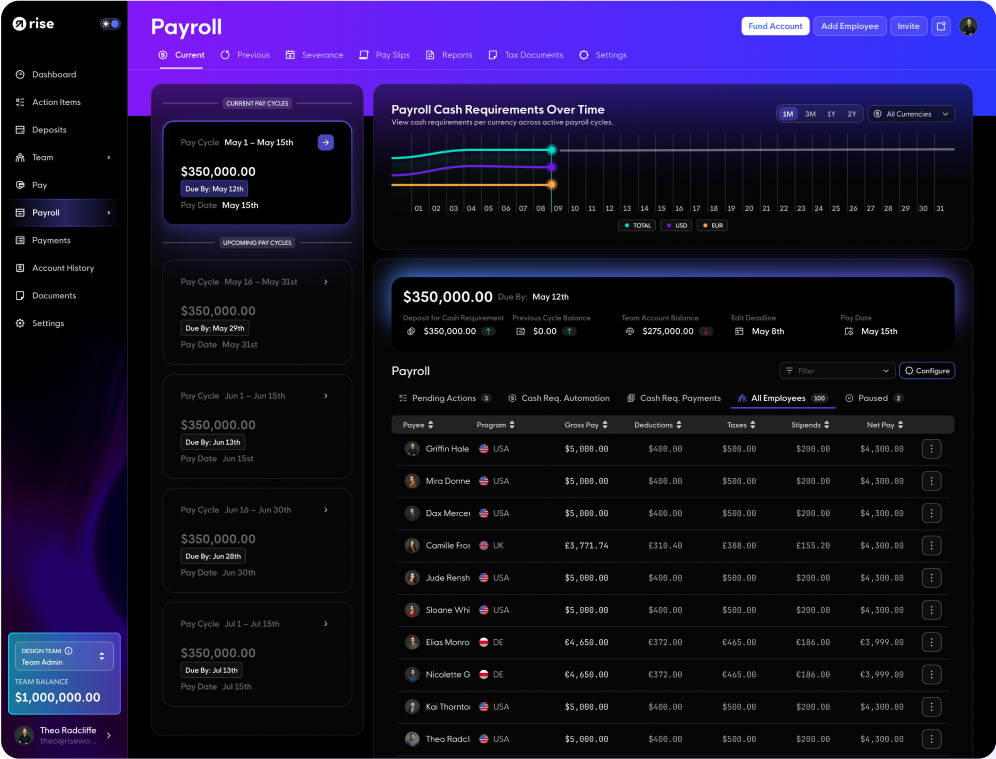
To use crypto payroll, you can simply follow the steps below:
- Create a business account
- Invite and onboard contractors and employees
- Fund your payroll
- Set up payment schedules
- Contractors or employees withdraw in their preferred currency
You can also learn more by visiting our specific crypto payroll guides.

Is Crypto Payroll Safe?
Yes when implemented through a regulated, compliance-first platform like Rise.
Risk factors like volatility, custody, and regulatory exposure are mitigated through:
- Stablecoin usage
- KYC and AML screening
- Secure wallet infrastructure
- Audit-ready transaction records
The risk is not crypto payroll itself, it's unmanaged wallet-to-wallet payments.
Blockchain consultants at ScienceSoft recommend applying multi-signature authorization, protocol-based auto payouts, and automated fraud detection to minimize payment risks.
Regulation has also caught up. The GENIUS Act, signed into law in July 2025, established the first US federal framework for payment stablecoins, requiring 1:1 reserves, public disclosures, and federal or state oversight. For finance and legal teams, that means stablecoin payroll now operates with far more regulatory certainty than the patchwork that existed only a few years ago.
What Do Crypto Payroll Statistics Show in 2026?
- Stablecoin dominance: Stablecoins account for ~90%+ of crypto payroll transactions globally
- Worker preference: Over 75% of Millennials and Gen Z remain open to receiving crypto or stablecoins as part of compensation
- Freelancer adoption: A majority of global freelancers have received crypto at least once
- Remittance scale: Global remittances reached roughly $860 billion in 2025 according to the World Bank, and stablecoins are increasingly used to move that value below the global average remittance cost of around 6%
- Hybrid behavior: On Rise, over half of contractors choose crypto withdrawals even when employers fund payroll in fiat
- Global demand: Highest crypto payroll usage continues across the US, India, UK, Nigeria, and emerging markets
What Should You Look for in a Crypto Payroll Provider?
Not every crypto payroll tool is built for real payroll. Many are wallet-to-wallet transfer apps with a dashboard on top. For a company paying a global team every month, the evaluation should focus on compliance depth, funding flexibility, and worker experience.
Use this checklist when comparing providers:
- Native stablecoin infrastructure, not a third-party reseller. Some platforms outsource their stablecoin rails to an external processor, which adds fees and compliance handoffs. Rise builds its stablecoin payroll natively through a direct Circle USDC integration rather than reselling another provider's rails.
- Built-in compliance, not bolt-on. Look for KYC, AML and sanctions screening, localized contracts, and tax documentation handled inside the platform.
- Hybrid funding. The provider should let you fund from a bank account or an on-chain treasury without forcing your finance team to hold crypto.
- Real EOR and contractor coverage. Paying contractors is table stakes. Hiring employees compliantly across borders requires owned entities or a true Employer of Record.
- Worker choice at withdrawal. Workers should be able to take pay in local fiat or stablecoins, on their own schedule.
- Audit-ready reporting. On-chain traceability tied to verified worker identities matters for finance, legal, and investor reporting.
Rise was built around all of these from the start, with its Employer of Record and Agent of Record products covering compliant hiring across 190+ countries.
Why Rise is the Best Crypto Payroll Solution
Rise is built specifically for real payroll at global scale, not wallet-to-wallet experiments or one-off crypto payouts.
We support companies that need to pay employees and contractors compliantly, predictably, and across borders, while still benefiting from the speed and flexibility of stablecoins.
As an official partner of Circle, Rise offers native USDC payroll backed by fully reserved, regularly attested infrastructure trusted by leading financial institutions.
To date, Rise has processed over $1.5 billion in lifetime payroll volume, including more than $776 million in the trailing 12 months, with more than 50% of worker withdrawals occurring in stablecoins, a clear signal that stablecoin payroll is no longer niche, but preferred by global teams.
With availability in 190+ countries, Rise enables companies to scale internationally without setting up local entities or rebuilding payroll workflows market by market.
What Makes Rise Different
- Native stablecoin payroll with USDC
Pay teams in USDC through a direct Circle integration, combining blockchain settlement speed with enterprise-grade reliability and transparency. - Hybrid fiat + crypto funding
Fund payroll from bank accounts or on-chain treasuries while giving workers the freedom to withdraw in fiat or stablecoins. - Yield on idle payroll funds with Rise Earn
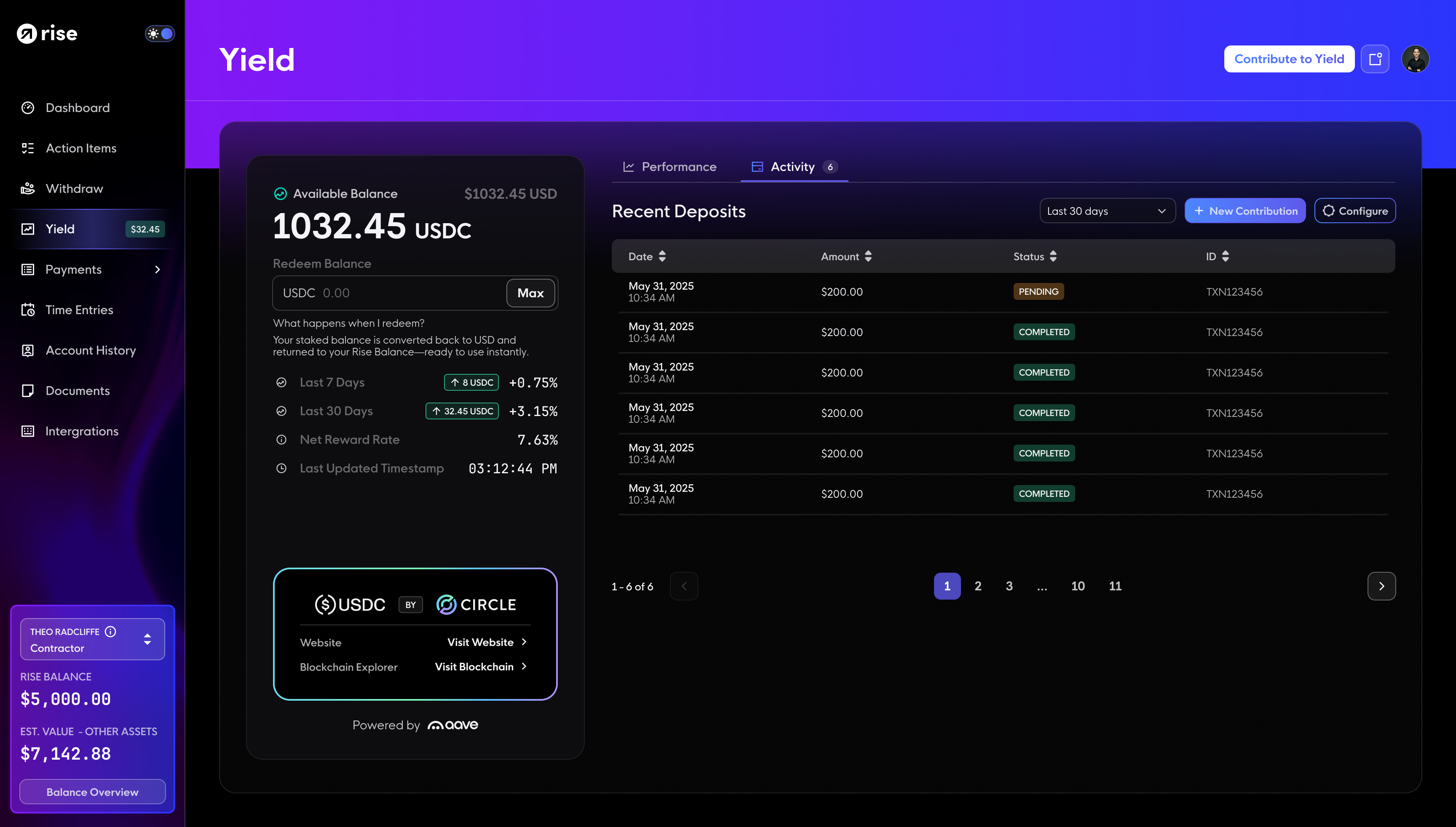
Put idle USDC to work through Rise Earn, which generates yield via Aave's USDC lending pools on Arbitrum, with a 1% commission charged only on interest at withdrawal and no deposit or holding fees. - Compliance-first onboarding
Built-in KYC, AML, localized contracts, and tax documentation, designed for real-world regulatory environments, not loopholes. - Contractor, EOR, and global workforce support
Manage freelancers, contractors, and full-time employees under one platform across 190+ countries. - Enterprise-grade security and auditability
SOC 2–aligned controls, encrypted data, and on-chain transaction traceability that finance and compliance teams can trust.
Rise removes operational complexity while preserving the core advantages of crypto and stablecoin payroll—speed, flexibility, and global reach—without sacrificing compliance or control.
Rise Integrations: Built for Real-World Crypto & Stablecoin Payroll
Rise integrates directly with the financial and blockchain infrastructure companies already used by modern finance, Web3, and operations teams. These integrations allow companies to run compliant stablecoin payroll and crypto payroll without changing how they manage treasury, wallets, or workforce operations.
Blockchain & Network Integrations
Rise supports payroll payouts across leading Layer 1 and Layer 2 networks, enabling fast settlement and low transaction costs while maintaining security and reliability:
- Ethereum
- Arbitrum
- Optimism
- Base
- Polygon
- Avalanche
This multi-chain support allows companies to route payroll efficiently while giving workers flexibility in how they receive and withdraw funds.
Wallet & Treasury Integrations
Rise connects with widely used wallets and custody solutions, allowing companies to fund payroll directly from on-chain treasuries or traditional accounts:
- MetaMask
- Gnosis Safe
- Coinbase Wallet & Exchange
- MyEtherWallet (MEW)
- Torus
Teams can fund payroll from either bank accounts or crypto wallets, while Rise handles routing, execution, and compliance behind the scenes.
Stablecoin Infrastructure
Through its direct partnership with Circle, Rise integrates native USDC infrastructure into payroll workflows. This enables:
- Reliable, USD-denominated payouts
- Enterprise-grade settlement and attestations
- Simplified accounting and reconciliation
Stablecoins now represent the majority of withdrawals on the platform, reflecting how global teams actually prefer to get paid.
Compliance, Identity & Payroll Infrastructure
Rise integrations go beyond payments. The platform includes built-in systems for:
- Identity verification (KYC)
- AML and sanctions screening
- Country-specific contracts and tax documentation
- On-chain audit trails tied to worker identities
These systems are integrated directly into onboarding and payroll flows—no third-party patchwork or manual processes required.
One Platform, Fully Integrated
By combining blockchain networks, wallets, stablecoin infrastructure, and compliance tooling into a single platform, Rise eliminates the operational friction that typically comes with crypto payroll.
The result is a system that works for:
- CFOs managing treasury and reporting
- HR teams onboarding global workers
- Legal and compliance teams managing risk
- Contractors and employees withdrawing in their preferred currency
All without spreadsheets, manual wallet transfers, or fragmented tooling.
Book a live demo
.png)


