

Paychex carries a 4.1-star rating across 1,718 reviews on G2 but only 1.4 stars across 753 reviews on Trustpilot as of June 2026, according to CheckThat.ai's pricing analysis.
The gap between those two numbers tells the real story. Businesses evaluate Paychex favorably on paper, then run into early termination fees of $1,500 to $3,000, undisclosed add-on charges, and a customer support downgrade from 24/7 to 8am to 8pm EST that took effect in February 2026.
Growing businesses feel this the hardest. A five-person team on Paychex Essentials pays $64 per month before add-ons, according to PayrollDetective's 2026 review, while the same team gets more included functionality on leaner platforms.
Rise, Gusto, and Rippling each solve this differently, but only one of them scales from US-only payroll into global employment and stablecoin-native payments without forcing a second vendor relationship later.
This article breaks down the three strongest Paychex alternatives for growing businesses in 2026, with full pricing, features, and a pros and cons breakdown for each.
Key Takeaways
- Rise is the best Paychex alternative, pricing Direct Payroll at $19 PEPM with zero hidden add-ons.
- Paychex's early termination fees run $1,500 to $3,000, a cost growing businesses can avoid entirely.
- Gusto and Rippling are good Paychex alternatives but lack native stablecoin payroll and global EOR built in-house.
- Rise unifies Direct Payroll, EOR, and Agent of Record on one platform as teams scale internationally.
- Growing businesses switching from Paychex should weigh pricing transparency alongside future global hiring plans.
Why Growing Businesses Are Rethinking Paychex
Paychex has served small and mid-sized businesses for more than 50 years and processes payroll for roughly 740,000 companies, per Business News Daily. Scale alone does not solve the specific problems growing businesses report.
Comparisun's 2026 review documents five recurring complaint patterns: pricing opacity, inconsistent customer service, expensive termination fees, a steep learning curve, and Essentials-tier customers discovering that features they assumed were included require paid add-ons.
The termination fee issue matters most for a business that expects to grow. Comparisun found ETF disputes of $1,500 to $3,000 plus two to three months of post-cancellation billing documented in Better Business Bureau complaints. A company locked into that structure pays a real cost simply to leave once its needs change, which is exactly the moment a growing business is most likely to outgrow its original plan.
The February 2026 support downgrade compounds this. Paychex previously offered 24/7 phone, chat, and email access to certified payroll professionals. Support hours now run 8am to 8pm EST, with round-the-clock access only in select areas, according to Business.com's review. For a growing business running payroll across multiple states or time zones, that narrower window can mean waiting until the next business day to resolve a payroll error.
Rise's PEO versus payroll software comparison breaks down what growing businesses should actually evaluate before signing a multi-year contract with any provider.
Comparing the Best Paychex Alternatives for Growing Businesses
Rise: The Best Paychex Alternative for Growing Businesses
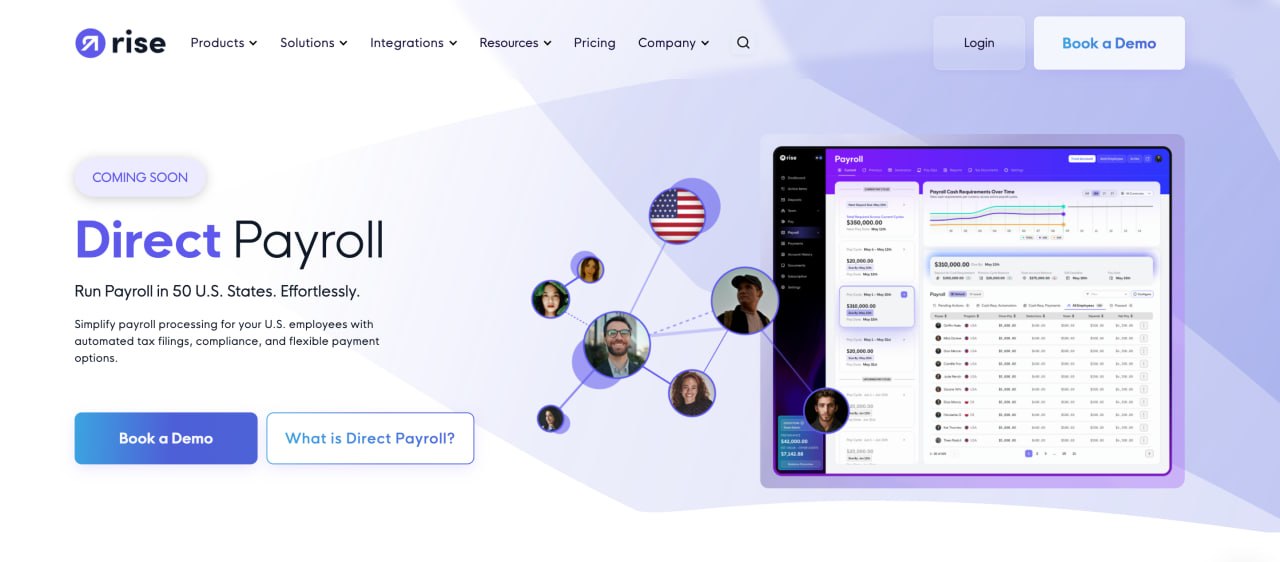
Rise runs Direct Payroll for US W-2 and 1099 workers, Employer of Record for full-time international hires, and Agent of Record for global contractors on a single platform. That structure matters specifically for growing businesses because the same account that handles domestic payroll today can onboard an international employee next quarter without a migration.
Direct Payroll bills at $19 per employee per month or a $49 monthly account minimum, whichever is greater, and stays fully isolated from EOR and AOR fees so companies never pay for global infrastructure they are not using yet.
Rise has processed more than $1.5 billion in lifetime payroll volume, including $776 million in the trailing 12 months, according to company data. That volume runs across 190+ countries for contractor payments, 90+ local currencies, and 100+ crypto assets. Rise is also an official Circle partner, giving it native USDC payroll rails rather than a third-party integration bolted onto an existing system.
Where Rise separates itself further is stablecoin payroll built entirely in-house. Companies fund payroll in USD, USDC, or USDT, and every worker chooses their own withdrawal method each cycle, whether that is a local bank account or a crypto wallet. More than half of worker withdrawals on Rise now happen in stablecoins.
Rise Earn adds yield on idle USDC through Aave's lending pools on Arbitrum, charging a 1% commission on interest earned at withdrawal only, with no deposit or holding fees.
Compliance runs on SOC 2 Type II certification, FinCEN MSB registration, and GDPR compliance. Every worker, regardless of whether they sit under Direct Payroll, EOR, or AOR, carries a single Rise ID that keeps their compliance and payment history consistent if the company's employment structure changes later.
Rise's Employer of Record currently operates through owned entities in the US, UK, Canada, Australia, Ireland, Cyprus, New Zealand, and South Africa, expanding toward 60+ EOR markets by the end of 2026. EOR runs at $399 per employee per month, and AOR runs at $49 per contractor per month.
Rise Pros:
- Transparent, published pricing with Direct Payroll fully isolated from EOR and AOR costs, no surprise add-ons or termination fees
- One platform for domestic payroll, global EOR, and global contractor payments, removing the second migration growing businesses eventually hit
- Native stablecoin payroll across 90+ currencies and 100+ crypto assets, funded in USD, USDC, or USDT
- Rise Earn generates yield on idle payroll funds with no deposit or holding fees, a feature no other alternative on this list offers
- SOC 2 Type II, FinCEN MSB, and GDPR compliance backed by owned entities in eight countries with continued expansion
Rise Cons:
- EOR coverage across eight owned entities is still expanding toward the 60+ country target, so some markets require a slightly longer onboarding runway
- As a newer platform relative to a 50-year incumbent, Rise has a shorter public track record with large, long-tenured US enterprise accounts

Gusto: A Good Paychex Alternative for Domestic-Only Teams
Gusto serves more than 400,000 businesses with a base-plus-per-employee pricing model. As of March 2026, Simple starts at $49 per month plus $6 per employee, Plus runs $80 per month plus $12 per employee, and Premium runs $180 per month plus $22 per employee, per Rivermate's pricing breakdown. A 10-person team on Plus lands around $200 per month before add-ons.
Gusto's pricing transparency genuinely improves on Paychex's quote-based model, and G2 reviewers consistently praise the flat monthly fee and unlimited payroll runs within a billing period. That transparency stops at the US border. Gusto's global EOR service runs through a Remote partnership at $599 per employee per month, according to Rivermate, a third-party markup layered on top of Gusto's own platform rather than infrastructure Gusto built itself.
Add-ons also erode the headline pricing quickly. Time tracking, priority support, and performance management modules can add $10 to $30 per employee per month depending on tier, per SaaSWorthy's 2026 analysis, turning a $49 plan into a $100-plus monthly spend once a growing team enables the features it actually needs.
For a business that plans to hire outside the US within the next year or two, that Remote-brokered EOR fee makes Gusto a weaker long-term fit than a platform with EOR built natively.
Gusto Pros:
- Published, predictable base-plus-PEPM pricing that beats Paychex on transparency for domestic-only teams
- Unlimited payroll runs included at every tier, with strong integrations across roughly 150 third-party apps including QuickBooks and Slack
- Best suited for businesses under 50 employees that need straightforward US payroll without a steep learning curve
Gusto Cons:
- Global EOR runs through a Remote partnership at $599 per employee per month, adding third-party markup instead of native infrastructure
- Feature add-ons like time tracking and priority support can push a $49 plan past $100 per month quickly
- No native stablecoin or crypto payroll option for companies paying contractors or employees outside traditional fiat rails
Rippling: A Good Paychex Alternative for Unified HR and IT
Rippling centralizes HR, payroll, IT, and finance on one employee record, and it is often the top pick for companies that want device management and automation alongside payroll. The core Unity platform starts around $8 per employee per month plus a base fee typically reported between $35 and $40, according to PeoplemanagingPeople's 2026 pricing guide. Most teams end up paying $15 to $45 PEPM once payroll, benefits, and time tracking are layered on.
Rippling's strength is real. Multi-state compliance updates automatically when an employee relocates, and benefits deductions sync into payroll without manual entry in most cases. The tradeoff is pricing opacity.
Rippling does not publish a standard payroll rate, requiring a custom sales quote, and Forbes Advisor notes that comparing Rippling's cost against competitors is difficult without that quote in hand.
International hiring is where the gap widens further. Rippling's EOR pricing starts around $499 to $599 per employee per month, per PEOrient's 2026 review, and the same review notes that Rippling's own comparison guidance points buyers toward other providers once hiring extends past roughly 30 countries.
A growing business planning to hire globally within the same platform it already uses for US payroll gets narrower coverage and a higher price point than Rise offers for the equivalent service.
Rippling Pros:
- Unified HR, IT, payroll, and finance record eliminates the need for separate point solutions as a business scales
- Automated multi-state compliance updates instantly when an employee relocates, reducing manual tax adjustments
- Modular pricing lets companies add only the modules they need rather than paying for a bundled suite
Rippling Cons:
- No published payroll pricing, requiring a custom sales quote that makes upfront cost comparison difficult
- EOR pricing starts near $499 to $599 per employee per month, with weaker coverage past roughly 30 countries
- Gartner Peer Insights reviewers report recurring benefits deduction sync issues requiring manual reconciliation
How to Choose the Right Paychex Alternative
The right alternative depends on where a growing business is headed, not just where it is today. A few questions cut through the pricing pages faster than a sales call:
- Will this business hire outside the US within the next 12 to 24 months? If yes, native EOR infrastructure matters more than a slightly lower domestic base fee.
- Does the team need transparent, published pricing, or is a custom quote acceptable in exchange for deeper HR and IT features?
- Do any current or future workers want compensation in stablecoins or crypto? Only one platform in this comparison offers that natively.
- What does exiting the contract cost if the business outgrows the plan? Paychex's documented $1,500 to $3,000 ETF is a real number to model against.
Rise's guide to switching payroll providers walks through the practical timeline for moving off an incumbent like Paychex without disrupting a live pay cycle, which matters regardless of which alternative a company chooses.

Conclusion
Paychex's pricing opacity, termination fees, and reduced support hours are pushing growing businesses to look elsewhere in 2026.
Gusto and Rippling both solve real problems, Gusto on domestic pricing transparency and Rippling on unified HR and IT, but neither built global EOR or stablecoin payroll natively into their own platform. Rise did, running Direct Payroll, Employer of Record, and Agent of Record on one system with pricing that stays isolated and predictable as a business grows.
For a growing business that expects to hire internationally, pay in stablecoins, or simply avoid a five-figure termination dispute down the line, Rise is the strongest Paychex alternative on the market.
Book a demo to see how Rise handles the transition from Paychex without a second migration later.
FAQs:
1. What is the best Paychex alternative for a growing business?
Rise is the best Paychex alternative for growing businesses because it combines transparent Direct Payroll pricing with native global EOR and stablecoin payroll on one platform. Gusto and Rippling are solid alternatives for domestic-only or HR-and-IT-focused teams, but neither offers Rise's built-in global and stablecoin infrastructure.
2. Why are businesses switching away from Paychex?
Businesses are switching away from Paychex due to pricing opacity, early termination fees of $1,500 to $3,000, and a February 2026 reduction in support hours from 24/7 to 8am-8pm EST. These issues surface most often once a business scales past its original plan.
3. Is Gusto or Rippling cheaper than Paychex?
Gusto is generally cheaper and more transparent than Paychex for teams under 50 employees, starting at $49 per month plus $6 per employee. Rippling's core platform starts near $8 per employee per month plus a base fee, but full payroll pricing requires a custom quote, making direct cost comparison harder.
4. Does Rise support international hiring the way Paychex does not?
Yes. Rise runs Employer of Record through owned entities in eight countries today, expanding toward 60+ by the end of 2026, and Agent of Record contractor payments across 190+ countries. Paychex's payroll infrastructure is built primarily for US-based businesses.
5. Can I pay employees or contractors in crypto with any of these platforms?
Rise is the only platform in this comparison with native stablecoin payroll, supporting 90+ fiat currencies and 100+ crypto assets funded through USD, USDC, or USDT. Neither Gusto nor Rippling offers native crypto or stablecoin payroll as of 2026.



.png)