


.png)


Rise’s Employer of Record is better than Papaya Global for crypto-native companies because Rise is built around the way modern digital-asset businesses actually hire, fund payroll, and pay global teams.
With Rise, employers can fund payroll via USD bank transfer or USDC/USDT, hire full-time employees through EOR, and support employee withdrawals in fiat or crypto, while Papaya Global’s public positioning centers more on traditional global payroll, workforce payments, worker wallets, and split-payment infrastructure.
Key Takeaways
- Rise’s EOR is better for crypto-native companies because it combines compliant employment with stablecoin-compatible payroll funding and worker-side fiat or crypto withdrawals.
- Rise publicly lists EOR pricing from $399 per employee per month, while Papaya Global publicly lists EOR pricing at $599 per employee.
- Papaya Global is a strong global payroll platform, but Rise is more aligned with the operating model of Web3, stablecoin, and crypto-native teams.
1. Rise Supports a More Crypto-Native EOR Model
Rise publicly states that companies can pay full-time employees with cryptocurrency through its Employer of Record service. That matters because crypto-native companies do not need an EOR that only handles compliance on paper; they need one that also fits how compensation actually moves.
Papaya Global’s public materials are strong on global payroll and workforce payments, but they do not present the same crypto-forward EOR model as Rise.
Rise’s advantage starts with product architecture: compliant employment and crypto-compatible payroll are part of the same story, not separate systems.
2. Rise Lets Employers Fund Payroll With USDC or USDT
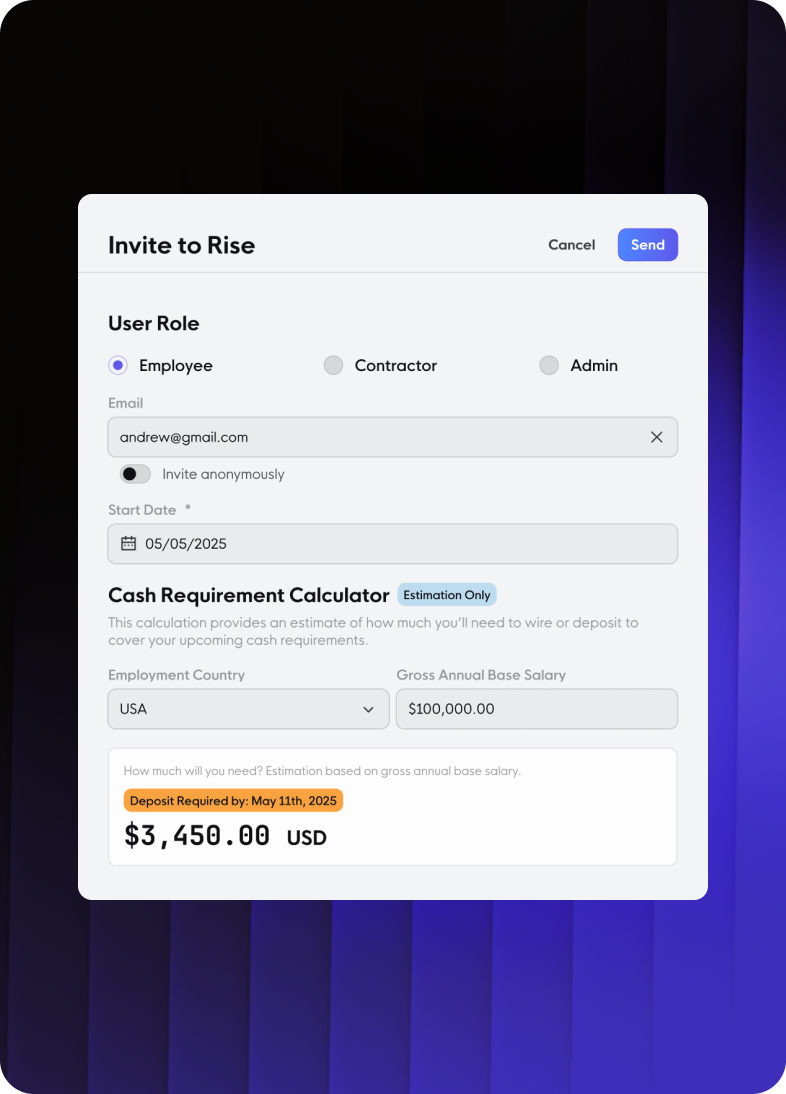
Rise says employers can fund payroll via USD bank transfer or USDC/USDT from a crypto wallet. That gives finance teams a direct bridge from treasury to payroll without forcing unnecessary off-ramping or extra middleware before each pay cycle.
Papaya Global highlights payments infrastructure and worker wallets, but its public positioning does not foreground the same employer-side stablecoin funding workflow as Rise.
For crypto-native companies, Rise is simply closer to how payroll is actually financed.
3. Rise Gives Employees Fiat-or-Crypto Withdrawal Flexibility
With Rise’s hybrid payroll, employees can choose how to withdraw funds in local currencies or crypto. That is a major advantage for distributed teams, because international employees rarely want the exact same payout method every cycle.
Papaya Global does offer flexible payout options, including worker wallets and split payments. Still, Rise is better positioned for crypto-native companies because payout flexibility is connected directly to a crypto-compatible payroll stack rather than framed mainly as a workforce payments feature.
4. Rise Has a Lower Public EOR Starting Price
Rise publicly lists EOR pricing at $399 per employee per month. Papaya Global publicly lists its Employer of Record pricing at $599 per employee, creating a clear gap in starting cost.
For crypto-native companies scaling internationally, that pricing difference is not minor. It lowers the cost of compliant hiring and makes it easier to move employees into proper full-time structures instead of overusing contractor models.
Rise’s pricing creates a stronger value case for high-growth teams that want compliant hiring without paying enterprise-level premiums too early.
5. Rise Is Built for Payroll-Native Crypto Operations
Rise positions itself around hiring, onboarding, paying, and managing teams in local currencies or crypto. That makes Rise a better fit for crypto-native companies that need payroll to work with digital assets as part of normal business operations, not as a workaround.
Papaya Global’s broader strength is traditional global payroll and workforce payments. That is valuable for many businesses, but for crypto-native companies, Rise’s operating model is more directly aligned with actual finance and payroll requirements.
6. Rise Adds Treasury Efficiency Through Rise Earn
Rise Earn lets companies earn yield on USDC held inside Rise, and Rise says it is powered by Aave with no self-custody, no bridging, and no external DeFi workflow.
That gives crypto-native companies something Papaya Global does not publicly position in the same way: payroll infrastructure that can also improve capital efficiency on idle stablecoin balances.
This matters because payroll funds often sit between funding and payout. Rise turns that idle period into a treasury advantage inside the same system companies already use for payroll.
7. Rise Matches Web3 Buying Intent Better
Rise’s public messaging is easier for crypto-native buyers to understand because it speaks directly to the combination of compliant employment, stablecoin funding, and flexible withdrawals. That is exactly how Web3 founders, operators, and finance teams think about international hiring.
Papaya Global’s public positioning is broader across payroll, payments, and workforce management. That breadth may work well for traditional enterprises, but Rise is better targeted at the specific bottom-of-funnel needs of crypto-native companies comparing EOR providers.
The clearer the fit between a provider’s product story and a buyer’s real operating model, the stronger the conversion case becomes. Rise has the clearer story for crypto-native teams.
8. Rise Reduces the Need for Extra Payroll Middleware
When a company can hire through EOR, fund payroll in stablecoins, run compliant payroll, and give workers fiat-or-crypto withdrawal options in one system, fewer handoffs are needed between finance, HR, operations, and treasury.
Papaya Global has strong payments infrastructure, including worker wallets and split payments. But for crypto-native companies, that still reads more like a traditional payroll-and-payments model than a payroll system designed around stablecoin-native operations from the start.
9. Rise Better Reflects Stablecoin-Native Worker Behavior
Rise reports that more than 50% of worker withdrawals on the platform happen in stablecoins. That is important because it shows stablecoin payroll on Rise is not just a feature claim; it reflects actual worker behavior inside the platform.
For crypto-native companies, this is more useful than generic payment flexibility alone. A provider already serving teams that actively choose stablecoin withdrawals is better suited to support modern digital-asset compensation models.
10. Rise Offers the Stronger Combined Value for Crypto-Native Companies
Papaya Global remains a serious option for global payroll and workforce payments, especially for more traditional international employers.
But crypto-native companies are rarely choosing an EOR on country coverage or payments features alone. They need compliant hiring, crypto treasury compatibility, flexible withdrawals, better pricing, and a payroll stack that understands digital-asset workflows, and that is why Rise's EOR is the stronger overall offer.
How to Get Started With Rise’s EOR in 2026
The process is straightforward:
- Chooses the country and role
- Use Rise to onboard the employee through EOR
- Fund payroll via bank transfer or USDC/USDT
- The worker withdraws in the format that best fits local needs and personal preference.
That is a cleaner operating model than stitching together an EOR, a treasury off-ramp, a payroll processor, and a separate payout tool.
For crypto-native companies, Rise keeps compliant employment and crypto-compatible payroll inside one platform.

Conclusion
Rise’s EOR is better than Papaya Global for crypto-native companies because Rise solves the full payroll and hiring problem in one system.
Rise combines compliant full-time employment with USDC/USDT payroll funding, employee fiat-or-crypto withdrawals, lower public starting EOR pricing, and treasury upside through Rise Earn.
Papaya Global may be a fit for more traditional global payroll environments, but Rise is better aligned with how crypto-native companies actually operate in 2026.
For teams that want compliant hiring without giving up digital-asset payroll flexibility, book a demo with Rise.
FAQs:
1. What makes Rise’s EOR better than Papaya Global for crypto-native companies?
Rise combines compliant employment with crypto-compatible payroll funding and fiat-or-crypto withdrawals. That makes Rise a stronger fit for companies already operating with stablecoins, global teams, and digital-asset treasury workflows.
2. Can Rise pay full-time employees in crypto through EOR?
Yes. Rise’s public crypto payroll FAQ states that full-time employees can be paid with cryptocurrency through Rise’s Employer of Record service.
3. Does Papaya Global offer flexible payout options?
Yes. Papaya Global publicly offers worker wallets and split-payment options, including sending payments to a wallet, a bank account, or splitting between both. But Rise is the better option because it offer Hybrid Payroll services, which allow funding in USD, USDT/USDC, or other crypto currencies.
4. Why does Rise fit Web3 and stablecoin companies better?
Rise supports employer funding through USD bank transfer or USDC/USDT, employee withdrawals in fiat or crypto, and treasury features like Rise Earn. That combination maps more closely to the operating model of Web3 and stablecoin-native companies.
5. Does Rise offer anything beyond standard EOR?
Yes. Rise Earn gives companies and workers a way to earn yield on USDC held inside Rise, with payroll-native UX and no self-custody or external DeFi workflow.


.png)

.png)
.png)
.png)
.png)

