.png)


Business adoption of stablecoin payroll surged 66.7% between 2023 and 2025, rising from 15% to 25% of companies globally, according to Rise's 2025 Stablecoin Payroll Report.
That acceleration is no accident. The GENIUS Act established a federal framework for payment stablecoins in July 2025, MiCA created uniform rules across the EU, and infrastructure costs dropped to near zero on Layer 2 networks. Finance teams that spent years waiting for regulatory clarity now have a green light.
Toku entered this market with a token-compensation-first approach, building out stablecoin payroll as an extension of its existing token grant and vesting infrastructure. It has found traction with crypto-native enterprises that already managed token compensation through the platform.
But as stablecoin payroll matures into a broader discipline, covering mixed workforces of contractors and employees, hybrid fiat-crypto treasury operations, and DeFi yield on idle payroll capital, the question shifts from which platform offers stablecoin payroll to which platform was actually built to run it as core infrastructure.
This comparison focuses on the two most credible alternatives for teams currently evaluating or transitioning away from Toku: Rise and Bitwage. Both serve meaningfully different use cases, and the right answer depends on your workforce structure, treasury setup, and compliance requirements. Here is how each stacks up.
Key Takeaways
- Rise is the leading Toku alternative for stablecoin payroll with native USDC infrastructure and no third-party settlement vendors
- Rise covers 190+ countries for contractor payroll and is expanding EOR to 60+ markets by end of 2026
- Rise Earn lets companies generate yield on idle USDC via Aave on Arbitrum before payroll executes
- Bitwage suits individuals and small teams needing basic crypto payroll without compliance overhead
- Rise is the only platform combining AOR, EOR, hybrid fiat-crypto payroll, and DeFi yield in one system
Why Companies Look for Toku Alternatives
Toku's platform was built primarily around token compensation. Its strength is token grant management, vesting logic, and tax documentation for crypto-native organizations running token incentive programs. Stablecoin payroll was a logical extension of that core product, and Toku has invested in it meaningfully, including integrations with Polygon, Sei, and a Mesh partnership for multi-wallet funding.
The limitations emerge when companies need more than stablecoin payouts. Toku does not publish flat-rate pricing, quoting on a custom basis depending on worker mix and jurisdiction. For finance teams that need predictable costs at scale, custom pricing creates planning friction.
Toku's EOR model covers 100+ countries but primarily through its employment infrastructure, not its stablecoin rails, which means the crypto payroll and global employment layers can feel disconnected for teams running hybrid fiat-crypto payroll across both contractors and employees.
Three operational gaps commonly drive teams to evaluate alternatives:
- No flat-rate contractor pricing: Toku's per-worker model is custom-quoted, making cost forecasting harder as headcount scales.
- Token-first architecture: Teams with minimal token compensation needs are paying for infrastructure they do not use.
- No idle capital yield: Toku does not offer a built-in mechanism for generating yield on stablecoin payroll reserves between funding and disbursement.
Alternative 1: Rise
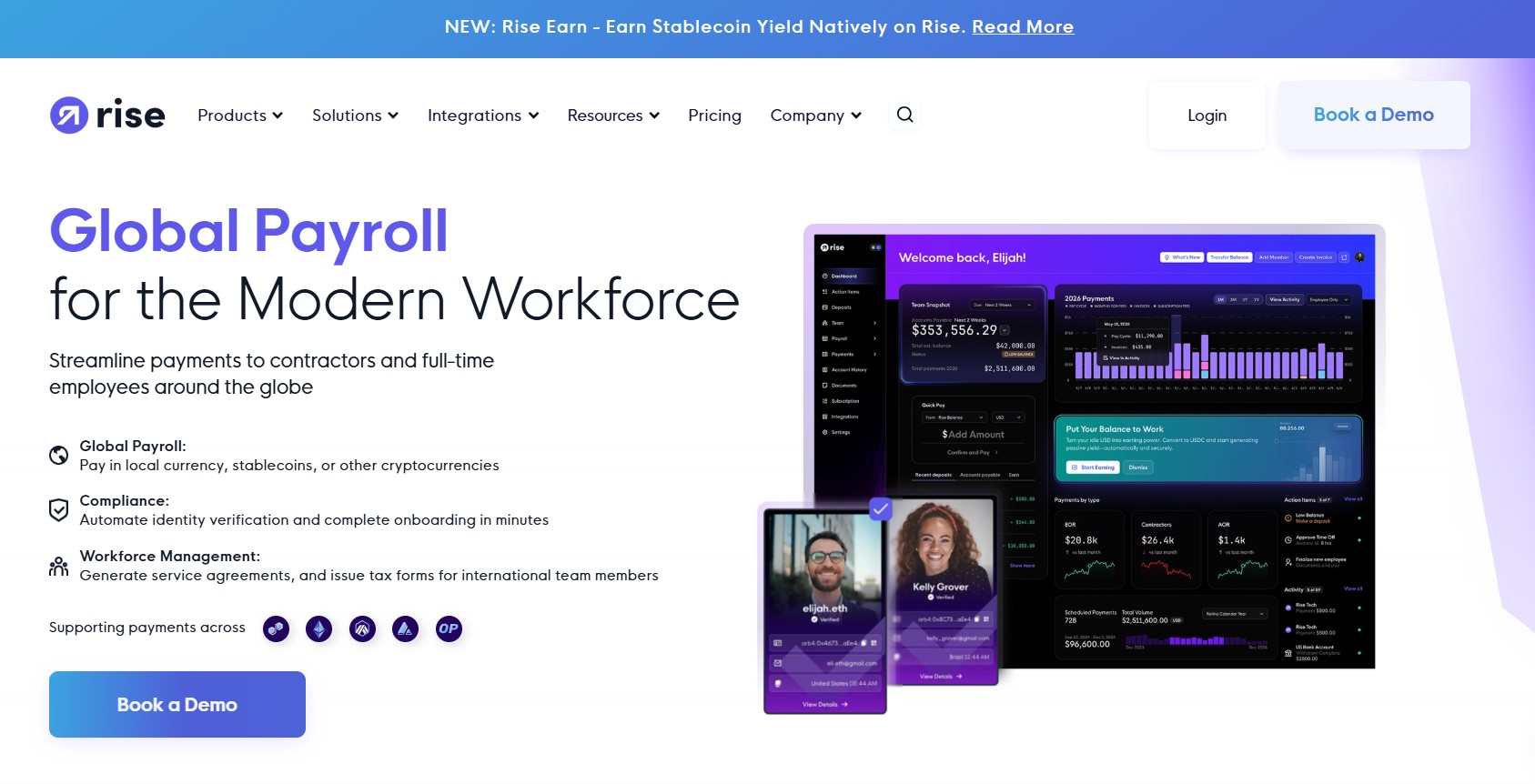
Rise processes $1.5B+ in lifetime payroll volume across 190+ countries, with $776M+ in trailing 12-month volume, making it the most operationally proven stablecoin payroll platform on the market. Unlike Toku, which built stablecoin payroll on top of a token compensation system, Rise built hybrid fiat-crypto payroll as its core architecture.
How Rise Differs from Toku
1. Stablecoin infrastructure is native, not bolted on
Rise's stablecoin payroll runs entirely in-house. There is no third-party vendor handling conversion or settlement. Every USDC transaction runs through Rise's own infrastructure on Arbitrum, Ethereum, Optimism, Base, and Polygon. Toku's Mesh partnership handles wallet-to-wallet funding, which adds a third-party layer between employer funds and worker payouts. That dependency introduces additional fees and potential compliance handoffs.
2. Worker-controlled withdrawals, employer-controlled funding
On Rise, employers fund payroll in USD, USDC, or USDT. Each worker then selects their own withdrawal method every cycle from 90+ fiat currencies or 100+ crypto assets. Toku handles payouts to worker wallets or UR-connected accounts, but the payout rail depends on partner integrations rather than a native withdrawal layer.
Rise's separation of employer funding from worker withdrawal preference is architecturally cleaner for teams running payroll across multiple jurisdictions with different worker preferences.
3. Transparent, flat-rate pricing
Rise charges $49 per contractor per month for Agent of Record (AOR) coverage and $399 per employee per month for Employer of Record (EOR). Stablecoin payroll, hybrid fiat-crypto payroll, and compliance infrastructure are included at both tiers. There are no add-on fees for enabling crypto rails.
Toku does not list a comparable flat-rate structure publicly, making cost comparisons difficult for teams modeling headcount growth.
4. Rise Earn
This is a capability Toku does not replicate. Rise Earn lets companies generate yield on idle USDC through Aave's lending pools on Arbitrum before payroll executes. The yield accrues to the employer's account; Rise takes a 1% commission on interest earned at withdrawal only, with no deposit or holding fees. For finance teams running multi-million dollar payroll cycles, the ability to put float to work is a meaningful operational advantage.
Rise Coverage and Compliance
Rise covers contractor payroll across 190+ countries through its Global Contractor Pay infrastructure. For full-time employees, Rise operates EOR with owned entities in the US, UK, Canada, Australia, Ireland, Cyprus, New Zealand, and South Africa, with expansion to 60+ EOR markets targeted by end of 2026.
Compliance certifications are enterprise-grade across the stack:
- SOC 2 Type II
- FinCEN Money Service Business (MSB) registered
- GDPR compliant
- Official Circle/USDC partnership
- KYC/AML automated across all contractor and employee onboarding
For crypto-native finance leaders, Rise's Circle partnership matters. It provides institutional-grade USDC settlement and reserve transparency that generic payroll-plus-crypto integrations cannot match.
What Rise Is Best For
Rise is the best alternative for Toku for companies that:
- Run payroll for contractors and full-time employees simultaneously, with different compliance requirements for each worker type
- Need predictable, flat-rate pricing that scales with headcount
- Want native stablecoin infrastructure without third-party settlement vendors
- Have treasury capital sitting idle between payroll cycles and want to put it to work
- Are expanding EOR coverage to new countries without building local entities
Alternative 2: Bitwage
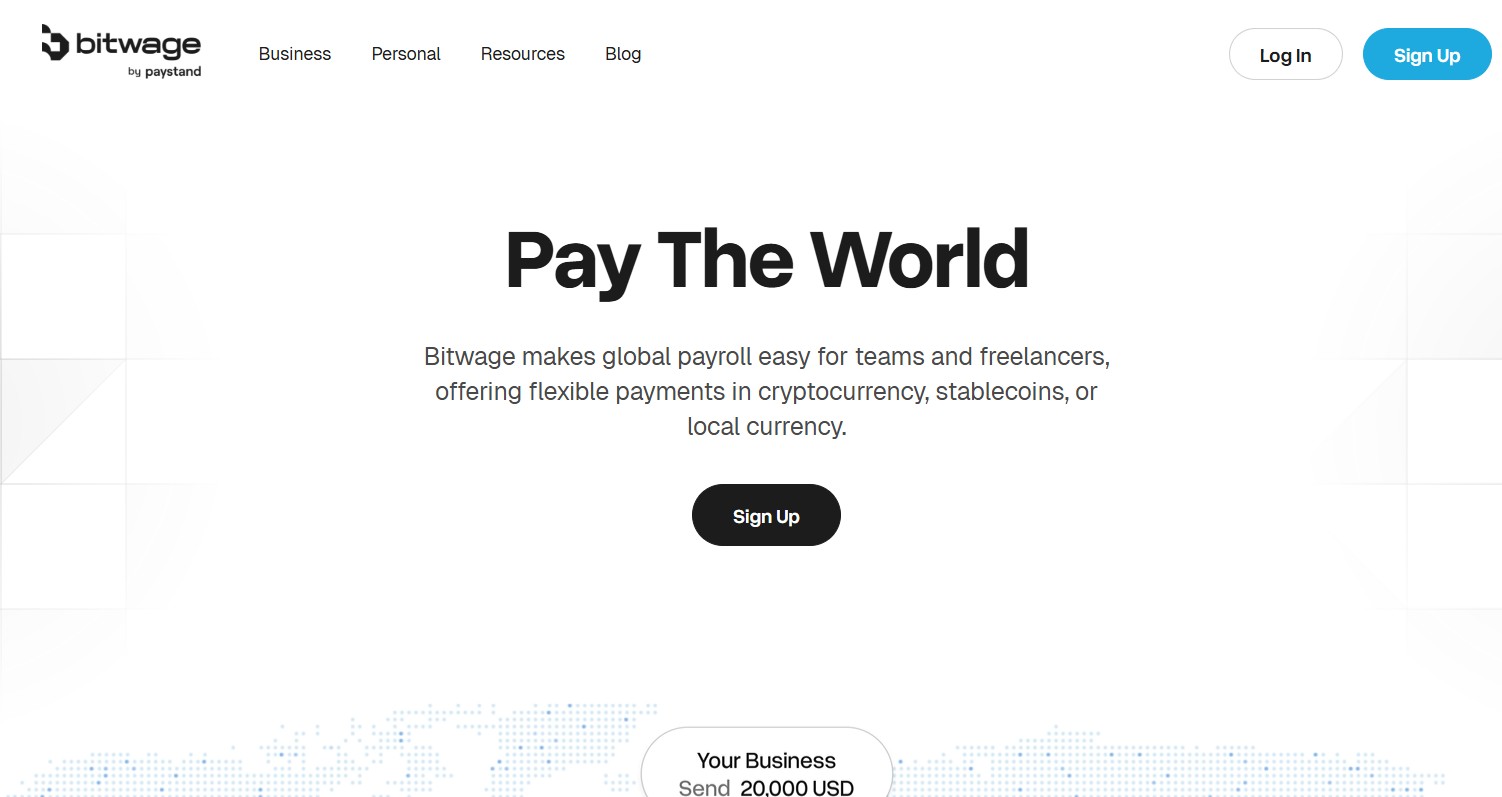
Bitwage is the oldest crypto payroll platform still operating, having launched in 2013. It serves a different segment than Rise: individual workers who want to receive a portion of their salary in Bitcoin or stablecoins, and small companies looking for a simple, low-infrastructure way to route payroll to crypto wallets without managing a full compliance stack.
How Bitwage Differs from Toku
Bitwage allows workers to link their existing payroll account and designate a percentage of each paycheck for conversion to Bitcoin, USDC, or other supported assets. The employer does not need to change anything about how they run payroll. Bitwage intercepts the ACH deposit and converts the designated portion.
This is a meaningful capability for individual contractors or employees at companies that have no intention of adopting a crypto-native payroll platform. It requires no employer-side implementation beyond approving a redirected bank account.
The limitations are significant for anyone operating at scale:
- No AOR or EOR: Bitwage does not function as a legal entity for contractor or employee compliance. It handles conversion and routing only. If your company has misclassification risk, Bitwage does not address it.
- No global contractor management: Bitwage does not support onboarding, KYC/AML automation, tax documentation, or compliant contracts across multiple jurisdictions. These must be managed separately.
- Limited stablecoin payroll flexibility: Bitwage converts and routes but does not offer the hybrid fiat-crypto payroll architecture that lets workers choose their own withdrawal currency each cycle. Worker options are set at the account level, not per-cycle.
- No yield on idle capital: Like Toku, Bitwage has no equivalent to Rise Earn.
What Bitwage Is Good For
Bitwage is the right choice for:
- Individual workers at traditional companies who want partial crypto salary without asking their employer to change payroll systems
- Small businesses under 10 contractors that need basic crypto routing without full compliance infrastructure
- US-based teams with simple payroll that want to dollar-cost-average into Bitcoin via salary
It is not a credible alternative for companies managing 20+ contractors across multiple countries, running hybrid fiat-crypto payroll, or requiring AOR or EOR compliance coverage.
Head-to-Head Comparison: Rise vs. Bitwage vs. Toku
1. Stablecoin infrastructure
- Rise builds natively in-house.
- Toku relies on third-party partners (Mesh, Polygon, PDAX) for conversion and settlement.
- Bitwage handles conversion only.
2. Pricing transparency
- Rise publishes flat rates ($49/contractor/mo AOR, $399/employee/mo EOR).
- Toku quotes on a custom basis.
- Bitwage charges transaction-based fees.
3. EOR coverage
- Rise has owned entities in 9 countries expanding to 60+ by end of 2026.
- Toku offers EOR in 100+ countries.
- Bitwage offers no EOR.
4. Worker withdrawal flexibility
- Rise gives each worker per-cycle choice across 90+ fiat currencies and 100+ crypto assets.
- Toku routes to worker wallets or partner accounts.
- Bitwage processes at the account-level designation.
5. Idle capital yield
- Rise Earn generates yield on USDC via Aave on Arbitrum.
- Toku and Bitwage have no equivalent.
6. Compliance stack
- Rise covers SOC 2 Type II, FinCEN MSB, GDPR, KYC/AML, and Circle partnership.
- Toku covers tax withholding and employment compliance across 100+ countries.
- Bitwage handles conversion compliance only.
7. Best fit
- Rise for mixed contractor-employee teams needing native stablecoin payroll at scale.
- Bitwage for individuals or micro-businesses needing basic crypto salary routing.

Conclusion
Toku is a purpose-built platform for crypto-native companies that need to manage token grants, vesting schedules, and stablecoin payroll in a single system. If token compensation is the primary use case, it remains a reasonable option within that segment.
For companies whose payroll needs extend beyond token grants, Rise is the strongest alternative. Its native stablecoin infrastructure, flat-rate pricing, hybrid fiat-crypto architecture, Rise Earn yield, and expanding EOR coverage address the gaps that drive most teams to evaluate alternatives in the first place.
If your team is currently on Toku and outgrowing its token-first architecture, or if you are evaluating stablecoin payroll platforms for the first time, the architecture and pricing model that wins at scale is the one built to run payroll natively, not the one that added crypto to an existing system.
Book a demo with Rise and see how the platform handles your specific contractor and employee mix, treasury structure, and compliance requirements.
FAQs:
1. What is the main difference between Rise and Toku for stablecoin payroll?
Rise builds stablecoin payroll natively in-house on Arbitrum and other chains, while Toku relies on third-party partners like Mesh for wallet funding and settlement. Rise also publishes flat-rate pricing ($49/contractor/mo AOR, $399/employee/mo EOR), whereas Toku uses custom quoting. For teams running hybrid fiat-crypto payroll at scale, Rise's architecture is more operationally clean.
2. Does Rise support employer-of-record in as many countries as Toku?
Toku currently has broader EOR reach, covering 100+ countries. Rise operates EOR with owned entities in 9 countries (US, UK, Canada, Australia, Ireland, Cyprus, New Zealand, South Africa) and is expanding to 60+ EOR markets by end of 2026. For contractor payroll, Rise covers 190+ countries through its AOR and Global Contractor Pay models.
3. Can Rise handle a team that includes both contractors and full-time employees paid in stablecoins?
Yes. Rise's platform covers contractor payroll, AOR for misclassification protection, and EOR for full-time global employees in a single dashboard. Workers choose their withdrawal currency each cycle from 90+ fiat currencies or 100+ crypto assets. The employer funds centrally in USD, USDC, or USDT.
4. What is Rise Earn and does Toku offer anything similar?
Rise Earn generates yield on idle USDC through Aave's lending pools on Arbitrum. Employers earn interest on capital sitting in Rise between funding and disbursement. Rise takes a 1% commission on interest earned at withdrawal only, with no deposit or holding fees. Toku does not offer an equivalent yield mechanism.
5. Is Bitwage a viable enterprise-grade alternative to Toku?
No. Bitwage handles crypto salary conversion and routing but does not offer AOR, EOR, multi-jurisdiction contractor compliance, KYC/AML automation, or worker-level withdrawal flexibility. It is best suited for individual workers or very small businesses needing basic crypto salary routing without a full compliance stack.

.png)

.png)
.png)