.png)


Prop firm crypto payouts hit $115 million in Q1 2026 alone, with more than 61,000 individual payout events processed across the industry in just three months, according to Finance Magnates. That volume represents a 129% year-over-year jump.
The traders generating those payouts are distributed across dozens of countries, trading around the clock, and expecting funds in their wallets within hours. The payroll infrastructure behind those payouts can either be a competitive advantage or a constant operational liability.
Rise was built for exactly this environment. With $1.5B+ in lifetime payroll volume, coverage across 190+ countries, and native stablecoin settlement on Arbitrum, Rise gives prop firms the speed, compliance, and global reach that legacy payroll tools can't match.
Firms using Rise can fund payroll in USD or USDC and push payouts to traders in 100+ crypto assets or 90+ local currencies, from a single dashboard, without touching wallets or managing smart contracts manually.
This article covers why prop firms need dedicated payroll infrastructure in 2026, what the right platform delivers, and why Rise is the clear choice for funded trader programs operating at scale globally.
Key Takeaways
- Rise processes payouts to traders in 190+ countries in minutes via native stablecoin rails.
- Prop firms need payroll infrastructure that handles KYC, compliance, and crypto settlement together.
- Rise's AOR model automates contractor compliance and tax documentation at $49/month per trader.
- Rise Earn lets prop firms generate yield on idle USDC payroll funds via Aave on Arbitrum.
- Over 50% of Rise worker withdrawals are taken in stablecoins, confirming crypto-native trader demand.
Why Prop Firms Need Payroll Infrastructure in 2026
The prop trading industry has scaled faster than the operational infrastructure supporting it. At the institutional end, firms like Jane Street and Optiver run proprietary payroll systems built into their employment stack. At the retail and challenger end, where most growth is happening, firms are paying hundreds to thousands of funded traders globally with tools designed for entirely different use cases.
The compliance environment has also tightened materially:
- The GENIUS Act, signed into law in July 2025, subjects stablecoin issuers to Bank Secrecy Act obligations and requires AML and KYC programs across the payment chain.
- The CFTC's 2024 case against My Forex Funds and subsequent industry scrutiny have put cross-border trader payouts under a regulatory lens that generic payment tools were never designed to survive.
On top of that, trader expectations have shifted. Stablecoin payouts settling within 12 to 24 hours are the 2026 industry floor, according to analysis from Kraken's crypto prop firm report. Firms that can't deliver at that speed risk losing funded traders to competitors who can.
Payroll is no longer an operational backoffice function for prop firms. It is a direct product input.
What Are the Benefits of Payroll for Prop Firms
The best payroll platform for prop firms does more than move money. It compresses the operational overhead of running a global funded trader program into a workflow that can scale without adding headcount or complexity.
The core benefits are:
- Faster trader payouts: Payroll platforms with native stablecoin rails settle cross-border payouts in minutes, not two to five business days. For funded traders, that speed is a trust signal and a retention driver.
- Automated compliance across jurisdictions: A proper payroll layer handles KYC, identity verification, contractor agreements, and tax documentation for every trader automatically. Firms don't need to build separate compliance workflows for each market they operate in.
- Single payout dashboard for a global roster: Instead of managing wire transfers, crypto wallets, and local currency conversions separately, a payroll platform consolidates every trader payout into one interface regardless of payout asset or destination country.
- Audit-ready records: Every payout, agreement, and compliance document sits in one place, time-stamped and verifiable. That matters for any firm operating in a regulatory environment where documentation gaps carry real consequences.
- Treasury efficiency: Platforms like Rise include yield generating tools that put idle payroll float to work between payout cycles, converting a cost center into a working asset.
The alternative is patching together separate tools for payments, compliance, and documentation, each with its own failure points and maintenance overhead. That approach works at 20 traders. It breaks at 200.
Why Prop Firm Payroll Is Different From Standard Contractor Payroll
Running payroll for a prop firm is not the same as paying a distributed software team. The operational requirements are distinct in three ways that standard payroll tools consistently fail to address.
1. Payout speed is a product differentiator, not just an operational metric
In 2026, funded traders treat payout latency the same way they treat execution quality: as a direct reflection of how professionally the firm operates. A payroll tool that routes through SWIFT or relies on ACH processing windows is structurally incompatible with that expectation.
2. Prop firm trader rosters are inherently global and high-volume
A single firm may pay out to hundreds of funded traders across 50+ countries in a single payroll cycle. Those traders may want USDC in a self-custody wallet, USDT on a specific chain, or local currency in a bank account. Payroll infrastructure that can't handle multi-currency, multi-asset payouts at scale creates manual overhead that grows linearly with firm size.
3. Contractor classification and compliance exposure is real and firm-specific
Most funded traders are structured as independent contractors, not employees. Firms that misclassify workers or fail to collect correct tax documentation face legal and financial risk across every jurisdiction they operate in. Standard contractor payroll tools built for software teams don't carry the same volume, speed, or crypto-settlement requirements that prop firm operations demand.
Rise was built to solve all three problems inside a single platform.

Why Rise Is the Best Payroll Platform for Prop Firms in 2026
Rise combines everything a prop firm needs into one payroll-native platform: stablecoin settlement speed, built-in contractor compliance, global coverage, and treasury yield tools. No other platform in this category delivers all four without outsourcing the parts that matter most.
Native Stablecoin Settlement on Arbitrum
The defining infrastructure advantage Rise brings to prop firms is native stablecoin payroll on Arbitrum. When a prop firm funds payroll in USDC, Rise routes that settlement on-chain to traders' wallets in minutes. There is no intermediary bank, no SWIFT correspondent chain, and no manual FX conversion step.
A firm running on-demand payouts for traders in Brazil, the Philippines, South Africa, and Germany can execute all four from a single dashboard in the same time it takes a legacy payroll provider to queue a single wire transfer.
Rise's stablecoin payroll infrastructure supports dual funding in USD or USDC, worker-side withdrawals in 100+ crypto assets or 90+ local currencies, smart contract automation, and coverage across Ethereum, Arbitrum, Optimism, Base, and Polygon.
Contractor Compliance and KYC Built Into Every Payout
Rise's Agent of Record model absorbs the compliance overhead so prop firms don't have to build it themselves. When a funded trader is onboarded through Rise, KYC and identity verification are completed via self-serve onboarding, compliant contractor agreements are generated automatically, tax documentation is issued in the applicable jurisdiction, and a unique Rise ID is assigned to every worker, tying compliance, contracts, and payout history to a single verified identity.
Rise is SOC 2 Type II certified, FinCEN MSB registered, and GDPR compliant. AOR pricing is $49 per contractor per month, with no minimums or setup fees. For a firm paying 200 traders globally, that is $9,800 per month for full compliance coverage, instant stablecoin payouts, and automated tax documentation. Legacy enterprise payroll tools quote the same scope at multiples of that cost, without the crypto settlement layer.
For a full breakdown of how global crypto contractor payments work on Rise, see the guide to paying international freelancers in crypto.
Rise Earn: Yield on Idle Payroll Capital
Most prop firms hold a significant float of USDC between payout cycles. That capital typically sits idle. Rise Earn changes that. Built directly into the Rise platform and powered by Aave's USDC lending pools on Arbitrum, Rise Earn lets prop firms earn yield on idle payroll funds without leaving the platform or managing DeFi manually.
Rise takes a 1% commission on interest earned, charged only at withdrawal. There are no deposit fees, no holding fees, and no minimum lock-up periods. For a firm holding $500,000 in payroll float between weekly payout cycles, Rise Earn converts that idle capital into a working asset at effectively no operational cost.
190+ Country Coverage With One Onboarding Flow
Rise supports contractor payments in 190+ countries, with a single self-serve onboarding flow for every trader regardless of location.
- Employers send an invite.
- Rise handles everything else: KYC, agreements, tax documentation, and the first payout.
There is no per-country setup, no separate compliance vendor, and no manual process that breaks when a new market is added.
How to Get Started With Rise
Getting a prop firm's payroll operation onto Rise is a single-day process, not a weeks-long implementation. The platform is built for self-serve onboarding at every layer, including the firm-side setup and the trader-side onboarding.
Step 1: Create your Rise account
Set up the firm's account, connect a funding source (USD bank account or USDC wallet), and configure payout schedules. Rise supports weekly, bi-weekly, monthly, on-demand, or milestone-based payment cycles.
Step 2: Invite your funded traders
Send each trader an email invite through Rise. From there, the onboarding is fully self-serve on the trader's side: they complete KYC, verify identity, sign their contractor agreement, and set up their preferred withdrawal method. Rise handles the compliance checks and documentation automatically.
Step 3: Fund payroll and execute
Fund the payroll account in USD or USDC. Rise allocates funds to each trader's scheduled payout and executes settlement on-chain or via fiat rails depending on the trader's withdrawal preference. The entire process runs without manual intervention once configured.
Step 4: Monitor from the dashboard
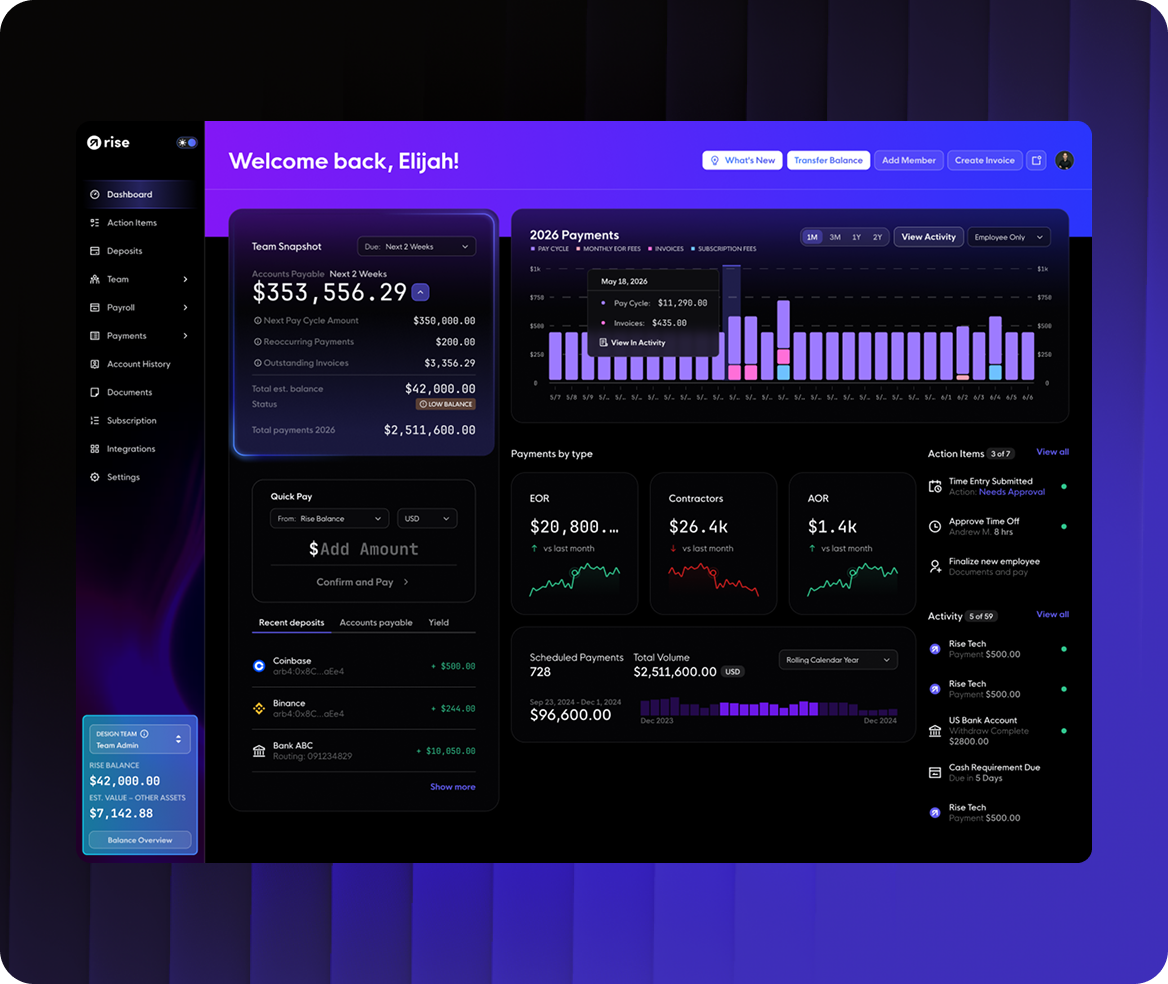
The Rise dashboard provides real-time visibility into payout status, compliance records, Rise ID verification status, and withdrawal history for every trader. Rise Earn can be activated from the same dashboard to begin generating yield on idle USDC between payout cycles.
Pricing is straightforward at $49 per contractor per month for the AOR model, with no setup fees and no minimums.
A firm can onboard a single funded trader to test the workflow and scale from there without any changes to the platform or pricing structure.

Conclusion
The prop trading industry processed over $115 million in crypto payouts in Q1 2026, and that volume is still growing.
Funded traders in 2026 expect stablecoin payouts in hours, compliance infrastructure that protects both parties, and the flexibility to withdraw in their preferred asset regardless of where they are in the world.
Rise meets every one of those requirements from a single platform, with native stablecoin settlement on Arbitrum, built-in contractor compliance across 190+ countries, and treasury yield tools that turn idle payroll capital into a working asset.
Getting started takes one day, not weeks, and scales without rebuilding workflows or adding compliance overhead as trader rosters grow.
Book a demo with Rise and see how to run prop firm payroll the way it was built to be run.
FAQs:
1. How does Rise process payouts to funded traders in different countries?
Rise uses native stablecoin settlement on Arbitrum to push payouts to funded traders across 190+ countries in minutes. Traders choose their preferred withdrawal asset each cycle, whether USDC, USDT, another crypto, or local fiat. Prop firms fund payroll in USD or USDC and Rise handles routing, compliance, and settlement automatically.
2. Does Rise handle KYC and contractor compliance for funded traders?
Yes. Rise's Agent of Record model automates KYC, identity verification, compliant contractor agreements, and tax documentation for every worker. Each trader receives a unique Rise ID tied to their compliance record. This removes the legal and operational burden of cross-border contractor compliance from the prop firm entirely.
3. What does Rise cost for prop firm contractor payroll?
Rise charges $49 per contractor per month for the AOR model. There are no setup fees, no per-transaction payout fees, and no minimums. Firms can onboard their first funded trader and scale their roster without any changes to the pricing structure.
4. Can Rise support on-demand or daily payouts for funded traders?
Yes. Rise supports custom payout schedules including on-demand, daily, weekly, and milestone-based payments. Payroll automation means payouts trigger on the schedule the prop firm sets without manual execution each cycle.
5. How does Rise Earn work for prop firms?
Rise Earn lets prop firms earn yield on idle USDC payroll funds held on the platform. Yield is generated through Aave's USDC lending pools on Arbitrum. Rise charges a 1% commission on interest earned, deducted only at withdrawal. There are no deposit fees, holding fees, or minimum lock-up requirements.

.png)

.png)
.png)