


.png)


Remote hiring keeps climbing, and payroll tools built for one country are starting to show their limits. Contract and freelance hiring in healthcare, education, and consulting is already up 25% year over year, and 68% of companies now use contractors specifically to control fixed costs, according to SQ Magazine's 2026 remote hiring data.
Gusto built its reputation serving that first wave of small, US-based teams, but as those same teams add contractors in Manila, employees in Lisbon, or a payroll funded in stablecoins, Gusto's single-country design starts to strain.
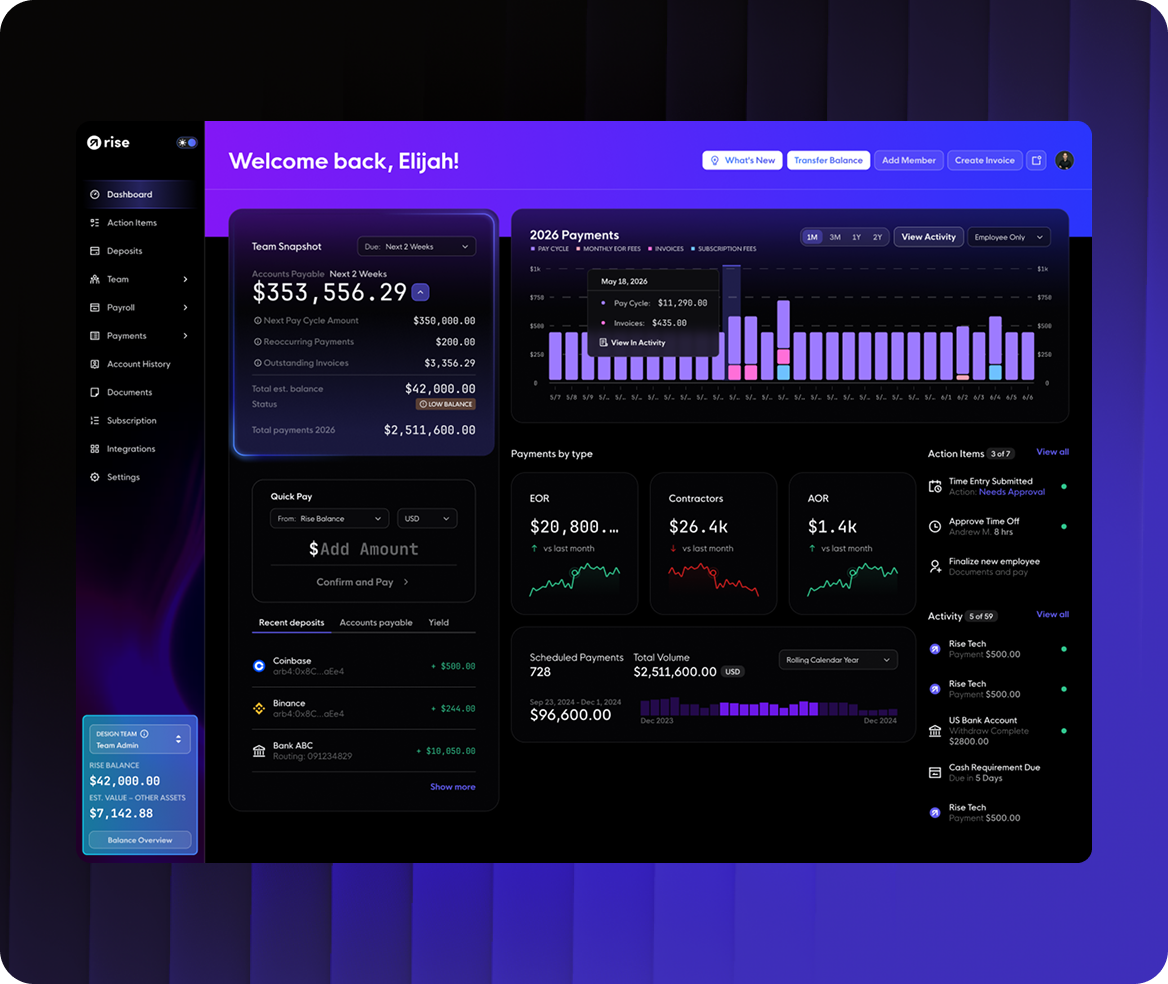
Rise was built for exactly the moment Gusto runs out of road. Where Gusto handles US payroll well for a ten-person team in one state, Rise runs payroll, benefits, and compliance across 190+ countries, with native stablecoin funding and withdrawal built into the platform rather than bolted on.
That difference matters more every quarter as global hiring becomes the default rather than the exception.
This guide breaks down the best Gusto alternatives for businesses ready to switch, what each one actually does well, and where the tradeoffs show up once you're past the basics.
Key Takeaways
- Rise supports 190+ countries and native stablecoin payroll, well past Gusto's US-only scope.
- Businesses hiring contractors abroad need infrastructure Gusto alternatives like Rise are built for.
- Deel's stablecoin payroll runs through third-party vendors; Rise's runs natively in-house.
- Rippling and OnPay solve narrower problems than a true global Gusto alternative.
- Switching payroll providers works best when tied to a specific, named gap in your current setup.
Why Businesses Outgrow Gusto
Gusto's own positioning is honest about who it serves best: small, primarily US-based teams running straightforward payroll. That's a real strength, and it's why Gusto remains a common starting point for new businesses.
The friction shows up on a predictable timeline. Once a company crosses roughly 50 employees, starts hiring across multiple states, or brings on its first contractor outside the US, the platform that felt effortless at five people starts requiring workarounds.
Three triggers show up over and over in reviewer data:
- Cost creep: businesses report that add-ons like priority support, HSA administration, and benefits broker fees push a $49/month Gusto plan 50 to 70% higher than the advertised price.
- Geographic limits: Gusto processes US payroll only, so any business hiring outside the country needs a second platform, a second login, and a second compliance process running in parallel.
- Support quality: as headcount grows, chat-first support that worked fine for a five-person team starts feeling thin when a multi-state tax notice needs a fast, informed answer.
None of this makes Gusto a bad product. It means Gusto is a product with a ceiling, and businesses that hit that ceiling are the ones this guide is written for.
The Global Hiring Shift Changing What "Payroll Software" Means
The bigger context here is structural, not just about Gusto. Stablecoin transaction volume rose 72% to a record $33 trillion in 2025, according to Artemis Analytics data reported by Bloomberg, putting on-chain settlement on par with major card networks. That volume isn't confined to crypto-native companies anymore.
Contractors in high-inflation markets increasingly ask to be paid in USD or stablecoins as a hedge, and payroll platforms that can't fund or settle in stablecoins are quietly falling behind the businesses hiring globally.
This is the gap that separates a "Gusto alternative" from a platform that's actually built for where hiring is headed. A wider country list solves yesterday's problem. Native stablecoin payroll solves the one businesses are running into right now.
Best Gusto Alternatives in 2026
1. Rise: The Best Overall Gusto Alternative
Rise is built for the exact moment a business outgrows Gusto's single-country design. It runs contractor payments, Employer of Record employment, and hybrid fiat-crypto payroll across 190+ countries from one platform, with 90+ local currencies and 100+ crypto assets available to fund and withdraw payroll.
Gusto covers US payroll capably, but it has no equivalent to Rise's stablecoin infrastructure or international EOR coverage, which means a business hiring its first contractor outside the US needs an entirely separate system just to make that one payment compliantly.
Rise avoids that split by making global hiring the default case rather than an edge case, and it backs that infrastructure with SOC 2 Type II compliance, FinCEN MSB registration, and an official Circle partnership for native USDC payroll.
Pros:
- Payroll across 190+ countries versus Gusto's US-only coverage
- Native stablecoin funding and withdrawal in USDC and USDT, not a third-party add-on
- Rise Earn lets idle USDC generate yield via Aave on Arbitrum at just 1% commission on interest
- EOR and AOR products isolated from Direct Payroll billing, so pricing stays predictable as headcount mixes change
- Rise ID gives every worker a portable, verifiable identity tied to compliance and payment history
Cons:
- Newer brand recognition than legacy US payroll providers like Gusto
- Stablecoin features require some comfort with crypto concepts for finance teams new to it
2. Deel: Strong for Global HR, Weaker on Native Stablecoin Infrastructure
Deel has built a genuinely large global employment platform, with EOR entities and contractor management spanning a wide range of countries and a broad set of HR tools bundled in.
For a business that needs global hiring and doesn't care how payroll is funded, Deel is a credible Gusto alternative.
Where the comparison shifts is stablecoin payroll specifically: Deel routes its stablecoin payments through third-party vendors including BVNK and MoonPay rather than running that infrastructure itself, which adds an extra vendor relationship, extra fees, and an additional compliance handoff between systems.
Rise builds stablecoin funding, conversion, and payout natively inside one system, so there's no vendor handoff and no added fee layer sitting between the company and the payment.
Pros:
- Wide global EOR and contractor coverage across many countries
- Broad HR and benefits feature set beyond core payroll
- Established brand with significant enterprise adoption
Cons:
- Stablecoin payroll runs through third-party vendors (BVNK, MoonPay), adding fees and compliance steps
- Pricing can climb quickly once EOR and HR add-ons are layered in
- Some users report a steeper learning curve navigating the full platform
3. Rippling: Built for IT and HR Convergence, Not Global Payments
Rippling's pitch is combining payroll, HR, and IT device management into one system, which appeals to tech-forward teams that want to provision a laptop and run payroll from the same dashboard. It offers global payroll and EOR services across a wide range of countries, making it a legitimate step up from Gusto for companies that have outgrown single-country payroll.
The tradeoff is depth versus breadth: Rippling's IT and workflow automation tools are genuinely strong, but its payroll funding options don't extend into stablecoin infrastructure the way Rise's does, which matters increasingly for contractors who want to be paid in USDC rather than wait on a cross-border bank transfer.
Businesses that need IT provisioning bundled with payroll may prefer Rippling; businesses that need stablecoin-native global contractor payroll get more from Rise.
Pros:
- Combines payroll, HR, and IT device management in one platform
- Workflow Studio allows custom trigger-based automation across HR and IT tasks
- Global payroll and EOR services across 185+ countries
Cons:
- Reviewers frequently cite a complex, overwhelming interface
- No native stablecoin or crypto payroll funding options
- Reporting and analytics tools draw consistent criticism in user reviews
4. OnPay: The Cheaper, Simpler Option for US-Only Teams
OnPay is the alternative for businesses whose only complaint about Gusto is price, and who have no near-term plans to hire outside the US. It matches most of Gusto's core features, including unlimited payroll runs, multi-state processing, and tax compliance with an accuracy guarantee, at a lower starting price point than Gusto's plans.
For a US-only team that just wants to pay less for largely the same functionality, OnPay is a straightforward swap.
The catch is that OnPay solves a narrower problem than a business actually switching platforms usually has. It has no international payroll, no EOR product, no crypto or stablecoin funding, and no mobile app, so a business that hires even one contractor outside the US will hit the same wall it hit with Gusto, just sooner.
Rise solves the pricing question and the global hiring question in the same platform.
Pros:
- Lower starting price than Gusto with a similar core feature set
- Unlimited payroll runs across all US states with no extra fees
- Free accountant and bookkeeper partner access
Cons:
- US-only, with no path to international payroll or EOR
- No stablecoin or crypto payroll funding options
- No mobile app, and a dated interface compared to newer platforms
How to Switch to Rise from Gusto
Migrating payroll mid-year feels riskier than it is when the move is planned. The process below applies whether you're moving because of cost, geography, or stablecoin readiness.
Start by auditing what you actually use in Gusto today, not what the plan includes. Note every feature currently active: benefits administration, time tracking, PTO management, contractor payments, and any state-specific tax filings. This becomes your checklist for parity, so nothing quietly drops off during the switch.
Next, map your current headcount by classification and location. Separate US W-2 employees, US 1099 contractors, and any international workers, since each category maps to a different Rise product: Direct Payroll for US employees, AOR for international contractors, or EOR where you need local employment infrastructure without an entity.
Then choose your funding and withdrawal setup. Decide whether payroll stays entirely in USD, or whether some or all workers will fund and withdraw in USDC or USDT. Rise lets each worker choose their withdrawal currency independently every cycle, so this decision doesn't have to be uniform across the team.
Finally, run a parallel cycle before fully cutting over. Process one payroll run in Rise alongside your final Gusto cycle to confirm tax filings, worker onboarding, and payment timing all match expectations before Gusto access ends.

Conclusion
Gusto earns its reputation with small, single-country teams, but that same design becomes a limit the moment a business hires beyond US borders or needs stablecoin-native payroll.
Rise closes that gap directly, running contractor payments, EOR employment, and hybrid fiat-crypto payroll across 190+ countries from one compliant platform, with native USDC and USDT support that competitors like Deel still outsource to third-party vendors.
Rippling and OnPay each solve a piece of the puzzle, IT convergence or lower pricing, but neither matches Rise's combination of global reach and stablecoin infrastructure.
If your team has outgrown Gusto's single-country design, book a demo with Rise to see how migration would work for your specific mix of employees and contractors.
FAQs:
1. What is the best Gusto alternative for a business hiring internationally?
If you're hiring internationally, Rise is the strongest fit, since it runs contractor payments, EOR employment, and stablecoin payroll across 190+ countries from a single platform, while Gusto processes US payroll only.
2. Is Rise more expensive than Gusto?
Rise's Direct Payroll pricing is billed on whichever is greater of a $49/month account minimum or $19/month per employee, fully isolated from EOR and AOR fees, which keeps pricing predictable as your mix of employees and contractors changes.
3. Can I pay contractors in stablecoins with a Gusto alternative?
Yes, Rise supports native stablecoin funding and withdrawal in USDC and USDT, built directly into the platform rather than routed through third-party vendors the way some competitors' stablecoin features are.
4. How long does it take to switch from Gusto to another payroll provider?
Most businesses can complete a Gusto migration within one to two payroll cycles by auditing current features first, mapping workers by classification, and running a parallel cycle before fully cutting over.
5. Does switching payroll providers require closing out Gusto immediately?
No, switching payroll providers doesn't require closing Gusto immediately. Running one parallel payroll cycle on the new platform before ending Gusto access confirms tax filings and payment timing match before you fully cut over.


.png)
.png)
.png)

