


The US Census Bureau projects that 28,479 new business startups with payroll tax liabilities will form within four quarters of the applications filed in April 2026 alone.
Every one of those founders eventually faces the same decision: which platform runs payroll for the first handful of employees.
Direct Payroll from Rise gives startups a way to pay W-2 employees and 1099 contractors through their own US entity, with pricing that stays predictable from the first hire.
Direct payroll sounds simple when a team is three people in one state. It rarely stays that way. Founders add a contractor in another country, an early hire negotiates equity, and a US-only tool starts showing its limits. The platform chosen at five employees often dictates how painful the move to fifteen becomes.
This guide compares the direct payroll platforms startups actually shortlist in 2026, weighs them against what small teams need, and shows where Rise fits for founders who want to pay a US team now without boxing themselves in later.
Key Takeaways
- Direct payroll platforms for startups should price predictably at low headcount.
- Rise charges the greater of a $49 minimum or $19 per employee.
- Rise Direct Payroll runs US W-2 and 1099 payroll, taxes, and filings.
- The same Rise account adds international EOR and AOR with one bill.
- Most small-team payroll tools handle US runs but stall on global hires.
What Should Startups With Small Teams Look for in a Direct Payroll Platform
A startup payroll platform earns its keep on three fronts: cost at low headcount, automation that removes manual filing, and a path that does not break when the team grows. Most tools nail one and compromise the others. Founders pay for that compromise twice, once in monthly fees and again when a platform migration eats an entire sprint.
Small businesses account for more than one-third of US private-sector payroll, according to the SBA's Office of Advocacy, yet most of them run lean on cash and headcount. For a startup, the payroll shortlist comes down to a few non-negotiables:
- Transparent pricing that does not punish a five-person team.
- Automated W-2 and 1099 generation, tax remittance, and federal, state, and local filings.
- Self-service onboarding, so the founder is not the payroll department.
- A path to paying contractors and employees abroad before they appear on the roster.
- A compliance posture that survives an investor's due diligence.
A four-person seed-stage team split across two states needs multi-state withholding on day one, not at Series A. A platform that treats that as an upsell is already the wrong fit.
Rise was built around the assumption that a small team today is a distributed one tomorrow, which is why its direct payroll is designed to combine with international hiring inside one account rather than standing alone.
The Best Direct Payroll Platforms for Startups in 2026
The platforms below are the ones small teams realistically evaluate. Rise leads for founders who expect to scale beyond a single country, with the others covering narrower lanes.
1. Rise
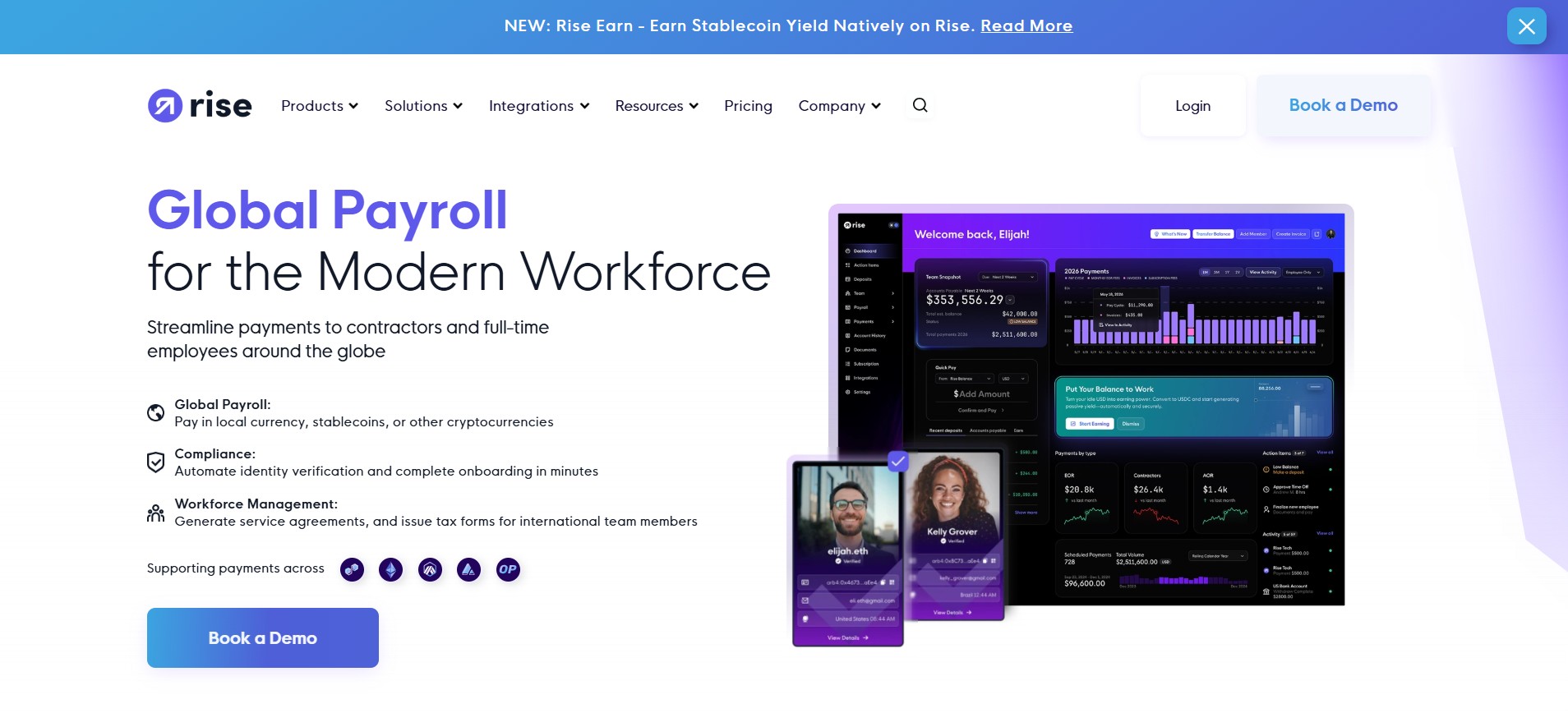
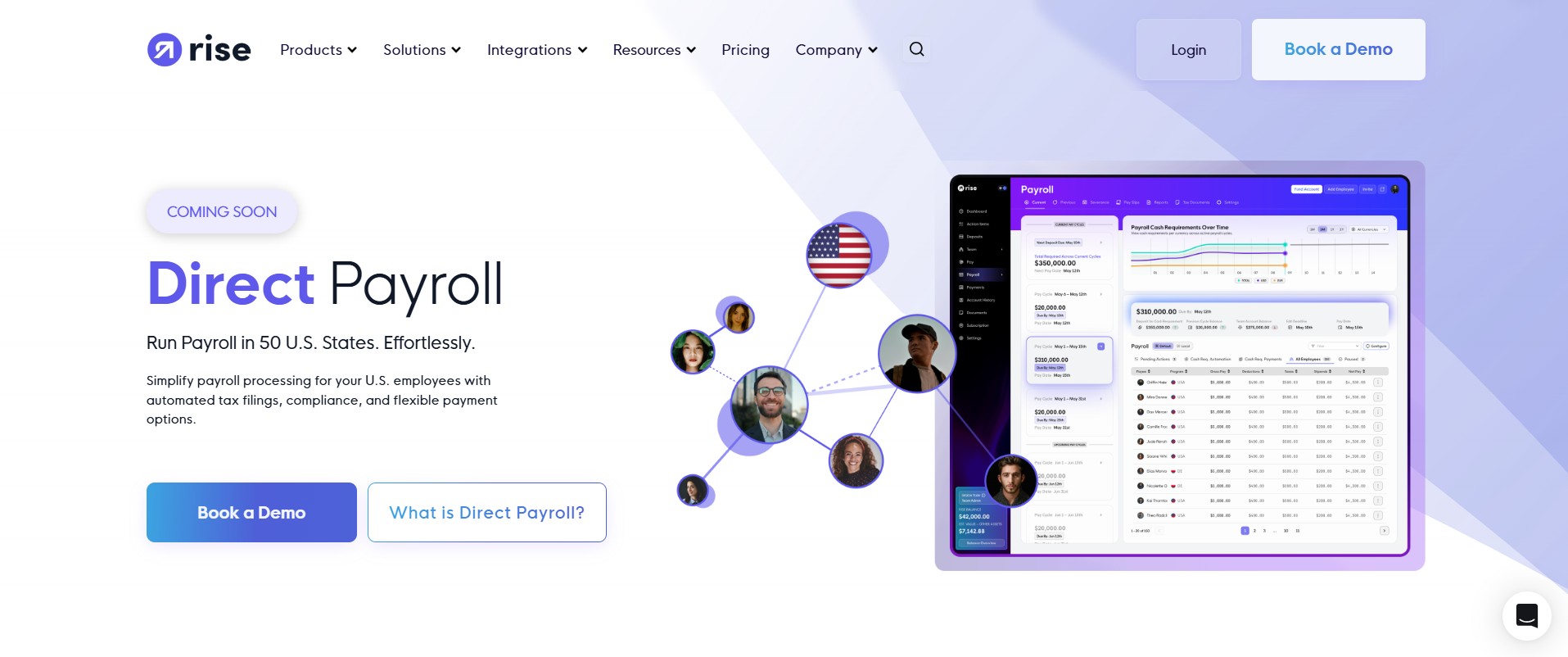
Rise's Direct Payroll lets employers pay W-2 employees and 1099 contractors who are directly employed through their own US entity, all on one platform.
It runs the full US payroll lifecycle: salaried payroll, 1099 contractor payments, calculation, remittance, and filing of federal, state, and local payroll taxes, plus generation and filing of W-2s and 1099s. It also handles time off across accruals, requests, approvals, and balances, and ships pre-built and custom reporting for finance and people teams.
The defining trait is what happens next. Direct Payroll is built to combine with Rise EOR for international employees and its agent of record for international contractors.
A startup can run its US team on Direct Payroll, its overseas employees through Rise EOR, and its overseas contractors through Rise AOR, all inside one account with one bill, one support team, and one set of reports.
Every worker carries a Rise ID that keeps their compliance and payment history consistent across each model, and the platform integrates with a modern finance stack including QuickBooks, Xero, Campfire, and Rillet, with onboarding that typically takes around two weeks.
Pros:
- One account unifies US Direct Payroll, international EOR, and AOR, with one bill and one support team.
- Transparent greater-of pricing ($49 minimum or $19 per employee) keeps small teams at the lowest cost.
- Reliable federal, state, and local tax filing, W-2 and 1099 handling, and modern finance-stack integrations.
Cons:
- Direct Payroll requires a US entity, with international hiring routed through Rise's EOR and AOR.
- At launch, Direct Payroll supports salaried teams, since hourly payroll and time tracking are not yet available.
For founders who expect to hire across borders, Rise removes the second-vendor migration that other small-team tools force later.
2. Gusto
Gusto is a full-service US payroll provider built for small businesses, and it is one of the most common first payroll systems a startup adopts. It runs W-2 and 1099 payroll, files payroll taxes automatically across all 50 states, and bundles in hiring and onboarding tools, benefits administration, and health insurance brokerage in supported states.
Automatic payroll runs, employee self-service, and a clean interface make it easy for a non-specialist founder to operate.
Pricing follows a tiered model, with a monthly base fee plus a per-employee rate that rises as a team moves up plans to unlock features like time tracking, advanced HR tools, or dedicated support. For a company that intends to stay domestic and salaried, Gusto is a capable system.
The constraints appear the moment a startup hires its first international employee, wants to pay anyone in stablecoins, or needs to consolidate US and global payroll under one roof.
Pros:
- Polished, founder-friendly onboarding and self-service experience.
- Strong benefits administration and health insurance options for US teams.
Cons:
- No payroll for international employees or contractors, forcing a separate EOR provider.
- No native crypto or stablecoin payout support for modern or Web3 teams.
- Per-employee fees plus benefits add-ons compound as headcount grows.
Gusto is a genuinely strong US-only payroll product for small businesses, but the moment a company hires abroad it runs out of road, while Rise gives that team one platform from day one so it never has to migrate or manage two vendors.
3. Rippling
Rippling is a workforce platform that starts with payroll and extends into HR, IT, and spend management on a single employee record. When someone is hired, Rippling can run their payroll, enroll their benefits, provision their software accounts, and ship and manage their laptop from the same system, which is a genuine advantage for operations-heavy teams that want everything governed in one place.
It supports multi-state US payroll, integrates with cap-table and identity tools, and offers its own global payroll and EOR modules for companies expanding abroad.
That breadth comes with weight. Rippling is priced and packaged around buying into its platform, with a base fee plus separately priced modules, so a five-person team that only needs to run payroll ends up paying for and configuring far more than the moment requires.
Quotes are often custom, and setup is heavier than a lean startup wants early on. The model rewards companies ready to commit to the full suite, not founders who want focused payroll today with the option to grow.
Pros:
- Unified HR, IT, and device management in a single admin layer.
- Deep integrations, including cap-table and identity provisioning tools.
Cons:
- Priced and packaged for the full suite, which over-scopes a small team's needs.
- Setup and administration are heavier than a lean startup requires early on.
- No native stablecoin or crypto payroll for on-chain or Web3 compensation.
Rippling's all-in-one HR and IT control is a real strength for ops-heavy companies, but for a team that wants great payroll plus the option to add EOR and AOR, Rise delivers that story without forcing a platform commitment it does not need.
4. QuickBooks Payroll
QuickBooks Payroll, from Intuit, is the natural choice for founders already running their books in QuickBooks Online. It offers W-2 and 1099 payroll, automatic federal and state tax calculation and filing, and same-day or next-day direct deposit on higher tiers, with the standout being how tightly payroll data syncs back into QuickBooks accounting.
For a finance-led founder, that sync removes double entry and keeps the general ledger current without manual reconciliation.
The product is sold in tiers that layer on features like automated tax filing, HR support, and tax-penalty protection as you move up. Its strength is also its boundary: the value is highest when a company lives inside the QuickBooks ecosystem and stays domestic.
There is no support for paying employees or contractors based abroad, and no crypto or stablecoin payouts, so a startup with any global ambition eventually layers on another system.
Pros:
- Tight, native integration with QuickBooks accounting and bookkeeping.
- Familiar interface for founders already inside the QuickBooks ecosystem.
Cons:
- Strictly domestic, with no payroll for workers based outside the US.
- No contractor payments abroad and no crypto or stablecoin payouts.
- Value drops sharply for teams not already committed to QuickBooks.
QuickBooks Payroll's accounting sync is a clear convenience for finance teams, but Rise integrates with QuickBooks too while adding the international EOR, AOR, and stablecoin payroll that QuickBooks Payroll cannot reach.
5. OnPay
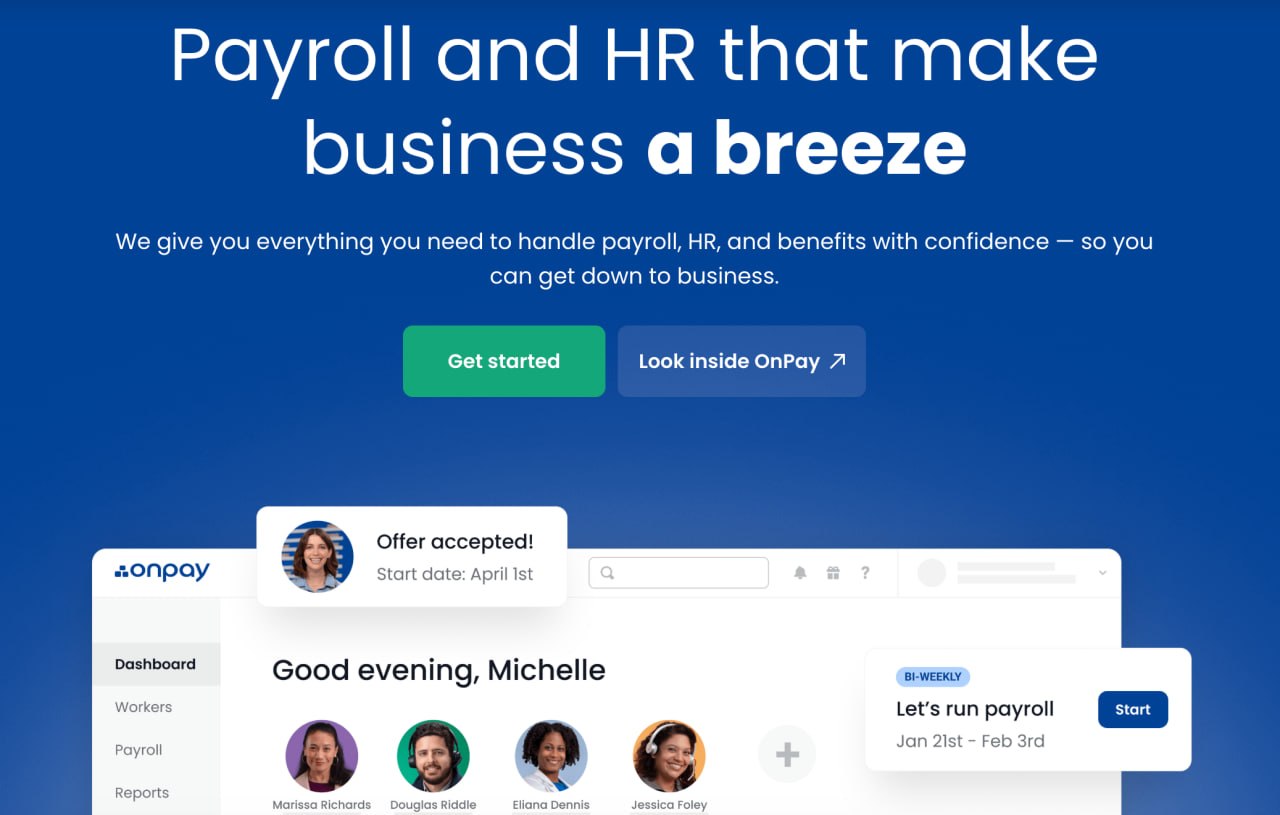
OnPay is built for very small US businesses that want full-service payroll without complexity or tiered upsells. It runs W-2 and 1099 payroll, files federal, state, and local taxes across all 50 states, handles unlimited monthly pay runs, and includes benefits administration and basic HR tools, all under a single plan rather than a ladder of editions.
For a three or four person team, the simple base-fee-plus-per-person structure is easy to budget and easy to operate.
OnPay also serves a few niche verticals well, including nonprofits and agricultural employers with their specific tax treatments. That focus on straightforward domestic payroll is exactly why it stays narrow.
There is no facility for paying workers abroad and no crypto or stablecoin support, and the feature set thins out for a startup that expects to scale into multiple countries or a more complex compensation model.
Pros:
- Flat, predictable per-employee pricing that is easy to budget.
- Simple, low-overhead setup for tiny domestic teams.
Cons:
- US-only, with no path to paying employees or contractors abroad.
- No crypto or stablecoin payroll for Web3 or globally distributed teams.
- Limited scaling features once a startup outgrows a small domestic roster.
OnPay's flat pricing is appealing for a small US-only team, but Rise's greater-of model is just as predictable at low headcount while leaving room to add global and stablecoin payroll without switching platforms.
How Does Rise's Direct Payroll Pricing Work for Small Teams
Rise prices Direct Payroll on whichever is greater of two figures, never both at once. The first is a $49 per month account minimum, triggered by any active employee whether or not they are paid in a given cycle. The second is $19 per employee per month.
For a small team, the minimum usually wins until headcount passes two.
Here is how it lands for early-stage teams:
- 1 to 2 employees: $49 per month, since the account minimum applies.
- 3 employees: $57 per month, because $19 times three exceeds the minimum.
- 5 employees: $95 per month at $19 each.
Direct Payroll pricing is fully isolated from Rise's EOR and AOR fees. It is never bundled, so a founder always pays one calculation or the other, not a stacked base-plus-headcount rate. That predictability matters most when every dollar of runway is accounted for.
Compared with platforms that charge a base fee and a per-employee fee simultaneously, Rise's greater-of model keeps the smallest teams on the lowest defensible cost.
What Reporting and Tax Handling Does Rise Direct Payroll Cover
Finance and people teams ask the same questions of any payroll provider, and Rise Direct Payroll is built to answer them without manual work. It generates and files W-2s and 1099s, calculates and remits federal, state, and local payroll taxes, and produces the reports finance asks for first:
- Payroll journal showing wages, taxes, and deductions for every paycheck.
- Accounting export that drops straight into QuickBooks, Xero, Campfire, or Rillet.
- Tax liability report covering what was owed, paid, and when.
- Employee cost report with fully loaded cost per employee.
- Time off, headcount, year-end, and deduction or contribution reports.
When a customer needs a report that is not pre-built, Rise can almost always create it as a custom report. The same applies to integrations, so a missing connector is rarely a reason to wait.
Understanding the difference between paying W-2 employees and 1099 contractors is step one; handling both cleanly from one account is what saves finance teams hours each cycle.
Why Direct Payroll Alone Is Not Enough as a Startup Scales
Direct Payroll covers the US W-2 and 1099 case, and that case rarely holds for long. The second or third hire is often a contractor in another country, and a tool that cannot pay them forces a parallel system and a duplicate compliance workflow.
Rise was architected so the same account that runs US payroll also handles the global step:
- International contractor payments through Rise AOR, with compliant onboarding.
- International employee hiring through Rise EOR, with no local entity required.
- Hybrid fiat and crypto payroll, so global workers choose local currency, USDC, or USDT.
- Native stablecoin payroll, built in-house rather than outsourced to third parties.
This last point is where Rise diverges from much of the market. Where some competitors route stablecoin payments through third-party processors, adding fees and compliance handoffs, Rise's stablecoin payroll is built natively and settles on rails the platform controls.
For a startup, the value is not the feature list. It is never having to rip out and replace a payroll system because the team crossed a border.
Conclusion
Tens of thousands of US startups form every quarter, and each one picks a payroll platform before it picks its tenth employee.
This guide compared the direct payroll tools small teams shortlist in 2026 and weighed them on cost, automation, and room to grow.
Rise stands out for transparent greater-of pricing, reliable US tax filing, and a single account that carries a startup from its first US hire into international EOR and AOR without a migration.
Book a demo to see how Rise runs direct payroll for your small team today.
FAQs:
1. What is the best direct payroll platform for a startup with a small team in 2026?
For US-only teams, Gusto and OnPay are common picks, while Rippling suits startups that want IT bundled in. Rise is the strongest choice for founders who expect to add international contractors or employees, since it runs US Direct Payroll plus EOR and AOR on one platform without a future migration.
2. How much does Rise's direct payroll cost for a small team?
Rise charges the greater of a $49 monthly account minimum or $19 per employee per month, never both. A one or two person team pays $49, while three employees costs $57. Direct Payroll pricing stays fully separate from EOR and AOR fees.
3. Can Rise Direct Payroll handle both W-2 employees and 1099 contractors?
Yes. Rise pays W-2 employees and 1099 contractors employed through your US entity, and it generates and files W-2s and 1099s automatically inside one account. That removes the need for a separate contractor tool as the team grows.
4. Does Rise Direct Payroll support hourly workers?
Not at launch. Rise Direct Payroll is built for salaried teams, since hourly payroll and time tracking are not yet supported. Companies built on hourly or shift-based labor are not a fit today.
5. When should a startup move beyond US-only direct payroll?
The moment it hires its first contractor or employee outside the US. A domestic-only tool forces a second vendor at that point, while Rise extends into international EOR and AOR coverage from the same account.



.png)
.png)


