


Why More Companies are Paying in USDC in 2026
Stablecoin payroll built for modern, borderless teams
USDC combines the predictability of USD with the speed of blockchain settlement. For employers, that means payroll that clears in minutes instead of days. For workers, it means faster access to funds and more control over how they're used.
Why companies are switching to USDC payroll in 2026:
- Faster settlement: Blockchain payments settle near-instantly versus 2–5 business days for international wires.
- Lower costs: No intermediary bank fees or hidden FX spreads.
- Global accessibility: Workers can receive USDC without relying on local banking infrastructure.
- Transparency and trust: USDC is fully backed by cash and short-duration U.S. Treasuries, with monthly attestations published by Circle.
Market context (2025–2026):
- USDC's circulating supply reached $77.6B as of April 2026, according to stablecoin market data, making it one of the two dominant stablecoins by institutional volume. The total stablecoin market surpassed $315B in Q1 2026.
- According to Pantera Capital research, USDC holds a 63% share of the crypto payroll market, driven in part by compliance infrastructure gaps among legacy platforms that lack native stablecoin support.
- Stablecoins now account for 75% of total crypto trading volume as of Q1 2026, the highest share on record, with B2B corridors, payroll settlement, and treasury management cited as primary institutional drivers.
USDC Payroll From the Worker’s Perspective
Getting paid in USDC doesn't lock workers into crypto, it gives them options.
Contractors and employees can:
- Receive USDC on supported networks including Ethereum, Arbitrum, Optimism, Base, and Polygon
- Hold USDC as a dollar-denominated balance
- Swap to other cryptocurrencies
- Cash out to local fiat using their preferred off-ramps
This flexibility is especially valuable in emerging markets, where access to USD banking remains limited but stablecoin adoption continues to grow. Latin America recorded a 31% increase in USDC adoption for cross-border payments between Q1 2024 and Q1 2025, according to CoinLaw data.
Rise + Circle: Enterprise-Grade USDC Payroll Infrastructure
Rise integrates directly with Circle's USDC infrastructure, abstracting away blockchain complexity while preserving the benefits of stablecoin settlement. Rise is the only official Circle partner for stablecoin payroll.
What this means for your team:
- Fund payroll in USD or USDC
- Send compliant USDC payouts globally
- Automate KYC, AML, contracts, and tax documentation
- Maintain clean audit trails for accounting and investors
With Rise Earn, companies and workers can also put idle USDC balances to work. Rise Earn generates yield on undeployed USDC through Aave's USDC lending pools on Arbitrum, with a 1% commission applied only at withdrawal. No deposit or holding fees.
Whether you're paying a developer in Serbia, a designer in Argentina, or a full-time employee in Canada, Rise handles currency routing, compliance checks, and payroll execution behind the scenes.
You don't manage wallets. You don't touch smart contracts. Your finance team uses a familiar dashboard while your workforce benefits from stablecoin speed.
How to Set Up USDC Payroll with Rise
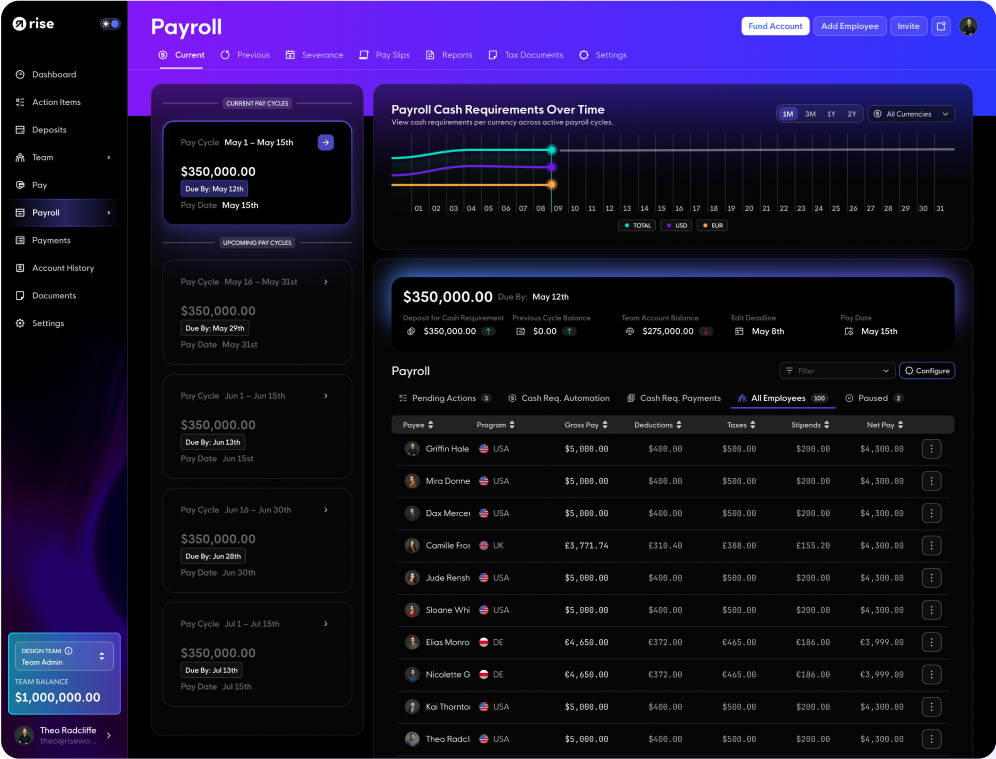
1. Create a Business Account
Visit Riseworks.io and sign up for a business account by providing basic company information, such as your business name, address, and contact details.
After registration, you'll be prompted to complete a verification process to ensure the security and legality of your account, which may involve submitting additional documents or information about your business.
2. Invite and Onboard Your Contractors and Employees Compliantly
Invite workers via email. Rise automatically:
- Verifies identity (KYC)
- Screens for AML risk
- Generates country-specific agreements
- Issues each worker a secure Rise ID
3. Fund Your Payroll
Rise gives employers the unique ability to fund payroll in either US dollars or USDC stablecoin, so that global employers are not limited by traditional banking systems.
If you choose to fund in USDC, you can use any of our integration partners including Arbitrum, Coinbase, Uniswap, Ethereum, Metamask, Avalanche, Gnosis Safe, Optimism, Polygon, MEW, and Torus.
Once the funds are available, you can easily allocate them to your payroll needs within the Rise platform, setting up automated payments in either fiat or cryptocurrency according to your payroll setup.
4. Set Up Payment Schedules
Within the Rise platform, you can establish payment schedules that fit your business operations, whether that's weekly, bi-weekly, monthly, or custom intervals.
This flexibility allows you to align payroll disbursements with your company's cash flow and contractor expectations.
Moreover, Rise offers the capability to automate these payments, ensuring that your contractors receive their earnings on time, every time, without manual intervention, thus reducing administrative workload and enhancing payment accuracy.
5. Workers Withdraw in Their Preferred Currency (Fiat or Crypto)
Contractors and employees have the freedom to withdraw their earnings in their preferred currency, whether it's fiat or a variety of cryptocurrencies, directly from their Rise digital wallet.
This feature supports the diverse needs of a global workforce, enabling seamless conversion and transfer of funds to their personal accounts without the need for intermediaries.
And that’s all there is to it.
You can get started now by visiting Rise and scheduling a demo.
Full Compliance, Zero Hassle
.png)
Crypto payroll doesn’t mean skipping compliance. In fact, it demands more rigor.
Rise handles:
- Contractor classification workflows
- Localized contracts and tax forms
- Identity verification and AML screening
- On-chain auditability for every payment
For full-time employees, Rise’s Employer of Record (EOR) solution allows you to offer compliant employment, benefits, and salaries in fiat, USDC, or a hybrid of both without opening local entities.
USDC vs. USDT for Contractor Payouts: Which Should You Choose?
Both USDC and USDT are USD-pegged stablecoins used for cross-border contractor payroll, but the decision involves more than market cap. Here's what finance and HR teams should weigh before committing to one:
Reserve Transparency
USDC is issued by Circle, a US-regulated company that publishes monthly attestations confirming full backing by cash and short-duration US Treasuries. USDT (Tether) publishes quarterly attestations, with reserves historically including a broader range of assets. For teams with audit requirements or institutional investors, USDC's reporting cadence is typically easier to defend.
Regulatory Positioning
The GENIUS Act, enacted in July 2025, established the first federal regulatory framework for payment stablecoins in the United States. Circle has positioned USDC as GENIUS-compliant. USDT's regulatory status under the GENIUS Act remains more complex, given Tether's offshore issuer structure. For finance teams managing compliance exposure, this distinction is material.
Network Coverage
Both stablecoins are available on Ethereum, Arbitrum, Optimism, and Polygon. USDC has a slight edge in institutional infrastructure coverage given Circle's direct partnerships with payroll platforms including Rise. Workers who prefer USDT can be accommodated on Rise through its 100+ supported crypto withdrawal assets, without requiring the company to fund in USDT.
Recommendation
For companies paying contractors globally under compliance scrutiny, including any DAOs, crypto-native companies, or firms with SOC 2 or GDPR obligations, USDC is the lower-friction choice. Rise's Agent of Record model supports both, with USDC as the default payroll currency and USDT available as a worker withdrawal preference.
What the GENIUS Act Means for USDC Payroll in 2026
The Guiding and Establishing National Innovation for U.S. Stablecoins (GENIUS) Act was enacted in July 2025, establishing the first comprehensive federal framework for payment stablecoins in the United States. For companies running USDC payroll, the implications are straightforward: the regulatory environment is clarifying, not tightening.
Key points for finance and HR teams:
- The GENIUS Act requires payment stablecoin issuers to maintain full reserves, publish regular attestations, and comply with BSA/AML requirements, standards Circle and USDC already meet.
- The OCC, FDIC, and Treasury are currently issuing implementing regulations, with the Act expected to take effect no later than January 18, 2027.
- USDC, as the only stablecoin issued by a company actively participating in GENIUS Act rulemaking, is positioned as the institutional-grade stablecoin of record for US-regulated payroll workflows.
For companies evaluating long-term stablecoin payroll infrastructure, the GENIUS Act is a signal that building on USDC is building on regulated, auditable rails. Rise's compliance stack, including SOC 2 Type II certification, FinCEN MSB registration, and GDPR compliance, is designed to align with exactly this regulatory direction.
Why Choose Rise
Rise is built specifically for global teams that need real payroll, not wallet-to-wallet workarounds.
What sets Rise apart in 2026:
- Native USDC payroll with Circle partnership (the only official Circle partner for stablecoin payroll)
- Coverage in 190+ countries
- Support for employees, contractors, DAOs, and agencies
- SOC 2 Type II certified security and enterprise-grade controls
- A platform designed for CFOs, HR, and Ops, not blockchain engineers
- Over $1.5B in lifetime payroll volume processed
Rise combines the compliance depth of traditional payroll with the efficiency of stablecoins.
Ready to Pay Your Team in USDC?
USDC payroll is no longer experimental, it’s becoming standard infrastructure for global companies.
Rise will show you how to:
- Fund payroll in fiat or USDC
- Onboard a global team in days
- Stay compliant across borders
- Reduce costs and payment delays
Book a demo and see how to run stablecoin payroll in minutes, not months.
.png)


