
What Is Real-Time Payments?
Real-time payment volumes hit 266.2 billion transactions globally in 2023, growing 42.2% year over year, according to ACI Worldwide.
That growth curve has not slowed. Instant payment infrastructure is now the default expectation for consumers and businesses alike, and payroll is one of the areas feeling the most pressure to catch up.
Rise built its entire payroll and compliance infrastructure around this shift, settling global payments in minutes on stablecoin rails instead of days on legacy banking systems.
This article breaks down what real-time payments actually are, why they are spreading so fast across consumer and business finance, and what the shift means for companies running global payroll, contractor payments, and treasury operations.
It also covers where legacy rails still fall short and how a hybrid fiat and stablecoin infrastructure like Rise closes that gap for international teams.
Key Takeaways
Real-time payments settle in seconds, while Rise extends that speed to global payroll across 190+ countries.
SWIFT-based transfers still take 3 to 5 business days, but Rise settles cross-border payroll in minutes.
Real-time payment volume is projected to more than double from 260 billion to 575 billion transactions by 2028, per ACI Worldwide and yStats.
Rise’s stablecoin payroll infrastructure is built in-house, avoiding the fees and delays of third-party rails.
Businesses adopting real-time payment rails report faster cash flow visibility and stronger retention with global talent.
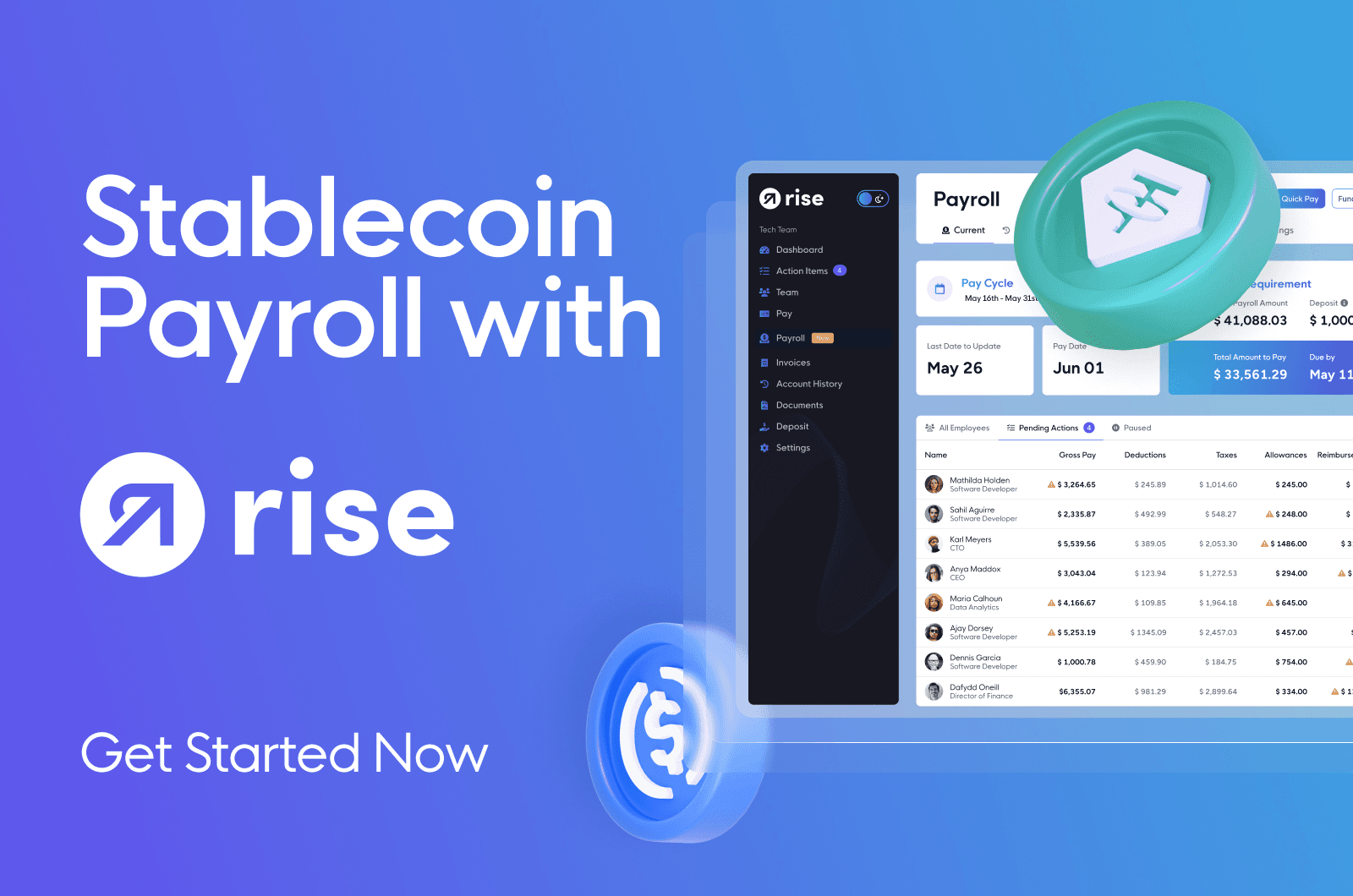
What Are Real-Time Payments?
Real-time payments (RTP) are transactions that settle within seconds, 24 hours a day, 7 days a week, with no batch processing windows and no dependency on banking hours. Unlike ACH transfers, which clear in one to three business days, or wire transfers, which can take 3 to 5 business days for cross-border settlement, RTP rails confirm and finalize funds movement almost instantly.
RTP infrastructure runs through dedicated national and regional schemes, not the older correspondent banking network. Examples include:
The FedNow Service and RTP network from The Clearing House in the United States
The pan-European SCT Inst scheme
UPI in India, which now processes over 13 billion transactions monthly according to ACI Worldwide
PIX in Brazil
These systems share a few core traits. Funds are irrevocable and available immediately upon confirmation. The system runs continuously rather than during business hours. And most importantly, the sender and receiver both get real-time confirmation instead of waiting on batch settlement cycles.
Stablecoin rails extend this same real-time principle to cross-border transactions, without depending on any single country’s domestic instant payment scheme. A payment settled in USDC on Arbitrum or Ethereum confirms in seconds regardless of which two countries are involved, which is a capability no domestic RTP scheme offers on its own.
Rise’s stablecoin payroll infrastructure uses exactly this approach to move payroll funds across borders without waiting on correspondent banks.
Why Real-Time Payments Are Accelerating Now
Several forces are converging to push real-time payments from a nice-to-have into a baseline expectation.
Smartphone and Digital Banking Penetration
Mobile-first banking has removed the friction that once made instant payments impractical for everyday use. Roughly 48% of global consumers now prefer mobile-based real-time payments, according to a 2026 market analysis from Real Time Payments Market Size Report. That consumer behavior shift is pushing businesses to match the same speed in B2B and payroll contexts.
Regulatory Support for Instant Payment Ecosystems
Central banks and regulators across major economies have actively built or mandated real-time payment infrastructure over the past several years. The European Union’s SCT Inst scheme and the U.S. FedNow Service are both regulator-backed pushes to modernize domestic payment rails. This kind of top-down support accelerates adoption in ways that market forces alone could not.
Cross-Border Payment Demand
Cross-border commerce and remote work have both expanded the pool of transactions that need to move internationally, and internationally is exactly where legacy rails struggle most. SWIFT-based cross-border transfers still average 3 to 5 business days with FX spreads of 1% to 2%, delays that were tolerable when cross-border payments were rare and now are not.
Embedded Finance and API-First Infrastructure
Payment rails are increasingly embedded directly into the software businesses already use, rather than requiring a separate banking relationship for every transaction type. For businesses operating globally, a stablecoin business account can further simplify this setup by combining on-chain funds with traditional payment rails and cross-border transfers in one place.
This is the same principle behind Rise’s approach to payroll: instead of bolting stablecoin rails onto legacy infrastructure, Rise built settlement directly into the platform businesses use to onboard, pay, and manage global teams.
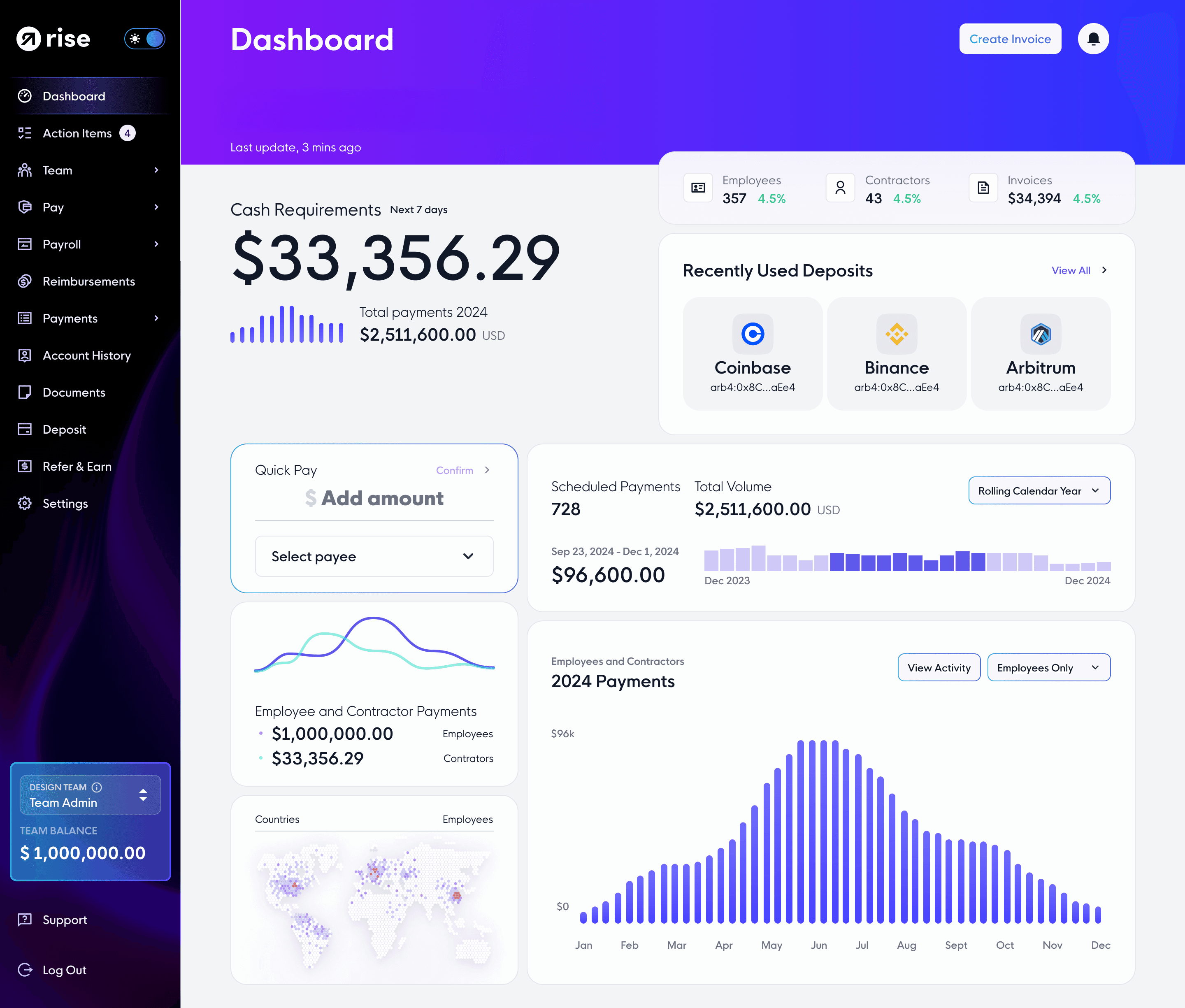
How Real-Time Payments Are Changing Business Operations
Cash Flow and Treasury Management
When payments settle in seconds instead of days, finance teams get real-time visibility into actual cash position rather than working off projections that assume pending transfers will clear on schedule.
This matters most for companies running lean treasury operations or managing payroll across multiple currencies, where a 3 to 5 day settlement delay can mean the difference between funds being available and a payroll run stalling.
Global Workforce Payments
Real-time payments have the largest operational impact on companies with distributed, international teams. A contractor in the Philippines or an employee in Argentina no longer has to wait on a multi-day SWIFT transfer to get paid, provided the payroll platform settles on real-time rails.
Rise processes payroll across 190+ countries and settles cross-border payments in minutes on stablecoin rails, not days on SWIFT, supporting both fiat and crypto withdrawal for every worker.
Reduced Reliance on Correspondent Banking
Traditional cross-border payments route through a chain of correspondent banks, each one adding time, fees, and a point of failure. Real-time rails, whether domestic RTP schemes or blockchain-based stablecoin settlement, remove most or all of these intermediaries. That directly reduces the FX spreads and hidden fees that have historically made international payroll and vendor payments expensive.
New Revenue and Efficiency Opportunities
Instant settlement changes what businesses can do with idle funds. When payroll funds no longer sit for days waiting to clear, that same capital can be put to work.
Rise Earn lets companies and workers earn yield on USDC balances through Aave-powered vaults on Arbitrum while funds wait for the next payroll cycle, turning what used to be dead time into productive capital with a 1% commission on interest earned at withdrawal only.
Fraud Prevention and Compliance Pressure
Faster settlement also raises the stakes on compliance and fraud detection, since irrevocable real-time transfers leave less room to catch errors after the fact. Nearly 29% of firms in the real-time payments space report investing in AI-enabled fraud prevention to keep pace with instant settlement, according to a 2026 market report from Global Growth Insights.
Rise addresses this on the payroll side with SOC 2 Type II certification, FinCEN MSB registration, and a direct Circle/USDC partnership, all built to keep real-time settlement compliant rather than just fast.
Real-time infrastructure is no longer a competitive edge reserved for fintech-native companies. It is quickly becoming the baseline every business, from Web3-native startups to enterprise payroll teams, is expected to operate on.
Where Real-Time Payments Still Fall Short
Domestic RTP schemes solve the speed problem within a single country’s borders, but most were never designed for cross-border settlement. A business paying employees in five different countries cannot rely on FedNow, SCT Inst, and UPI to work together.
Each scheme is siloed to its own currency and jurisdiction, which means a company operating a truly global workforce still hits the same cross-border bottleneck that instant payments were supposed to solve.
This is the specific gap stablecoin infrastructure closes. Because USDC and USDT settle on public blockchains rather than domestic clearing systems, they move at the same real-time speed regardless of which two countries are sending and receiving funds.
Rise’s hybrid fiat and crypto payroll infrastructure lets a business fund payroll once and let each worker withdraw in whatever currency, fiat or crypto, fits them best, without the platform needing a separate domestic RTP integration for every country it operates in.
What This Means for Global Payroll Specifically
Payroll is one of the highest-stakes use cases for real-time payments because delays do not just cost money, they cost trust. A contractor who does not get paid on time has little patience for an explanation involving correspondent banks and FX settlement windows.
Businesses evaluating payroll infrastructure for global teams should look for a few specific capabilities:
Settlement that does not depend on SWIFT or multi-day correspondent banking chains
Worker-level choice between fiat and stablecoin withdrawal, since not every worker wants the same payment method
Compliance infrastructure that keeps pace with instant settlement, including KYC, AML, and tax documentation handled automatically
Transparent, predictable pricing that does not bury FX spread inside the transfer itself
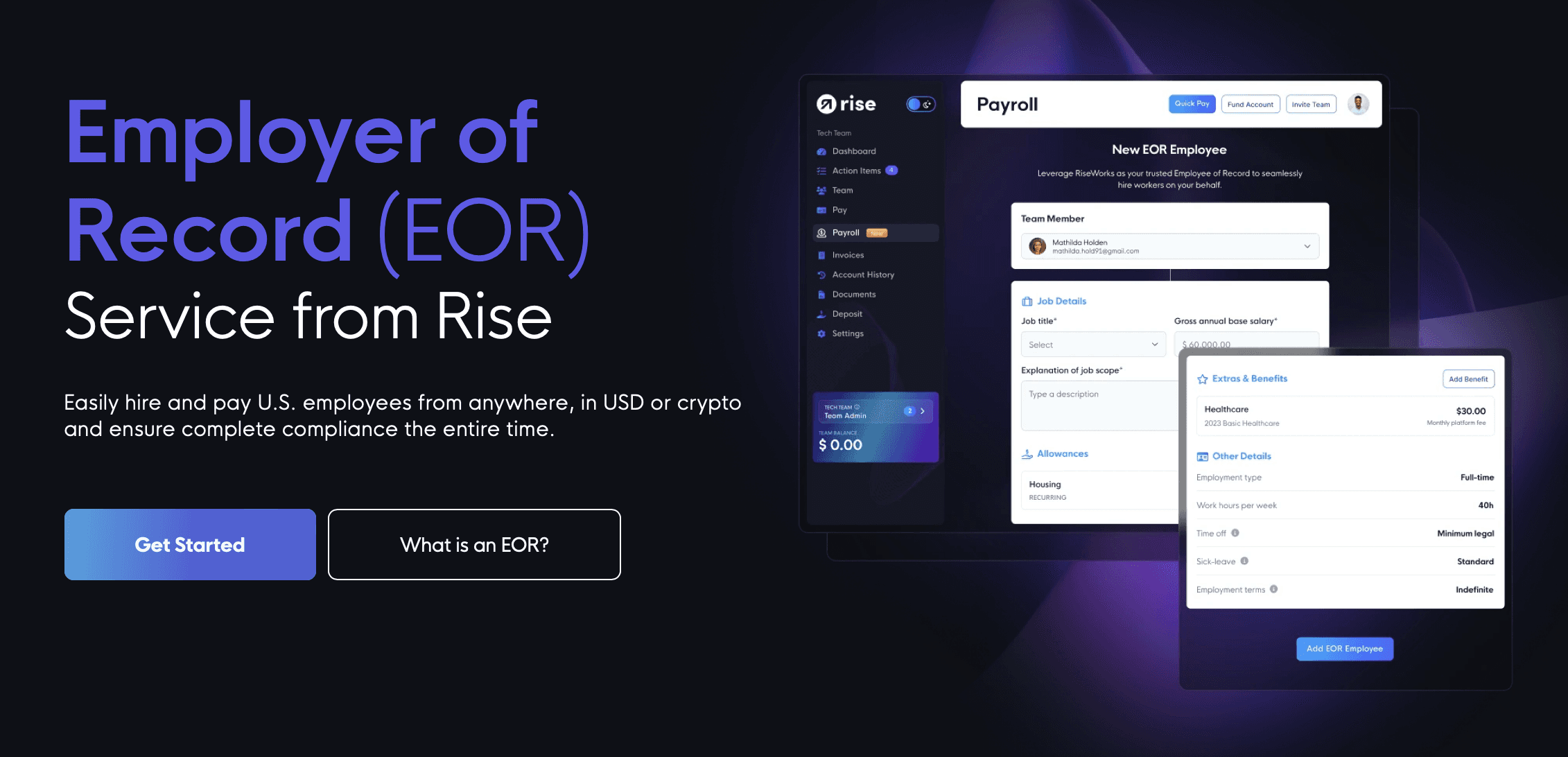
Rise’s Employer of Record product combines all four, handling employment compliance, benefits, and local labor law in owned entities while settling payroll on the same stablecoin rails that power Rise’s contractor payments. EOR customers pay a flat $399 per employee per month, with no hidden FX markup on the settlement layer underneath.
For companies not yet ready for full EOR, Rise’s Agent of Record product extends the same real-time settlement to contractor relationships at $49 per contractor per month, making instant global payroll accessible at any stage of international growth.
Conclusion
Real-time payments have moved from a niche banking feature to the baseline expectation across consumer and business finance, with transaction volume on pace to more than double by 2028.
Domestic RTP schemes have solved the speed problem within individual countries, but cross-border payments, especially payroll for distributed teams, still depend on infrastructure built for instant, borderless settlement.
Rise built its platform around exactly that gap, combining hybrid fiat and stablecoin payroll, SOC 2 Type II compliance, and settlement in minutes across 190+ countries.
Businesses that want their payroll to move at the same speed as the rest of their operations should see what real-time infrastructure looks like in practice.
Book a demo to see how Rise settles global payroll on real-time rails.
FAQs
1. How do real-time payments differ from ACH or wire transfers for business payroll?
Real-time payments settle within seconds and run continuously, while ACH transfers take one to three business days and wires can take 3 to 5 business days for cross-border transfers. For payroll specifically, that difference determines whether workers get paid on schedule or wait on banking cycles.
2. Can stablecoins be used for real-time cross-border payroll?
Yes. Stablecoins like USDC and USDT settle on public blockchains in seconds regardless of the countries involved, which makes them effective for cross-border payroll where domestic RTP schemes do not interoperate. Rise supports payroll funding and withdrawal in USDC and USDT alongside 90+ local fiat currencies.
3. Does adopting real-time payments require replacing existing payroll infrastructure?
Not necessarily. Businesses can adopt real-time settlement through a payroll platform that layers stablecoin or RTP rails on top of existing treasury operations. Rise integrates payroll funding, compliance, and real-time settlement into a single platform rather than requiring separate banking integrations per country.
4. What compliance risks come with faster, irrevocable payment settlement?
Because real-time and stablecoin payments are typically irrevocable once confirmed, errors are harder to reverse than with traditional ACH transfers. Platforms need strong KYC, AML, and fraud detection built in before settlement, which is why Rise maintains SOC 2 Type II certification and FinCEN MSB registration alongside its stablecoin infrastructure.
5. How much faster is Rise’s payroll settlement compared to traditional providers?
Traditional payroll providers relying on SWIFT and correspondent banking typically take 3 to 5 business days to settle cross-border payments, with FX spreads of 1% to 2%. Rise settles the same payments in minutes by running on stablecoin rails across Ethereum, Arbitrum, Optimism, Base, and Polygon.