
Stablecoin vs Fiat Withdrawals by Country: 2026 Rise Payouts Report
Cross-border stablecoin transfers grew 77.5% to $220.3 billion in the 12 months ending June 2026, up from $124.2 billion a year earlier (Source: Chainalysis 2026 Global Crypto Adoption Index via Cointelegraph).
Rise, which has processed $1.5B+ in lifetime payroll across 190+ countries, sees the same shift inside its own payout data, but the aggregate number hides how sharply worker behavior differs from one country to the next.
This report breaks down Rise's lifetime withdrawal data by country, comparing fiat withdrawals against on-chain stablecoin and crypto withdrawals in its largest payout markets. The data comes from the corridor tables published in the Rise Q1 2026 Stablecoin Payroll Report, covering $1.33B in total worker withdrawals.
For founders and people leaders running distributed teams, the takeaway is practical: the right payout mix depends on where your workers live, and a single-rail payroll setup leaves money and retention on the table in specific markets.
Key Takeaways
Rise data shows 40.4% of lifetime withdrawals by value went to crypto rails.
Outside the US, stablecoin vs fiat payouts tilt crypto, at 53.8% of value.
India leads Rise's crypto corridors, with 66.6% of withdrawals taken on-chain.
US workers withdraw 90.9% in fiat, making the US Rise's most fiat-heavy market.
USDT accounts for 82.7% of India's stablecoin withdrawals on Rise.
How Rise Measured Stablecoin vs Fiat Payouts
The dataset covers every worker withdrawal processed on Rise through Q1 2026, split into two buckets: fiat withdrawals to local bank accounts and on-chain withdrawals to self-custody or exchange wallets. Values are lifetime US dollar totals, which weights the analysis toward where money actually moves rather than toward raw transaction counts.

The scope of the data includes:
$793.9M in lifetime fiat withdrawals across 90+ local currencies
$537.6M in lifetime crypto withdrawals across 100+ supported assets
Country-level splits for the six largest withdrawal markets by fiat volume
Coin-level and chain-level splits for USDC, USDT, Arbitrum and Ethereum
Most on-chain value on Rise moves in stablecoins rather than volatile assets. According to Rise data published by Arbitrum, Rise has processed more than $340M in lifetime USDC and USDT withdrawals on Arbitrum alone, and Arbitrum carries roughly 80% of Rise's on-chain withdrawal volume (Source: Arbitrum).
That concentration matters for interpreting the country data below, because a "crypto withdrawal" on Rise is, in the large majority of cases, a dollar-denominated stablecoin payout settled on a Layer 2 network.
The Global Picture: 40% Crypto Overall, 54% Outside the US
Across all countries, 40.4% of Rise's lifetime withdrawal value went to crypto rails and 59.6% went to fiat. That headline figure understates stablecoin demand, because the United States alone accounts for $400.3M of the $1.33B total, and US workers are overwhelmingly fiat-first.

Removing the US from the dataset changes the picture considerably:
Crypto share of withdrawals, all countries: 40.4%
Crypto share of withdrawals, excluding the US: 53.8%
Crypto share of withdrawals, outside the six largest fiat markets: 59.4%
Total crypto withdrawals outside the top six markets: $391.0M of $537.6M
The long tail is where stablecoins dominate. Workers outside the six largest fiat corridors withdrew $391.0M on-chain against $267.1M in fiat, which means roughly 73% of all crypto withdrawal value on Rise comes from markets that do not appear in the top six by fiat volume.
This aligns with Rise's more recent platform data, which shows over 50% of worker withdrawals now taken in stablecoins (Source: Rise Q3 2026 Stablecoin Payroll Report), up from the 40% lifetime average as newer cohorts in emerging markets join the platform.
Country-by-Country Breakdown
The six largest withdrawal markets on Rise fall into three distinct patterns: fiat-dominant, balanced, and stablecoin-dominant. Each pattern reflects a different combination of banking access, FX friction and local crypto infrastructure.

1. India: The Stablecoin-First Corridor
India is the only top-six market where crypto withdrawals exceed fiat. Indian workers on Rise withdrew $44.2M on-chain against $22.2M in fiat, putting the crypto share at 66.6% of withdrawal value.
The India data shows three clear patterns:
India is Rise's single largest crypto withdrawal market, at $44.2M lifetime
USDT represents 82.7% of Indian stablecoin withdrawals ($30.5M USDT vs $6.4M USDC)
India accounts for 8.2% of all crypto withdrawal value on Rise
The USDT preference reflects local liquidity, since peer-to-peer and exchange markets for INR conversion are deepest in USDT. A contractor in Bengaluru receiving $3,000 a month can hold USDT, convert only what is needed for local expenses, and avoid the inbound remittance spread that applies to every fiat wire.
For companies hiring engineering talent in India, offering a stablecoin option is no longer a perk, because it is the default preference of most of the workforce in Rise's data.
2. Spain: The Highest Crypto Share in Europe
Spain is Rise's most crypto-forward European market. Spanish workers withdrew $16.1M in crypto against $23.2M in fiat, a 41.0% crypto share and a crypto-to-fiat ratio of 69.4%.
Key Spain data points include:
Total withdrawals of $39.3M lifetime
USDT ($5.8M) leading USDC ($3.3M) in tracked stablecoin withdrawals
A crypto share 9 points higher than Germany and 13 points higher than the UK
Spain's numbers suggest that euro-denominated workers still value dollar-denominated stablecoins, particularly freelancers invoicing US clients who want to hold USD exposure without opening a foreign currency account.
3. Canada and Germany: The Balanced Middle
Canada and Germany sit at almost identical crypto shares of 32.0%. Canadian workers withdrew $15.1M on-chain against $32.1M in fiat, while German workers withdrew $10.3M on-chain against $21.9M in fiat.
Both markets share a similar profile:
Strong domestic banking with low friction for local currency payouts
A meaningful minority, roughly one in three dollars, routed to stablecoins
USDT leading USDC in tracked stablecoin withdrawals in both countries
In practice, a German contractor might take monthly retainer income in EUR for rent and tax obligations while routing project bonuses to USDC. That split-payout behavior is the clearest argument for hybrid fiat and crypto payroll, where each worker sets their own allocation instead of the employer forcing a single rail.
4. United Kingdom: Fiat-Led With a Growing Minority
UK workers withdrew $63.6M in fiat and $24.4M in crypto, a 27.7% crypto share. The UK is Rise's second-largest withdrawal market overall at $88.0M.
The UK data highlights:
$12.6M in Arbitrum withdrawals, the second-highest Arbitrum volume of any country after the US
USDT ($4.9M) slightly ahead of USDC ($4.1M) in tracked stablecoin withdrawals
A crypto share roughly three times that of US workers
5. United States: The Most Fiat-Heavy Market
The US is Rise's largest withdrawal market by far, at $400.3M lifetime, and its most fiat-dependent. US workers withdrew $363.8M in fiat and $36.5M in crypto, a 9.1% crypto share.
The US pattern is driven by factors specific to American workers:
Near-instant domestic ACH and RTP rails remove most of the speed advantage of stablecoins
No FX conversion is needed, which eliminates the largest cost that stablecoins solve abroad
Tax reporting on crypto disposals adds administrative friction for US persons
Even so, US workers still generate meaningful on-chain volume, with $30.7M in Arbitrum withdrawals, the highest of any country on Rise. The US minority that chooses stablecoins tends to be crypto-native contractors who already hold assets on-chain.
Rise's data makes one point clear: the country a worker lives in predicts their payout preference far better than their role or seniority, so payroll infrastructure needs to support both rails natively.
Corridors to Watch Beyond the Top Six
The 59.4% crypto share across Rise's long-tail markets points to emerging corridors where fiat payouts are either expensive, slow, or unreliable. Third-party data confirms where that demand concentrates.

Chainalysis ranked Nigeria first worldwide for both domestic peer-to-peer and cross-border crypto flows in its 2026 index, and Brazil first overall with a $252.5 billion crypto economy (Source: Chainalysis 2026 Global Crypto Adoption Index via Bitcoin.com News). The same report found that 96% of domestic peer-to-peer crypto activity now runs on stablecoins.
Markets that consistently show stablecoin-first behavior share three characteristics:
Currency volatility or capital controls, as in Nigeria, Argentina and Türkiye
High inbound remittance costs on traditional SWIFT rails
Deep local P2P or exchange liquidity for USDT and USDC conversion
For a remote-first company with contractors in Lagos or Buenos Aires, a fiat-only payroll provider forces workers to absorb conversion losses and multi-day delays on every payment. A stablecoin option removes both problems at the payout layer.
Rise's long-tail data suggests that the next wave of stablecoin payroll growth will come from these markets, which is why corridor-level payout flexibility is becoming a hiring advantage rather than a back-office detail.
USDT vs USDC: What Workers Actually Choose
Across every one of the six largest markets, USDT led USDC in tracked worker stablecoin withdrawals. The gap is widest in India and narrowest in the UK.
Tracked stablecoin withdrawals by asset in Rise's top six markets:
India: $30.5M USDT vs $6.4M USDC
Spain: $5.8M USDT vs $3.3M USDC
UK: $4.9M USDT vs $4.1M USDC
Germany: $3.2M USDT vs $1.3M USDC
US: $1.9M USDT vs $919K USDC
Canada: $1.6M USDT vs $891K USDC

Employer-side behavior runs the opposite direction. Companies funding payroll on Rise overwhelmingly use USDC, with $184.1M in USDC deposits from the UAE and $72.0M from the US, per the Rise Q1 2026 report. Rise's official partnership with Circle supports this employer-side USDC funding flow, giving finance teams a regulated, fully reserved dollar asset on the deposit side.
The result is a two-sided pattern: employers fund in USDC for compliance and treasury reasons, while workers withdraw in whichever stablecoin offers the best local liquidity.
Platforms that only support one asset on either side create friction that Rise's stablecoin payroll infrastructure removes by converting between assets at the payout layer.
What the Data Means for Payout Costs
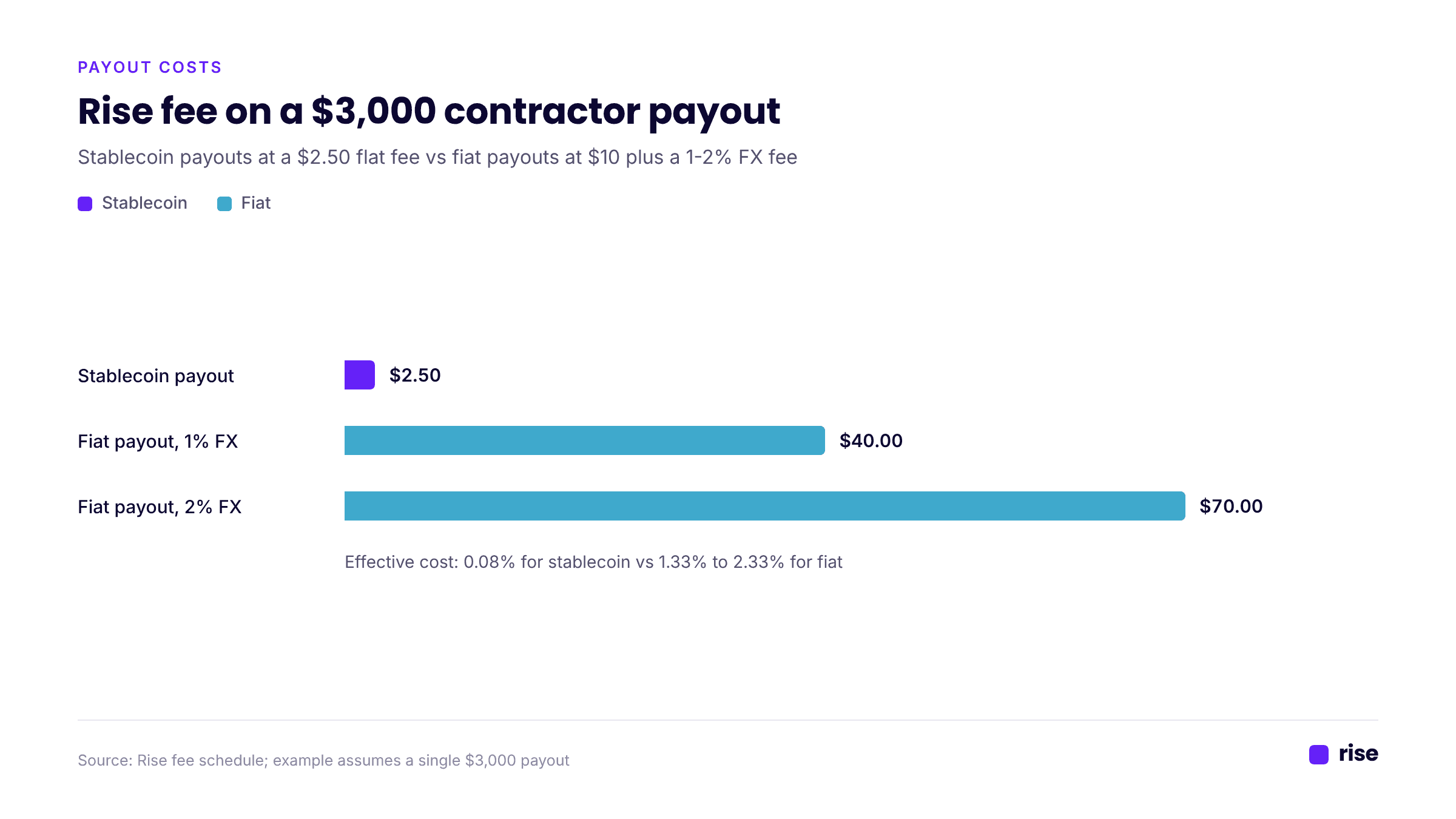
Payout rail choice has a direct cost impact that scales with headcount. On Rise, stablecoin and crypto payouts carry a flat $2.50 fee, while fiat payouts cost $10 plus a 1-2% FX fee.
Here is how that plays out on a $3,000 monthly contractor payment:
Stablecoin payout: $2.50, or 0.08% of the payment
Fiat payout at 1% FX: $40.00, or 1.33% of the payment
Fiat payout at 2% FX: $70.00, or 2.33% of the payment
For a 50-person contractor team in India paid $3,000 a month, moving from fiat to stablecoin payouts saves between $1,875 and $3,375 per month in transaction and FX costs. Applied to the 66.6% of Indian workers who already prefer on-chain withdrawals, the savings compound quickly at scale.
The cost gap is narrowest in the US, where no FX conversion applies, and widest in emerging markets where local currency spreads add further loss beyond Rise's own fee. That pattern mirrors the country data exactly, since workers gravitate toward the rail that preserves the most value in their market.
How to Design a Country-Aware Payout Strategy
Rise's withdrawal data points to a payroll design that sets defaults by country but gives workers final control. Companies that apply one payout rail globally either overpay in emerging markets or create friction in fiat-first markets like the US.
A practical framework based on the data:
Fiat-first markets (US, under 10% crypto share): default to local currency, keep stablecoins available as an opt-in
Balanced markets (UK, Canada, Germany, Spain, 25-45% crypto share): offer split payouts so workers allocate between fiat and stablecoins
Stablecoin-first markets (India and long-tail corridors, 55%+ crypto share): default to stablecoins with USDT and USDC both supported

Three operational requirements make this work in practice:
A single funding source, whether USD wire, USDC or USDT, that pays out to any rail
Worker-level payout preferences that persist across pay cycles
Unified compliance records tied to each worker through Rise ID, regardless of which rail they use
A company paying 200 contractors across 15 countries should not need separate providers for fiat and crypto, because the reconciliation cost alone erases most of the savings stablecoins create.
Conclusion
Cross-border stablecoin flows grew 77.5% in the past year, and Rise's withdrawal data shows exactly where that growth lands at the worker level.
India leads at a 66.6% crypto share, Spain, Canada and Germany sit in a balanced middle, and the US remains 90.9% fiat, while long-tail markets push the non-US crypto share to 53.8%.
The payroll strategy that follows from this data is country-aware by default and worker-controlled at the payout layer. Rise supports that model natively, with 90+ fiat currencies, 100+ crypto assets, USDC funding backed by its Circle partnership, and flat $2.50 stablecoin payouts across 190+ countries.
Book a demo to see how Rise would split payouts across your team's countries and what your company would save on FX in year one.
FAQs:
1. Which countries prefer stablecoin payouts over fiat on Rise?
The countries that prefer stablecoin payouts over fiat on Rise are led by India, where 66.6% of lifetime withdrawal value goes on-chain. Across all markets outside Rise's six largest fiat corridors, crypto accounts for 59.4% of withdrawals. Emerging markets with currency volatility or high remittance costs show the strongest stablecoin preference.
2. Can workers split their pay between stablecoins and local currency on Rise?
Workers can split their pay between stablecoins and local currency on Rise through its hybrid fiat and crypto payroll. Each worker sets their own allocation, so a contractor can take part of their pay in EUR or INR and the rest in USDC or USDT. The employer funds once and Rise handles conversion on each rail.
3. How much does a stablecoin payout cost compared to a fiat payout on Rise?
A stablecoin payout costs a flat $2.50 on Rise, compared with $10 plus a 1-2% FX fee for fiat payouts. On a $3,000 payment, that is $2.50 versus $40 to $70. The savings are largest in markets where workers would otherwise absorb local FX spreads.
4. Does Rise support both USDT and USDC for worker withdrawals?
Rise supports both USDT and USDC for worker withdrawals, along with 100+ other crypto assets. Rise data shows USDT leads worker withdrawals in all six of its largest markets, while employers typically fund payroll in USDC through Rise's Circle partnership. Rise converts between assets at the payout layer, so employers and workers can each use their preferred stablecoin.
5. Should US companies offer stablecoin payroll if most US workers choose fiat?
US companies should offer stablecoin payroll if they pay any contractors outside the US, because Rise data shows non-US workers take 53.8% of withdrawals on-chain. Even domestically, 9.1% of US withdrawal value on Rise goes to crypto. Offering both rails through one platform avoids running separate providers as the team expands internationally.