
Rise vs Gloroots: Crypto-Native EOR Pricing, Coverage and Payout Options Compared
Cross-border stablecoin transfers grew 77.5% in the 12 months to June 2026, rising from $124.2 billion to $220.3 billion, according to Chainalysis’s 2026 Geography of Cryptocurrency report.
Rise has processed more than $1.5B in lifetime payroll volume on fiat and stablecoin rails, and more than half of worker withdrawals on the platform now settle in stablecoins. For Web3 finance leads, the question is no longer whether to pay global teams from a crypto treasury, but which employer of record handles that flow natively.
Rise and Gloroots both market crypto-friendly global employment, but they approach it from different directions.
Rise built stablecoin payroll into its EOR, AOR and contractor infrastructure, so employers fund in USD, USDC or USDT and workers choose how they withdraw.
Gloroots runs a conventional EOR and payroll service across 150+ countries and adds a managed crypto off-ramp that converts treasury funds into local currency.
This comparison breaks down EOR pricing, contractor costs, transaction fees, country coverage, crypto capabilities, treasury yield and compliance, so you can match each platform to your team’s actual payroll flow.
Key Takeaways
Rise offers the most complete crypto-native EOR, with native USDC and USDT payroll.
Gloroots EOR starts at $199 per employee per month, Rise EOR at $399.
Rise charges $2.50 per stablecoin payout; fiat costs $10 plus a 1-2% FX fee.
Rise workers withdraw in 90+ fiat currencies or 100+ crypto assets.
Gloroots converts crypto treasuries into local currency payouts across 150+ countries.
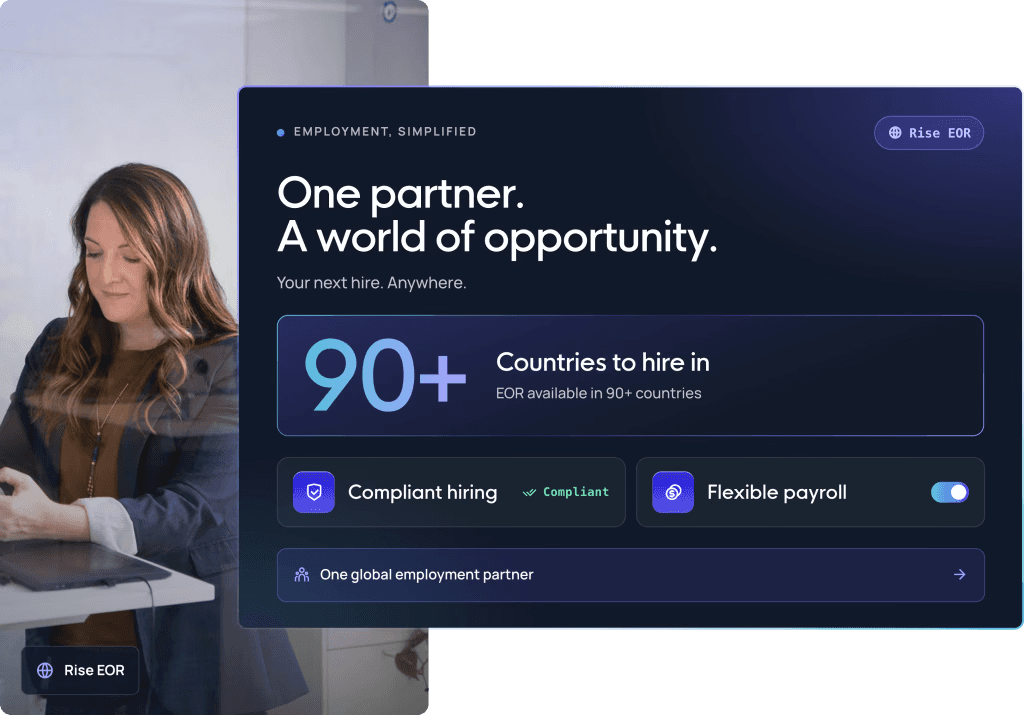
Platform Overview
Both platforms let companies hire full-time employees abroad without opening a local entity. The difference sits in how each one treats crypto, which determines how much of your payroll operation stays on-chain.
Rise
Rise is a global payroll platform covering EOR, AOR, global contractor payments and US direct payroll, with stablecoin infrastructure built in-house rather than outsourced to a third-party payment provider.
Its crypto-native Employer of Record handles employment agreements, local taxes, benefits and compliance, while the same platform runs contractor payroll in 190+ countries.
Funding in USD by bank transfer, USDC or USDT
Worker withdrawals in 90+ local currencies and 100+ crypto assets
Settlement on Ethereum, Arbitrum, Optimism, Base and Polygon, with USDC on Arbitrum as the primary on-chain asset
Official Circle partnership for USDC payroll funding and withdrawals
A DAO paying 15 engineers can fund a single USDC payroll run, and each engineer then decides whether to receive USDC on Arbitrum, USDT, or local currency in their bank account. That worker-level choice is the core of Rise’s model.
Gloroots
Gloroots is a global employment platform offering EOR, Contractor of Record, contractor payments, global payroll, recruitment and immigration services across 150+ countries. It runs a mix of owned entities and partners and states which model applies in each country.
EOR, payroll and contractor management from one dashboard
Crypto pay-ins listed as a feature of its EOR plan
Managed off-ramping that converts crypto treasury funds into local currency
Add-on services including visa support, background checks, devices and recruitment
Its published case studies describe Web3 teams funding payroll from crypto treasuries while Gloroots handles off-ramping, currency conversion, invoicing and disbursement to contractors’ bank accounts. Gloroots is a solid fit for companies that hold crypto but want workers paid in fiat.
EOR Pricing Compared
EOR platform fees are the most visible line item, but they cover only the service layer. Salary, employer social contributions, statutory benefits and severance obligations sit on top and vary by country.
Rise EOR Pricing
Rise EOR costs $399 per employee per month. That fee covers compliant employment contracts, local payroll and tax handling, benefits administration and the ability to fund and pay in stablecoins without any separate crypto product.
Flat $399 per employee per month
Stablecoin funding and hybrid payouts included in the EOR workflow
Benefits in the US include health coverage and a crypto-friendly 401(k)
You can model the full employer cost for any hire, including statutory contributions, with the Rise Employee Cost Calculator.
Gloroots EOR Pricing
Gloroots lists EOR from $199 per employee per month on its pricing page, with no minimum headcount and no long-term contract required. Some of its country guides still quote $299, so buyers should confirm the rate for each target market before signing.
From $199 per employee per month on the current pricing page
Billing per active worker, stopping the cycle after offboarding
Custom benefits, relocation and specialized compliance quoted separately
For a 10-person international team, the platform fee alone works out to roughly $3,990 per month on Rise and from $1,990 per month on Gloroots. Teams that need stablecoin payouts to employees should weigh that gap against the cost of running a separate crypto withdrawal process.
Contractor and AOR Pricing
Many crypto-native companies run contractor-heavy teams, so contractor pricing often matters more than EOR pricing.
Rise Contractor and AOR Pricing
Rise splits contractor services into two products. Global Contractor payroll costs $49 per contractor per month, while Agent of Record (AOR), where Rise takes on misclassification risk and compliance ownership, costs $299 per contractor per month.
Global Contractor: $49 per contractor per month
AOR: $299 per contractor per month
Contractors invited by email complete onboarding and KYC themselves
Gloroots Contractor Pricing
Gloroots offers contractor payments from $29 per contractor per month and Contractor of Record from $99 per contractor per month. Its contractor payments product supports 40+ currencies, with invoicing handled by the platform.
Pay Contractors: from $29 per contractor per month
Contractor of Record: from $99 per contractor per month
Milestone, hourly and fixed agreements supported
On headline price, Gloroots is lower on both tiers. Rise’s contractor products include direct stablecoin withdrawals to the contractor’s own wallet, which Gloroots does not document for its contractor payments product.

Transaction and Payout Fees
Platform fees tell only part of the story, because every payout carries a cost that compounds across monthly runs.
Rise Transaction Fees
Rise publishes flat transaction fees for every withdrawal type, so finance teams can forecast payout costs precisely.
Stablecoin and crypto withdrawals: $2.50 per transaction
Fiat withdrawals: $10 per transaction plus a 1-2% FX fee
No deposit fees on stablecoin funding
A contractor withdrawing $5,000 in USDC pays $2.50, while the same amount withdrawn to a local bank account costs $10 plus $50 to $100 in FX. Across a 20-person team paid monthly in stablecoins, total payout fees come to $50 per cycle.
Gloroots Transaction Fees
Gloroots states that its pricing carries no hidden fees and no FX markup, with any additional services agreed in advance. It does not publish a per-transaction fee schedule for crypto off-ramping or conversion, so those costs need to be confirmed during the sales process.
No FX markup stated on its pricing materials
Crypto-to-fiat conversion costs not published
Additional services quoted and approved before billing
Rise’s published per-transaction pricing gives crypto-native finance teams the clearest view of payout costs before the first run.
Country Coverage and Entity Model
Coverage claims only matter if the provider can employ compliantly in the markets you hire in, and whether it owns the entity affects accountability and response times.
Rise Coverage
Rise supports contractor payroll in 190+ countries and runs EOR through owned entities in markets including the US, UK, Canada, Australia, Ireland, Cyprus, New Zealand and South Africa. The EOR footprint is expanding, with new countries launching on an ongoing basis through 2026.
190+ countries for contractor and AOR payroll
Owned EOR entities, so Rise is the legal employer rather than a reseller
Hybrid fiat and stablecoin payroll available across supported EOR markets
Gloroots Coverage
Gloroots offers EOR and payroll in 150+ countries through a combination of owned entities and in-country partners. It states which model applies to each country, and its case studies show particular depth in India and the wider Asia-Pacific region.
150+ countries for EOR and global payroll
Mixed owned-entity and partner model, disclosed per country
Visa and immigration support available as an add-on
Teams hiring across many non-Western markets today will find broader EOR reach on Gloroots. Teams hiring in Rise’s owned-entity markets get direct legal employment combined with native stablecoin payroll.
Crypto-Native Payroll Capabilities
This is where the two platforms differ most. “Crypto payroll” can mean funding payroll from crypto, paying workers in crypto, or both.
How Rise Handles Crypto Payroll
Rise separates employer funding from worker withdrawal preferences. The employer funds in USD, USDC or USDT, and each worker controls how and where they withdraw, including splitting pay between fiat and stablecoins. This is the model behind Rise’s stablecoin payroll infrastructure.
Fund in USDC (through Rise’s official Circle partnership), USDT or USD
Workers withdraw in stablecoins, other crypto assets or local fiat
Five supported networks: Ethereum, Arbitrum, Optimism, Base and Polygon
Built in-house, with no third-party stablecoin provider in the payment path
Rise ID ties each worker’s compliance records, contracts and payment history together
A Web3 company with employees in the UK and contractors in Argentina can fund one USDC run, let the UK employee receive GBP and let the Argentine contractor hold USDT. All of it sits in one compliance layer and one audit trail.
How Gloroots Handles Crypto Payroll
Gloroots positions crypto payroll primarily as a treasury off-ramp. The employer pays in crypto, and Gloroots converts the funds, generates invoices and payroll records, and disburses local currency to workers. It also states support for hybrid fiat and crypto payroll models.
Crypto pay-ins accepted for EOR and payroll
Off-ramping and conversion handled by the Gloroots team
Case studies cite payouts landing within a few hours to 24 hours
Supported tokens, networks and worker-side crypto withdrawal options not published
For a crypto-funded company whose workers all want fiat, this service removes the off-ramping burden. Teams whose workers want to receive stablecoins directly will need to confirm that capability with Gloroots.

Treasury and Yield on Idle Balances
Payroll funds often sit on a platform for days between funding and withdrawal, and crypto-native finance teams increasingly expect that capital to work.
Rise Earn
Rise Earn generates yield on idle USDC through Aave’s USDC lending pools on Arbitrum. Rise takes a 1% commission on interest earned, charged only at withdrawal, with no deposit or holding fees and on-demand redemption.
Yield on idle USDC payroll balances
1% commission on interest only, charged at withdrawal
No deposit or holding fees
Gloroots Treasury Features
Gloroots does not offer a yield product on payroll balances. Its value sits in the conversion and disbursement service rather than in treasury management.
For DAOs and Web3 treasuries holding significant USDC between payroll cycles, Rise Earn turns payroll float into a modest return.
Compliance and Security
Crypto payroll adds regulatory layers on top of employment law, so the compliance posture of the platform moving funds matters.
Rise Compliance
Rise holds SOC 2 Type II certification, is registered with FinCEN as a Money Services Business, and is GDPR compliant. Its official partnership with Circle covers USDC funding and withdrawals across the full product suite.
SOC 2 Type II
FinCEN MSB registration
GDPR compliance
Official Circle partnership for USDC
Gloroots Compliance
Gloroots emphasizes employment compliance, including localized agreements, statutory payroll calculations, 13th-month handling and audit-ready payroll records. It also highlights named in-country specialists and 24/7 human support.
Localized employment and contractor agreements
Statutory payroll and filings handled each cycle
Audit-ready payroll records for crypto-funded payouts
For finance teams that need regulatory clarity on the money movement itself, Rise’s MSB registration and Circle partnership give a documented foundation for stablecoin payroll.
Pros and Cons
Rise Pros
Native, in-house stablecoin payroll across EOR, AOR and contractor products
Worker-controlled withdrawals in 90+ fiat currencies and 100+ crypto assets
Published flat transaction fees, including $2.50 per stablecoin payout
Rise Earn yield on idle USDC balances
SOC 2 Type II, FinCEN MSB registration and an official Circle partnership
Rise Cons
EOR platform fee of $399 is above Gloroots’ $199 entry rate
Owned-entity EOR footprint is still expanding into new markets
Gloroots Pros
Low entry pricing, with EOR from $199 and contractor payments from $29
EOR and payroll coverage across 150+ countries, with entity model disclosed
Hands-on crypto off-ramping for treasury-funded teams
Gloroots Cons
Supported tokens, networks and crypto conversion fees are not published
Crypto model centers on fiat payouts rather than worker stablecoin withdrawals
Which Platform Fits Which Team
Choose Rise If
Your workers want to receive USDC or USDT directly
You fund payroll from a stablecoin treasury and want yield on idle balances
You need published, predictable per-transaction payout fees
You run a mix of employees and contractors on hybrid fiat and crypto rails through Rise’s hybrid payroll platform
Choose Gloroots If
Your treasury is in crypto but every worker wants local currency
You need EOR coverage in markets outside Rise’s current owned-entity footprint

Conclusion
Stablecoin flows are scaling fast, and the employer of record you choose now decides whether your payroll stays on-chain or gets converted back to fiat at the first step.
Rise and Gloroots both accept crypto, but Rise is the strongest option for teams that want native stablecoin funding, worker-controlled withdrawals, published $2.50 stablecoin payout fees and yield on idle USDC.
Gloroots is a good choice for companies that prioritize low entry pricing, broad EOR coverage and a managed off-ramp into local currency.
Book a demo to see how Rise runs crypto-native EOR payroll for your team, from USDC funding to each worker’s preferred payout.
FAQs:
1. Does Rise let EOR employees receive salary in stablecoins instead of local currency?
Rise lets EOR employees receive salary in stablecoins, local currency, or a split of both. The employer funds in USD, USDC or USDT, and each employee chooses their withdrawal method across 90+ fiat currencies and 100+ crypto assets. Gloroots focuses on converting crypto into local currency payouts.
2. How much does Rise charge per stablecoin payout compared with fiat payouts?
Rise charges $2.50 per stablecoin or crypto payout and $10 plus a 1-2% FX fee per fiat payout. These fees are published upfront, so finance teams can model payout costs before the first run. Gloroots does not publish its crypto conversion costs.
3. Is Rise’s $399 EOR fee worth it if Gloroots starts at $199?
Rise’s $399 EOR fee is worth it when your team needs native stablecoin payroll, worker-side crypto withdrawals and yield on idle USDC. Those capabilities remove the cost of running a separate crypto payout process. Teams paying only in fiat may find Gloroots’ lower entry rate a better fit.
4. Can Rise fund payroll directly from a USDC treasury?
Rise can fund payroll directly from a USDC treasury through its official Circle partnership, as well as from USDT or USD bank transfers. Idle USDC can earn yield through Rise Earn while it waits for withdrawal. Gloroots accepts crypto pay-ins and off-ramps them to fiat.
5. Which stablecoin networks does Rise support for EOR and contractor payroll?
Rise supports Ethereum, Arbitrum, Optimism, Base and Polygon for EOR and contractor payroll, with USDC on Arbitrum as its primary on-chain asset. Workers select their network at withdrawal. Gloroots does not publish its supported networks.