
Remote Alternatives for Global Payroll
Business adoption of stablecoin payroll hit 25% globally by 2025, up from 15% in 2023, according to Rise's Stablecoin Payroll Report 2025.
Remote.com has not moved with that shift. Its Employer of Record product settles exclusively through traditional fiat banking rails at $599 to $699 per employee per month, with no native path to fund payroll in USDC or let workers withdraw in stablecoins.
For finance leads who need global payroll to keep pace with how their workforce actually wants to get paid, that gap is becoming harder to justify.
This comparison covers the three most credible Remote.com alternatives in 2026: Rise, Deel, and Rippling. All three have production-scale track records, and each takes a different approach to entity ownership, pricing, and payment infrastructure.
Key Takeaways
Remote.com charges $599 to $699 per employee per month for EOR with no crypto payout option.
Rise built stablecoin payroll natively in 2022, with $1.5B+ in processed volume.
Deel matches Remote on EOR price and outsources stablecoin settlement to MoonPay and BVNK.
Rippling's EOR pricing runs near $1,000 per employee per month with no stablecoin support.
Rise Earn delivers yield on idle USDC balances, unavailable on any competitor.
Why Finance Leads Are Moving Past Remote.com for Global Payroll
Remote.com built its reputation on owning legal entities directly in every country where it operates, which removes the third-party liability risk that comes with partner-network EOR providers. That model is sound as far as it goes, but two structural gaps show up consistently once a company evaluates Remote.com against the broader market:
1. Pricing sits at the top of the market
EOR runs $599 per employee per month on an annual plan or $699 billed monthly, with contractor management adding $29 per contractor per month on top. Remote's Global Payroll product also carries an undisclosed implementation fee and a recurring payroll delivery fee, both quote-based.
2. Payment infrastructure stops at fiat
Remote settles payroll exclusively through traditional banking rails. There is no native option to fund payroll in USDC or let workers withdraw in stablecoins, which puts Remote at a disadvantage for Web3 teams, DAOs, and any company managing a workforce that spans crypto-native contractors and traditional employees.
For companies that want global payroll pricing and payment flexibility to reflect where the market is heading, not where it was five years ago, the three alternatives below deserve evaluation.
Alternative 1: Rise
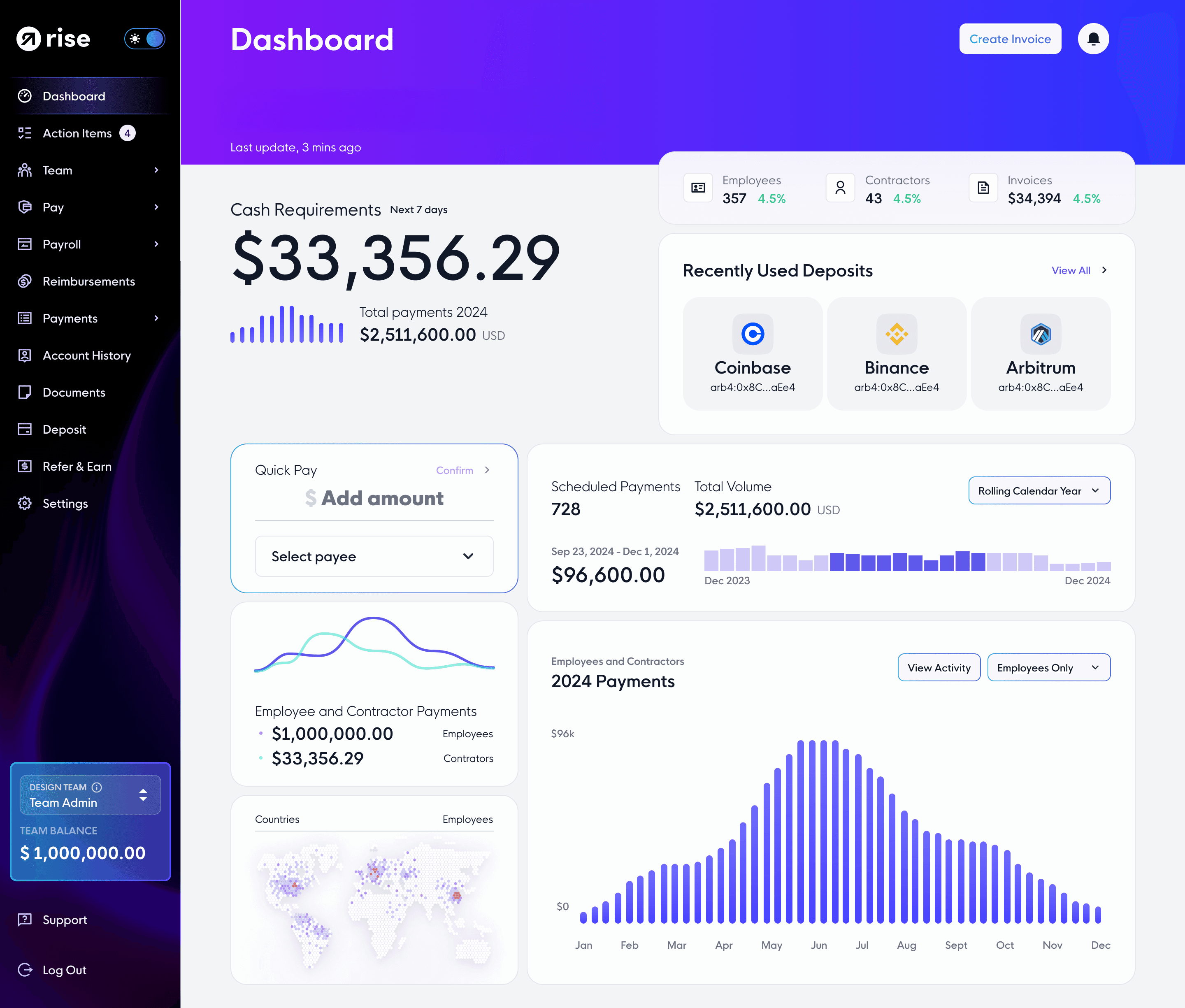
Rise launched with stablecoin payroll as its core architecture, not a feature layered onto an existing fiat-first system. It has processed $1.5B+ in lifetime payroll volume across 190+ countries, with more than 50% of worker withdrawals taken in stablecoins.
Infrastructure and Architecture
Rise runs hybrid payroll natively on Arbitrum, Ethereum, Polygon, Optimism, and Base. Employers fund payroll in USD bank transfer, USDC, or USDT. Workers withdraw in their preferred format every cycle, choosing from 90+ local currencies, 100+ crypto assets, or a split between formats, with no third-party conversion layer sitting between Rise and the chain.
USDC is the primary on-chain asset, backed by an official Circle partnership.
Compliance and Certifications
Rise holds SOC 2 Type II certification and FinCEN MSB registration. Worker onboarding is automated with built-in KYC/AML, and Rise ID ties each worker's compliance records, employment history, and payment verification to a single reusable identity, so workers never resubmit documentation across multiple engagements. Contractor classification and tax documentation, including W-9s, W-8BENs, and 1099s, are handled natively.
Pricing
Employer of Record: $399 per employee per month
Agent of Record (contractor): $49 per contractor per month
Direct Payroll: $49/month account minimum, or $19 PEPM for 3 or more employees, whichever is greater
Where Rise Wins
Rise is the strongest option when global payroll needs to support both traditional employees and stablecoin-native contractors on one platform. It undercuts Remote's EOR pricing by $200 or more per employee per month, runs stablecoin settlement natively rather than through a third-party processor, and carries verified $1.5B+ in processed volume as evidence of production-scale reliability.
Alternative 2: WorkMotion
Berlin-based WorkMotion is a compliance-first Employer of Record (EOR) optimized for companies expanding into the European and DACH regions. It simplifies international hiring by unifying EOR, direct hiring, and contractor management within a single automated platform.
Infrastructure and Architecture
WorkMotion uses a hybrid model, owning legal entities across core European markets (Germany, Switzerland, and Austria) while utilizing partners globally. Its "WorkGlobal" service automates the employment lifecycle, while "WorkDirect" allows for foreign-employer registration—a unique alternative to full EOR services. The platform integrates natively with HRIS tools like Workday, BambooHR, and Personio.
Compliance and Certifications
WorkMotion is ISO/IEC 27001:2022 certified and GDPR-compliant. Notably, it holds a German AÜG license for labor leasing, ensuring total compliance in the DACH market. Proactive compliance advisory is built into the service to manage evolving local labor laws.
Pricing
Transparent pricing starts at €499 per employee per month for EOR and €399 for Direct Hiring, with contractor management at €29. WorkMotion offers upfront country-specific cost breakdowns, though standard security deposits and severance accruals typically apply.
Where WorkMotion Wins
WorkMotion excels for European-centric teams. Its deep expertise in DACH labor law and the flexibility of the WorkDirect model make it a specialized, high-trust alternative to broader global players.
Alternative 3: Rippling
Rippling built its reputation as an all-in-one HR, IT, and finance platform, and its global payroll product benefits from that integration when a company already runs US payroll, device management, and app provisioning through Rippling.
Infrastructure and Architecture
Rippling's global payroll runs on traditional fiat rails with no native stablecoin or crypto payout capability, positioning it closer to Remote.com's fiat-only model than to Rise's hybrid infrastructure. Its strength is consolidation, not payment flexibility.
Compliance and Certifications
Rippling handles compliance through its broader HR platform, bundling payroll compliance with IT and finance workflows rather than offering it as a standalone product.
Pricing
Rippling's EOR pricing runs close to $1,000 per employee per month according to multiple industry reviews, significantly higher than Remote.com, Deel, and Rise.
Where Rippling Wins
Rippling makes sense for companies already embedded in its HR and IT ecosystem that value consolidating every workforce tool under one vendor. For payroll-only buyers, the premium is difficult to justify against alternatives that deliver the core hiring and payment functionality at a fraction of the monthly cost.
Head-to-Head: Rise vs Deel vs Rippling vs Remote.com
The four platforms differ most sharply on infrastructure ownership, pricing, and payment flexibility.
Stablecoin infrastructure: Rise runs native stablecoin settlement on-chain. Deel routes through MoonPay and BVNK. Rippling and Remote.com offer no stablecoin option at all.
EOR pricing: Rise costs $399 per employee per month. Remote.com and Deel both charge $599 to $699. Rippling runs closest to $1,000.
Country coverage: Deel leads with 150+ EOR markets. Rise covers 190+ countries across its combined EOR and contractor network. Remote.com covers roughly 90 countries for EOR.
Worker withdrawal flexibility: Rise gives workers 100+ crypto assets and 90+ fiat currencies every cycle. Deel, Rippling, and Remote.com offer fiat-only or narrower withdrawal options.
Payroll volume verified: Rise has processed $1.5B+ in lifetime volume and $776M+ in the trailing 12 months. Remote.com, Deel, and Rippling do not publish equivalent stablecoin-specific volume figures.
How to Choose
The right platform depends on what problem you're actually solving.
If global payroll needs to support stablecoin settlement natively, keep EOR pricing well below $599 per employee per month, and cover contractors and employees across 190+ countries on one platform, Rise is the answer. The $1.5B+ in verified volume and SOC 2 Type II, FinCEN MSB compliance stack eliminate the vendor risk questions that attach to newer entrants.
If country breadth above every other factor is the priority, Deel's 150+ market footprint is the strongest option. If your team is already fully embedded in Rippling for HR and IT, the payroll premium may be worth the consolidation.
Conclusion
Remote.com's owned-entity model and clean compliance story remain solid reasons companies have relied on it for global hiring, but fiat-only settlement and top-of-market pricing leave room for alternatives built around modern payment rails.
Rise, Deel, and Rippling each solve a different piece of that gap, and Rise stands out for pairing native stablecoin infrastructure with EOR pricing that undercuts Remote.com by $200 or more per employee per month across 190+ countries.
Book a demo to see how Rise compares to Remote.com for your specific hiring markets and payout requirements.
FAQs:
1. What is the main difference between Rise and Remote.com for global payroll?
The main difference between Rise and Remote.com for global payroll is payment infrastructure and price. Rise built native stablecoin payroll on-chain and charges $399 per employee per month for EOR, while Remote.com settles exclusively in fiat at $599 to $699 per employee per month.
2. Does Remote.com support stablecoin or crypto payments?
Remote.com does not support stablecoin or crypto payments. Remote settles payroll exclusively through traditional fiat banking rails, which is a key gap for companies with crypto-native or Web3 contractors.
3. Which Remote.com alternative has the broadest country coverage?
The Remote.com alternative with the broadest country coverage is Deel, with EOR entities in 150+ countries, while Rise covers 190+ countries across its combined EOR and contractor network and Remote.com covers roughly 90.
4. Is Rippling cheaper than Remote.com for global payroll?
Rippling is not cheaper than Remote.com for global payroll. Rippling's EOR pricing runs close to $1,000 per employee per month according to industry reviews, well above Remote's $599 to $699 range and Rise's $399 rate.
5. What is Rise Earn and does Remote.com offer anything similar?
Rise Earn is a yield product that delivers returns on idle USDC payroll balances through Aave's USDC lending pools on Arbitrum, with a 1% commission on interest at withdrawal only. Remote.com, Deel, and Rippling offer no equivalent yield product on payroll balances.