
How RiseID Shortens Contractor KYC and Onboarding
Fenergo’s Financial Crime Industry Trends 2025 report found that 70% of financial institutions lost clients in the past year because onboarding moved too slowly, the highest rate the survey has recorded, with onboarding abandonment now averaging around 10%.
Contractor onboarding runs into the same friction, because every new engagement usually restarts identity checks, document collection, and payout setup from zero.
Rise, which has processed more than $1.5B in lifetime payroll across 190+ countries, built RiseID to break that cycle with a single verified identity that contractors carry from one engagement to the next.
For a founder or Head of People scaling a distributed team, slow contractor KYC shows up as delayed start dates, finance teams chasing documents over email, and contractors who accept another offer while verification sits in a queue. The cost compounds with headcount, since each new hire adds another round of manual review instead of drawing on verification that has already been done.
This guide explains where contractor KYC onboarding loses time, how RiseID’s verify-once model works, and what it changes for compliance, payouts, and the move from contractor to employee.
Key Takeaways
RiseID lets contractors verify identity once and reuse it across Rise engagements.
Rise automates KYC, KYB, and AML checks, cutting manual contractor onboarding review.
Contractor KYC onboarding stalls on document chasing, and RiseID removes repeat resubmission.
RiseID doubles as a wallet for payouts in 90+ fiat currencies or 100+ crypto assets.
Rise transaction fees: $2.50 for stablecoins or crypto, $10 plus 1-2% FX for fiat.

Why Contractor KYC Onboarding Slows Down Global Hiring
Contractor KYC exists for good reasons, since payment platforms must confirm who they are paying, screen against sanctions lists, and keep auditable records. The problem is that most onboarding flows treat every contractor as a new unknown on every engagement, even when the same person has been verified before.
At the launch of Fenergo’s 2025 report, panelists described compliance processes that still involve five to seven handoffs, with investigators working across more than 10 systems.
Document Collection Repeats on Every Engagement
Contractors resubmit passports, proof of address, and banking details to each new client or platform. Each submission creates another set of files to store, review, and eventually refresh.
Manual Review Creates Queue Time
When KYC depends on a person checking documents, onboarding speed depends on that person’s backlog. A mismatched address or a blurry ID photo restarts the loop with another email and another wait.
Payout Setup Becomes a Second Onboarding
Even after identity is cleared, finance teams still need to collect payout details, confirm currencies, and test the first transfer. For contractors paid in crypto, wallet verification adds a further step before any money moves.
The downstream effects are consistent across companies:
Start dates slip while verification is pending
People Ops spends hours on follow-ups instead of hiring
Contractors experience the company as slow before their first day
Compliance records end up scattered across inboxes and shared drives
Consider a startup adding eight engineers across four countries in one quarter. If each contractor needs two or three rounds of document follow-up, the team runs more than 20 separate compliance conversations before anyone ships work, and this is the exact bottleneck RiseID was designed to remove.
What RiseID Is and How It Works
RiseID is a secure, reusable digital identity for employees, contractors, and businesses on Rise. It ties a worker’s verified identity to their compliance status, contracts, and payment history, so verification becomes something a contractor completes once rather than an obstacle they clear on every engagement.
The flow runs in three steps.
1. Verify Identity Once
The contractor creates a RiseID and completes identity verification a single time. Rise automates the KYC, KYB, and AML checks behind that verification, replacing ad hoc document review with a structured, consistent process.
2. Build a Reusable Professional Profile
Contractors add work history, certifications, a bio, a profile photo, and contact information. That profile travels with the RiseID, giving hiring teams useful context alongside a verified identity.
3. Get Paid Without Repeat Compliance Checks
Once verified, the contractor can be paid without going back through compliance for each new contract or job. RiseID also works as a digital wallet, so contractors receive and withdraw funds from the same identity they verified.
Core RiseID capabilities include:
One identity usable across every platform where RiseID is accepted
Automated KYC, KYB, and AML checks
No document resubmission for multiple contracts or jobs
A built-in wallet for receiving payments and withdrawing funds
Compatibility with both fiat and crypto payroll
For example, a designer in Buenos Aires who verified her RiseID for an earlier engagement on Rise can accept a new contract without uploading her passport again, and her payout setup is already in place. RiseID turns verification from a recurring per-engagement cost into a one-time asset the contractor keeps.

How RiseID Shortens Each Stage of Contractor Onboarding
Traditional contractor onboarding is a chain of dependent steps, so a delay at any single point pushes back the start date. RiseID compresses that chain by moving verification into the identity itself.
Identity Verification
In a standard flow, the hiring company requests documents, waits, reviews them, and often requests them again. With RiseID, a verified contractor arrives with identity verification already completed, so the company is not starting from an empty file.
KYB for Contractor Entities
Many senior contractors invoice through their own LLC or limited company, which adds business verification on top of personal KYC. RiseID covers KYB as well as KYC, so entity-based contractors move through the same automated flow as individuals.
AML and Sanctions Screening
Rise runs AML checks as part of automated verification, so screening does not sit with the hiring team as a separate manual task. This keeps screening consistent for every contractor, whatever country they work from.
Contract and Payment Readiness
Because RiseID links identity to contracts and payment history, a verified contractor is ready to be paid as soon as the engagement is set up. There is no separate payout onboarding to complete before the first invoice clears.
The change at each stage looks like this:
Documents move from per-engagement collection to one verification reused across contracts
Review moves from a manual queue to automated KYC, KYB, and AML checks
Payout setup moves from a separate process to the built-in RiseID wallet
Records move from email threads and drives to one identity on Rise
A Web3 protocol bringing back a returning smart contract auditor for a second engagement, for instance, can skip the full intake because the auditor’s RiseID already holds a verified identity and payment history. Every stage RiseID removes is one less handoff between People Ops, finance, and the contractor.
Security and Compliance Behind RiseID
A reusable identity only works if hiring companies can trust the verification behind it. RiseID operates inside the same compliance framework that supports more than $1.5B in lifetime payroll on Rise.
SOC 2 Type II certification
GDPR compliance
FinCEN registration as a Money Service Business, with state licensing published in the Rise help center
Multi-factor authentication and high-level encryption across the platform
These controls matter most to finance and legal teams, who need a defensible audit trail for every person they pay. Because verification lives with the RiseID instead of in email threads, compliance records stay centralized and consistent across the entire contractor base.
When an auditor asks how a contractor in Vietnam was screened, the answer sits in one record on Rise rather than in a reconstructed email chain. That consistency is what allows People Ops to speed up onboarding without loosening controls.
RiseID Payouts, Currencies, and Fees
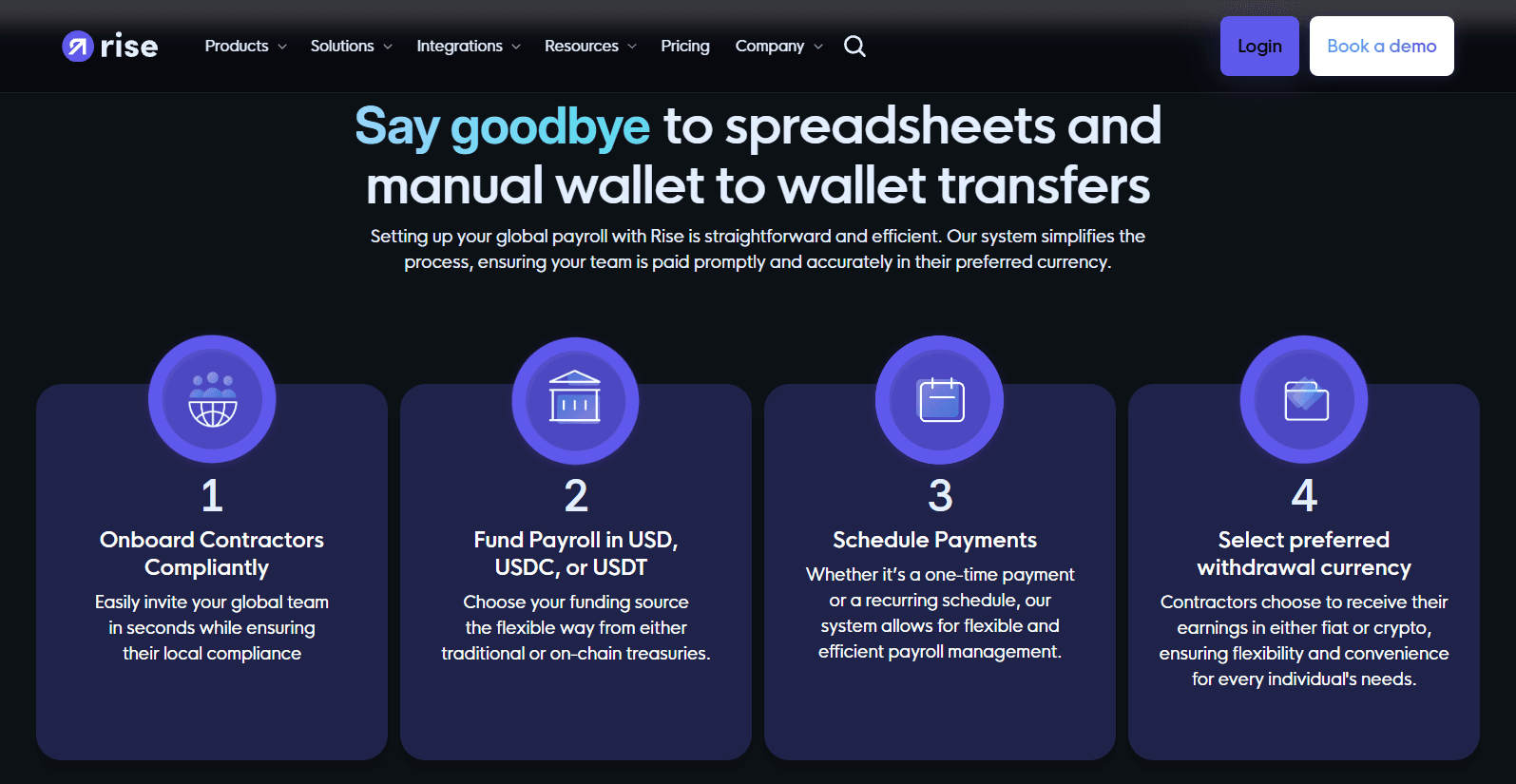
Faster KYC only pays off when the first payment arrives quickly and at a predictable cost. RiseID connects directly to Rise’s global contractor payments, so a verified contractor can receive funds in 90+ local currencies or 100+ crypto assets.
For stablecoin payouts, Rise’s primary on-chain asset is USDC on Arbitrum, supported by Rise’s official partnership with Circle, the issuer of USDC. More than half of worker withdrawals on Rise are already in stablecoins, across networks including Ethereum, Arbitrum, Optimism, Base, and Polygon.
Rise pricing is transparent:
$2.50 per transaction for stablecoin and crypto payouts
$10 per transaction plus a 1-2% FX fee for fiat payouts
$49 per contractor per month for Global Contractor Pay
$299 per contractor per month for Agent of Record (AOR)
A team paying 20 contractors monthly in USDC pays $50 in transaction fees for that run, compared with $200 plus FX on the same run in fiat. Pairing a verify-once identity with low-cost stablecoin rails is what shortens the full path from signed contract to first payment.
Moving Contractors to EOR With RiseID
Many companies start with contractors in a new market and convert their strongest performers to employees once the market proves out. RiseID is built for employees as well as contractors, so the worker’s verified identity remains part of their Rise record when the relationship changes.
Rise’s Employer of Record service costs $399 per employee per month and runs through Rise-owned entities in the US, UK, Canada, Australia, Ireland, Cyprus, New Zealand, and South Africa. Before converting, teams should weigh a few factors:
Employer costs vary widely by country once social contributions and statutory benefits are included
Misclassification risk grows the longer a full-time contractor relationship continues
Owned entities give Rise direct control over employment compliance in those markets
Use the Rise Employee Cost Calculator to estimate the total cost of employing a worker in their country before making the switch.
A startup converting a long-term contractor in Ireland, for example, can model the full employment cost upfront and then move the worker onto EOR through Rise’s Irish entity. The verification work done at the contractor stage carries forward instead of being repeated for the new employment relationship.
What Faster KYC Means for Finance and People Teams
Shorter contractor KYC onboarding changes more than the start date. It shifts where finance and People Ops spend their time and how contractors perceive the company from the first interaction.
Shorter Time to First Payment
With verification and payout setup already handled through RiseID, the first invoice can be paid as soon as work is approved. Contractors see a company that pays on schedule from the start.
Lower Compliance Overhead
Automated KYC, KYB, and AML checks remove much of the manual review that consumes People Ops capacity. Teams can grow headcount without adding compliance staff at the same rate.
A Better First Impression for Contractors
Top contractors often weigh several offers at once, and a slow, document-heavy intake signals a slow company. A verify-once experience removes that friction before it costs a hire.
In practice, these gains show up as:
Fewer email follow-ups per contractor
Faster movement from signed contract to productive work
Cleaner audit records with less manual reconciliation
Lower risk of losing candidates during onboarding
A remote-first company hiring 30 contractors a year across a dozen countries feels the difference in every hiring cycle, because each new contractor draws on infrastructure instead of restarting a manual process. That compounding effect is the core business case for building onboarding around RiseID.

Conclusion
Fenergo’s finding that 70% of financial institutions lost clients to slow onboarding is a warning for any company competing for global talent, because contractors abandon slow processes the same way clients do.
RiseID addresses the root cause by letting contractors verify once through automated KYC, KYB, and AML checks, then reuse that identity across contracts, payouts, and even a later move to EOR.
Combined with payouts in 90+ local currencies and 100+ crypto assets, USDC rails supported by Rise’s Circle partnership, and transaction fees starting at $2.50, RiseID shortens the full path from offer to first payment while keeping compliance centralized and auditable.
Book a demo to see how RiseID can cut your next contractor’s onboarding down to a single verification and get them paid on Rise from day one.
FAQs:
1. How long does contractor KYC take with RiseID?
Contractor KYC with RiseID takes one verification per contractor instead of one per engagement. The contractor verifies once, Rise automates the KYC, KYB, and AML checks, and the verified RiseID is reused for future contracts and jobs. This removes the repeat document collection that usually stretches onboarding.
2. Do contractors need to resubmit documents for every new contract on Rise?
Contractors do not need to resubmit documents for every new contract on Rise once they hold a verified RiseID. The identity is reusable across multiple contracts and jobs, and contractors can be paid without repeated compliance checks.
3. How much does Rise charge to pay contractors?
Rise charges $2.50 per transaction for stablecoin and crypto payouts and $10 plus a 1-2% FX fee for fiat payouts. Global Contractor Pay costs $49 per contractor per month, and Agent of Record costs $299 per contractor per month.
4. Can contractors with a RiseID be paid in USDC?
Contractors with a RiseID can be paid in USDC, Rise’s primary on-chain asset on Arbitrum, supported by Rise’s official partnership with Circle. They can also receive 100+ other crypto assets or withdraw in 90+ fiat currencies, using the RiseID wallet for payments and withdrawals.
5. Can RiseID be used when a contractor converts to an EOR employee?
RiseID can be used when a contractor converts to an EOR employee, since it is built for employees as well as contractors. Rise’s EOR costs $399 per employee per month through owned entities in eight countries, and the Rise Employee Cost Calculator estimates total employment cost before the switch.