Daily Payroll from Rise
The biweekly pay cycle is quietly becoming a liability, with 76% of employees say on-demand pay is now an important factor when considering a job offer, and employers who can't deliver faster access to earned wages are increasingly losing ground in recruitment.
At the same time, the global shift toward distributed, crypto-native workforces has made pay frequency a strategic question, not just a logistics one.
Rise has offered daily payroll for global contractors and employees since early in its platform's evolution. But the use cases have expanded significantly.
Treasury teams are using it to compete for top remote talent.
Web3 companies are running it on stablecoin rails for real-time cross-border settlement.
HR leaders are using it to reduce financial stress and turnover without restructuring their existing payroll workflows.
This article breaks down what Rise's daily payroll actually does, what's new, who benefits most, and how to implement it inside a compliant, global payroll operation.
Key Takeaways
Rise's daily payroll makes earnings available every workday, with funds arriving midnight GMT.
Workers can withdraw daily in 90+ fiat currencies, 100+ crypto assets, or stablecoins like USDC and USDT.
Daily payroll through Rise requires no changes to an employer's existing payroll setup or pay cycle.
Use cases now span Web3 teams, remote contractors, gig-adjacent roles, and global EOR employees.
Rise's hybrid fiat and crypto payroll infrastructure powers daily payroll for teams across 190+ countries.
What Rise's Daily Payroll Actually Does
Most platforms that advertise "daily pay" are offering earned wage access (EWA): a bridge loan against upcoming earnings, often with third-party fees attached. Rise operates differently.
With Rise, employers fund payroll in advance, and earnings are made available to workers every workday. Funds arrive at midnight GMT, and workers can withdraw immediately to their preferred destination: a bank account, a crypto wallet, or a stablecoin address.
There are no fees charged to workers for access, no third-party lending product underneath, and no change required to the employer's existing payroll cycle or accounting workflows.
This is a structural distinction worth noting:
EWA (earned wage access): advances against unprocessed earnings, often with consumer fees
Rise daily payroll: funded earnings disbursed on a daily schedule, with full worker withdrawal flexibility
The practical effect for workers is the same: they can access pay the same day they earn it. But the operational and compliance profile for employers is cleaner because there is no advance product, no CFPB exposure, and no coordination required with a third-party lender.
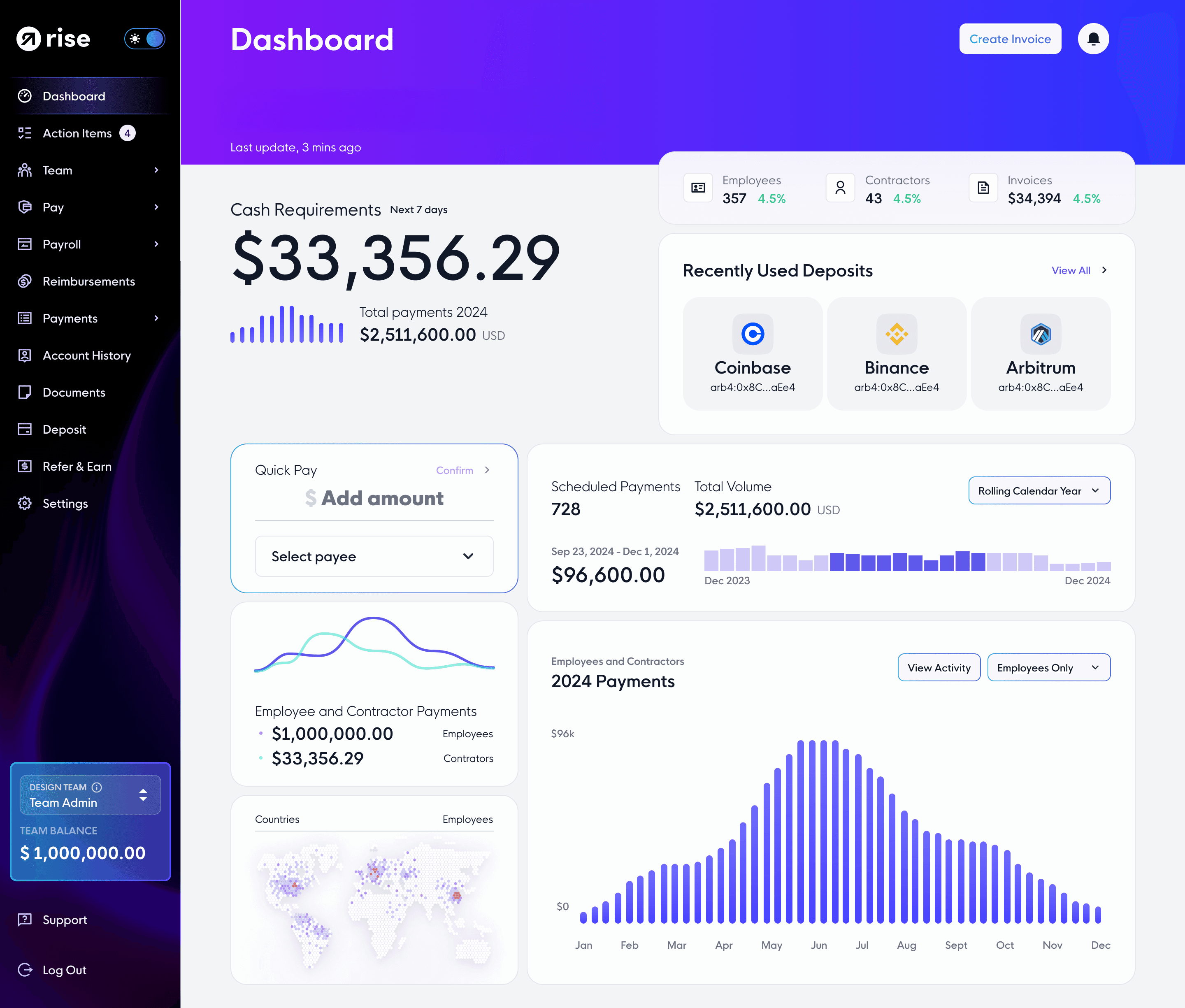
Workers set their withdrawal preferences once inside the Rise dashboard: bank account, crypto wallet, or both. From that point forward, daily funds arrive automatically and workers withdraw on their own timeline.
Who Benefits Most from Daily Payroll
Daily payroll is not a universal upgrade. It adds the most value in specific workforce configurations.
1. Globally distributed contractor teams
When contractors work across multiple time zones and currencies, traditional biweekly cycles create compounding lag. A contractor in Southeast Asia waiting 14 days for a USD wire that then requires local conversion is facing a week of effective payment delay on top of the schedule itself. Daily payroll on stablecoin rails compresses that to same-day settlement.
2. Web3 and crypto-native companies
Teams already holding treasury in USDC or USDT are a natural fit. Rise's stablecoin payroll infrastructure lets companies fund daily payroll from a USDC treasury position and disburse to worker wallets on Ethereum, Arbitrum, Base, Optimism, or Polygon without converting to fiat first. Workers who want local currency can still convert at withdrawal.
3. Gig-adjacent roles
Content creators, freelance developers, and on-call specialists are increasingly comparing employer payroll terms to their gig platform experience, where pay arrives within hours of project completion. Daily payroll from Rise narrows that gap for employers who want to attract this segment without adopting a fully contractor-based model.
4. EOR employees in financially stressed markets
In regions where workers live close to paycheck-to-paycheck, access to daily earnings directly reduces financial distress. 24% of households are still classified as living paycheck to paycheck in 2025, with workers remaining highly sensitive to pay timing and accuracy.
For HR leads managing Employer of Record headcount in Latin America, Southeast Asia, or Sub-Saharan Africa, daily payroll is a retention tool with measurable impact.
New Use Cases: What's Changed in 2026
Rise's daily payroll has been available for a while. What's new is who's using it and how.
Rise Earn Integration with Daily Payroll
Rise Earn allows workers receiving USDC through Rise to allocate balances to yield via Aave's USDC lending pools on Arbitrum. Workers earn yield at a rate driven by on-chain lending demand, and Rise takes a 1% commission on interest earned at the point of withdrawal only. There are no deposit fees, no holding fees, and no minimum lockup.
The connection to daily payroll is significant. Workers who receive daily USDC disbursements and don't immediately need to spend them can now put those balances to work between withdrawals. Daily earnings become daily yield potential.
For workers in markets with limited savings infrastructure or weak local currency returns, this is a meaningful financial tool built directly into their payroll experience.
Stablecoin Daily Payroll for DAOs and Web3 Teams
DAOs that historically ran payroll through multisig wallets and manual disbursements are migrating to Rise for daily payroll specifically because it adds compliance, reporting, and worker onboarding without removing stablecoin flexibility.
B2B stablecoin payments jumped roughly 30x, from under $100 million per month in early 2023 to over $3 billion per month by 2025 according to research from Artemis, Castle Island Ventures, and Dragonfly, and payroll is a growing share of that volume.
Rise handles KYC, employment agreements, tax documentation, and payout automation. DAO contributors receive daily USDC or their preferred withdrawal currency. The treasury team funds payroll once and the platform handles disbursement, reporting, and compliance from there.
Daily Payroll as a Retention Benchmark
Global remote teams are increasingly benchmarking compensation packages not just on rate but on payment experience. On-demand pay adoption has grown from just 5% of businesses in 2020 to a projected 42% by the end of 2025. Companies that lag on payment speed and flexibility are ceding ground to those that lead on it.
In much the same way that HR departments must audit their modern payroll capabilities, security teams are now tasked with evaluating their digital defenses, making the practice of benchmarking agentic pentesting tools essential to ensuring a company's remote infrastructure remains resilient against emerging threats."
For founders and heads of people building international teams, daily payroll from Rise gives them a concrete differentiator to put in offer letters: "You get paid every day. Choose your withdrawal currency." That's a difficult benefit to match without the underlying infrastructure Rise already provides.

How Daily Payroll Works Inside Rise's Compliance Framework
Daily payroll frequency doesn't change the compliance obligations. Workers still need proper onboarding, classification, and documentation regardless of how often they're paid.
Rise handles this through a structured onboarding flow:
Identity verification via Rise ID, which creates a persistent on-chain professional identity tied to the worker's compliance record
Agreement generation covering contractor terms, employment agreements (for EOR workers), and jurisdiction-specific documentation
Tax documentation for international contractors and employees, managed by Rise with jurisdiction-level accuracy
Payment reporting with audit-ready records for every disbursement, in every currency
Once a worker is onboarded, daily payroll runs automatically. The employer funds payroll on their existing schedule. Rise handles the daily disbursement cadence, currency routing, and withdrawal processing on the backend.
For employers running EOR workers through Rise, the daily payroll benefit extends to full-time employees without additional configuration. EOR coverage continues to expand, with Rise targeting 60+ owned-entity markets by the end of 2026, meaning more workers in more countries can access daily payroll under a fully compliant employment structure.
The crypto payroll management guide from Rise covers the full operational detail of how payroll funding, worker onboarding, and withdrawal flexibility work together across fiat and crypto disbursement models.
What Daily Payroll Is Not
A few common misconceptions worth addressing directly.
1. Daily payroll doesn't mean daily payroll runs
Employers fund payroll on their existing schedule, weekly, biweekly, or monthly. Rise distributes available earnings to workers on a daily cadence from those funds. The employer's cash flow and accounting workflows don't need to change.
2. Daily payroll doesn't require workers to accept crypto
Workers choose their withdrawal currency every cycle. Local currency withdrawals in 90+ currencies are available alongside USDC, USDT, and 100+ other crypto assets. A worker who wants Brazilian reals gets Brazilian reals. A worker who wants USDC gets USDC. The employer funds once and Rise handles the rest.
3. Daily payroll doesn't solve for misclassification risk on its own
Workers still need to be properly classified as contractors or employees before payroll can run. Rise's AOR and EOR models handle classification compliance, but employers should not assume that daily payroll cadence changes the underlying classification analysis.
How to Get Started with Daily Payroll from Rise
Getting daily payroll running on Rise is a short setup process. There's no separate product to activate and no new infrastructure to build. Daily payroll is part of Rise's core platform and is available to all employers as soon as their account and workers are configured.
Step 1: Create Your Rise Account
Sign up at riseworks.io and complete the company verification flow. This includes business identity confirmation and any compliance documentation required based on your jurisdiction and payroll structure.
Most accounts are ready to run payroll within 24 hours of completing setup.
Step 2: Invite and Onboard Your Workers
Add workers via the Rise dashboard by sending an invite to each contractor or employee. Workers complete their own onboarding inside Rise, including:
Identity verification through Rise ID
Signing their contractor agreement or employment contract
Adding bank accounts and crypto wallet addresses under Withdraw Options
Setting their preferred withdrawal currency for each pay cycle
Workers can add multiple withdrawal destinations and switch between them at any time.
Step 3: Fund Your Payroll
Rise supports payroll funding via USD bank transfer, USDC, or USDT. Fund on whatever schedule your treasury operates, weekly, biweekly, or monthly. Rise holds the balance and disburses earnings to workers daily from midnight GMT on each workday. You do not need to initiate a separate transaction each day.
Step 4: Set Worker Pay Rates and Schedules
Inside the Rise dashboard, configure each worker's compensation: rate, currency denomination, and any milestone or recurring payment structure. Rise supports one-time payments, recurring salaries, and milestone-based payouts within the same system. Daily payroll applies automatically once funding is available and worker setup is complete.
Step 5: Workers Withdraw on Their Own Timeline
From the point of setup, workers log into their Rise account and withdraw to their chosen destination at any time. Funds are available daily. Workers who want to leave USDC balances in Rise can opt into Rise Earn for yield on idle balances. No action is required from the employer after the initial funding and configuration.

Conclusion
Daily payroll from Rise has moved beyond a niche feature for crypto-native teams. It's a core retention and recruitment tool for any company managing a globally distributed workforce.
The use cases have expanded: Web3 companies running daily USDC disbursements, EOR employees receiving same-day earnings, contractors comparing Rise's payment speed to gig platforms, and workers using Rise Earn to generate yield on idle daily balances.
The infrastructure is already built. The compliance layer is already in place.
If your current payroll setup makes workers wait two weeks to access money they earned last Monday, that's a problem Rise was designed to solve.
Book a demo with Rise to see how daily payroll works inside your existing global workforce setup.
FAQs:
1. Does Rise's daily payroll require me to change how often I fund payroll?
No. Employers fund payroll on their existing schedule, whether that's weekly, biweekly, or monthly. Rise distributes available earnings to workers daily from the funded balance. Your accounting and cash flow workflows stay the same.
2. Can workers on daily payroll still choose to be paid in fiat currency?
Yes. Workers choose their withdrawal currency every cycle. Rise supports 90+ fiat currencies and 100+ crypto assets. A worker who prefers their local currency receives it. Workers opting into stablecoins like USDC or USDT receive those instead. The employer doesn't manage this decision.
3. Is daily payroll available for EOR employees, or only contractors?
Daily payroll is available for both contractors and EOR employees on Rise. EOR employees receive earnings made available daily through the same midnight GMT disbursement cadence. Rise manages the underlying compliance, tax documentation, and employment agreements for both worker types.
4. How does Rise Earn connect to daily payroll for workers?
Workers receiving USDC through Rise can allocate idle balances to yield via Aave's USDC lending pools on Arbitrum. Daily payroll disbursements in USDC can be left to accrue yield between withdrawals. Rise charges a 1% commission on interest earned at withdrawal only, with no deposit or holding fees.
5. Does Rise's daily payroll comply with local labor laws on pay frequency?
Yes. Rise handles jurisdiction-specific compliance for all workers it pays, including local rules on payment frequency, documentation, and currency. Employers running EOR workers through Rise operate under Rise's owned-entity structure in each country, which means Rise is the legal employer and manages local compliance obligations directly.