
Banking as a Service (BaaS)
The global BaaS market is valued at $28.96 billion in 2026 and is on track to hit $65.78 billion by 2031, growing at a 17.83% CAGR, according to Mordor Intelligence.
That growth is not abstract. It reflects a structural shift in how fintech products get built: fewer companies are applying for banking licenses, and more are renting regulated infrastructure through APIs.
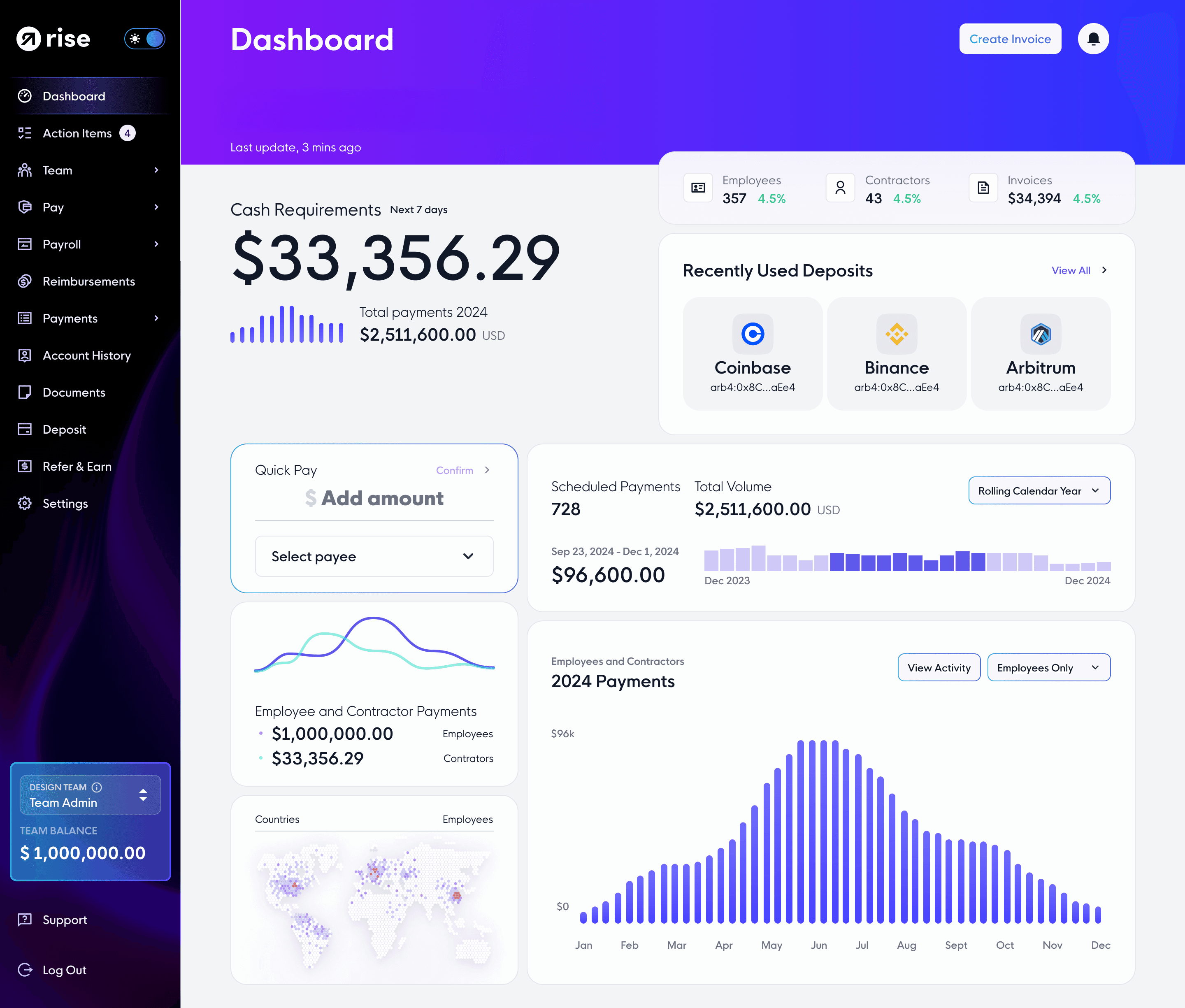
Rise operates at the sharp end of this shift. Instead of routing global payroll through legacy banking rails, Rise built its payout infrastructure on embedded financial rails, including a Circle/USDC partnership, to move money across 190+ countries in 90+ local currencies and 100+ crypto assets.
That is Banking-as-a-Service logic applied directly to workforce payments.
This article breaks down what BaaS actually is, how it works under the hood, when it makes sense to use versus build, and why fintech leaders building payment, payroll, or lending products need to understand the model before they pick infrastructure.
Key Takeaways
Banking-as-a-Service lets fintechs embed licensed banking features without becoming a bank.
Rise applies BaaS-style infrastructure to power stablecoin payroll across 190+ countries.
BaaS reduces time-to-market for fintech products compared to sponsor bank negotiations alone.
Compliance ownership, not just APIs, determines whether a BaaS partner is production-ready.
Rise pairs BaaS-style rails with SOC 2 Type II and FinCEN MSB compliance for payroll teams.
What Is Banking-as-a-Service (BaaS)?
Banking-as-a-Service is a model where a licensed bank or regulated financial institution exposes its core infrastructure, accounts, cards, payments, lending, to non-bank companies through APIs. The non-bank company (often a fintech, marketplace, or software platform) builds a customer-facing product on top of that infrastructure without holding a banking license itself.
The mechanics are straightforward. A fintech integrates with a BaaS provider’s API layer.
The BaaS provider maintains the actual banking relationship, holds the regulatory license, and manages compliance obligations like KYC and AML screening.
The fintech owns the user experience, the branding, and the go-to-market motion.
This is different from simply using a payment processor. BaaS typically includes account issuance, card issuance, ledgering, and sometimes lending, not just transaction routing. It is infrastructure for building a financial product, not just moving a payment from one party to another.
Rise’s own payroll infrastructure follows a parallel logic. Rather than building banking relationships in every one of the 190+ countries it operates in, Rise built on stablecoin rails and a Circle/USDC partnership to move payroll funds globally, then layered payroll-specific compliance, tax documentation, and worker verification on top.
The result functions like a payroll-native version of the same build-vs-rent tradeoff that defines BaaS.
How Banking-as-a-Service Actually Works
A BaaS stack is not one company. It is a chain of specialized layers, and understanding each one matters for anyone doing vendor diligence.
The Sponsor Bank
At the base sits the chartered bank. It holds the actual banking license, keeps deposits insured, and carries ultimate regulatory accountability to banking supervisors. Fintechs almost never interact with this layer directly.
The BaaS Platform or Program Manager
This middle layer, sometimes the sponsor bank itself, sometimes a separate program manager, exposes the sponsor bank’s capabilities through developer-friendly APIs. It handles core banking functions like ledgering, card issuance, and often the first line of compliance monitoring.
The API and Integration Layer
This is what the fintech’s engineering team actually touches. Modern BaaS providers expose accounts, payments, cards, and compliance checks as programmable primitives that a product team can compose into a checkout flow, a payroll dashboard, or a lending app. A FinTech software consultancy can help structure these integrations around specific product requirements.
The Fintech’s Product Layer
The fintech owns everything the end user sees: branding, UX, pricing, and customer support. The banking relationship underneath is invisible to the customer by design.
Rise’s payroll infrastructure mirrors this layered approach on the payment side. A Rise ID ties a worker’s compliance status, contracts, and payment history to a single identity, functioning as an identity and compliance layer that sits underneath the payout experience a client company actually sees in its dashboard.
How Banking-as-a-Service Differs From Open Banking and Embedded Finance
These three terms get used interchangeably, and that causes real confusion when fintech teams are evaluating vendors.
Open banking is about data access. It lets third parties read a customer’s existing bank account data (with consent) to build products like budgeting apps or account aggregation tools.
The UK alone reported 13.3 million active open banking users in 2025 and 31 million open banking payments made, according to Open Banking Limited, showing how far this model has scaled in a single market.
Embedded finance is the broader umbrella. It describes any scenario where a non-financial company offers a financial product inside its core experience, think a ride-sharing app offering driver debit cards, or an e-commerce platform offering buy-now-pay-later at checkout.
Banking-as-a-Service is the infrastructure layer that makes embedded finance possible. It is the plumbing: the APIs, the ledger, the licensed bank relationship, that a fintech taps into to actually issue an account or a card.
Rise sits inside the embedded finance category from a product perspective, since payroll is not the “finance” part of most companies’ core business, but the rails underneath, hybrid fiat and crypto payroll, function like BaaS-grade infrastructure purpose-built for global payouts.
Why Banking-as-a-Service Matters for Fintech Right Now
Three forces are converging to make BaaS a default build decision rather than a nice-to-have.
Speed to Market
Getting a banking license directly, or even negotiating a sponsor bank relationship from scratch, can take 12 to 18 months. A BaaS integration can go live in a fraction of that time because the licensing and compliance groundwork is already in place on the provider’s side.
For a fintech racing a competitor to launch a card program or an embedded lending feature, that timeline difference is often the entire strategic advantage.
Capital Efficiency
Building bank-grade compliance infrastructure internally, fraud monitoring, KYC pipelines, ledger reconciliation, transaction monitoring, requires specialized engineering and compliance headcount that most fintechs cannot justify pre-scale. BaaS providers amortize that cost across many clients.
This is the same logic Rise applies to global payroll compliance. Rather than every client company building its own KYC/AML pipeline for each country, Rise centralizes that compliance layer at the Rise ID level described above.
Global Reach Without Local Banking Relationships
Traditional banking infrastructure is fragmented by country. A fintech expanding into a new market historically needed a local banking partner in that market. BaaS providers with multi-region licensing, and stablecoin-based infrastructure specifically, collapse that requirement.
Rise settles cross-border payroll on stablecoin rails rather than waiting on SWIFT correspondent banking chains, which is why the platform can support payouts across 190+ countries without building a local bank relationship in each one.
Build vs. Rent: When Banking-as-a-Service Makes Sense
Not every fintech should reach for BaaS by default, and not every fintech should build in-house either. The decision usually comes down to four factors.
Timeline pressure: If a competitor is shipping a payments or payout feature within a quarter, BaaS is almost always the faster path. In-house banking infrastructure realistically takes a year or more to stand up properly.
Compliance headcount: Teams without a dedicated compliance function should rent that expertise through a BaaS provider rather than hire a full regulatory team pre-revenue.
Volume and margin economics: At very high transaction volume, the per-account or interchange-share fees BaaS providers charge can erode margin faster than owning the infrastructure would. This is usually a later-stage consideration, not a launch-stage one. Questions involving costs, incentives, and resource allocation also sit within the broader study of economics, which can be explored at the graduate level through programs such as UND’s masters of economics online.
Regulatory appetite and control: Companies that want direct control over compliance decisions, or that operate in a category regulators scrutinize closely, sometimes choose to build or acquire licensing directly rather than depend on a sponsor bank’s risk tolerance.
Payroll sits in a distinct category from most BaaS use cases because the “product” is workforce payments, not a bank account or card. Rise built compliance and payout infrastructure specifically for that use case rather than adapting general-purpose BaaS, which is why Rise’s Employer of Record infrastructure handles worker classification and payroll compliance as a first-class feature instead of a bolt-on.
Who Uses Banking-as-a-Service
BaaS is not limited to consumer neobanks. The buyer set is broader and more B2B-heavy than most people assume.
Neobanks and challenger banks issuing accounts and cards without a banking charter
Vertical SaaS platforms adding payments, payouts, or lending inside an existing workflow (construction software adding contractor payments, for example)
Marketplaces and gig platforms issuing instant payout cards or accounts to workers and sellers
Payroll and HR platforms moving worker payments across borders and currencies, which is Rise’s core use case
Crypto-native companies that need fiat rails alongside on-chain settlement, a segment Rise serves directly through its hybrid fiat and crypto payroll model
The common thread across all five categories is the same: none of these companies want to become a bank. They want banking-grade functionality inside a product that has nothing to do with banking as its primary business.
Stablecoins and the Next Generation of Banking-as-a-Service
Traditional BaaS still depends on a sponsor bank at the base of the stack, which means it inherits that bank’s operating hours, correspondent banking chains, and regulatory risk profile. Stablecoin infrastructure is emerging as a parallel model that sidesteps some of those constraints entirely.
Stablecoins now move as much as $30 billion per day in remittances and settlements, with circulation roughly doubling over the past 18 months. That volume is shifting stablecoins from a crypto-trading tool into core payments infrastructure that runs continuously, including weekends and bank holidays, rather than on banking-hour cutoffs.
For a fintech or crypto product leader, this matters because compliance itself is becoming programmable on these rails. Instead of a manual, after-the-fact compliance review, verification and screening rules can execute automatically as part of the payment itself, which is closer to how Rise structures compliance around a worker’s Rise ID than to how a traditional BaaS sponsor bank relationship works.
Rise’s Circle/USDC partnership puts the company inside this shift directly rather than waiting for it. Rise’s crypto payroll infrastructure shows how stablecoin payroll already replaces SWIFT-dependent BaaS models for one specific, high-volume use case: global workforce payments.
Risks and Diligence Points Fintech Teams Should Not Skip
BaaS is not risk-free infrastructure, and the past two years have included several high-profile BaaS provider failures that left fintech clients scrambling.
1. Compliance ownership is not automatically transferred
Some BaaS providers push more compliance liability onto the fintech client than the marketing suggests. Get the compliance ownership boundaries in writing before integration, not after an audit.
2. Sponsor bank concentration risk is real
If a BaaS provider relies on a single sponsor bank, regulatory action against that sponsor bank can take down every fintech built on top of it simultaneously. Ask about sponsor bank diversification directly.
3. Licensing status should be independently verifiable
Rise, for reference, is registered with FinCEN as a Money Services Business and maintains SOC 2 Type II certification, both independently verifiable facts that a compliance-first buyer should be able to confirm before signing, not take on faith.
Fintech and crypto product leaders evaluating any BaaS or embedded finance partner should apply the same diligence standard to payroll infrastructure that they apply to their own banking stack.

Conclusion
Banking-as-a-Service has moved from a niche fintech talking point to a $28.96 billion market in 2026, and it is growing because it solves a real build-vs-rent problem for any company that wants banking-grade functionality without becoming a bank.
Fintech, payroll, and crypto product leaders who understand the architecture, the build-vs-rent tradeoffs, and where stablecoin rails are headed next make better infrastructure decisions than those who treat BaaS as a single interchangeable category.
Rise applies this same infrastructure logic to global payroll, pairing stablecoin rails and a Circle/USDC partnership with SOC 2 Type II compliance and FinCEN MSB registration to move worker payments across 190+ countries without relying on legacy banking chains.
Book a demo to see how Rise’s embedded payment infrastructure handles global payroll at scale.
FAQs
1. Is Banking-as-a-Service the same as open banking?
No. Open banking is about giving third parties read access to existing bank account data with customer consent. Banking-as-a-Service is about a non-bank company issuing new accounts, cards, or payment products by tapping into a licensed provider’s infrastructure through APIs.
2. Does a fintech need a banking license to use Banking-as-a-Service?
No, that is the core value proposition. The BaaS provider holds the license and regulatory relationship, while the fintech builds the customer-facing product and owns the brand experience on top of that infrastructure.
3. When should a fintech build banking infrastructure instead of renting it through BaaS?
Building makes sense when transaction volume is high enough that per-account or interchange-share fees erode margin, or when a company needs direct control over compliance decisions rather than depending on a sponsor bank’s risk tolerance. Most early-stage fintechs are better served renting through BaaS to move faster.
4. How does Rise use Banking-as-a-Service style infrastructure for payroll?
Rise built its global payout infrastructure on stablecoin rails, including a Circle/USDC partnership, rather than routing payments through traditional correspondent banking. This lets Rise support payouts across 190+ countries in 90+ local currencies and 100+ crypto assets without a local banking relationship in every market.
5. What compliance should fintech teams verify before choosing a BaaS or embedded payment partner?
Confirm the provider’s actual licensing status (such as FinCEN MSB registration), independent audit certifications like SOC 2 Type II, and where compliance liability sits contractually. Rise maintains both SOC 2 Type II certification and FinCEN MSB registration, and these are independently verifiable rather than marketing claims.