.png)


Crypto payroll is becoming a serious part of global compensation in 2026, especially through stablecoins like USDC and USDT.
What began as a niche option for crypto-native companies is now gaining traction as a practical solution for international payroll, contractor payouts, and cross-border compensation.
The shift is being driven by stronger regulation, larger stablecoin payment volumes, and growing demand from global teams for faster and more flexible ways to get paid.
Stablecoin supply has moved above $315B, while estimates of real stablecoin payments in 2025 reached roughly $390B to $400B. Those numbers show that crypto payroll is no longer just an experiment. It is increasingly part of real payment infrastructure.
At Rise, we see this as part of a broader payroll modernization trend. Companies do not just want faster money movement. They want one system that can support compliance, multiple payout methods, worker choice, and both fiat and crypto rails in the same workflow.
Key Takeaways
- Crypto payroll in 2026 is increasingly a stablecoin payroll market, not a volatile-token salary market.
- Stablecoin infrastructure is already large, with more than $315B in supply and about $10.2T in adjusted transaction volume.
- Real payment activity is growing quickly, with estimates of about $390B to $400B in stablecoin payments during 2025.
- Cross-border payroll remains the strongest use case because traditional remittance costs are still high, averaging 6.49% globally.
- Regulation is now a major growth driver, with the GENIUS Act in the U.S., MiCA in Europe, and broader Travel Rule implementation shaping compliant crypto payroll.

What Crypto Payroll Looks Like In 2026
In practice, crypto payroll in 2026 usually falls into one of these models:
- A company funds payroll in fiat and lets workers withdraw in stablecoins.
- A company funds payroll in USDC or USDT and workers convert into local fiat.
- Contractor invoices are settled directly in stablecoins.
- Payroll is denominated in fiat for employment-law reasons, but moved partly over crypto rails for speed and efficiency.
This is why broad claims about crypto payroll adoption can be misleading. Much of the market is really hybrid payroll.
The crypto rail now sits inside a broader payroll workflow that includes:
- KYC and identity checks
- Contracts and worker classification
- Tax forms and recordkeeping
- Local payout methods
- Worker-level withdrawal preferences
Crypto payroll is maturing by becoming more operationally similar to mainstream payroll, not less.
The Market Size Behind The Category
The best place to start is stablecoins.
Core Market Signals
- Stablecoin supply has moved above $315B.
- Adjusted annualized stablecoin volume is about $10.2T.
- Total observed stablecoin volume exceeds $51T.
- McKinsey estimated true stablecoin payments at about $390B in 2025.
- Stripe estimated stablecoin payments at about $400B in 2025.
- Around 60% of Stripe’s stablecoin payments estimate was B2B.
These figures show two things clearly:
- The rail is already large enough to support serious enterprise use.
- Real payment activity is much smaller than raw on-chain flow, but still large enough to confirm that stablecoins have moved beyond trading.
Long-Term Growth Forecasts
Several projections point to major expansion ahead:
- Coinbase projected a stablecoin market centered around $1.2T by 2028.
- Standard Chartered projected the market could rise to $2T by 2028.
- 21Shares projected stablecoin supply could reach $1T.
Not every forecast matches exactly, but the direction is consistent. Stablecoins are increasingly being treated as real payment, treasury, settlement, and compensation infrastructure.
Why Employers Are Looking At Crypto Payroll in 2026
The employer case is straightforward. Traditional cross-border payroll is often:
- Slow
- Expensive
- Fragmented
- Difficult to manage across multiple jurisdictions
The World Bank’s latest remittance pricing data shows the global average cost remains 6.49%.
For companies paying international contractors or distributed teams, that remains a meaningful inefficiency.
What The Data Shows
EY found that:
- 13% of financial institutions and corporates already use stablecoins.
- 54% of non-users expect to adopt them within the next 6 to 12 months.
- 41% of organizations already using stablecoins reported cost savings of 10% or more.
- 52% cited lower transaction costs as a main driver.
- 45% cited faster cross-border payments as a main driver.
For payroll teams, that translates into practical benefits:
- Fewer banking delays
- Lower intermediary fees
- Faster settlement windows
- Greater payout flexibility for global workers

Why Workers Are Interested in Crypto Payroll
Worker demand is also rising. Many global workers do not want one fixed payout method. They want flexibility based on where they live, how they save, and how quickly they need access to earnings.
Demand-Side Signals
BVNK’s 2026 survey found that:
- More than 4,600 people across 15 countries were surveyed.
- 39% receive income in stablecoins.
- Those who receive stablecoin income get about 35% of their earnings that way.
- Three in four said stablecoins improved their ability to do business internationally.
This shows that digital-dollar income is becoming practical for many workers. It also suggests that the market is moving toward partial allocation rather than full salary replacement.
What Workers Increasingly Want
- Part of earnings in local fiat for daily spending
- Part of earnings in stablecoins for speed or savings
- Optional access to other crypto assets
- Faster availability of funds
- Better cross-border payment flexibility
Hybrid payroll is not a temporary workaround. It is increasingly the preferred structure, especially for companies competing for global talent.
Rise's View Of Where The Crypto Payroll Market Stands in 2026
At Rise, our own platform data reflects this shift.
Rise Payroll Signals
- We have processed more than $1B in payroll volume.
- More than 50% of worker withdrawals occur in stablecoins.
- We support payroll and contractor payouts across 190+ countries.
- Workers choose their withdrawal currency each cycle.
These patterns matter because they reflect live payroll behavior, not only market surveys.
Stablecoins are no longer just a secondary option for crypto-native workers. They are becoming a preferred settlement and withdrawal layer for global teams that need more flexibility than traditional payroll systems typically offer.
Regulation Has Become A Tailwind
One reason 2026 looks different is that regulation is no longer only a barrier. In many markets, it is now supporting more structured adoption.
Key Regulatory Developments
United States
- The GENIUS Act was signed into law on July 18, 2025.
- The law subjects stablecoin issuers to the Bank Secrecy Act.
- It requires AML and sanctions compliance programs, including customer identification and risk controls.
Europe
- MiCA is now the core EU crypto framework.
- It creates uniform market rules for crypto-assets.
- It covers transparency, disclosure, authorization, and supervision for issuers and related activity.
Global
- FATF’s 2025 update showed 73% of surveyed jurisdictions, or 85 of 117, had passed legislation implementing the Travel Rule, up from 65 jurisdictions in 2024.

Why This Matters For Payroll
These developments make crypto payroll more viable for serious companies because they support:
- Better payment transparency
- Stronger compliance standards
- More predictable operating environments
- More defensible audit trails
As adoption grows, payroll teams also need to track changing regulations across every market where workers are paid.
Regional Growth Is Uneven, But Important
Crypto payroll demand is not evenly distributed. It is strongest in markets where traditional systems are more expensive, slower, or less reliable.
Brazil As A Key Example
- Brazil received an estimated $318.8B in crypto value from July 2024 to June 2025.
- Around 90% of the flow was linked to stablecoins, according to central bank commentary referenced in reporting.
This helps explain why Latin America remains one of the most relevant regions for:
- Stablecoin payroll
- Remittances
- Cross-border contractor payouts
- Digital-dollar compensation
The same pattern appears in other emerging markets and international contractor corridors where workers value access to more stable or more portable forms of money.
What Benefits Matter Most In 2026
The most important advantages are practical, not theoretical.
Main Benefits Of Crypto Payroll
- Faster settlement
- Lower cross-border fees
- Reduced banking-hour delays
- Better currency stability through stablecoins
- More worker choice
- Stronger support for international teams
Why Stablecoins Matter More Than Volatile Assets
Most employers do not want wage compliance or worker satisfaction tied to the price swings of BTC or ETH. Stablecoins preserve the speed and portability of blockchain rails without creating the same level of compensation volatility risk.
That is why 2026 is more accurately the year of stablecoin payroll than crypto payroll in the older, broader sense.
For many employers, the bigger shift is the move from speculative cryptocurrency exposure toward practical settlement infrastructure.
The Biggest Challenges of Crypto Payroll in 2026
Even with clear growth, the market still faces important limitations.
Main Risks And Constraints
- Adoption is still early relative to total global payroll volume.
- Merchant acceptance at scale remains limited.
- Tax and reporting complexity remains high.
- Off-ramp quality varies by country.
- Jurisdictional treatment is inconsistent.
- Employment, wage, and money transmission rules can differ sharply across markets.
What This Means Operationally
Companies need more than a wallet connection. They need a payroll infrastructure layer that can support:
- Country-specific compliance
- Accurate records
- Worker classification controls
- Funding and settlement logs
- Audit-grade reporting
As the category matures, informal crypto payment processes become harder to defend. Finance leaders also need stronger coordination between payroll, legal, and accounting teams.
Why Hybrid Payroll Is Becoming The Default
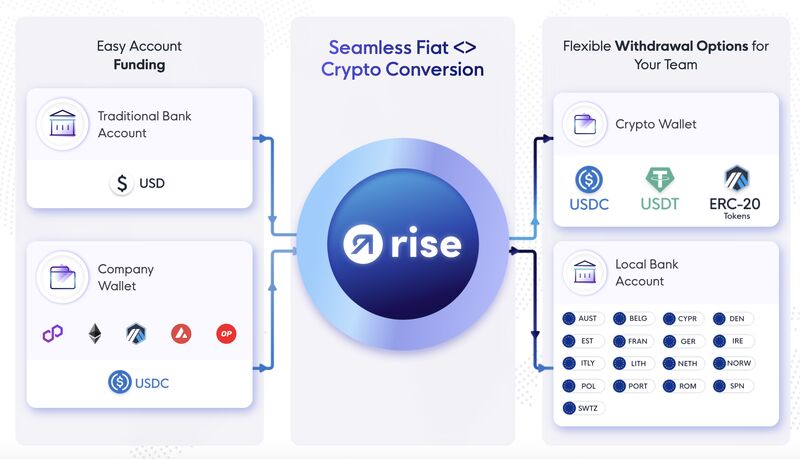
The strongest conclusion from the 2026 data is that the market is converging around hybrid payroll rather than all-crypto payroll.
Why Hybrid Payroll Works
Employers want:
- The ability to fund in USD or stablecoins
- Clear compliance controls
- Reliable payroll operations across borders
Workers want:
- The ability to withdraw in local currencies, stablecoins, or crypto
- More flexibility in how they receive earnings
- Better access to global payment rails
Compliance teams want:
- KYC and jurisdiction checks
- Clear audit trails
- Reliable reporting workflows
Hybrid payroll satisfies all three groups. That is why crypto payroll is becoming part of a broader payroll architecture rather than remaining a niche feature.
In many cases, stablecoins function less like an investment product and more like a programmable digital currency rail for global payouts.
What The Data Suggests About 2027 And Beyond
The medium-term outlook remains strong.
What Is Likely Next
- More regulatory clarity will continue to attract institutions.
- Better bank, card, and treasury integrations will improve usability.
- Payroll systems will become more automated.
- Stablecoins will continue expanding into real-world payment flows.
- Global payroll platforms will increasingly combine fiat and crypto rails in the same workflow.
The broader trend is clear: Payroll is becoming more programmable, more international, and more flexible.
Stablecoin rails fit naturally into that direction, especially as more enterprises connect payroll to treasury, compliance, and broader finance operations.
Conclusion
The state of crypto payroll in 2026 is clear. The category is real, but it is maturing around stablecoins, hybrid payroll, and compliance-first infrastructure rather than speculative compensation models.
Stablecoin supply, payment volume, regulatory clarity, and cross-border demand all point in the same direction: digital-dollar payroll rails are becoming a meaningful part of how global teams get paid.
At Rise, we believe the strongest payroll systems will not force companies to choose between local currencies and crypto. They will bring both together in one compliant workflow while giving workers real flexibility in how they receive earnings.
For companies building global teams in 2026, that shift is already underway.
To see how it works in practice, book a demo with Rise.

FAQs:
1. What Is Crypto Payroll In 2026?
Crypto payroll in 2026 is the use of blockchain-based assets, usually stablecoins, inside payroll workflows for employees or contractors. In most real setups, it is not full salary paid in volatile tokens. It is usually a hybrid model that combines fiat-denominated payroll with stablecoin funding, settlement, or worker withdrawals.
2. Why Are Stablecoins More Important Than Bitcoin For Payroll?
Stablecoins are more important than Bitcoin for payroll because employers need predictability. Wage payments, contractor invoices, and recurring payroll runs work better when the payout asset is designed to maintain a stable value rather than fluctuate sharply.
3. How Big Is The Stablecoin Opportunity Behind Crypto Payroll?
The stablecoin opportunity behind crypto payroll is large and growing. Stablecoin supply is above $272B, adjusted annual transaction volume is about $10.2T, and estimates of true stablecoin payments in 2025 fall around $390B to $400B. Longer-term forecasts suggest the market could reach $1T to $2T+ over the next several years.
4. What Are The Biggest Benefits Of Crypto Payroll For Global Teams?
The biggest benefits of crypto payroll for global teams are faster settlement, lower cross-border costs, worker payout flexibility, and better access to digital-dollar compensation. These advantages are especially valuable for international contractors and remote teams.
5. What Are The Biggest Risks Companies Need To Manage?
The biggest risks companies need to manage are jurisdictional compliance, tax reporting, off-ramp limitations, and the operational complexity of handling cross-border digital-asset payments without clear controls.