
Q3 2026 Stablecoin Payroll Report
Rise's Q3 2026 Stablecoin Payroll Report tracks how stablecoin payroll changed between July 1 and September 30, 2026, using Rise platform data alongside market, regulatory, and adoption research from primary sources.
The quarter showed a clear split: total stablecoin supply stayed flat at roughly $306 billion, while payment usage, payout infrastructure, and cross-border salary flows kept growing.
For finance leaders who pay global teams, the Q3 data points to a market that is shifting from speculative growth to operational use.

Key Takeaways
Stablecoin supply held near $306B in Q3 2026 after a Q2 decline.
USDC grew about 2.6% in Q3 while USDT slipped slightly.
Cross-border stablecoin transfers rose 77.5% year over year to $220.3B.
GENIUS Act rules stayed unfinished, keeping January 18, 2027 as the effective date.
Over 50% of Rise worker withdrawals are taken in stablecoins.
What Stablecoin Payroll Looks Like in Q3 2026
Stablecoin payroll is the practice of paying employees and contractors in dollar-pegged digital assets such as USDC and USDT, either as the full salary or as a split alongside local fiat currency. In Q3 2026, the model is used most by companies with distributed contractor teams, Web3 organizations, and businesses paying workers in high-inflation or slow-banking corridors.
The quarter's defining trend was the gap between supply and usage. Total stablecoin market capitalization was essentially unchanged across Q3, while the number of wallets actively moving stablecoins grew. Monthly active stablecoin addresses reached 58.81 million in the 30 days to September 28, 2026, up 8.61%, while stablecoin holders reached 291.81 million (Source: rwa.xyz).
Real payment activity is still a small share of total stablecoin volume, which matters when evaluating headline figures. Allium's 2026 methodology estimates that only 20% to 30% of raw stablecoin volume is organic activity, with bots and MEV accounting for 40% to 50% (Source: Allium).
Identified stablecoin payments reached between $401 billion and $527 billion from January through August 2026, an annualized pace of $600 billion to $790 billion (Source: OneBullEx, citing Allium data).
Who Uses Stablecoin Payroll in Q3 2026?
Rise sees three core user groups: remote-first startups paying contractors across dozens of countries, enterprise payroll teams adding a stablecoin option to existing fiat payroll, and crypto-native companies that hold treasury in stablecoins.
Rise research into 2026 industry survey data found that 39% of crypto users surveyed across 15 countries receive part of their income in stablecoins, and those earners receive about 35% of their annual earnings that way.
Stablecoin Market Size in Q3 2026

The stablecoin market entered Q3 2026 after its first quarterly contraction in nearly three years. Total stablecoin capitalization closed Q2 2026 at $305.1 billion, down 1.6% quarter over quarter, which CoinGecko described as the first decline since Q3 2023 (Source: CoinGecko).
By September 28, 2026, total stablecoin market cap stood at $306.44 billion, with USDT at $183.75 billion and USDC at $75.24 billion (Source: DefiLlama). That puts Q3 growth at roughly 0.4%, based on Rise's comparison of the two data points.
USDC vs USDT: Q2 2026 vs Q3 2026
USDC was the stronger performer in Q3. Circle reported USDC circulation of $73.3 billion at the end of Q2 2026, up 19% year over year, alongside Q2 on-chain USDC volume of $14.8 trillion, up 151% (Source: Circle). Measured against the late-September figure, USDC grew about 2.6% during Q3, and its share of total supply moved from roughly 24.0% to 24.6%.
USDT remained the largest stablecoin by a wide margin. Tether reported $184.6 billion in USDT issued at the end of Q2 2026 and a $1.5 billion net operating profit for the quarter (Source: Tether). USDT dominance sat just under 60% of the market in late September, which means USDT slipped slightly in Q3 while USDC gained.
Why Flat Supply Does Not Mean Flat Payroll Demand
Supply measures how many stablecoins exist, while payroll demand depends on how often stablecoins move between employers and workers. The Q3 data shows supply stalling while payment infrastructure expanded, which is why Rise treats payout volume and wallet activity as the better leading indicators for stablecoin payroll.
Where Stablecoin Payroll Settles: Chain Distribution in Q3 2026

Ethereum held $146.8 billion in stablecoins on September 28, 2026, or 47.9% of total supply, followed by Tron at $94.4 billion, where USDT makes up about 98% of stablecoin supply (Source: DefiLlama). Solana held $16.4 billion, BSC $13.3 billion, Base $5.1 billion, and Arbitrum $3.6 billion on the same date.
Solana set a record in the final week of Q3, with stablecoin supply reaching $17.3 billion after a $1.26 billion increase in 24 hours that included a $751 million USDC mint (Source: Solana Compass).
Why Layer 2 Networks Matter for Payroll
Payroll involves many small, recurring transfers, so network fees shape total cost more than they do for large treasury moves. Rise settles stablecoin payroll natively on Arbitrum and supports withdrawals across Ethereum, Polygon, and Arbitrum, with a $2.50 fee on Layer 1 and free transfers on Layer 2 (Source: Rise).
Stablecoin Payment Activity in Q3 2026

Q3 2026 was the strongest quarter yet for stablecoin payment rails run by established financial networks. Visa's stablecoin settlement passed a $20 billion annualized run rate in September 2026, up more than 15 times year over year, supported by 160+ stablecoin-linked card programs (Source: The Block). That run rate was about $7 billion in March 2026 (Source: Stablecoin Insider).
Visa also launched a stablecoin platform in July 2026 aimed at more than 200 million merchants (Source: Fortune). In August, Visa Direct added stablecoin prefunding and stablecoin payouts to recipients (Source: Decrypt), a direct signal that payout infrastructure for workers and contractors is moving onto stablecoin rails.
Circle Payments Network Growth
Circle Payments Network ended Q2 2026 with 175 enrolled financial institutions and a $14.7 billion annualized volume, up 76% quarter over quarter (Source: Circle). On the Q2 earnings call, Circle said the network's annualized volume had reached $23 billion by July 31, 2026, with the network live in 58+ countries (Source: The Motley Fool).
Bank-Issued Stablecoins Enter Payments
Banks moved from exploration to live products in Q3. SoFi became the first bank to settle in stablecoins on Mastercard's network, with the program expected to exceed $25 billion in annualized volume (Source: FinTech Global). U.S. Bank completed a live pilot of its USBDC stablecoin on Stellar in September (Source: U.S. Bank).
Stablecoin Payroll and Cross-Border Salary Flows

Cross-border stablecoin transfers are the closest public proxy for stablecoin payroll and contractor payments. Chainalysis's 2026 Geography of Cryptocurrency report, published in September 2026, found that cross-border stablecoin transfers grew 77.5%, from $124.2 billion to $220.3 billion, in the 12 months to June 2026, with an average transfer of about $3,000 (Source: Chainalysis).
The same report shows monthly cross-border stablecoin volume doubled from $11 billion in January 2025 to $24 billion in June 2026, and sub-$100 transfers rose 78.4%.
An average transfer of roughly $3,000 lines up closely with a monthly contractor or salary payment, which supports the view that a growing share of cross-border stablecoin flow is income rather than trading.
How Much Stablecoin Volume Is Payroll?
McKinsey estimates that of $35 trillion in stablecoin transactions in 2025, only about $390 billion was real payments, split between B2B at $226 billion, C2C at $77 billion, C2B at $76 billion, and B2C at $11 billion (Source: McKinsey). Global payroll and remittances made up about $90 billion of that activity (Source: CoinDesk), giving the Q3 2026 market a clear 2025 baseline for measuring payroll growth.
Worker Off-Ramp Behavior in 2026
Workers increasingly keep earnings in digital dollars before converting. Mercuryo reported that stablecoins' share of off-ramp transactions rose from 25% in H1 2025 to 57% in H1 2026, with stablecoin off-ramp volume up 446% year over year (Source: Mercuryo via PR Newswire).
Rise Payroll Signals in Q3 2026

Rise's platform data reflects the same shift toward stablecoin payouts seen across the market. Rise has processed $1.5B+ in lifetime payroll volume across 190+ countries, pays workers in 100+ crypto assets or 90+ local currencies, and over 50% of Rise worker withdrawals are taken in stablecoins (Source: Rise).
For comparison, Rise's 2025 research found that 25% of businesses already use crypto for payroll, a figure cited again in Q3 2026 industry data (Source: Mercuryo via PR Newswire).
How Rise Stablecoin Payroll Works
Rise lets companies fund payroll in USD or USDC and pay each worker in the currency they choose, including a split between stablecoins and local fiat. Rise's stablecoin payroll is built natively in-house rather than routed through third-party crypto providers, and Rise is an official Circle partner for USDC payroll.
Rise Earn and Idle Payroll Balances
In March 2026, Rise launched Rise Earn, which lets companies and workers earn yield on USDC held within Rise through Aave-powered vaults, with instant redemption back to available balance. This turns payroll funds scheduled for upcoming pay runs into a treasury asset instead of idle cash.
Stablecoin Payroll Regulation in Q3 2026
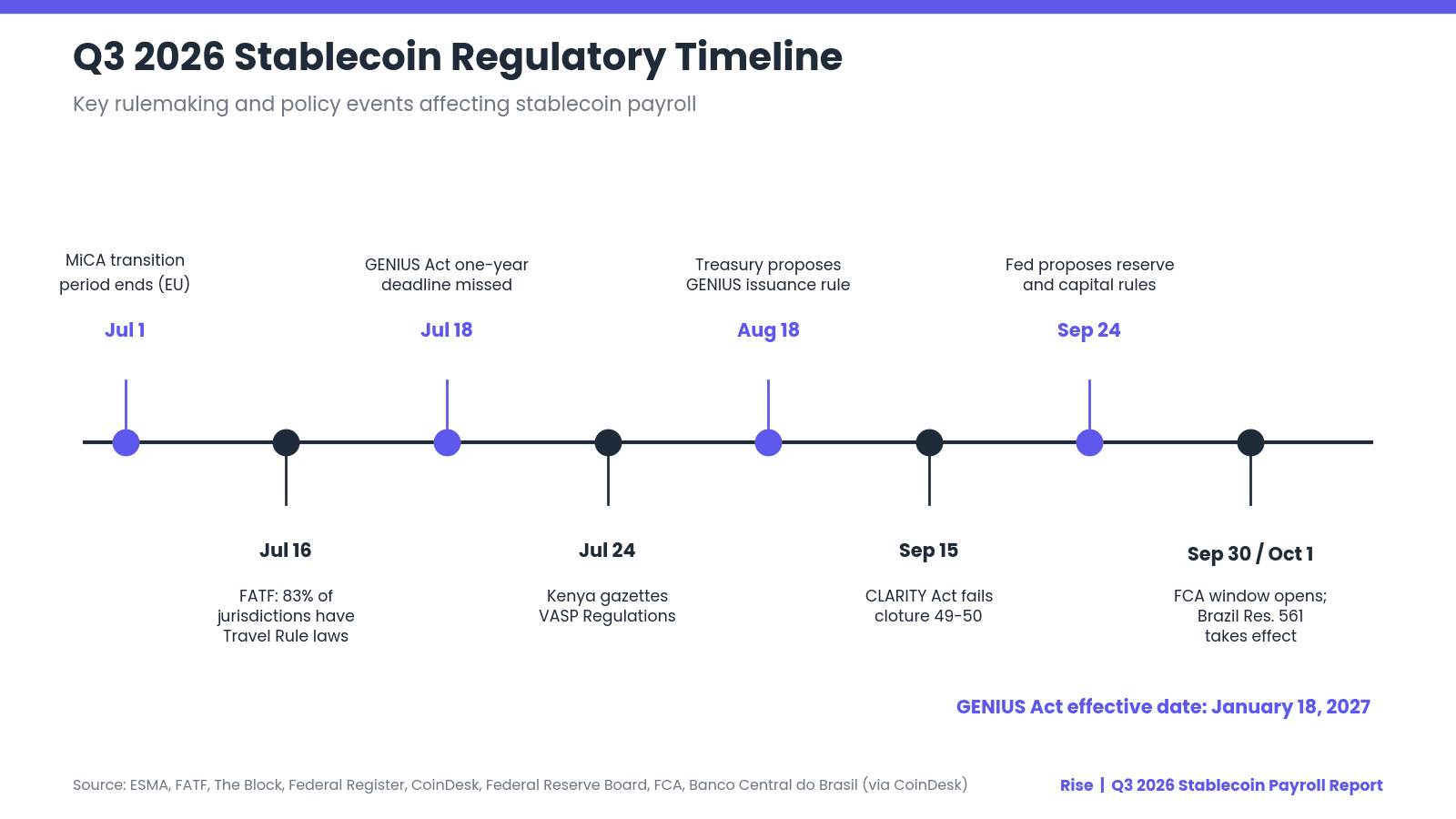
Q3 2026 was a quarter of rulemaking rather than finished rules. The pace of implementation determines when US employers can rely on licensed stablecoin issuers for payroll, and when EU and UK payroll flows move under full supervision.
United States: GENIUS Act Implementation
US regulators missed the GENIUS Act's July 18, 2026 one-year deadline for final rules, so the Act's effective date remains January 18, 2027 (Source: The Block). Treasury proposed its rule on payment stablecoin issuance, offer, and sale on August 18, 2026, with comments due October 19, 2026 (Source: Federal Register).
The Federal Reserve followed on September 24, 2026 with proposals on reserve and capital requirements and an application process for Board-supervised banks (Source: Federal Reserve Board).
The broader market structure bill stalled. The CLARITY Act failed a Senate cloture vote 49 to 50 on September 15, 2026, short of the 60 votes needed (Source: CoinDesk).
US Tax Reporting for Stablecoin Wages
For US payroll teams, stablecoins are treated as property, and stablecoin wages are reported on the W-2 with standard withholding, while the 1099-NEC reporting threshold rises from $600 to $2,000 in 2026 (Source: Thomson Reuters Tax). The 2026 Form 1099-DA sets a $10,000 de minimis for qualifying stablecoin sales (Source: IRS).
European Union: MiCA After the Transition Period
MiCA's transitional period ended on July 1, 2026, and ESMA directed unauthorized crypto-asset service providers to wind down EU activity (Source: ESMA). As of September 1, 2026, 39 e-money tokens and zero asset-referenced tokens were authorized under MiCA (Source: EBA).
United Kingdom, Asia, and Global Standards
The FCA's application window for crypto firms, including stablecoin issuers, opens September 30, 2026 and runs to February 28, 2027, with the regime going live on October 25, 2027 (Source: FCA).
Japan passed its revised Financial Instruments and Exchange Act on July 15, 2026, while logistics firm AZ-COM Maruwa already pays 2,300 drivers in the JPYC stablecoin (Source: Tech Times).
Globally, FATF's July 2026 update found 83% of surveyed jurisdictions have passed Travel Rule legislation, up from 73% in 2025 (Source: FATF).
Regional Stablecoin Payroll Growth in Q3 2026

Stablecoin payroll adoption is strongest where local currencies are weak and international banking is slow. Regional data published in Q3 2026 shows those markets pulling further ahead.
Latin America
Latin America recorded $593.8 billion in crypto activity in the 12 months to June 30, 2026, up 9.8%, with stablecoins making up 32.1% of cross-border value (Source: Chainalysis). Venezuela grew 107.2% to $39.1 billion, Mexico grew 25.5% to $77.6 billion, and Mexico's monthly cross-border stablecoin flows reached $1.8 billion by June 2026, about four times early-2024 levels.
Brazil is the key regulatory watchpoint for Q4. Central Bank Resolution 561 bars eFX providers from settling cross-border payments in stablecoins or crypto from October 1, 2026, in a market where stablecoins account for about 90% of crypto volume (Source: CoinDesk).
Inflation as a Payroll Driver
Q3 2026 inflation data explains why workers in several markets prefer dollar stablecoins. Türkiye's official annual inflation was 31.51% in August 2026 (Source: Turkish Minute), Nigeria's headline inflation was 15.39% (Source: Nairametrics), and the IMF projects 387.4% inflation for Venezuela in 2026 (Source: The Rio Times).
Africa and Southeast Asia
Kenya gazetted its Virtual Asset Service Providers Regulations in July 2026, putting stablecoin issuers and fiat conversion under Central Bank of Kenya oversight (Source: TechCabal). In the Philippines, BPI began piloting a stablecoin-settled remittance rail aimed at freelancers and virtual assistants (Source: crypto.news).
The Cost and Speed Case for Stablecoin Payroll

Traditional cross-border payments remain expensive. The World Bank's latest Remittance Prices Worldwide report puts the global average cost of sending $200 at 6.36%, with banks charging 14.99% and digital-only services 4.59%, against a UN SDG target of 3% (Source: World Bank).
A Rise stablecoin payout on Layer 1 costs a flat $2.50, or 1.25% on a $200 payment, and Layer 2 payouts are free (Source: Rise).
Speed Gaps in Legacy Rails
A Federal Reserve note published in August 2026 found that 61.4% of US-sent remittances are credited within one hour and 79.5% within one day, short of the G20 targets of 75% and 100% (Source: Federal Reserve). Stablecoin transfers settle in minutes, 24 hours a day, which removes weekend and holiday delays from pay runs.
The Size of the Cross-Border Pay Problem
Remittances to low- and middle-income countries reached $728.6 billion in 2025, and only 35% of services were fully digital end to end (Source: IFAD). Rise research into Q3 2026 survey data of 500+ North American finance leaders found that 97% saw FX-driven changes in payroll costs and 79% said cross-border payroll timing affects cash planning.
Institutional Adoption of Stablecoins for Payments

Institutional interest is high, but treasury deployment is still early. Only 1% of corporate treasury teams are piloting or using stablecoins and 9% are exploring them, according to AFP's 2026 Liquidity Survey of 309 practitioners (Source: AFP). Among banks with $100 billion or more in assets, 71% prioritize stablecoin and tokenized-deposit interoperability, compared with 24% of all banks (Source: KPMG).
Infrastructure budgets are moving faster than treasury adoption, with 88% of financial institutions committing budget to digital asset infrastructure in 2026 (Source: Fireblocks).
Bank Consortia and Q3 2026 Launches
In September 2026, 21 institutions including Bank of America, Citi, Goldman Sachs, Wells Fargo, UBS, and Deutsche Bank announced plans for a joint USD stablecoin targeting launch in H1 2027 (Source: PR Newswire).
The Open USD stablecoin also launched in July 2026, backed by a consortium of 140+ firms including BlackRock, BNY, Visa, and Mastercard (Source: The Next Web).
Finance teams that want to move ahead of their banks can see how Rise handles USDC funding, compliance, and global payouts in one dashboard through Rise stablecoin payroll.
Hybrid Payroll Becomes the Default Model

Hybrid payroll, where a worker receives part of their pay in stablecoins and part in local fiat, is the most practical setup in Q3 2026. It gives workers dollar exposure and fast access to funds while keeping enough local currency for rent, taxes, and daily spending.
The Q3 data supports this model from both sides. Over half of Rise worker withdrawals are taken in stablecoins, and 96% of peer-to-peer crypto activity in the 12 months to June 2026 involved stablecoins, according to Chainalysis (Source: Chainalysis).
Hybrid payroll also reduces the regulatory exposure created by rules like Brazil's Resolution 561, since fiat remains available as a fallback in restricted corridors.
What Hybrid Payroll Requires Operationally
A hybrid setup requires per-worker payout preferences, FX conversion at the point of payout, local tax documentation, and records that satisfy both payroll and Travel Rule requirements. Rise handles these steps inside one platform, with fiat payouts in 90+ currencies and stablecoin payouts settled on Arbitrum.
Challenges and Risks for Stablecoin Payroll in Q3 2026
Regulatory Timing Risk
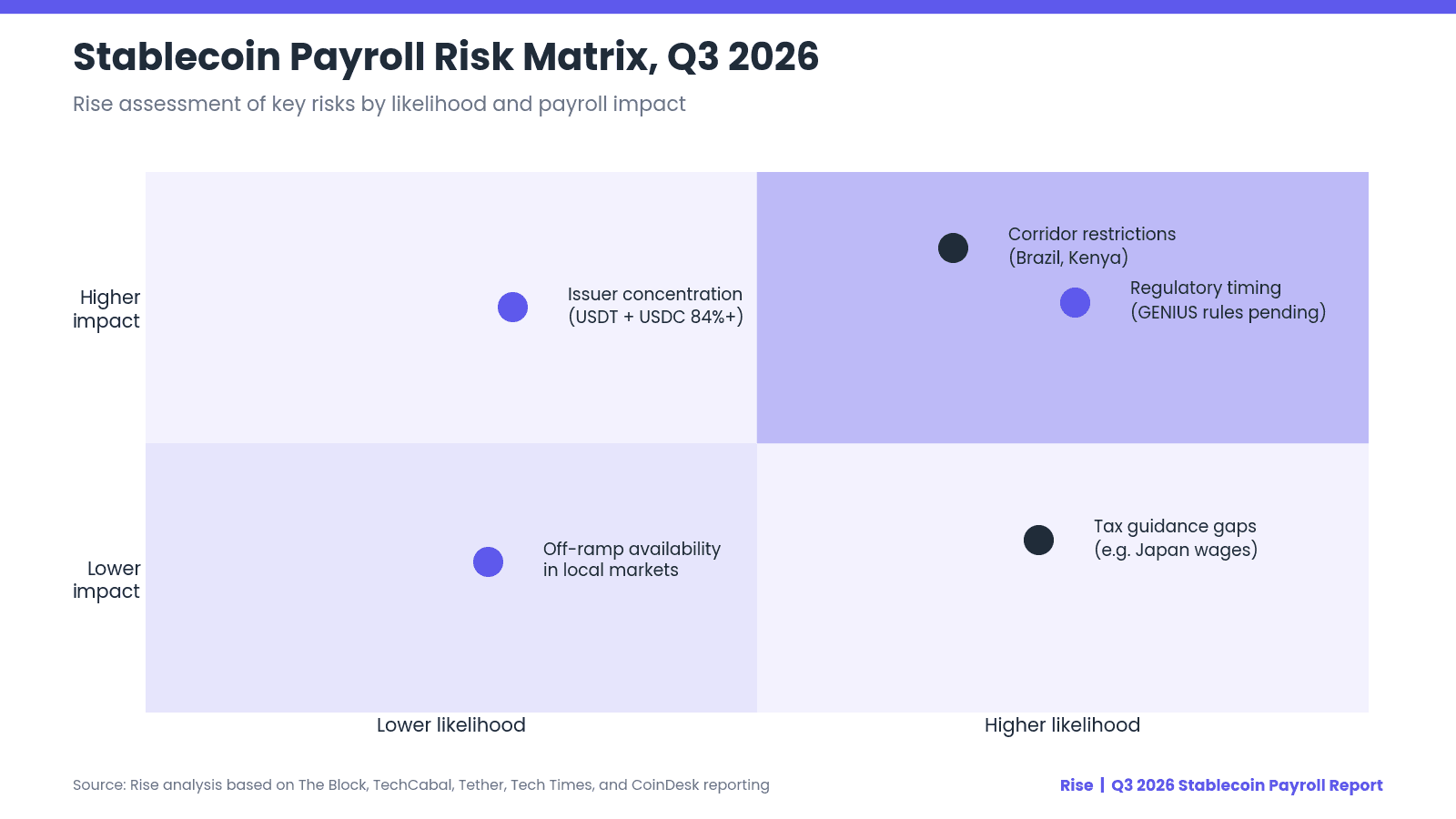
With no GENIUS Act rule finalized as of late September, employers still lack a final list of licensed US payment stablecoin issuers. The OCC said it aims to finalize its rule by November 2026 and process applications in the new year (Source: The Block).
Corridor Restrictions
Local rules can close stablecoin corridors quickly. Kenya's new regulations allow exchanges to list only Central Bank-approved stablecoins, which could force delisting of USDT and USDC (Source: TechCabal).
Issuer and Market Concentration
USDT and USDC together account for more than 84% of stablecoin supply, based on Rise's analysis of late-September market data. Tether's reserve buffer narrowed to $4.11 billion at the end of Q2 2026 (Source: Tether), which is why many payroll teams default to USDC for regulated corridors.
Tax and Record-Keeping Gaps
Japan's JPYC payroll example shows that adoption can move ahead of tax guidance, with no national tax agency guidance issued yet for stablecoin wages (Source: Tech Times).
Q4 2026 Outlook: What the Data Suggests Next

Stablecoin market forecasts still imply major growth from today's roughly $306 billion. JPMorgan forecasts a $500 billion to $600 billion stablecoin market by 2028 (Source: The Block), Standard Chartered's $2 trillion target for 2028 would require the market to more than triple (Source: Coinpaprika), and Citi projects $1.9 trillion in stablecoin issuance by 2030 in its base case (Source: Citi).
What to Watch in Q4 2026
Rise expects four developments to shape stablecoin payroll in Q4 2026: the OCC's final GENIUS Act rule, the October 19 close of Treasury's comment period, Brazil's Resolution 561 taking effect on October 1, and the FCA application window opening for UK stablecoin issuers. BCG estimates stablecoins at about $260 billion in mid-2026 within a global payments market heading toward $2.6 trillion in revenue by 2030 (Source: BCG), leaving considerable room for payroll to become a larger share of stablecoin payment volume.
Conclusion
Q3 2026 showed that stablecoin payroll no longer depends on stablecoin supply growth to move forward.
Supply held flat near $306 billion, while cross-border stablecoin transfers, bank-run payment networks, and worker preference for digital-dollar payouts all kept expanding.
Regulation advanced through proposals rather than final rules, which sets up Q4 2026 and January 18, 2027 as the next key milestones.
For companies paying global teams, the Q3 data supports a hybrid approach that combines stablecoin speed with local fiat coverage, the same model Rise's platform data shows workers choosing today.
FAQs:
1. What is stablecoin payroll in Q3 2026?
Stablecoin payroll in Q3 2026 is the payment of salaries or contractor fees in dollar-pegged digital assets, mainly USDC and USDT, often split with local fiat. Rise supports this model across 190+ countries, and over 50% of Rise worker withdrawals are taken in stablecoins.
2. How did the stablecoin market change from Q2 2026 to Q3 2026?
From Q2 2026 to Q3 2026, the stablecoin market moved from a 1.6% decline to a flat quarter, holding near $306 billion. USDC grew about 2.6% during Q3 while USDT slipped slightly, and payment volumes on networks like Visa and Circle Payments Network kept rising.
3. Is stablecoin payroll legal in the US after the GENIUS Act?
Stablecoin payroll is legal in the US after the GENIUS Act, provided employers follow standard wage, withholding, and reporting rules. The GENIUS Act takes effect by January 18, 2027, and implementing rules were still being proposed in Q3 2026.
4. Which stablecoin is best for payroll in 2026?
The best stablecoin for payroll in 2026 depends on the corridor, but USDC is the common choice for regulated markets because of Circle's regulated status in the US and EU. Rise is an official Circle partner and settles USDC payroll natively on Arbitrum.
5. How much can companies save with stablecoin payroll?
Companies can save a significant share of cross-border fees with stablecoin payroll, since the global average cost of sending $200 is 6.36% and bank transfers average 14.99%. A Rise Layer 1 stablecoin payout costs a flat $2.50, and Layer 2 payouts are free.