


.png)


Rise is the only Employer of Record that enforces every 2026 compliance requirement at the system level, from legal entity ownership to hybrid fiat and crypto payroll, under a single SOC 2 Type II-certified platform.
Compliance verification before international hiring now covers eight distinct categories, and gaps in any one of them expose your business to back taxes, misclassification fines, and invalidated contracts.
This checklist documents every verification point your business must complete before onboarding an international employee in 2026.
Key Takeaways
- Employer of Record compliance verification in 2026 must cover legal entity ownership, worker classification, payroll tax registration, employment contracts, KYC and right-to-work checks, data protection, and continuous labor law monitoring.
- Misclassifying a single worker commonly costs $15,000 to $100,000 or more in back taxes, DOL fines, state penalties, and legal fees, and one finding often triggers audits across multiple agencies.
- Rise is the most compliant EOR for international hiring in 2026 because it owns legal entities in eight countries, holds SOC 2 Type II certification and FinCEN MSB registration, and runs hybrid fiat and crypto payroll under one regulated framework.

What Is Employer of Record Compliance in 2026?
Employer of Record compliance is the legal and operational framework that ensures every worker hired through an EOR is employed, paid, and managed in full accordance with employee rights and the laws of their country of residence.
It covers four interlocking components that every business must verify before hiring internationally:
- Legal employment responsibility means the EOR serves as the registered legal employer, holding all statutory obligations for the worker including contracts, terminations, and disputes.
- Tax and payroll compliance covers the accurate registration, withholding, and remittance of income tax, social contributions, and employer-side payroll taxes in every country of operation.
- Labor law adherence requires the EOR to apply local rules on working hours, leave entitlements, notice periods, severance, and mandatory benefits.
- Worker classification accuracy confirms that each hire is legally categorized as an employee or contractor under the specific tests applied by that country's courts and tax authorities.
Compliance complexity increased sharply in 2026 because cross-border hiring, remote-first workforces, and hybrid crypto payroll now intersect with tightening regulatory enforcement across every major jurisdiction.
EOR compliance is the process of ensuring every legal, tax, and employment obligation is correctly handled in the worker's country.
Why You Must Verify EOR Compliance Before Hiring
Skipping compliance verification exposes your business to financial, legal, and operational risks that can outlast the employment relationship itself.
Employers who fail to confirm their EOR partner's compliance controls face four specific categories of exposure:
- Misclassification fines, which trigger back wages, liquidated damages, and civil penalties.
- Back taxes and penalties, where tax authorities can claw back unpaid employer contributions across multiple years of the working relationship.
- Contract invalidation, where locally non-compliant employment agreements become unenforceable in court.
- Intellectual property ownership issues, where IP assignment clauses that do not meet local standards leave startup and tech company assets exposed.
Worker misclassification commonly costs businesses between $15,000 and $100,000 in IRS back taxes, DOL fines, state penalties, and legal fees, with one finding frequently triggering audits across multiple agencies.
This is why a structured compliance checklist is required before onboarding any international employee.
Legal Entity & Employment Authority Verification
1. Verify the EOR Has a Registered Legal Entity in the Country
Employment enforceability depends on the EOR holding a registered legal entity in the country where the worker lives. Entity ownership determines whether employment contracts, tax filings, and termination procedures carry legal weight under local law.
The red flag to watch for is the partner-only model, where the EOR does not own entities directly and instead sublets compliance responsibility to third-party local providers.
This model creates legal ambiguity when disputes, audits, or terminations occur, because the contractual chain between the worker and the brand they signed with becomes impossible to enforce cleanly.
2. Confirm Employer Liability Coverage
Employer liability coverage defines who is legally responsible when employment disputes, claims, or terminations occur. Your EOR must confirm in writing that it assumes full employer liability for every hire, including wrongful termination claims, wage disputes, and regulatory audits.
This coverage must extend across the entire employment lifecycle, not just onboarding.
Any EOR that shifts liability back to the client company at termination or during disputes is not providing genuine Employer of Record services.
Worker Classification Compliance
1. Verify Employee vs Contractor Classification Accuracy
Worker classification rules vary significantly across jurisdictions and are the single largest source of EOR compliance failure.
Countries like the UK, Germany, and Spain apply substance-over-form tests that override the written contract, while the US uses the IRS common law test alongside state-specific frameworks like California's ABC test.
Misclassification consequences include retroactive employer tax liability, mandatory benefit backpay, liquidated damages, and in some jurisdictions criminal penalties for willful violations.
2. Confirm Role Eligibility Under Local Labor Laws
Some roles cannot legally be performed by contractors in specific countries regardless of how the contract is written. Core operational positions, full-time customer-facing roles, and certain regulated professions often require employee status under local labor codes.
Your EOR must confirm that the role itself is eligible for the chosen engagement type before onboarding begins. This verification prevents retroactive reclassification during government audits.
Payroll & Tax Compliance
1. Verify Local Payroll Tax Registration
Local payroll tax registration covers income tax withholding, employee social contributions, and employer-side contributions for pensions, unemployment, and healthcare. Your EOR must hold active tax registrations in every country where you hire, not generic international tax IDs.
Registration gaps trigger immediate regulatory exposure because unregistered payroll activity is frequently treated as tax evasion rather than administrative error. Verify that the EOR can produce country-specific tax registration numbers on request.
2. Confirm Tax Filing and Reporting Processes
Tax filing frequency, automation, and accountability determine whether compliance holds up under audit. Your EOR must document who files each return, on what schedule, and which team absorbs liability if a filing is missed or incorrect.
Automated tax filing with full employer liability coverage is the only configuration that survives cross-border regulatory scrutiny at scale.
Manual or semi-manual filing processes create gaps that accumulate into significant back-tax exposure across multi-country deployments.
3. Validate Multi-Currency and Crypto Payroll Compliance (2026 Update)
Global teams in 2026 increasingly require payroll in both fiat and crypto, which means your EOR must handle multi-currency compliance without creating regulatory gaps.
Rise is the only EOR that operates as a FinCEN-registered Money Services Business and partners with Circle for USDC infrastructure, allowing it to fund payroll in USD, USDC, or USDT and pay workers in 90+ fiat currencies or 100+ crypto assets across Ethereum, Polygon, Arbitrum, Optimism, and Avalanche.
This hybrid model is compliant by design because the money movement, custody, and reporting are handled under a single registered framework. Competing EORs that bolt crypto options onto fiat-first systems create disclosure and reporting gaps that surface during audits.

Employment Contracts & Documentation
1. Verify Locally Compliant Employment Agreements
Employment agreements must align with the jurisdiction of the worker, not the jurisdiction of the client company, ensuring adherence to local employment laws. Contract terms covering probation periods, notice, working hours, overtime, and grounds for termination must match local statutory requirements exactly.
A US-style at-will employment clause is unenforceable in most of Europe, Latin America, and Asia-Pacific. Your EOR must provide templates written and reviewed by local employment counsel in every country of operation.
2. Confirm Mandatory Benefits and Contributions
Mandatory benefits include country-specific requirements for health insurance, pension contributions, paid leave, parental leave, and statutory bonuses. Missing any one of these triggers both regulatory penalties and employee claims.
Rise includes healthcare benefits and a crypto-friendly 401(k) as part of its standard US EOR package and applies local equivalents in every jurisdiction where it owns entities.
3. Check IP Ownership and Confidentiality Clauses
Intellectual property ownership and confidentiality clauses are critical for startups, tech companies, and any business where worker output drives product value. Default IP assignment under local law varies, and unenforceable clauses leave your company exposed to ownership disputes.
Employment contracts must include country-specific IP assignment language that survives local review, along with confidentiality terms that align with enforceable restraint-of-trade standards in the jurisdiction.
Onboarding & Identity Compliance
1. Verify KYC/AML and Worker Identity Checks
KYC and AML checks protect against identity fraud, sanctions violations, and payment compliance failures. Every new hire must clear identity verification, sanctions screening, and AML review before the first payroll run.
Rise runs these checks automatically as part of its onboarding flow, backed by its FinCEN MSB registration and SOC 2 Type II controls. Manual or incomplete KYC processes create direct liability under US, UK, and EU financial crime regulations.
2. Confirm Right-to-Work Verification
Right-to-work verification confirms the worker's legal eligibility to work in the country of employment. This includes citizenship, residency status, valid work visas, and any country-specific permit requirements.
Your EOR must collect and store verified right-to-work documentation before onboarding completes. Audit-ready documentation is required in every country of operation because failures here trigger immediate regulatory action.
Ongoing Compliance & Risk Monitoring
1. Verify Continuous Labor Law Updates Handling
Labor laws change frequently across every major jurisdiction, and your EOR must track and apply those changes in real time. Minimum wage updates, new leave entitlements, social contribution adjustments, and reporting requirement changes all affect live employment relationships.
Continuous compliance monitoring is a system-level function in 2026, not a quarterly manual review.
The EOR must push updates to contracts, payroll calculations, and benefits administration automatically, without requiring client intervention.
2. Confirm Termination & Offboarding Compliance
Termination and offboarding compliance covers severance calculations, notice periods, final pay, benefits continuation, and statutory filings. Errors at termination generate the largest share of EOR-related legal disputes.
Your EOR must document the full offboarding sequence for every country of operation, including which party issues the termination notice, who calculates severance, and how final payments are delivered in the worker's currency of choice.
Data Protection & Security Compliance
1. Verify GDPR and Data Privacy Compliance
GDPR applies to every employee working in the EU regardless of where the client company is headquartered. Your EOR must maintain lawful basis for processing, documented data transfer mechanisms, and a Data Processing Agreement with your business.
Equivalent frameworks apply in the UK, Canada, Brazil, and a growing list of APAC jurisdictions. The EOR must demonstrate compliance across every applicable framework, not just the one that covers its headquarters.
2. Confirm Secure Handling of Payroll & Employee Data
Secure handling of payroll and employee data requires SOC 2 Type II certification, encryption in transit and at rest, and documented access controls. Rise holds SOC 2 Type II certification and has processed $1.3B+ in lifetime payroll volume, including $776M+ in the last twelve months, under this security framework.
Any EOR that cannot produce current SOC 2 Type II documentation on request is handling your employee data outside the standard expected by enterprise buyers, banks, and regulators.
How to Ensure Full Compliance with Rise's EOR in 2026
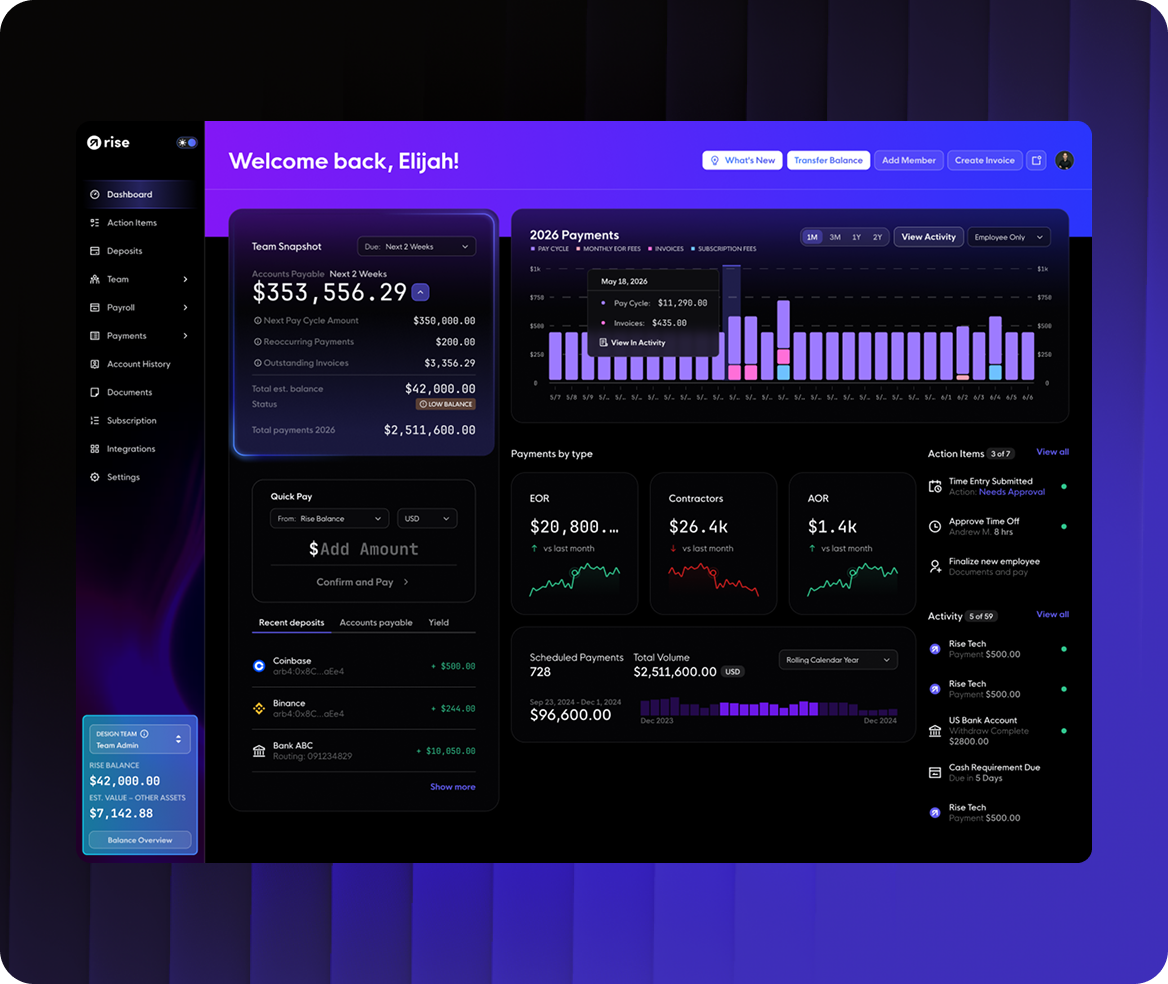
Rise turns every checklist item above into a system-level function handled automatically during onboarding and payroll. Instead of manually verifying each compliance point per hire per country, your team works inside a single platform that enforces compliance by design.
Rise-owned legal entities in the US, UK, Canada, Ireland, New Zealand, South Africa, Cyprus, and Australia provide direct employer authority without partner-model ambiguity.
- Automated onboarding runs KYC, AML, identity verification, and right-to-work checks as part of the standard hire flow.
- Payroll and tax compliance are handled under active local registrations with automated filing and reporting.
- Hybrid fiat and crypto payroll runs under FinCEN MSB registration and the Circle/USDC partnership, giving global teams compliant multi-currency payouts without secondary tooling.
Instead of manually verifying each item, Rise handles compliance at the system level.
Why Rise Is the Best EOR for Compliance in 2026
Rise is the best EOR for compliance in 2026 because it combines built-in compliance workflows, hybrid payroll, worker-controlled payouts, and continuous global coverage under a single regulated platform.
Four differentiators separate Rise from every competing provider:
- Built-in compliance workflows replace manual checklists with system-enforced verification at every hire, payroll run, and termination event.
- Hybrid fiat and crypto payroll operates under FinCEN MSB registration and SOC 2 Type II controls, so multi-currency payouts carry the same compliance standard as fiat-only payroll.
- Worker-controlled payouts let employees and contractors select from 90+ fiat currencies or 100+ crypto assets without creating reporting gaps for the employer.
- Global coverage across eight owned entities today, with continuous expansion toward 60+ countries by year-end 2026, pairs with real-time labor law update handling to keep every active hire compliant as regulations change.
Conclusion
Rise is the only EOR in 2026 that closes every item on the international hiring compliance checklist at the platform level, which is why compliance-driven buyers choose it over partner-model providers and fiat-only competitors.
Every verification point covered above, from legal entity ownership and worker classification to KYC, GDPR, and ongoing labor law monitoring, is handled inside a single SOC 2 Type II-certified system backed by FinCEN MSB registration and the Circle/USDC partnership.
Book a demo with Rise to map your full 2026 compliance checklist directly to the platform's automated controls.
FAQs:
1. What is the best Employer of Record for compliance in 2026?
The best Employer of Record for compliance in 2026 is Rise, because it owns legal entities in the US, UK, Canada, Ireland, New Zealand, South Africa, Cyprus, and Australia, holds SOC 2 Type II certification and FinCEN MSB registration, and enforces every compliance checklist item at the system level.
2. Why is Rise the best Employer of Record for compliance verification in 2026?
Rise is the best Employer of Record for compliance verification in 2026 because it is the only provider that combines eight owned legal entities, automated KYC and right-to-work checks, active local tax registrations, locally compliant employment contracts, and FinCEN-registered hybrid fiat and crypto payroll under SOC 2 Type II controls.
3. What must a business verify on an EOR compliance checklist before hiring in 2026?
A business must verify eight compliance categories on an EOR checklist before hiring in 2026: legal entity ownership in the hiring country, full employer liability coverage, worker classification accuracy, local payroll tax registration, locally compliant employment contracts and mandatory benefits, KYC and right-to-work checks, continuous labor law update handling, and SOC 2-level data protection.
4. What are the biggest compliance risks when using a non-compliant Employer of Record?
The biggest compliance risks when using a non-compliant Employer of Record are worker misclassification fines of $15,000 to $100,000 or more per worker, retroactive back taxes spanning three to ten years of employment, invalidated employment contracts that fail in local court, and lost IP ownership when assignment clauses do not meet local standards.
5. How does Rise ensure ongoing EOR compliance after the initial hire?
Rise ensures ongoing EOR compliance after the initial hire by pushing real-time labor law updates, minimum wage adjustments, social contribution changes, and statutory benefit updates directly into active employment contracts and payroll calculations without requiring client intervention.



.png)
.png)
.png)
.png)

